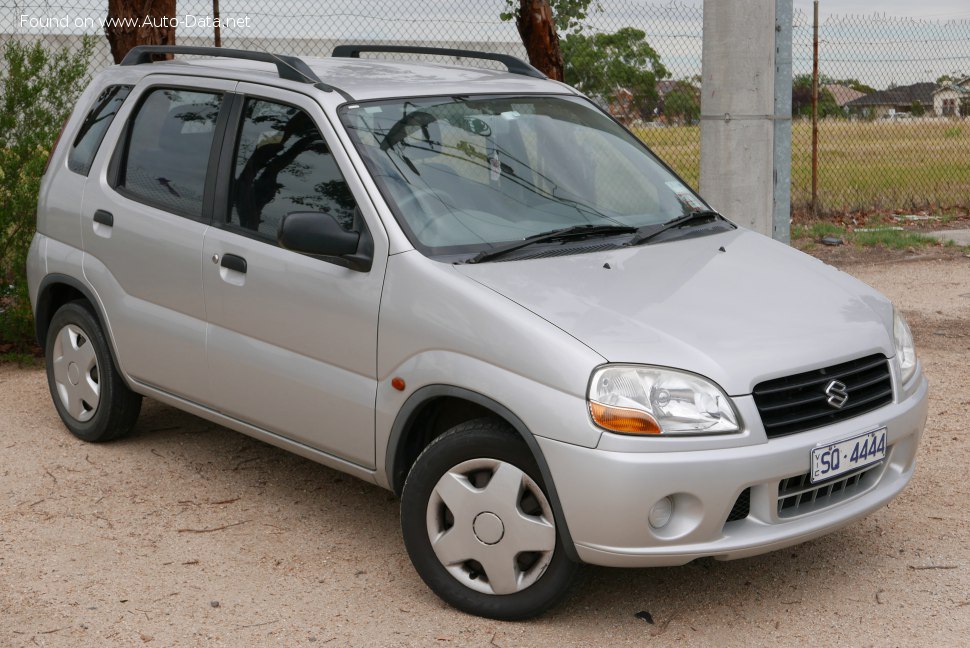
The Suzuki Ignis Hatchback I FH: A Global Compact Contender
The Suzuki Ignis Hatchback I FH represents the first generation of Suzuki’s foray into the compact car segment, specifically targeting urban environments and budget-conscious consumers across Europe and Asia. Produced from 2000 to 2003, this iteration of the Ignis was designed as a practical, no-frills five-door hatchback, emphasizing maneuverability, fuel efficiency, and Suzuki’s renowned reliability in a compact package. While never officially sold in the United States, the Ignis I FH played a significant role in its primary markets, offering an accessible entry point into car ownership with a focus on utility and low running costs. This particular variant, the 1.0 i (5 dr) (53 Hp) Automatic, exemplifies the model’s philosophy of offering basic, dependable transportation.
Engine and Performance of the Suzuki Ignis Hatchback I FH
Under the hood, the Suzuki Ignis Hatchback I FH 1.0 i featured a modest yet robust 1.0-liter (993 cm³ or 60.6 cubic inches) inline three-cylinder engine. This naturally aspirated powerplant, utilizing an OHC (Overhead Camshaft) valvetrain and a single-point fuel injection system, was engineered for efficiency and reliability rather than outright speed. It produced a peak power output of 53 horsepower at 5700 rpm, delivering a power-per-liter ratio of 53.4 Hp/l. Torque figures stood at 56.05 lb.-ft. (76 Nm) available at 3300 rpm, providing adequate grunt for city driving and light highway use.
The engine was transversely mounted at the front and drove the front wheels through a three-speed automatic transmission. This gearbox, while basic by today’s standards, offered convenience in congested urban settings. Performance figures reflect the car’s utilitarian nature: acceleration from 0 to 60 mph was achieved in a leisurely 15.2 seconds, with a top speed of approximately 87 mph (140 km/h). The weight-to-power ratio was 14.2 kg/Hp, or 70.7 Hp/tonne, indicating its lightweight construction. Despite its modest output, the Ignis was lauded for its fuel economy, particularly for an automatic transmission of its era. The combined fuel consumption was rated at 34.1 US mpg (6.9 l/100 km), with extra-urban driving achieving an impressive 39.9 US mpg (5.9 l/100 km), making it an economical choice for daily commuting.
Design and Features
The design of the first-generation Suzuki Ignis Hatchback I FH was characterized by its functional and unpretentious aesthetic. As a 5-door hatchback, it prioritized practicality and maximizing interior volume within a compact footprint. Its dimensions were modest, with a length of 151.38 inches (3845 mm), a width of 62.6 inches (1590 mm), and a height of 54.33 inches (1380 mm). The relatively short wheelbase of 93.11 inches (2365 mm) contributed to its excellent maneuverability, with a minimum turning circle of just 31.5 feet (9.6 meters), making it highly adept at navigating tight city streets and parking spaces.
The interior offered seating for five, though the rear seats were best suited for two adults or three children on longer journeys. Despite its compact exterior, the Ignis provided a respectable trunk capacity, ranging from 9.89 cubic feet (280 liters) with all seats in place, expanding to a generous 21.9 cubic feet (620 liters) when the rear seats were folded. This flexibility underscored its utility as a small family car or a versatile urban hauler. The vehicle’s kerb weight of just 1653.47 lbs (750 kg) was a testament to its lightweight construction, further contributing to its efficiency and nimble handling.
In terms of chassis and running gear, the Ignis featured a straightforward setup. The front suspension employed a wishbone design, while the rear utilized coil springs, providing a comfortable ride for its class. Braking duties were handled by ventilated discs at the front and drum brakes at the rear, a common and cost-effective configuration for vehicles in this segment during the early 2000s. Steering was managed by a rack and pinion system, offering direct and predictable control. Standard tire size was 155/70 R13, emphasizing low rolling resistance and economy.
Technical Specifications
| General Information | |
|---|---|
| Brand | Suzuki |
| Model | Ignis |
| Generation | Ignis Hatchback I FH |
| Type (Engine) | 1.0 i (5 dr) (53 Hp) Automatic |
| Start of Production | 2000 year |
| End of Production | 2003 year |
| Powertrain Architecture | Internal Combustion engine |
| Body type | Hatchback |
| Seats | 5 |
| Doors | 5 |
| Performance Specifications | |
| Fuel Consumption (Economy) – Urban | 8.6 l/100 km (27.4 US mpg) |
| Fuel Consumption (Economy) – Extra Urban | 5.9 l/100 km (39.9 US mpg) |
| Fuel Consumption (Economy) – Combined | 6.9 l/100 km (34.1 US mpg) |
| Fuel Type | Petrol (Gasoline) |
| Acceleration 0 – 60 mph | 15.2 seconds |
| Acceleration 0 – 100 km/h | 16 seconds |
| Maximum Speed | 86.99 mph (140 km/h) |
| Weight-to-Power Ratio | 14.2 kg/Hp (70.7 Hp/tonne) |
| Weight-to-Torque Ratio | 9.9 kg/Nm (101.3 Nm/tonne) |
| Engine Specifications | |
| Power | 53 Hp @ 5700 rpm |
| Power per Liter | 53.4 Hp/l |
| Torque | 56.05 lb.-ft. (76 Nm) @ 3300 rpm |
| Engine Layout | Front, Transverse |
| Engine Displacement | 1.0 liters (993 cm³ / 60.6 cu. in.) |
| Number of Cylinders | 3 |
| Engine Configuration | Inline |
| Cylinder Bore | 2.91 in. (74 mm) |
| Piston Stroke | 3.03 in. (77 mm) |
| Compression Ratio | 9.5:1 |
| Number of Valves per Cylinder | 2 |
| Fuel Injection System | Single-point injection |
| Engine Aspiration | Naturally aspirated engine |
| Valvetrain | OHC |
| Space, Volume and Weights | |
| Kerb Weight | 1653.47 lbs (750 kg) |
| Max. Weight | 2821.92 lbs (1280 kg) |
| Max Load | 1168.45 lbs (530 kg) |
| Trunk (Boot) Space – Minimum | 9.89 cu. ft. (280 l) |
| Trunk (Boot) Space – Maximum | 21.9 cu. ft. (620 l) |
| Fuel Tank Capacity | 10.57 US gal (40 l) |
| Dimensions | |
| Length | 151.38 in. (3845 mm) |
| Width | 62.6 in. (1590 mm) |
| Height | 54.33 in. (1380 mm) |
| Wheelbase | 93.11 in. (2365 mm) |
| Front Track | 53.74 in. (1365 mm) |
| Rear (Back) Track | 52.76 in. (1340 mm) |
| Minimum Turning Circle (Turning Diameter) | 31.5 ft. (9.6 m) |
| Drivetrain, Brakes and Suspension Specifications | |
| Drivetrain Architecture | The Internal combustion engine (ICE) drives the front wheels of the vehicle. |
| Drive Wheel | Front wheel drive |
| Number of Gears and Type of Gearbox | 3 gears, automatic transmission |
| Front Suspension | Wishbone |
| Rear Suspension | Coil spring |
| Front Brakes | Ventilated discs |
| Rear Brakes | Drum |
| Steering Type | Steering rack and pinion |
| Tires Size | 155/70 R13 |
Legacy and Market Impact of the Suzuki Ignis Hatchback I FH
The Suzuki Ignis Hatchback I FH carved out a significant niche for itself in the highly competitive European and Asian markets during its production run. Positioned as an affordable, practical, and dependable compact car, it appealed strongly to first-time car buyers, urban dwellers, and those seeking a reliable secondary vehicle. Its compact dimensions made it an ideal choice for navigating crowded city streets and fitting into tight parking spaces, a common challenge in its primary markets.
Competitors for the Ignis in its segment included other budget-friendly hatchbacks and city cars from various manufacturers. In Europe, it contended with models like the Daihatsu Sirion, Hyundai Atos, Fiat Panda, and even some variants of its stablemate, the Suzuki Wagon R+. In Asian markets, it faced competition from a broader range of compacts, including those from domestic brands and other Japanese manufacturers. What set the Ignis apart was often Suzuki’s reputation for building robust and reliable small vehicles, offering peace of mind to owners.
The first-generation Ignis was particularly noted for its low running costs, a critical factor for its target demographic. Its efficient 1.0-liter engine, combined with the lightweight body, translated into excellent fuel economy and reasonable insurance premiums. Maintenance was generally straightforward and affordable, further enhancing its appeal as an economical choice. While not a performance car, its nimble handling and responsive steering made it an enjoyable car for its intended use.
The legacy of the Ignis I FH extends beyond its immediate sales figures. It contributed to Suzuki’s reputation as a leader in compact and small SUV segments. The Ignis nameplate itself would evolve, with subsequent generations adopting a more crossover-like stance and design, reflecting changing market trends towards vehicles with higher ground clearance and rugged aesthetics. The original Ignis, however, remains a testament to Suzuki’s ability to produce highly functional, reliable, and cost-effective vehicles that perfectly met the needs of a specific market segment, proving that sometimes, less truly is more when it comes to practical urban mobility.