
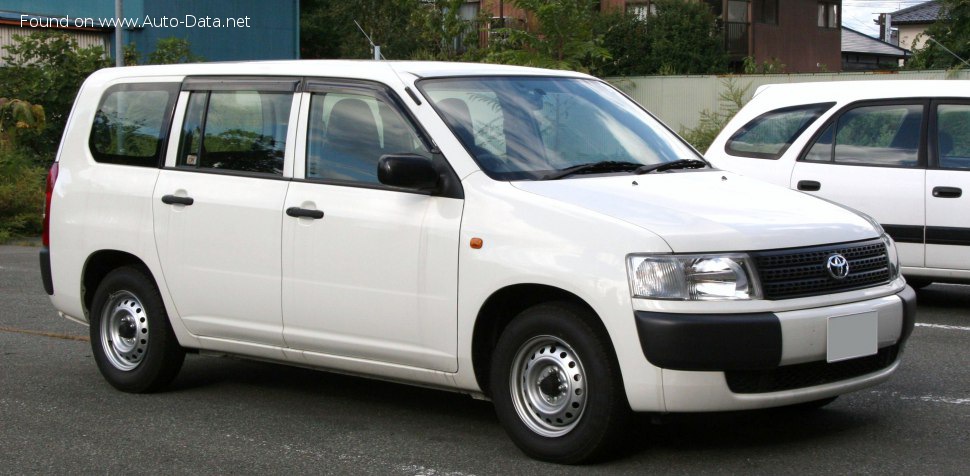
The Toyota Probox 1.5 i: A Pillar of Japanese Utility and Efficiency (2002-2014)
The Toyota Probox, specifically the Toyota Probox 1.5 i variant produced between 2002 and 2014, stands as a testament to Toyota’s mastery in creating highly functional and incredibly reliable vehicles designed for the demands of everyday commerce and practical family life in Japan. While not officially sold in the United States, the Probox carved out a significant niche in its home market and several other regions as a no-nonsense, highly efficient, and exceptionally durable station wagon. Primarily conceived as a light commercial vehicle, its robust build quality, ample cargo space, and economical operation quickly endeared it to a broad spectrum of users, from small businesses needing a dependable delivery vehicle to families seeking a practical and low-maintenance daily driver.
Representing its inaugural generation, the Probox was engineered on the highly versatile NCP50 platform, shared with other successful Toyota models like the Vitz/Yaris and the Platz/Echo. This shared architecture allowed for cost-effective production while ensuring a proven foundation of reliability and driving dynamics. The 1.5 i model, powered by the ubiquitous 1NZ-FE engine, offered a compelling blend of adequate performance for urban and highway driving, coupled with exceptional fuel efficiency, making it a cornerstone of the Japanese automotive landscape for over a decade.
Engine and Performance: The Reliable 1NZ-FE Heartbeat
At the core of the Toyota Probox 1.5 i’s enduring appeal was its powertrain, featuring the renowned 1NZ-FE engine. This 1.5-liter (1497 cm3 or 91.35 cu. in.) inline four-cylinder gasoline engine was a paragon of Toyota’s engineering philosophy: robust, efficient, and remarkably dependable. Equipped with a Double Overhead Camshaft (DOHC) valvetrain and multi-port manifold fuel injection, the engine was naturally aspirated, emphasizing smooth power delivery and fuel economy over outright speed.
The 1NZ-FE generated a respectable 109 horsepower at 6000 revolutions per minute (rpm), providing sufficient impetus for the Probox’s intended utility. Its peak torque output stood at 141 Newton-meters (104 lb.-ft.) delivered at 4200 rpm. This torque curve was particularly well-suited for a utility vehicle, ensuring responsive acceleration from a standstill and ample pulling power for carrying cargo without feeling strained. With a compression ratio of 10.5:1 and a bore of 75 mm (2.95 in.) coupled with an 84.7 mm (3.33 in.) piston stroke, the engine was designed for longevity and smooth operation. Its power-to-liter ratio of 72.8 Hp/l underscored its efficient design for its displacement class.
The engine was mounted in a front, transverse layout, driving the front wheels (Front Wheel Drive – FWD). This configuration optimized interior space and provided predictable handling characteristics, crucial for a vehicle often navigating congested urban environments. The modest curb weight of 2270.76 lbs. (1030 kg) meant that the 109 horsepower was more than adequate, resulting in a weight-to-power ratio of 9.4 kg/Hp (105.8 Hp/tonne) and a weight-to-torque ratio of 7.3 kg/Nm (136.9 Nm/tonne). These figures highlight the Probox’s efficient power utilization, making it an agile and economical choice for its segment.
Design and Features: Form Follows Function
The design of the Toyota Probox 1.5 i is a masterclass in utilitarian aesthetics. It is a 5-door, 5-seat station wagon (or estate, as it’s often called internationally) that prioritizes functionality and cargo capacity above all else. Its exterior lines are straightforward and boxy, a deliberate choice to maximize interior volume and facilitate easy loading and unloading of goods. The relatively compact dimensions – a length of 165.16 inches (4195 mm), a width of 66.73 inches (1695 mm), and a height of 60.04 inches (1525 mm) – made it perfectly suited for navigating narrow Japanese city streets and fitting into tight parking spaces, a critical consideration in its primary market.
Despite its modest exterior footprint, the Probox boasts an impressive wheelbase of 100.39 inches (2550 mm), contributing to a stable ride and a surprisingly spacious cabin. The interior, while spartan by luxury standards, is designed for durability and ease of cleaning, featuring hard-wearing plastics and straightforward controls. The rear seats are engineered to fold flat, creating an expansive, nearly flat cargo area, which is the vehicle’s defining feature. This versatility allows it to transform from a people-carrier to a goods-hauler with minimal effort, making it invaluable for businesses. Standard features for its era would include essentials like air conditioning (in most trims), power windows, and a basic audio system, focusing on providing a comfortable yet no-frills environment for its occupants.
Safety features, while not as advanced as modern vehicles, included standard airbags for the driver and front passenger, along with anti-lock braking systems (ABS) in later models, providing adequate protection for its time. The robust chassis and predictable front-wheel-drive architecture contributed to its overall safety profile.
Technical Specifications of the Toyota Probox 1.5 i (2002-2014)
Below is a detailed breakdown of the technical specifications for the Toyota Probox 1.5 i, providing a comprehensive overview of its mechanical and dimensional attributes.
| Category | Specification | Metric Value | US/Imperial Value |
|---|---|---|---|
| General Information | |||
| Brand | Toyota | ||
| Model | Probox | ||
| Generation | Probox | ||
| Type (Engine) | 1.5 i (109 Hp) | ||
| Start of Production | 2002 year | ||
| End of Production | 2014 year | ||
| Powertrain Architecture | Internal Combustion engine | ||
| Body type | Station wagon (estate) | ||
| Seats | 5 | ||
| Doors | 5 | ||
| Performance Specs | |||
| Fuel Type | Petrol (Gasoline) | ||
| Weight-to-power ratio | 9.4 kg/Hp | 105.8 Hp/tonne | |
| Weight-to-torque ratio | 7.3 kg/Nm | 136.9 Nm/tonne | |
| Engine Specs | |||
| Power | 109 Hp @ 6000 rpm. | ||
| Power per liter | 72.8 Hp/l | ||
| Torque | 141 Nm @ 4200 rpm. | 104 lb.-ft. @ 4200 rpm. | |
| Engine layout | Front, Transverse | ||
| Engine Model/Code | 1NZ-FE | ||
| Engine displacement | 1497 cm3 | 91.35 cu. in. | |
| Number of cylinders | 4 | ||
| Engine configuration | Inline | ||
| Cylinder Bore | 75 mm | 2.95 in. | |
| Piston Stroke | 84.7 mm | 3.33 in. | |
| Compression ratio | 10.5:1 | ||
| Number of valves per cylinder | 4 | ||
| Fuel injection system | Multi-port manifold injection | ||
| Engine aspiration | Naturally aspirated engine | ||
| Valvetrain | DOHC | ||
| Engine oil capacity | 3.7 l | 3.91 US qt | 3.26 UK qt | |
| Coolant | 4.4 l | 4.65 US qt | 3.87 UK qt | |
| Space, Volume and Weights | |||
| Kerb Weight | 1030 kg | 2270.76 lbs. | |
| Fuel tank capacity | 50 l | 13.21 US gal | 11 UK gal | |
| Dimensions | |||
| Length | 4195 mm | 165.16 in. | |
| Width | 1695 mm | 66.73 in. | |
| Height | 1525 mm | 60.04 in. | |
| Wheelbase | 2550 mm | 100.39 in. | |
| Front track | 1455 mm | 57.28 in. | |
| Rear (Back) track | 1465 mm | 57.68 in. | |
| Drivetrain, Brakes and Suspension Specs | |||
| Drivetrain Architecture | The Internal combustion engine (ICE) drives the front wheels of the vehicle. | ||
| Drive wheel | Front wheel drive | ||
| Tires size | 175/65 R14 | ||
Legacy and Market Impact of the Toyota Probox
The Toyota Probox, particularly the 1.5 i variant, has cemented its legacy as one of the most practical and enduring utility vehicles in the Japanese market. Its reputation is built on an unshakeable foundation of reliability, cost-effectiveness, and unparalleled utility. For small businesses, delivery services, and tradespeople in Japan, the Probox became the default choice, a true workhorse that could be relied upon day in and day out, regardless of the load or the driving conditions. Its low running costs, primarily due to the 1NZ-FE engine’s fuel efficiency and Toyota’s legendary durability, made it an economically sound investment for its owners.
Competitors in its primary market, such as the Nissan AD Van and the Honda Partner, offered similar propositions, but the Probox consistently held its own, often outselling rivals due to its strong brand reputation and perceived superior build quality. Its simple yet effective design meant fewer things could go wrong, and maintenance was straightforward and affordable. This focus on durability and ease of ownership extended the vehicle’s lifespan considerably, with many Probox models still in active service well over a decade after their production, a testament to their robust engineering.
Beyond its commercial applications, the Probox also gained a following among private owners who appreciated its spacious interior, especially the vast cargo area for hobbies, sports equipment, or simply large grocery runs. Its compact exterior dimensions, combined with a surprisingly large interior, made it a versatile family vehicle for those prioritizing practicality over luxury or performance. The ability to fold the rear seats completely flat created a cavernous space, ideal for transporting everything from furniture to camping gear, further enhancing its appeal.
The historical significance of the Toyota Probox lies in its embodiment of a highly specific market need. It wasn’t designed to be flashy or exciting, but to be an utterly dependable tool. Its success underscores the importance of functional design and engineering for purpose. While it never officially graced American showrooms, its impact in Japan and other markets where it was sold (or grey-imported) is undeniable. It represents a segment where practicality, reliability, and efficiency are paramount, demonstrating Toyota’s ability to cater to diverse global automotive needs with highly specialized and incredibly successful products. The Probox continues to be a symbol of steadfast utility, a vehicle that simply gets the job done, day after day, year after year.

