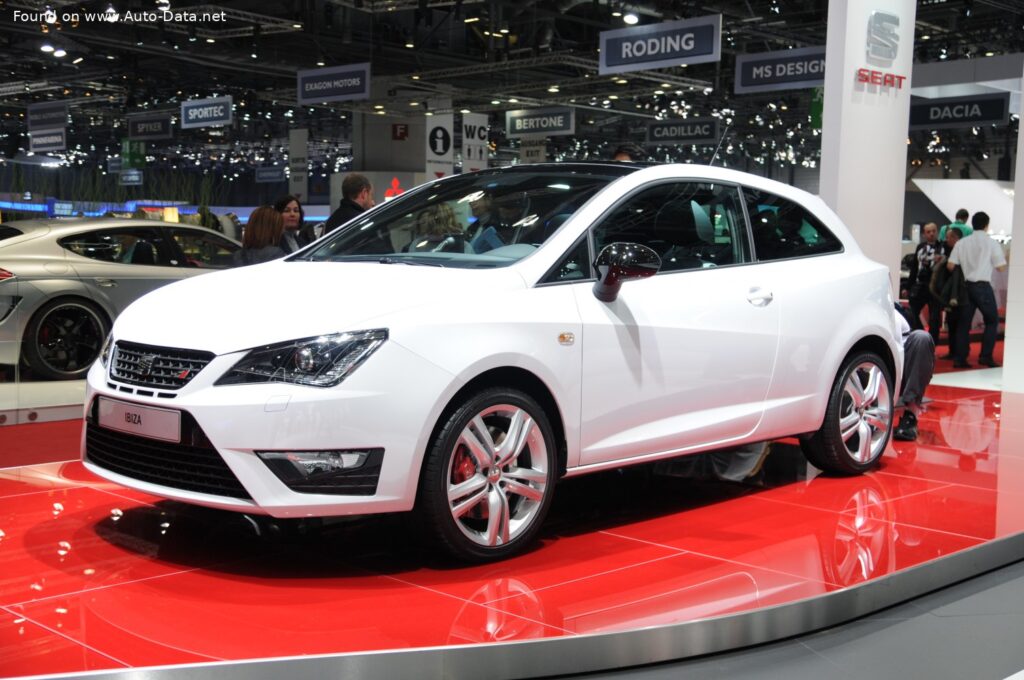
Introduction to the Seat Ibiza IV SC (facelift 2012)
The Seat Ibiza IV SC (facelift 2012) represents a significant evolution in the fourth generation of Seat’s popular subcompact car, known internally as the 6J series. Produced by the Spanish automaker Seat, a subsidiary of the Volkswagen Group, the Ibiza has long been a cornerstone of the brand’s identity, particularly in European markets. The “SC” designation stands for “Sport Coupe,” indicating its three-door body style, which offered a more dynamic and youthful aesthetic compared to its five-door hatchback sibling. This particular variant, powered by the robust 2.0 TDI (143 Hp) engine, was manufactured from 2012 to 2015, serving as a performance-oriented diesel option within the subcompact segment.
While the Seat brand is not sold in the United States, the Ibiza is a highly recognizable and competitive player in Europe’s B-segment, often vying for market share against stablemates like the Volkswagen Polo and Skoda Fabia, as well as rivals such as the Ford Fiesta, Renault Clio, and Peugeot 208. The 2012 facelift brought subtle yet effective updates to the Ibiza’s exterior styling, interior refinement, and technological offerings, keeping it fresh against increasingly fierce competition. The inclusion of a potent 2.0-liter turbodiesel engine, delivering 143 horsepower, positioned this Ibiza SC as a compelling choice for drivers seeking a blend of spirited performance, exceptional fuel efficiency, and a sporty demeanor in a compact package.
Powertrain and Performance: The 2.0 TDI in the Seat Ibiza IV SC (facelift 2012)
At the heart of this particular Seat Ibiza IV SC (facelift 2012) lies a highly regarded 2.0-liter TDI (Turbocharged Direct Injection) diesel engine, a testament to the Volkswagen Group’s expertise in efficient and powerful diesel powertrains. Codenamed CFHD, this inline four-cylinder engine boasts a displacement of 1968 cubic centimeters (approximately 120.09 cubic inches or 2.0 Liters). It features a common rail fuel injection system, a turbocharger, and an intercooler, all working in concert to produce an impressive 143 horsepower at 4200 revolutions per minute.
More critically for a diesel engine, the torque output is substantial: 236.02 lb.-ft. (320 Nm), available across a broad and accessible rev range from 1750 to 2500 rpm. This characteristic provides the Ibiza SC with strong, immediate acceleration and excellent pulling power, making it feel remarkably agile for its size. Power is delivered to the front wheels via a precise 6-speed manual transmission, offering engaging control for the driver.
The performance figures for the 2.0 TDI variant underscore its sporty aspirations. The Ibiza SC can accelerate from 0 to 60 miles per hour in a brisk 7.8 seconds, with a top speed reaching 130.49 mph (210 km/h). These numbers place it firmly in the “warm hatch” territory within the subcompact class, offering a driving experience that belies its economical nature.
Fuel efficiency is a standout feature, a hallmark of modern diesel engines. The Ibiza IV SC 2.0 TDI achieves an impressive combined fuel economy of 51.1 US mpg (4.6 L/100 km). Even in urban driving, it manages 39.9 US mpg (5.9 L/100 km), while extra-urban cruising sees figures climb to an outstanding 60.3 US mpg (3.9 L/100 km). Coupled with CO2 emissions of 119 g/km, meeting the stringent Euro 5 emission standard, this Ibiza offers a compelling balance of performance and environmental responsibility, making it a highly attractive option in markets where diesel powertrains are prevalent. The vehicle’s kerb weight of 2764.6 lbs. (1254 kg) contributes to a favorable weight-to-power ratio of 8.8 kg/Hp, further enhancing its dynamic capabilities.
Exterior and Interior Design
The design of the Seat Ibiza IV SC (facelift 2012) is characterized by its sharp lines and sporty proportions, a signature of Seat’s design language under the direction of Luc Donckerwolke. The “Sport Coupe” (SC) body type, with its three doors, gives the car a sleeker, more dynamic profile than its five-door counterpart. The facelift introduced subtle refinements, including revised headlights with optional LED daytime running lights, a more aggressive front bumper, and updated wheel designs, all contributing to a more modern and assertive road presence.
With an overall length of 160.08 inches (4066 mm), a width of 66.65 inches (1693 mm), and a height of 56.06 inches (1424 mm), the Ibiza SC maintains compact dimensions, making it agile in urban environments. The wheelbase of 97.2 inches (2469 mm) contributes to its stable handling. Inside, the cabin is designed for five occupants, offering a functional and driver-focused environment. While a subcompact, the interior features a logical layout with good ergonomics. The trunk space, at 8.33 cubic feet (236 liters), is respectable for its class, suitable for daily errands and weekend trips. The vehicle’s turning circle of 34.38 feet (10.48 m) highlights its maneuverability.
Chassis, Safety, and Driver Assistance
The Ibiza IV SC is built on the Volkswagen Group’s PQ25 platform, shared with other successful models like the VW Polo and Audi A1, which is known for providing a solid foundation for handling and ride comfort. The suspension setup features an independent McPherson strut system with coil springs and an anti-roll bar at the front, while the rear utilizes a trailing arm setup. This configuration delivers a responsive and engaging driving experience, characteristic of European subcompacts, with a good balance between sportiness and daily usability.
Braking performance is handled by ventilated discs at the front and disc brakes at the rear, providing confident stopping power. Standard safety features for this era included ABS (Anti-lock Braking System), which prevents wheel lock-up during hard braking, enhancing vehicle control. The steering system is a rack and pinion type with electric power steering, offering light effort at low speeds for easy maneuvering and a more weighted feel at higher speeds for stability. The car was available with a range of tire sizes, from 185/60 R15 to sportier 215/40 R17 options, mounted on corresponding wheel rims (6J x 15 to 7J x 17), allowing buyers to tailor the car’s grip and aesthetic.
Technical Specifications
| Category | Specification |
|---|---|
| Brand | Seat |
| Model | Ibiza |
| Generation | Ibiza IV SC (facelift 2012) |
| Type (Engine) | 2.0 TDI (143 Hp) |
| Production Start | 2012 |
| Production End | 2015 |
| Powertrain Architecture | Internal Combustion engine |
| Body type | Coupe |
| Seats | 5 |
| Doors | 3 |
| Performance Specs | |
| Fuel consumption (urban) | 39.9 US mpg (5.9 l/100 km) |
| Fuel consumption (extra urban) | 60.3 US mpg (3.9 l/100 km) |
| Fuel consumption (combined) | 51.1 US mpg (4.6 l/100 km) |
| CO2 emissions | 119 g/km |
| Fuel Type | Diesel |
| Acceleration 0 – 60 mph | 7.8 sec |
| Maximum speed | 130.49 mph (210 km/h) |
| Emission standard | Euro 5 |
| Weight-to-power ratio | 8.8 kg/Hp, 114 Hp/tonne |
| Weight-to-torque ratio | 3.9 kg/Nm, 255.2 Nm/tonne |
| Engine Specs | |
| Power | 143 Hp @ 4200 rpm |
| Power per liter | 72.7 Hp/l |
| Torque | 236.02 lb.-ft. (320 Nm) @ 1750-2500 rpm |
| Engine layout | Front, Transverse |
| Engine Model/Code | CFHD |
| Engine displacement | 120.09 cu. in. (1968 cm3) |
| Number of cylinders | 4 |
| Engine configuration | Inline |
| Cylinder Bore | 3.19 in. (81 mm) |
| Piston Stroke | 3.76 in. (95.5 mm) |
| Compression ratio | 16:1 |
| Number of valves per cylinder | 4 |
| Fuel injection system | Diesel Commonrail |
| Engine aspiration | Turbocharger, Intercooler |
| Engine oil capacity | 4.54 US qt (4.3 l) |
| Coolant | 8.45 US qt (8 l) |
| Engine systems | Particulate filter |
| Space, Volume and Weights | |
| Kerb Weight | 2764.6 lbs. (1254 kg) |
| Max. weight | 3725.81 lbs. (1690 kg) |
| Max load | 961.22 lbs. (436 kg) |
| Trunk (boot) space – minimum | 8.33 cu. ft. (236 l) |
| Fuel tank capacity | 11.89 US gal (45 l) |
| Dimensions | |
| Length | 160.08 in. (4066 mm) |
| Width | 66.65 in. (1693 mm) |
| Height | 56.06 in. (1424 mm) |
| Wheelbase | 97.2 in. (2469 mm) |
| Front track | 57.05 in. (1449 mm) |
| Rear (Back) track | 56.73 in. (1441 mm) |
| Minimum turning circle | 34.38 ft. (10.48 m) |
| Drivetrain, Brakes and Suspension Specs | |
| Drivetrain Architecture | Front wheel drive. Internal Combustion engine. |
| Drive wheel | Front wheel drive |
| Number of gears and type of gearbox | 6 gears, manual transmission |
| Front suspension | Independent, type McPherson with coil spring and anti-roll bar |
| Rear suspension | Trailing arm |
| Front brakes | Ventilated discs |
| Rear brakes | Disc |
| Assisting systems | ABS (Anti-lock braking system) |
| Steering type | Steering rack and pinion |
| Power steering | Electric Steering |
| Tires size | 185/60 R15; 215/45 R16; 215/40 R17 |
| Wheel rims size | 6J x 15; 7J x 16; 7J x 17 |
Legacy and Market Impact in the European Segment
The Seat Ibiza IV SC (facelift 2012) 2.0 TDI (143 Hp) holds a notable place in the European subcompact market. As a core model for Seat, the Ibiza has consistently been one of the brand’s best-sellers, particularly in its home market of Spain and other Southern European countries. The fourth generation, especially after its 2012 facelift, continued this tradition by offering a compelling package of stylish design, engaging driving dynamics, and the practical benefits of Volkswagen Group engineering.
In a segment crowded with strong contenders, the Ibiza differentiated itself with a sportier image, positioned as the more passionate and youthful alternative to its platform siblings, the Volkswagen Polo and Skoda Fabia. The “Sport Coupe” (SC) variant, with its three-door configuration, further amplified this appeal, targeting buyers who prioritized style and a dynamic driving feel over maximum practicality. The 2.0 TDI engine, in particular, was a key differentiator. While many competitors offered smaller, less powerful diesel options, the 143-horsepower 2.0-liter unit provided a level of performance that bordered on “hot hatch” territory, yet delivered economy figures that were hard to beat. This unique combination made it attractive to those who wanted spirited acceleration and high cruising speeds on European highways without sacrificing efficiency.
Competitors in the European B-segment were numerous and formidable, including the aforementioned VW Polo and Skoda Fabia, as well as the Ford Fiesta, Renault Clio, Peugeot 208, and Opel Corsa. The Ibiza carved out its niche by emphasizing its “auto emoción” philosophy, promising an emotional connection through its driving experience. The 2.0 TDI variant was a strong embodiment of this, offering a punchy powertrain that made everyday driving more enjoyable. Its competitive pricing, coupled with robust build quality and a comprehensive list of standard features for its time, ensured its continued relevance.
The production run of this specific facelifted generation concluded in 2015, making way for the subsequent fifth-generation Ibiza. However, the Ibiza IV SC 2.0 TDI remains a testament to Seat’s ability to inject a dose of Spanish flair and performance into the practical subcompact category. It cemented Seat’s reputation as the sporty and design-focused arm of the Volkswagen Group, offering a distinct alternative for European consumers who valued driving pleasure alongside efficiency and compact dimensions. Its legacy is one of a well-rounded, performance-oriented diesel subcompact that successfully balanced conflicting demands, leaving a lasting impression on the segment it inhabited.