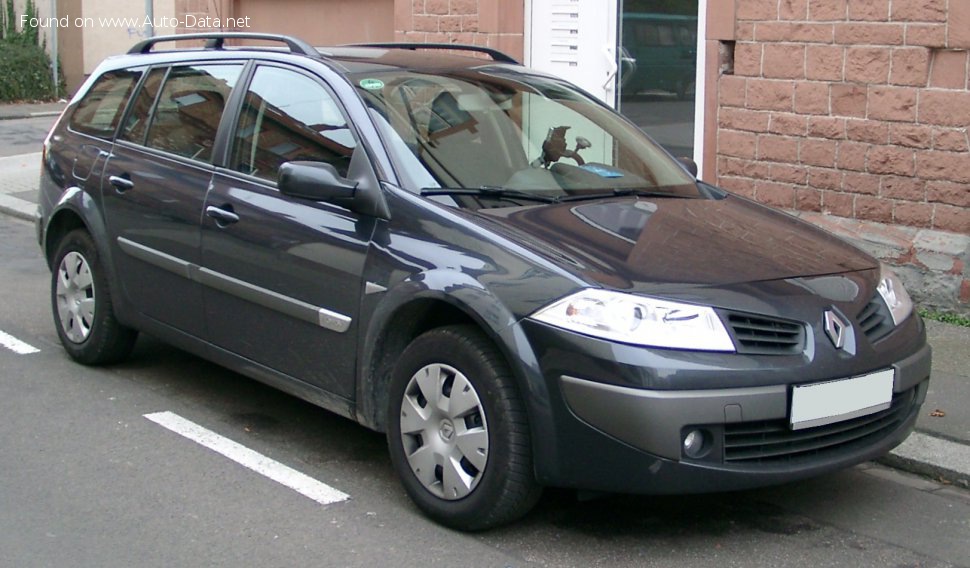
The Renault Megane II Grandtour (Phase II, 2006) 1.5 dCi (106 Hp): A Practical European Workhorse
The Renault Megane II Grandtour (Phase II, 2006) 1.5 dCi (106 Hp) represents a practical and highly efficient offering within the highly competitive European compact car segment. As a five-door station wagon, or “estate” as it’s known across the Atlantic, this specific iteration of the Megane II was part of the model’s mid-life refresh, launched in 2006. While the Renault brand, and particularly the Megane, was not sold in the United States, it played a pivotal role in the European market, catering to families and individuals seeking a versatile, economical, and comfortable vehicle with substantial cargo capacity. This particular model, equipped with the 1.5-liter dCi (direct commonrail injection) turbodiesel engine, epitomized Renault’s commitment to fuel efficiency and low emissions, making it a compelling choice for the environmentally conscious and budget-minded European consumer.
Powertrain and Driving Dynamics of the Renault Megane II Grandtour
At the heart of the 2006 Renault Megane II Grandtour lies the renowned K9K Turbo 1.5 dCi diesel engine, a powerplant celebrated across Europe for its blend of economy and adequate performance. With an engine displacement of 1461 cubic centimeters (89.16 cubic inches), this inline four-cylinder unit delivered 106 horsepower at 4000 rpm. More significantly for a diesel, it produced a robust 177.01 lb.-ft. of torque at a low 2000 rpm, providing excellent pulling power for daily driving and highway cruising, especially when loaded with passengers and cargo. The engine featured a commonrail fuel injection system and was boosted by a turbocharger with an intercooler, optimizing combustion efficiency and power delivery.
Power was routed to the front wheels via a slick-shifting 6-speed manual transmission, a common and preferred setup in Europe for its engagement and efficiency. This drivetrain architecture contributed to the vehicle’s impressive fuel economy figures: an estimated 50 US miles per gallon combined, with urban consumption at 40.6 US mpg and extra-urban figures soaring to 57.4 US mpg. These numbers were exceptional for the era and remain competitive even by today’s standards, underscoring the Megane dCi’s appeal as a long-distance cruiser. Performance-wise, the Grandtour 1.5 dCi could accelerate from 0 to 60 mph in a respectable 10.8 seconds, reaching a maximum speed of 114.95 mph. Furthermore, with CO2 emissions of just 124 g/km, the vehicle met the Euro 4 emission standard, reflecting its relatively clean operation for a diesel of its time.
The driving dynamics were tailored for comfort and stability, characteristic of European family cars. The front suspension utilized an independent McPherson strut setup, known for its ability to balance ride comfort with predictable handling. The rear featured a torsion beam suspension, a compact and effective design for a front-wheel-drive vehicle that also maximized cargo space. Braking was handled by ventilated discs at the front and solid discs at the rear, augmented by an Anti-lock Braking System (ABS) for enhanced safety and control. The electric power steering system offered light and precise steering, making the Grandtour easy to maneuver in urban environments and on winding roads.
Design, Practicality, and Features
The Megane II generation, introduced in 2002, was renowned for its avant-garde styling, particularly the distinctive “bustle-back” design of the hatchback. While the Grandtour station wagon adopted a more conventional, yet still characterful, aesthetic, it retained the family resemblance with its distinctive front fascia and sculpted lines. Its primary design objective was practicality, and it delivered generously. With a length of 177.17 inches, a width of 69.96 inches (79.76 inches including mirrors), and a height of 57.76 inches, the Grandtour provided ample interior space for five occupants and their luggage.
The station wagon body type offered exceptional versatility. The trunk space started at a capacious 18.36 cubic feet with all seats in place, expanding dramatically to a cavernous 56.5 cubic feet when the rear seats were folded down. This made the Megane II Grandtour an ideal companion for family vacations, hauling sports equipment, or tackling everyday errands. The thoughtful design extended to practical details such as a maximum roof load of 176.37 lbs and a permitted trailer load with brakes of 2866.01 lbs, further enhancing its utility.
Inside, the Megane II Grandtour offered a comfortable and functional cabin. While specific luxury features might vary by trim, the general focus was on ergonomic design and ease of use. The vehicle rode on 205/50 R17 tires mounted on 6.5J X 17-inch wheel rims, providing a good balance of grip and ride comfort. Safety features, beyond ABS, typically included multiple airbags and robust body construction, aligning with European safety standards of the time. The overall package was designed to offer a safe, reliable, and highly functional vehicle for the discerning European family.
Technical Specifications
| Category | Specification |
|---|---|
| General Information | |
| Brand | Renault |
| Model | Megane |
| Generation | Megane II Grandtour (Phase II, 2006) |
| Type (Engine) | 1.5 dCi (106 Hp) |
| Production Years | 2006 – 2006 |
| Powertrain Architecture | Internal Combustion engine |
| Body type | Station wagon (estate) |
| Seats | 5 |
| Doors | 5 |
| Performance Specifications | |
| Fuel consumption (urban) | 5.8 l/100 km (40.6 US mpg) |
| Fuel consumption (extra urban) | 4.1 l/100 km (57.4 US mpg) |
| Fuel consumption (combined) | 4.7 l/100 km (50 US mpg) |
| CO2 emissions | 124 g/km |
| Fuel Type | Diesel |
| Acceleration 0-60 mph | 10.8 sec |
| Maximum speed | 185 km/h (114.95 mph) |
| Emission standard | Euro 4 |
| Weight-to-power ratio | 11.9 kg/Hp (84.1 Hp/tonne) |
| Weight-to-torque ratio | 5.3 kg/Nm (190.5 Nm/tonne) |
| Engine Specifications | |
| Power | 106 Hp @ 4000 rpm |
| Power per liter | 72.6 Hp/l |
| Torque | 240 Nm @ 2000 rpm (177.01 lb.-ft. @ 2000 rpm) |
| Engine layout | Front, Transverse |
| Engine Model/Code | K9K Turbo |
| Engine displacement | 1461 cm3 (89.16 cu. in.) |
| Number of cylinders | 4 |
| Engine configuration | Inline |
| Cylinder Bore | 76 mm (2.99 in.) |
| Piston Stroke | 80.5 mm (3.17 in.) |
| Compression ratio | 15.6:1 |
| Number of valves per cylinder | 2 |
| Fuel injection system | Diesel Commonrail |
| Engine aspiration | Turbocharger, Intercooler |
| Engine oil capacity | 4.5 l (4.76 US qt) |
| Engine oil specification | Not specified |
| Coolant capacity | 7.5 l (7.93 US qt) |
| Space, Volume, and Weights | |
| Kerb Weight | 1260 kg (2777.82 lbs.) |
| Max. weight | 1840 kg (4056.51 lbs.) |
| Max load | 580 kg (1278.68 lbs.) |
| Trunk (boot) space – minimum | 520 l (18.36 cu. ft.) |
| Trunk (boot) space – maximum | 1600 l (56.5 cu. ft.) |
| Fuel tank capacity | 60 l (15.85 US gal) |
| Max. roof load | 80 kg (176.37 lbs.) |
| Permitted trailer load with brakes (12%) | 1300 kg (2866.01 lbs.) |
| Permitted trailer load without brakes | 650 kg (1433 lbs.) |
| Permitted towbar download | 75 kg (165.35 lbs.) |
| Dimensions | |
| Length | 4500 mm (177.17 in.) |
| Width | 1777 mm (69.96 in.) |
| Width including mirrors | 2026 mm (79.76 in.) |
| Height | 1467 mm (57.76 in.) |
| Wheelbase | 2686 mm (105.75 in.) |
| Front track | 1518 mm (59.76 in.) |
| Rear (Back) track | 1514 mm (59.61 in.) |
| Front overhang | 842 mm (33.15 in.) |
| Rear overhang | 972 mm (38.27 in.) |
| Ride height (ground clearance) | 120 mm (4.72 in.) |
| Minimum turning circle (turning diameter) | 11 m (36.09 ft.) |
| Drivetrain, Brakes, and Suspension Specs | |
| Drivetrain Architecture | Front-wheel drive (Internal Combustion Engine drives front wheels) |
| Drive wheel | Front wheel drive |
| Number of gears and type of gearbox | 6 gears, manual transmission |
| Front suspension | Independent type McPherson |
| Rear suspension | Torsion |
| Front brakes | Ventilated discs |
| Rear brakes | Disc |
| Assisting systems | ABS (Anti-lock braking system) |
| Steering type | Steering rack and pinion |
| Power steering | Electric Steering |
| Tires size | 205/50 R17 |
| Wheel rims size | 6.5J X 17 |
Legacy and Market Impact
The Renault Megane II, and particularly the Grandtour variant, carved out a significant niche in the European automotive landscape. Its distinctive styling, especially during its initial launch, helped it stand out in a crowded segment dominated by stalwarts like the Volkswagen Golf Variant, Ford Focus Wagon, Opel Astra Caravan, and Peugeot 307 SW. The Phase II update in 2006 refined its aesthetics and technology, keeping it competitive against these rivals. The Megane II Grandtour’s reputation was built on its combination of practicality, comfort, and, crucially, its outstanding fuel efficiency, especially with the 1.5 dCi engine.
For European families, the Megane Grandtour offered a compelling proposition: a car that was economical to run, spacious enough for family duties, and comfortable for long journeys. Renault’s expertise in diesel powertrains, refined over decades, was evident in the K9K engine, which proved to be a durable and reliable workhorse. This specific model’s commitment to low emissions for its time also aligned with growing environmental awareness in Europe, contributing to its appeal and making it a popular choice for company car fleets and private buyers alike.
While never officially imported to the United States, the Renault Megane II Grandtour remains an excellent example of a vehicle perfectly tailored to its target market. It showcased Renault’s design daring, engineering prowess in compact vehicle platforms, and a strong understanding of the European consumer’s demand for efficiency and versatility. Its legacy lies in its contribution to making practical, economical family transport accessible and stylish, cementing its place as an important chapter in Renault’s rich automotive history.