The Ford Mustang V (facelift 2012) 3.7 V6: A Modern Pony Car Evolution
The Ford Mustang, an iconic symbol of American automotive prowess and freedom, continued its legacy with the fifth generation, particularly the refreshed model produced from 2012 to 2014. Among its compelling offerings, the Ford Mustang V (facelift 2012) 3.7 V6 stood out as a significant leap forward for the base model, shedding its “secretary’s car” stereotype and establishing itself as a legitimate performance machine. This iteration of the Mustang, built on the venerable D2C platform, represented a harmonious blend of classic Mustang aesthetics with contemporary engineering, offering enthusiasts and everyday drivers a potent, stylish, and relatively fuel-efficient sports coupe.
Introduced in 2012, this refreshed Mustang V brought subtle but impactful styling updates and, more importantly, a significantly upgraded powertrain lineup. The 3.7-liter V6 variant, in particular, was a game-changer. It delivered impressive horsepower and torque figures that rivaled the V8s of previous generations, democratizing performance for a wider audience. Positioned squarely in the American pony car segment, it faced stiff competition but carved out its own niche by offering a compelling balance of performance, affordability, and the timeless Mustang appeal.
Engine and Performance: The Potent 3.7 V6 Duratec
At the heart of the 2012-2014 Ford Mustang V (facelift 2012) 3.7 V6 model lies the formidable Duratec 37 engine, a naturally aspirated V6 powerplant that redefined expectations for the entry-level Mustang. This 3.7-liter (3731 cm³ or 227.68 cu. in.) engine was a marvel of modern engineering for its time, featuring a sophisticated DOHC (Double Overhead Camshaft) valvetrain with Ti-VCT (Twin Independent Variable Cam Timing).
The Ti-VCT system played a crucial role in optimizing valve overlap and lift across the engine’s entire operating range, contributing to both impressive power output and improved fuel efficiency. This engine generated a robust 305 horsepower at a high 6500 rpm, delivering a power-per-liter figure of 81.7 Hp/l, a testament to its advanced design. Torque was equally impressive, peaking at 280.27 lb.-ft. (380 Nm) at 4250 rpm, providing strong acceleration and responsive throttle feel. The maximum engine speed was a thrilling 7000 rpm, encouraging drivers to explore the upper reaches of the tachometer.
Power was sent to the rear wheels via a standard 6-speed manual transmission, offering an engaging and direct driving experience that purists cherished. The combination of the powerful V6 and the precise manual gearbox allowed the Mustang to achieve a respectable weight-to-power ratio of 5.2 kg/Hp (192.1 Hp/tonne), ensuring lively performance whether on the open highway or winding back roads. The internal combustion engine (ICE) architecture, front-longitudinal engine layout, and rear-wheel-drive configuration maintained the classic Mustang dynamic, providing a balanced and predictable handling characteristic. Fueling this performance was a multi-port manifold injection system, optimized for gasoline, and a compression ratio of 10.5:1.
Design and Features: Classic Lines, Modern Appeal
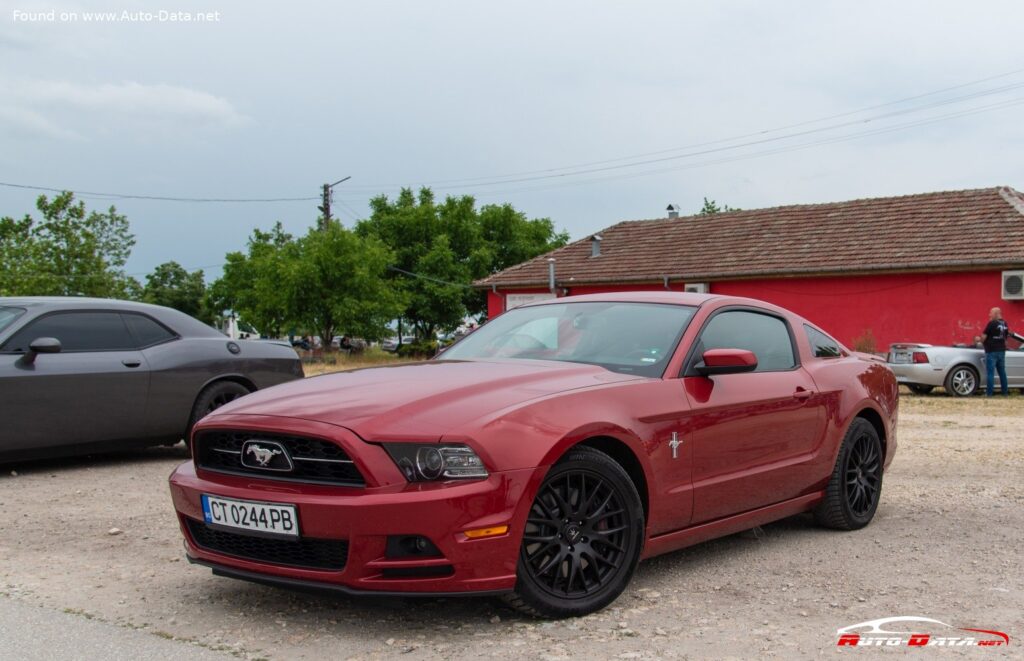
The Ford Mustang V (facelift 2012) carried forward the retro-futuristic design language introduced with the fifth generation but incorporated subtle yet impactful updates that gave it a more aggressive and contemporary edge. As a 2-door coupe with seating for four, it retained the iconic long hood, short deck proportions that have defined the Mustang for decades.
Exterior enhancements for the 2012 facelift included a more prominent power dome on the hood, a revised front fascia with a larger grille and updated headlights featuring integrated LED accent lighting, and a restyled rear end with sequential LED taillights—a signature Mustang touch. These changes injected a dose of modern sophistication while honoring the car’s heritage. The dimensions of 188.5 inches (4788 mm) in length, 73.9 inches (1877 mm) in width (80.12 inches or 2035 mm including mirrors), and 55.79 inches (1417 mm) in height, along with a 107.09-inch (2720 mm) wheelbase, gave the Mustang a substantial and planted stance.
Inside, the cabin blended classic Mustang design cues with improved materials and technology. While the data doesn’t detail interior features, for its era, the 2012 Mustang offered a driver-focused cockpit with available features like Ford’s SYNC infotainment system, an improved sound system, and comfortable bucket seats. Safety was addressed with standard features such as an Anti-lock Braking System (ABS), a suite of airbags, and a robust body structure. The steering system utilized electric power steering (EPAS), offering precise control and improved fuel efficiency over traditional hydraulic systems.
The suspension setup comprised an independent McPherson type with a transverse stabilizer at the front, while the rear featured a rigid axle suspension with coil springs and a transverse stabilizer. While the rigid rear axle was a point of contention for some enthusiasts desiring a fully independent rear suspension, it contributed to the Mustang’s traditional character and ruggedness. Braking duties were handled by ventilated discs both front (316×30 mm) and rear (300×19 mm), providing confident stopping power. The Mustang offered a choice of tire sizes, including 225/60 R17, 235/50 R18, and 255/40 R19, mounted on corresponding wheel rims (7J x 17; 8J x 18; 8.5J x 19), allowing for customization and enhanced grip.
Technical Specifications: Ford Mustang V (facelift 2012) 3.7 V6 (305 Hp)
| Category | Specification | Value |
|---|---|---|
| General Information | Brand | Ford |
| Model | Mustang | |
| Generation | Mustang V (facelift 2012) | |
| Type (Engine) | 3.7 V6 (305 Hp) | |
| Start of production | 2012 year | |
| End of production | 2014 year | |
| Powertrain Architecture | Internal Combustion engine | |
| Body type | Coupe | |
| Seats | 4 | |
| Doors | 2 | |
| Performance Specs | Fuel consumption (economy) – urban | 12.4 l/100 km (19 US mpg) |
| Fuel consumption (economy) – extra urban | 8.1 l/100 km (29 US mpg) | |
| Fuel consumption (economy) – combined | 10.7 l/100 km (22 US mpg) | |
| Fuel Type | Petrol (Gasoline) | |
| Weight-to-power ratio | 5.2 kg/Hp, 192.1 Hp/tonne | |
| Weight-to-torque ratio | 4.2 kg/Nm, 239.3 Nm/tonne | |
| Engine Specs | Power | 305 Hp @ 6500 rpm |
| Power per liter | 81.7 Hp/l | |
| Torque | 380 Nm (280.27 lb.-ft.) @ 4250 rpm | |
| Maximum engine speed | 7000 rpm | |
| Engine layout | Front, Longitudinal | |
| Engine Model/Code | Duratec 37 | |
| Engine displacement | 3731 cm³ (3.7 Liters / 227.68 cu. in.) | |
| Number of cylinders | 6 | |
| Engine configuration | V-engine | |
| Cylinder Bore | 95.5 mm (3.76 in.) | |
| Piston Stroke | 86.7 mm (3.41 in.) | |
| Compression ratio | 10.5:1 | |
| Number of valves per cylinder | 4 | |
| Fuel injection system | Multi-port manifold injection | |
| Engine aspiration | Naturally aspirated engine | |
| Valvetrain | DOHC, Ti-VCT | |
| Engine oil capacity | 5.7 l (6.02 US qt) | |
| Coolant capacity | 11.7 l (12.36 US qt) | |
| Space, Volume and Weights | Kerb Weight | 1588 kg (3500.94 lbs) |
| Trunk (boot) space – minimum | 379 l (13.38 cu. ft.) | |
| Fuel tank capacity | 61 l (16.11 US gal) | |
| Permitted trailer load with brakes (12%) | 454 kg (1000.9 lbs) | |
| Dimensions | Length | 4788 mm (188.5 in.) |
| Width | 1877 mm (73.9 in.) | |
| Width including mirrors | 2035 mm (80.12 in.) | |
| Height | 1417 mm (55.79 in.) | |
| Wheelbase | 2720 mm (107.09 in.) | |
| Front track | 1582 mm (62.28 in.) | |
| Rear (Back) track | 1598 mm (62.91 in.) | |
| Minimum turning circle (turning diameter) | 10.2 m (33.46 ft.) | |
| Drivetrain, Brakes and Suspension Specs | Drivetrain Architecture | The Internal combustion engine (ICE) drives the rear wheels of the vehicle. |
| Drive wheel | Rear wheel drive | |
| Number of gears and type of gearbox | 6 gears, manual transmission | |
| Front suspension | Independent type McPherson, Transverse stabilizer | |
| Rear suspension | Rigid axle suspension, Transverse stabilizer, Coil spring | |
| Front brakes | Ventilated discs, 316×30 mm | |
| Rear brakes | Ventilated discs, 300×19 mm | |
| Assisting systems | ABS (Anti-lock braking system) | |
| Steering type | Steering rack and pinion | |
| Power steering | Electric Steering | |
| Tires size | 225/60 R17; 235/50 R18; 255/40 R19 | |
| Wheel rims size | 7J x 17; 8J x 18; 8.5J x 19 |
Legacy and Market Impact of the Ford Mustang V (facelift 2012) 3.7 V6
The 2012-2014 Ford Mustang V (facelift 2012) 3.7 V6 cemented its place in Mustang history as the model that truly elevated the base Mustang from an entry-level commuter to a genuine performance car. Prior to the introduction of the Duratec 37, V6 Mustangs were often seen as a compromise, offering the iconic styling without the compelling performance. This 3.7-liter engine, however, changed that perception entirely.
With 305 horsepower, the V6 Mustang of this era boasted more power than the 4.6-liter V8 GT models of just a few years prior (e.g., the 2004 Mustang GT had 260 hp). This made the V6 a highly attractive option for buyers who desired the Mustang’s aggressive looks and engaging driving dynamics but sought better fuel economy and a lower purchase price than the V8-powered GT. The combined fuel economy of 22 US mpg (10.7 l/100 km) was quite commendable for a rear-wheel-drive sports coupe with over 300 horsepower, making it a practical choice for daily driving without sacrificing excitement.
In the fiercely competitive American pony car segment, the Mustang V 3.7 V6 squared off against rivals such as the Chevrolet Camaro V6 and the Dodge Challenger V6. While each offered its unique appeal, the Mustang often stood out for its blend of classic styling, a more athletic feel, and the strong performance of its V6 engine. Ford’s decision to equip the base model with such a potent and technologically advanced engine broadened the Mustang’s appeal, attracting a new generation of buyers who might have previously dismissed the V6 variant.
The legacy of this particular Mustang generation lies in its successful modernization of a classic. It proved that a Mustang didn’t necessarily need a V8 to be thrilling, powerful, and authentic. The Duratec 37 V6 became a beloved engine among enthusiasts for its high-revving nature and impressive output, offering a distinct character from its V8 siblings. This era of the Mustang helped pave the way for even more advanced V6 and EcoBoost four-cylinder engines in subsequent generations, ensuring the Mustang remained relevant and competitive in an evolving automotive landscape, all while staying true to its roots as America’s original pony car.