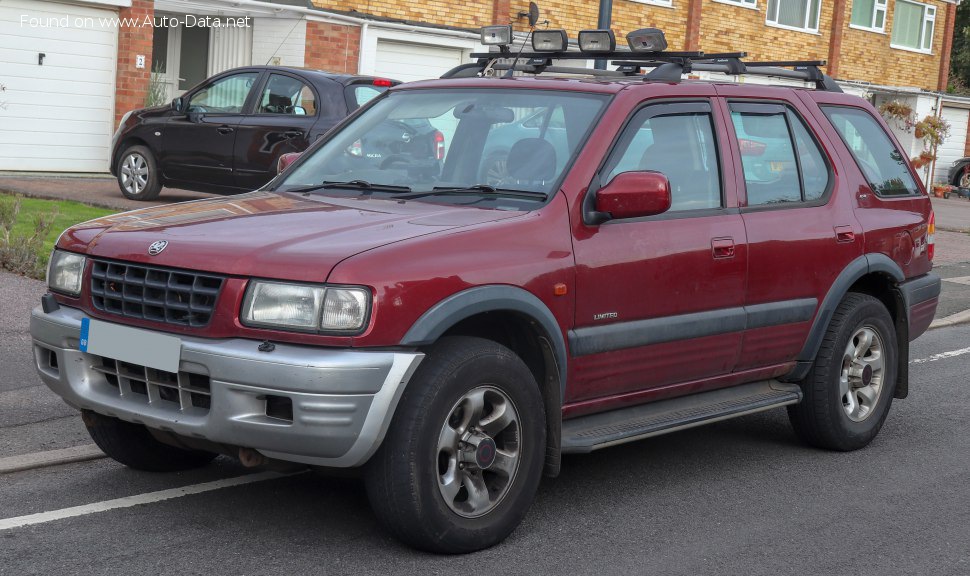
Introduction to the Vauxhall Frontera Mk II Sport 2.5 TD
The Vauxhall Frontera Mk II Sport 2.5 TD represents a notable chapter in the evolution of the compact sport utility vehicle (SUV) market, particularly within the United Kingdom and broader European landscape during the late 1990s. Produced by Vauxhall, the British subsidiary of General Motors, this vehicle was a rebadged version of the Opel Frontera, which itself was based on the Isuzu MU (Mysterious Utility) and Isuzu Wizard platforms sold globally as the Isuzu Rodeo. The Mk II generation, specifically the 3-door “Sport” variant, was introduced in 1996 and remained in production until 1998, offering a more refined and updated package compared to its predecessor.
Positioned as a rugged yet accessible off-roader, the Frontera Mk II Sport aimed to bridge the gap between utilitarian 4x4s and the burgeoning market for more lifestyle-oriented SUVs. This particular model, equipped with the robust 2.5-liter Turbo Diesel engine, was tailored for markets where diesel power offered significant advantages in fuel economy and torque, appealing to both private owners and commercial users. While not sold in the United States under the Vauxhall badge, its underlying Isuzu architecture was familiar to American consumers through the Isuzu Rodeo and Amigo. The Vauxhall Frontera Mk II Sport 2.5 TD was a key player in its segment, offering a compelling blend of four-wheel-drive capability, practical design, and diesel efficiency.
Engine and Performance of the Vauxhall Frontera Mk II Sport 2.5 TD
At the heart of the Vauxhall Frontera Mk II Sport 2.5 TD lay a dependable 2.5-liter (2500 cm3 or 152.56 cu. in.) inline four-cylinder diesel engine, designated by the code VM41B. This powerplant, sourced from VM Motori, was known for its robust construction and strong low-end torque, essential for an SUV designed to tackle varied terrain. The engine featured an Overhead Camshaft (OHC) valvetrain with two valves per cylinder and a high compression ratio of 21:1, characteristic of diesel engines of its era.
Fuel delivery was managed by a Diesel Commonrail injection system, a relatively advanced feature for the time, which contributed to better fuel atomization and efficiency. A turbocharger was employed to boost performance, allowing the engine to produce a healthy 116 horsepower at 3600 rpm. More significantly for an off-road capable vehicle, it generated a substantial 260 Nm (191.77 lb.-ft.) of torque at a low 1800 rpm, providing ample pulling power and making it well-suited for towing or navigating challenging conditions.
Power was sent to all four wheels via a 5-speed manual transmission, offering the driver direct control and a tactile driving experience. This all-wheel-drive (4×4) powertrain architecture ensured confident traction across various surfaces. While not a speed demon, the Frontera Mk II Sport 2.5 TD delivered respectable performance for its class and purpose. It could accelerate from 0 to 60 mph in approximately 15.2 seconds, with a top speed reaching 96.31 mph (155 km/h).
Fuel economy, a crucial factor for diesel vehicles in Europe, was competitive. The urban fuel consumption was rated at 12.8 liters per 100 km (18.4 US mpg), while on the extra-urban cycle, it achieved 8.4 liters per 100 km (28 US mpg). These figures underscored the practicality and cost-effectiveness of the diesel engine, especially for longer journeys. The engine oil capacity was 6.3 liters (6.66 US qt), and the cooling system held 8.8 liters (9.3 US qt) of coolant.
Design and Features
The Vauxhall Frontera Mk II Sport, as its name suggests, was the more compact and sportier 3-door variant of the Frontera lineup. Its body type was a classic SUV, designed for both on-road utility and off-road excursions. With seating for five occupants, it offered a decent balance of passenger space and cargo capacity for its segment. The exterior dimensions were practical for urban maneuvering and trail driving alike: a length of 168.03 inches (4268 mm), a width of 70.35 inches (1787 mm), and a height of 66.61 inches (1692 mm). The wheelbase measured 96.93 inches (2462 mm), contributing to its maneuverability.
Visually, the Mk II Frontera Sport adopted a more rounded and contemporary aesthetic compared to its squarer predecessor, aligning with late 1990s automotive design trends. Despite the modernization, it retained a rugged stance, emphasized by its generous ground clearance and standard 235/70 R16 tires mounted on 6.5J wheel rims, suggesting its capability beyond paved roads.
Inside, the Frontera Mk II Sport offered a functional and straightforward cabin. While not luxurious, it was designed to be durable and practical, suitable for active lifestyles. Cargo versatility was a key strength; the trunk (boot) space ranged from 10.59 cubic feet (300 liters) with all seats in place, expanding significantly to 40.97 cubic feet (1160 liters) when the rear seats were folded, making it capable of carrying substantial gear.
From a chassis perspective, the Frontera Mk II Sport featured a robust setup. The front suspension utilized a torsion bar system, known for its durability and ability to handle rough terrain, while the rear employed coil springs, offering a better compromise between off-road articulation and on-road comfort than traditional leaf springs. Braking power came from disc brakes on both the front and rear wheels, augmented by an Anti-lock Braking System (ABS), a vital safety feature for preventing wheel lock-up under heavy braking. Steering was managed by a worm-reduction unit with hydraulic power steering, providing assisted steering for easier low-speed maneuvers and off-road driving. The vehicle’s kerb weight was 3869.11 lbs (1755 kg), with a maximum permissible weight of 5533.6 lbs (2510 kg), allowing for a maximum load of 1664.49 lbs (755 kg). The fuel tank capacity was 21.13 US gallons (80 liters), providing a decent range between fill-ups.
Technical Specifications
| Category | Specification |
|---|---|
| General Information | |
| Brand | Vauxhall |
| Model | Frontera |
| Generation | Frontera Mk II Sport |
| Engine Type | 2.5 TD (116 Hp) |
| Production Start | 1996 |
| Production End | 1998 |
| Powertrain Architecture | Internal Combustion Engine |
| Body Type | SUV |
| Seats | 5 |
| Doors | 3 |
| Performance Specs | |
| Fuel Consumption (Urban) | 12.8 l/100 km (18.4 US mpg) |
| Fuel Consumption (Extra Urban) | 8.4 l/100 km (28 US mpg) |
| Fuel Type | Diesel |
| Acceleration 0-60 mph | 15.2 seconds |
| Maximum Speed | 96.31 mph (155 km/h) |
| Weight-to-Power Ratio | 15.1 kg/Hp (66.1 Hp/tonne) |
| Weight-to-Torque Ratio | 6.8 kg/Nm (148.1 Nm/tonne) |
| Engine Specs | |
| Power | 116 Hp @ 3600 rpm |
| Power per Liter | 46.4 Hp/l |
| Torque | 260 Nm (191.77 lb.-ft.) @ 1800 rpm |
| Engine Layout | Front, Longitudinal |
| Engine Model/Code | VM41B |
| Engine Displacement | 2500 cm3 (152.56 cu. in.) |
| Number of Cylinders | 4 |
| Engine Configuration | Inline |
| Cylinder Bore | 92 mm (3.62 in.) |
| Piston Stroke | 94 mm (3.7 in.) |
| Compression Ratio | 21:1 |
| Valves per Cylinder | 2 |
| Fuel Injection System | Diesel Commonrail |
| Engine Aspiration | Turbocharger |
| Valvetrain | OHC |
| Engine Oil Capacity | 6.3 l (6.66 US qt) |
| Coolant Capacity | 8.8 l (9.3 US qt) |
| Space, Volume and Weights | |
| Kerb Weight | 1755 kg (3869.11 lbs) |
| Max. Weight | 2510 kg (5533.6 lbs) |
| Max Load | 755 kg (1664.49 lbs) |
| Trunk (boot) Space – Minimum | 300 l (10.59 cu. ft.) |
| Trunk (boot) Space – Maximum | 1160 l (40.97 cu. ft.) |
| Fuel Tank Capacity | 80 l (21.13 US gal) |
| Dimensions | |
| Length | 4268 mm (168.03 in.) |
| Width | 1787 mm (70.35 in.) |
| Height | 1692 mm (66.61 in.) |
| Wheelbase | 2462 mm (96.93 in.) |
| Front Track | 1515 mm (59.65 in.) |
| Rear Track | 1520 mm (59.84 in.) |
| Drivetrain, Brakes and Suspension Specs | |
| Drive Wheel | All-wheel drive (4×4) |
| Number of Gears | 5 |
| Gearbox Type | Manual Transmission |
| Front Suspension | Torsion |
| Rear Suspension | Coil spring |
| Front Brakes | Disc |
| Rear Brakes | Disc |
| Assisting Systems | ABS (Anti-lock braking system) |
| Steering Type | Worm-reduction unit |
| Power Steering | Hydraulic Steering |
| Tires Size | 235/70 R16 |
| Wheel Rims Size | 6.5J |
Legacy and Market Impact of the Vauxhall Frontera Mk II Sport 2.5 TD
The Vauxhall Frontera Mk II Sport 2.5 TD, while a relatively short-lived iteration from 1996 to 1998, played a significant role in the burgeoning SUV market in the United Kingdom and continental Europe. Its legacy is intrinsically linked to the broader success of the Frontera line, which was one of the earliest mainstream SUVs to gain widespread acceptance in European markets, traditionally dominated by smaller sedans and hatchbacks.
In its primary market, the Frontera Mk II Sport 2.5 TD was positioned as a practical and affordable alternative to more expensive, purpose-built off-roaders like the Land Rover Defender or Discovery, and a more rugged option than emerging soft-roaders such as the Toyota RAV4 or Honda CR-V. Its direct competitors included vehicles like the Nissan Terrano II, Suzuki Vitara, and the Ford Maverick (a rebadged Nissan Terrano). What set the Frontera apart was its combination of proven Isuzu mechanicals, a robust diesel engine well-suited to European fuel prices and driving cycles, and a relatively competitive price point.
The 3-door “Sport” designation appealed to younger buyers or those seeking a more compact and nimble vehicle for both urban driving and weekend adventures. The diesel engine, with its strong torque and reasonable fuel economy, made it a popular choice for those who needed to tow or simply preferred the efficiency of diesel power. The Frontera helped to popularize the idea that an SUV could be a family vehicle, a workhorse, and a leisure vehicle all in one package.
Despite its merits, the Frontera series faced criticism over time regarding its on-road refinement compared to more car-like SUVs that emerged later. However, for its era, the Mk II represented a significant improvement in ride quality, interior ergonomics, and overall fit and finish over the first generation. Its robust construction and genuine four-wheel-drive capability ensured it was a credible choice for those needing to venture off the beaten path.
The Vauxhall Frontera Mk II Sport 2.5 TD ultimately paved the way for future generations of SUVs from Vauxhall/Opel and other manufacturers, demonstrating the strong market appetite for versatile, elevated vehicles. While the Frontera nameplate itself was eventually retired in the early 2000s, its contribution to establishing the SUV as a mainstream vehicle type in Europe remains a key part of its historical significance. It served as a testament to the effectiveness of international collaborations (GM, Isuzu, VM Motori) in creating market-relevant vehicles for specific regional demands. Today, surviving examples are appreciated for their straightforward mechanics and enduring off-road capabilities, representing a bygone era of more utilitarian SUVs before the segment fully embraced car-based platforms and urban-centric designs.