The Peugeot 3008 I (Phase II, 2013): A European Crossover’s Evolution
The
Peugeot 3008 I (Phase II, 2013)
represents a significant offering from the French automaker in the highly competitive European compact crossover segment. Unveiled as a facelift to the first-generation 3008, which originally debuted in 2008, this updated model aimed to refresh its appeal and keep pace with evolving consumer demands and tighter emission standards. Positioned as a versatile vehicle blending attributes of an SUV, an MPV (Multi-Purpose Vehicle), and a hatchback, the 3008 was a pivotal model for Peugeot, showcasing its commitment to practical, family-oriented transport with a touch of French flair. While Peugeot does not officially sell new vehicles in the United States market, the 3008’s design philosophy, engineering, and market impact provide valuable insights into global automotive trends and the brand’s strategic direction in its primary European and Asian markets. The Phase II refresh, produced from 2013 to 2015, brought subtle yet effective enhancements to its styling, features, and overall refinement, particularly evident in models equipped with the efficient 1.6 THP (Turbo High Pressure) gasoline engine.
This iteration of the 3008 was designed to offer a compelling package of elevated driving position, flexible interior space, and a comfortable ride, making it a popular choice for families and individuals seeking a versatile daily driver. Its architecture, shared with other PSA Group models of the era, emphasized front-wheel-drive efficiency and a balanced chassis setup.
Engine & Performance: The Robust 1.6 THP (156 Hp) Powertrain
At the heart of the
Peugeot 3008 I (Phase II, 2013)
featured here is the highly regarded 1.6 THP (Turbo High Pressure) gasoline engine, delivering a respectable 156 horsepower at 6000 rpm. This four-cylinder, inline engine, with a displacement of 1598 cubic centimeters (approximately 1.6 liters), was a product of collaboration between PSA Peugeot Citroën and BMW, known for its blend of performance and efficiency. Employing direct fuel injection and a turbocharger with an intercooler, the engine produces a robust 177.01 lb.-ft. of torque from a remarkably low 1400 rpm. This low-end torque characteristic is crucial for a crossover, providing excellent responsiveness in urban driving and strong acceleration when needed.
Paired with a precise 6-speed manual transmission, this powertrain sends power to the front wheels, a common configuration for European compact crossovers prioritizing fuel economy and packaging efficiency over off-road capability. The performance figures for this setup are quite competitive for its segment and era: the 3008 can accelerate from 0 to 60 mph in a swift 8.5 seconds, and reach a top speed of 125.52 mph.
Despite its spirited performance, the 1.6 THP engine in the 3008 I (Phase II) also demonstrated commendable fuel economy. The combined fuel consumption is rated at an impressive 34.1 US mpg, with urban figures around 25.3 US mpg and extra-urban figures reaching 42.8 US mpg. These numbers highlight the engine’s efficiency, aided by its advanced technology and the vehicle’s relatively aerodynamic design for an SUV. With CO2 emissions of 159 g/km, the vehicle met the Euro 5 emission standard, reflecting a commitment to environmental responsibility that was becoming increasingly important in the European market. The engine’s layout is front-transverse, optimizing space and contributing to the vehicle’s balanced weight distribution and handling characteristics.
Design & Features: Blending Practicality with Modern Aesthetics
The
Peugeot 3008 I (Phase II, 2013)
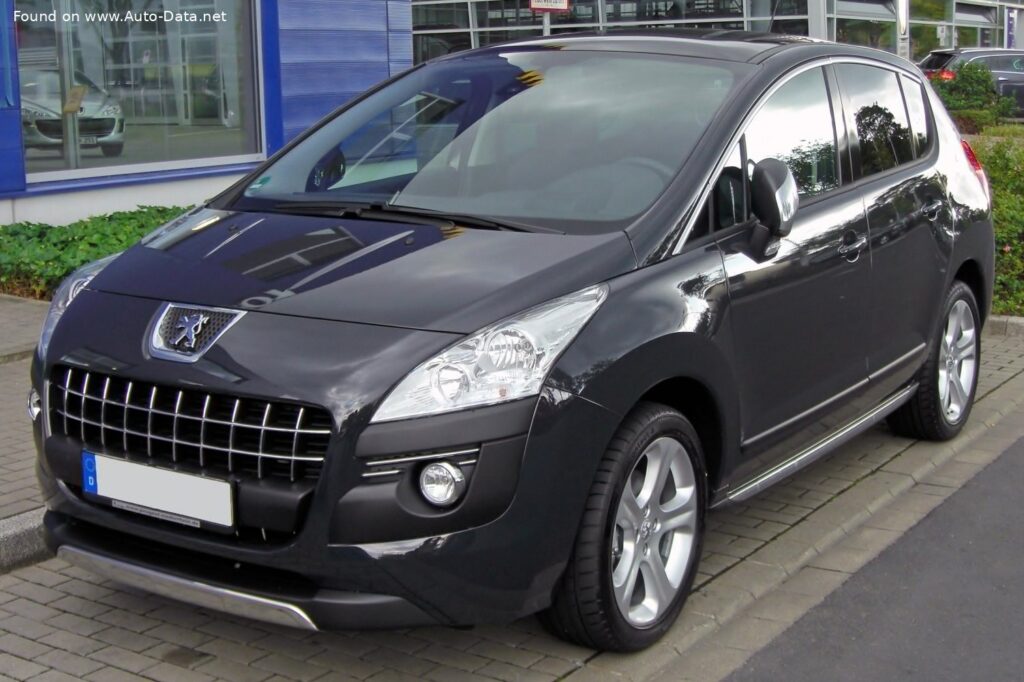
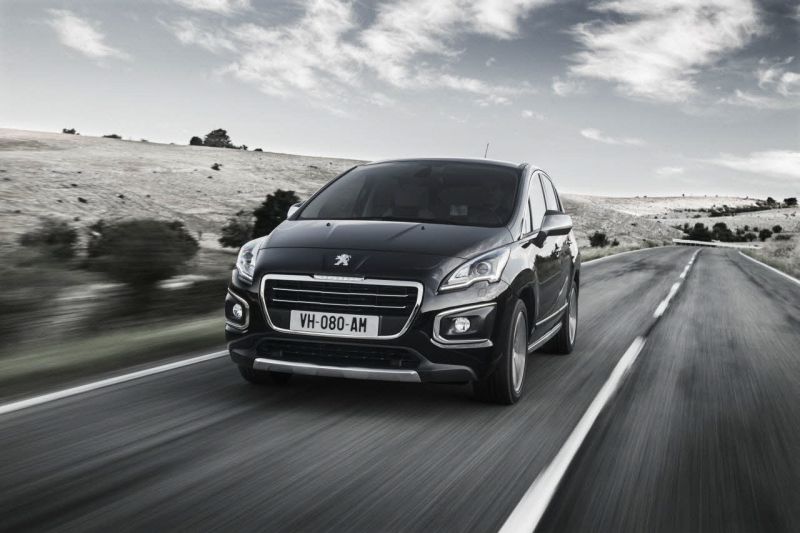
retained the unique crossover silhouette of its predecessor but introduced a refreshed aesthetic that aligned it with Peugeot’s contemporary design language. The front fascia received the most significant updates, featuring a redesigned grille that was more upright and prominent, new headlights with integrated LED daytime running lights, and revised bumper styling. These changes gave the 3008 a more assertive and modern appearance, moving it slightly away from its initial MPV-like styling towards a more SUV-inspired look.
Measuring 171.85 inches in length, 72.32 inches in width (excluding mirrors), and 64.37 inches in height, the 3008 offers a substantial road presence without being overly bulky, making it maneuverable in tight European city streets. The 102.87-inch wheelbase contributes to a stable ride and generous interior space for five occupants across its five doors. The interior was praised for its quality materials and ergonomic layout, featuring a cockpit-like driver’s area with an elevated center console.
Practicality was a cornerstone of the 3008’s design. The SUV body type provided an elevated driving position, offering improved visibility. Its cargo capacity was particularly impressive for its class, with a minimum trunk space of 18.08 cubic feet, which could expand to a cavernous 56.64 cubic feet with the rear seats folded down. This flexibility made it ideal for families and those needing ample luggage space. Standard features for the era included power steering with rack and pinion setup, an Anti-lock Braking System (ABS) for enhanced safety, and a choice of 17 or 18-inch wheels with corresponding tire sizes (225/50 R17 or 235/45 R18). The suspension system, featuring independent McPherson struts with coil springs and an anti-roll bar at the front, and independent coil springs at the rear, was tuned for a comfortable yet controlled ride, characteristic of European vehicles. Braking was handled by ventilated discs at the front and solid discs at the rear, ensuring confident stopping power.
Technical Specifications: Peugeot 3008 I (Phase II, 2013) 1.6 THP (156 Hp)
| Category | Specification |
|---|---|
| Brand | Peugeot |
| Model | 3008 |
| Generation | 3008 I (Phase II, 2013) |
| Type (Engine) | 1.6 THP (156 Hp) |
| Start of Production | 2013 year |
| End of Production | 2015 year |
| Powertrain Architecture | Internal Combustion engine |
| Body type | SUV |
| Seats | 5 |
| Doors | 5 |
|
Performance Specs |
|
| Fuel consumption (economy) – urban | 9.3 l/100 km (25.3 US mpg) |
| Fuel consumption (economy) – extra urban | 5.5 l/100 km (42.8 US mpg) |
| Fuel consumption (economy) – combined | 6.9 l/100 km (34.1 US mpg) |
| CO2 emissions | 159 g/km |
| Fuel Type | Petrol (Gasoline) |
| Acceleration 0 – 60 mph | 8.5 sec |
| Maximum speed | 202 km/h (125.52 mph) |
| Emission standard | Euro 5 |
| Weight-to-power ratio | 9.4 kg/Hp (106.9 Hp/tonne) |
| Weight-to-torque ratio | 6.1 kg/Nm (164.5 Nm/tonne) |
|
Engine Specs |
|
| Power | 156 Hp @ 6000 rpm |
| Power per liter | 97.6 Hp/l |
| Torque | 240 Nm @ 1400 rpm (177.01 lb.-ft. @ 1400 rpm) |
| Engine layout | Front, Transverse |
| Engine Model/Code | 5FM EP6CDTM |
| Engine displacement | 1598 cm3 (97.52 cu. in.) |
| Number of cylinders | 4 |
| Engine configuration | Inline |
| Number of valves per cylinder | 4 |
| Fuel injection system | Direct injection |
| Engine aspiration | Turbocharger, Intercooler |
| Engine oil capacity | 4.25 l (4.49 US qt) |
| Coolant | 6.2 l (6.55 US qt) |
|
Space, Volume and Weights |
|
| Kerb Weight | 1459 kg (3216.54 lbs) |
| Max. weight | 2020 kg (4453.34 lbs) |
| Max load | 561 kg (1236.79 lbs) |
| Trunk (boot) space – minimum | 512 l (18.08 cu. ft.) |
| Trunk (boot) space – maximum | 1604 l (56.64 cu. ft.) |
| Fuel tank capacity | 60 l (15.85 US gal) |
|
Dimensions |
|
| Length | 4365 mm (171.85 in.) |
| Width | 1837 mm (72.32 in.) |
| Width with mirrors folded | 1910 mm (75.2 in.) |
| Width including mirrors | 2113 mm (83.19 in.) |
| Height | 1635 mm (64.37 in.) |
| Wheelbase | 2613 mm (102.87 in.) |
| Front overhang | 916 mm (36.06 in.) |
| Rear overhang | 836 mm (32.91 in.) |
| Minimum turning circle (turning diameter) | 10.9 m (35.76 ft.) |
|
Drivetrain, Brakes and Suspension Specs |
|
| Drivetrain Architecture | The Internal combustion engine (ICE) drives the front wheels of the vehicle. |
| Drive wheel | Front wheel drive |
| Number of gears and type of gearbox | 6 gears, manual transmission |
| Front suspension | Independent, type McPherson with coil spring and anti-roll bar |
| Rear suspension | Independent coil spring |
| Front brakes | Ventilated discs |
| Rear brakes | Disc |
| Assisting systems | ABS (Anti-lock braking system) |
| Steering type | Steering rack and pinion |
| Tires size | 225/50 R17; 235/45 R18 |
| Wheel rims size | 17; 18 |
Legacy & Market Impact of the Peugeot 3008 I (Phase II, 2013)
The
Peugeot 3008 I (Phase II, 2013)
played a crucial role in cementing Peugeot’s position in the burgeoning compact crossover segment, particularly across Europe. When it first launched, the 3008 was a somewhat unconventional design, blending elements of an SUV, an MPV, and even a large hatchback. This unique approach, initially met with mixed reactions, ultimately proved successful in attracting buyers looking for versatility and a distinctive appearance. The Phase II facelift helped refine this vision, making the vehicle more visually cohesive and contemporary in an increasingly crowded market.
In its primary markets, the 3008 competed against established rivals such as the Nissan Qashqai, Volkswagen Tiguan, Ford Kuga (Escape in North America), and Renault Kadjar. Its strengths lay in its comfortable ride, practical and flexible interior, and the efficiency of its powertrain options, particularly the 1.6 THP gasoline engine, which offered a compelling balance of performance and fuel economy for everyday use. The elevated driving position and generous trunk space made it a favorite among families, while its relatively compact exterior dimensions ensured it remained manageable in urban environments.
The reputation of the first-generation 3008, including its Phase II update, was generally positive, with owners appreciating its refinement and value proposition. It was seen as a dependable and comfortable vehicle, if not the most dynamically engaging in its class. However, its success paved the way for a dramatic shift in Peugeot’s design philosophy for its successor. The second-generation 3008, launched in 2016, embraced a much more conventional and overtly SUV-like design, which garnered widespread critical acclaim and numerous awards, including European Car of the Year. This success was built on the foundation laid by the first generation, demonstrating Peugeot’s ability to adapt and innovate in response to market demands.
Ultimately, the Peugeot 3008 I (Phase II, 2013) stands as an important transitional model for the brand. It represented a mature and refined version of Peugeot’s initial foray into the crossover segment, showcasing a practical, efficient, and well-appointed vehicle that resonated with European consumers. While it never graced American showrooms, its engineering and market performance offer a clear picture of Peugeot’s capabilities and its strategic positioning within the global automotive landscape during the early to mid-2010s. It remains a testament to Peugeot’s commitment to offering diverse and compelling vehicles tailored to the specific needs of its target markets.