
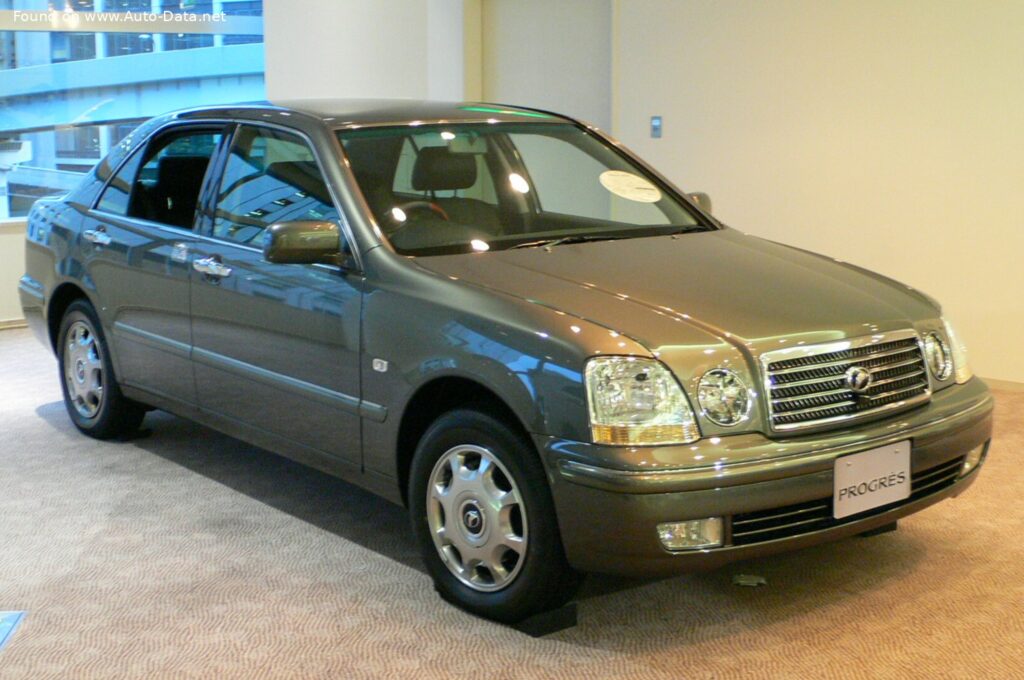
The Toyota Progres 3.0 i 24V: A Japanese Domestic Market Luxury Sedan
The Toyota Progres, specifically the 3.0 i 24V variant, represents a fascinating chapter in Toyota’s history of crafting sophisticated, high-quality luxury sedans for its discerning domestic market. Launched in 1998, the Progres (a portmanteau of “progress” and “progrès” in French) was positioned as a compact yet premium executive sedan, designed to offer a blend of traditional Japanese luxury, advanced technology, and exceptional refinement in a relatively modest footprint. While never officially sold in the United States, the Progres embodied Toyota’s engineering prowess and commitment to comfort, aiming to attract older, affluent buyers seeking an understated yet thoroughly capable vehicle. It served as a spiritual successor to earlier compact luxury efforts and shared some underpinnings with other prominent Toyota and Lexus models of the era, though it carved out its own niche with a focus on interior comfort and a smooth, serene driving experience.
Engine & Performance: The Silken Inline-Six of the Toyota Progres 3.0 i 24V
At the heart of the Toyota Progres 3.0 i 24V lies a highly respected powertrain: Toyota’s 2JZ-GE 3.0-liter inline-six engine. This naturally aspirated, 24-valve DOHC (Double Overhead Camshaft) unit was renowned for its buttery-smooth operation, robust reliability, and linear power delivery. Generating a respectable 215 horsepower at 5800 rpm and 216.84 lb.-ft. of torque at 3800 rpm, the engine provided ample motivation for the Progres. Its multi-port manifold injection system ensured precise fuel delivery, contributing to both responsiveness and efficiency for its class.
The engine’s configuration, a front-longitudinal layout, paired with a rear-wheel-drive architecture, underscored its luxury sedan aspirations, offering a balanced feel and a traditional driving dynamic preferred by many luxury buyers. Power was managed through a smooth-shifting 4-speed automatic transmission, prioritizing comfort and seamless transitions over aggressive sportiness. While the Progres 3.0 i 24V was not engineered for outright speed, its maximum velocity of 111.85 mph was more than adequate for its intended use on Japanese highways. The vehicle’s weight-to-power ratio of 7.1 kg/Hp (or 141.4 Hp/tonne) indicated a solid, if not exhilarating, performance profile, emphasizing its role as a refined cruiser. Fuel economy, while not a primary selling point for luxury vehicles of this era, was reasonable for a 3.0-liter engine, with an estimated 16.8 US mpg in urban driving and 26.1 US mpg on the highway. This combination of a potent yet refined engine and a well-matched transmission created a driving experience characterized by quiet competence and effortless progress, perfectly aligning with the car’s name.
Design & Features: Understated Elegance and Japanese Craftsmanship
The design of the Toyota Progres was deliberately conservative and elegant, reflecting the tastes of its target demographic. As a four-door, five-seat sedan, its exterior styling was clean and unpretentious, eschewing flashy chrome or aggressive lines for a timeless, dignified appearance. With a length of 177.56 inches, a width of 66.93 inches, and a height of 56.5 inches, the Progres was classified as a compact luxury sedan, making it maneuverable in Japan’s often-crowded urban environments while still offering a substantial road presence. The 109.45-inch wheelbase contributed to a stable ride and a surprisingly spacious cabin for its exterior dimensions.
Inside, the Progres prioritized comfort and convenience. While specific interior features are not detailed in the data, vehicles in this segment from Toyota typically boasted high-quality materials, excellent fit and finish, and a wealth of standard amenities. Expect features such as automatic climate control, premium audio systems, power-adjustable seating, and refined wood or metallic trim accents. The trunk space of 14.83 cu. ft. offered practical utility for daily use or weekend getaways. Safety was also a consideration, with the Progres featuring an Anti-lock Braking System (ABS) as standard, a crucial safety feature for preventing wheel lock-up during hard braking. The suspension system, featuring double wishbones at both the front and rear, was tuned for a compliant and comfortable ride, effectively absorbing road imperfections. Steering was handled by a hydraulic rack and pinion system, providing direct feedback and ease of maneuverability. The 195/65 R15 tires were chosen to complement the car’s comfort-oriented dynamics, offering a good balance of grip and ride quality.
Technical Specifications: Toyota Progres 3.0 i 24V (215 Hp)
| Category | Specification |
|---|---|
| General Information | |
| Brand | Toyota |
| Model | Progres |
| Generation | Progres |
| Type (Engine) | 3.0 i 24V (215 Hp) |
| Start of Production | 1998 year |
| End of Production | 2007 year |
| Powertrain Architecture | Internal Combustion engine |
| Body type | Sedan |
| Seats | 5 |
| Doors | 4 |
| Performance Specs | |
| Fuel Consumption (Urban) | 16.8 US mpg (14 l/100 km) |
| Fuel Consumption (Extra Urban) | 26.1 US mpg (9 l/100 km) |
| Fuel Type | Petrol (Gasoline) |
| Maximum Speed | 111.85 mph (180 km/h) |
| Weight-to-Power Ratio | 7.1 kg/Hp, 141.4 Hp/tonne |
| Weight-to-Torque Ratio | 5.2 kg/Nm, 193.4 Nm/tonne |
| Engine Specs | |
| Power | 215 Hp @ 5800 rpm |
| Power per Liter | 71.7 Hp/l |
| Torque | 216.84 lb.-ft. @ 3800 rpm (294 Nm) |
| Engine Layout | Front, Longitudinal |
| Engine Displacement | 3.0 liters (2997 cm3, 182.89 cu. in.) |
| Number of Cylinders | 6 |
| Engine Configuration | Inline |
| Cylinder Bore | 3.39 in. (86 mm) |
| Piston Stroke | 3.39 in. (86 mm) |
| Compression Ratio | 10.5:1 |
| Number of Valves per Cylinder | 4 |
| Fuel Injection System | Multi-port manifold injection |
| Engine Aspiration | Naturally aspirated engine |
| Valvetrain | DOHC |
| Space, Volume and Weights | |
| Kerb Weight | 3351.03 lbs (1520 kg) |
| Max. Weight | 3957.3 lbs (1795 kg) |
| Max Load | 606.27 lbs (275 kg) |
| Trunk (Boot) Space – Minimum | 14.83 cu. ft. (420 l) |
| Fuel Tank Capacity | 18.49 US gal (70 l) |
| Dimensions | |
| Length | 177.56 in. (4510 mm) |
| Width | 66.93 in. (1700 mm) |
| Height | 56.5 in. (1435 mm) |
| Wheelbase | 109.45 in. (2780 mm) |
| Front Track | 58.07 in. (1475 mm) |
| Rear (Back) Track | 57.48 in. (1460 mm) |
| Drivetrain, Brakes and Suspension Specs | |
| Drivetrain Architecture | The Internal combustion engine (ICE) drives the rear wheels of the vehicle. |
| Drive Wheel | Rear wheel drive |
| Number of Gears and Type of Gearbox | 4 gears, automatic transmission |
| Front Suspension | Double wishbone |
| Rear Suspension | Double wishbone |
| Front Brakes | Ventilated discs |
| Rear Brakes | Disc |
| Assisting Systems | ABS (Anti-lock braking system) |
| Steering Type | Steering rack and pinion |
| Power Steering | Hydraulic Steering |
| Tires Size | 195/65 R15 |
Legacy & Market Impact of the Toyota Progres
The Toyota Progres carved out a distinctive niche within the highly competitive Japanese luxury car market during its production run from 1998 to 2007. It was positioned strategically by Toyota, slotting below the larger, more overtly luxurious Crown and Celsior (the Japanese market Lexus LS) but above mainstream sedans like the Camry. Its primary competition came from other domestic market luxury offerings, such as the Nissan Cima (Infiniti Q45 in some markets) and Cedric/Gloria, as well as the Honda Inspire/Saber. Unlike some of its rivals that occasionally pursued sportier pretensions, the Progres remained steadfast in its mission to deliver a supremely comfortable, quiet, and refined experience.
Its emphasis on interior quality, a plush ride, and an effortlessly smooth powertrain resonated with a specific demographic in Japan: buyers who valued discretion, reliability, and sophisticated engineering over flashy aesthetics or aggressive performance. The Progres was often seen as a car for the discerning individual who appreciated subtle luxury and advanced technology without needing to flaunt it. Its relatively compact dimensions, especially its sub-1.7-meter width, also made it attractive in a market where vehicle size could impact road tax and parking availability, though the Progres was still a substantial vehicle.
The Progres also played a role in showcasing Toyota’s ability to engineer high-end luxury features and integrate them into a smaller package. While it never achieved the global recognition of its Lexus counterparts, its influence can be seen in the continued refinement of Toyota’s domestic luxury offerings. Today, the Toyota Progres remains a sought-after used vehicle for enthusiasts in Japan and other right-hand-drive markets who appreciate its enduring quality, comfortable ride, and the robust nature of its 2JZ engine. Its legacy is one of quiet competence and a testament to Toyota’s deep understanding of its domestic luxury segment, proving that true luxury doesn’t always need to be the largest or most ostentatious vehicle on the road. For the international automotive expert, the Progres serves as an excellent example of a tailored market approach, where specific regional preferences dictate design and engineering priorities, resulting in a unique and memorable vehicle.

