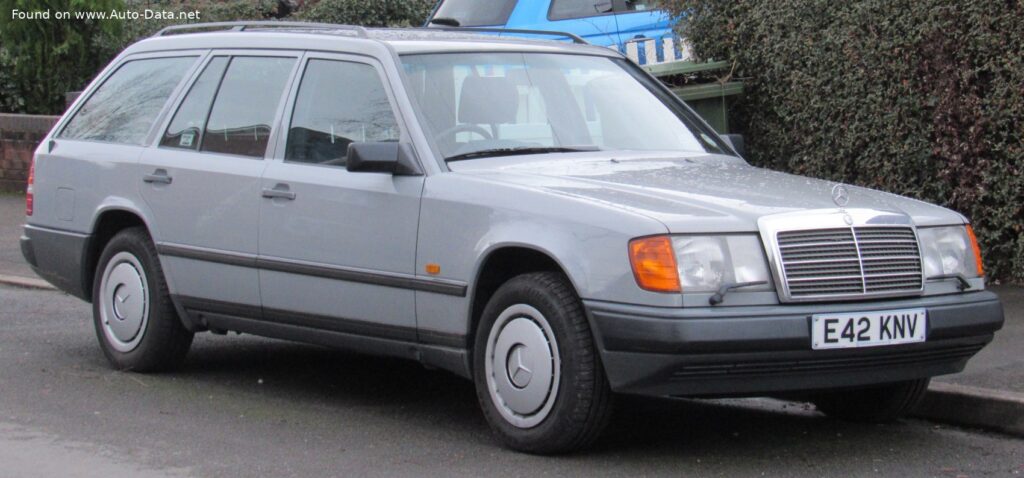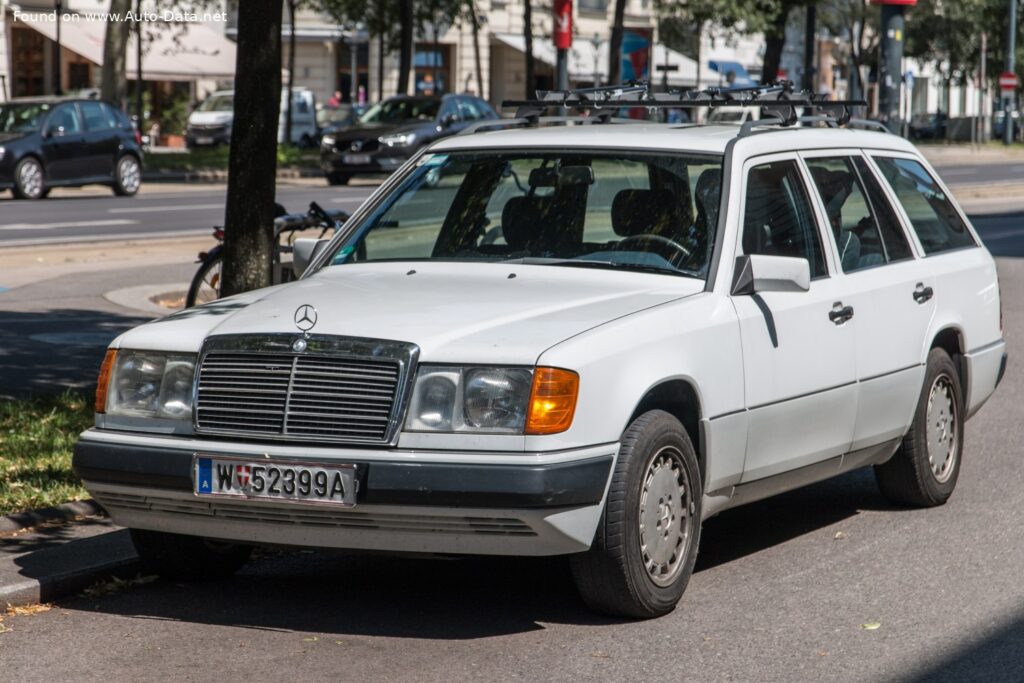
The Enduring Elegance: Mercedes-Benz S124 (facelift 1989) 300 TE (180 Hp) Automatic
The Mercedes-Benz W124 series, produced from 1984 to 1995, stands as a testament to German engineering prowess and timeless design. Among its various body styles, the S124 station wagon (or “estate” as it’s known in Europe) holds a special place, combining the W124’s legendary durability and refined driving dynamics with unparalleled practicality. This article focuses on the Mercedes-Benz S124 (facelift 1989) 300 TE (180 Hp) Automatic, a prime example of Mercedes-Benz’s commitment to quality and innovation during the late 1980s and early 1990s. Introduced in September 1989 as part of a significant mid-cycle refresh, this model represented the pinnacle of the W124 wagon’s development before the subsequent E-Class rebadging. It carved out a niche in the executive segment, offering a compelling blend of performance, luxury, and utility that few rivals could match.
The W124 generation, known for its “over-engineered” reputation, cemented Mercedes-Benz’s status as a leader in automotive safety and reliability. The S124 variant, in particular, provided a spacious and versatile platform, making it a popular choice for families and professionals alike across North America and Europe. The 300 TE, with its robust inline-six engine and smooth automatic transmission, embodied the sophisticated yet understated luxury that defined Mercedes-Benz vehicles of this era.
Engine and Performance: The Heart of the Mercedes-Benz S124 (facelift 1989) 300 TE
At the core of the Mercedes-Benz S124 (facelift 1989) 300 TE (180 Hp) Automatic lies the venerable M 103 E 30 engine, also known by its code 103.983. This naturally aspirated, 3.0-liter (2960 cm³) inline-six engine was a hallmark of Mercedes-Benz engineering during this period, renowned for its silky-smooth operation, robust construction, and impressive longevity. The engine featured a Single Overhead Camshaft (SOHC) valvetrain with two valves per cylinder, fed by a multi-port manifold injection system, ensuring efficient fuel delivery and consistent performance.
The M 103 E 30 engine in the 300 TE produced a healthy 180 horsepower at 5700 rpm, translating to a power-per-liter output of 60.8 horsepower per liter. Torque was equally impressive for its time, peaking at 188.08 lb-ft (255 Nm) at 4400 rpm. This power and torque combination, coupled with a kerb weight of 3373.07 lbs (1530 kg), resulted in a respectable weight-to-power ratio of 8.5 kg per horsepower and a weight-to-torque ratio of 6 kg per Nm.
Power was delivered to the rear wheels via a smooth-shifting 4-speed automatic transmission, a common and reliable choice for Mercedes-Benz models of this vintage. This powertrain allowed the 300 TE to accelerate from 0 to 60 mph in a brisk 8.6 seconds, with a top speed of 128.62 mph (207 km/h). While not a sports car, these figures were highly competitive for a luxury station wagon of its size and class, offering confident highway cruising and effortless overtaking. Fuel economy, while not a primary concern for buyers of this segment at the time, was reasonable, with an estimated 17 US mpg in urban driving and 25 US mpg on the highway. The 19.02 US gallon (72-liter) fuel tank provided a substantial cruising range.
Design and Features: The Practical Elegance of the S124 Wagon
The design of the Mercedes-Benz S124 (facelift 1989) 300 TE (180 Hp) Automatic is a study in functional elegance. As a 5-door, 5-seat station wagon, it offered immense practicality without compromising on the W124’s distinctive, understated aesthetic. The facelift in 1989 brought subtle but important refinements, including body-colored side cladding (often referred to as “Sacco panels” after their designer, Bruno Sacco), which gave the car a more cohesive and modern appearance. The overall silhouette remained clean, angular, and aerodynamic for its era, contributing to stability at speed and reduced wind noise.
Measuring 187.6 inches in length, 68.5 inches in width, and 58.62 inches in height, with a generous 110.24-inch wheelbase, the S124 wagon provided ample interior space for passengers and cargo. The rear cargo area was particularly versatile, often featuring an optional rear-facing third-row seat, transforming it into a 7-seater for occasional use – a highly desirable feature for families. The build quality was exceptional, with tight panel gaps, high-quality materials, and a sense of solidity that has become legendary.
In terms of chassis and safety, the S124 300 TE was well-appointed. It featured an advanced independent multi-link rear suspension, a Mercedes-Benz innovation that provided a superb balance of ride comfort and handling stability. The front suspension utilized a wishbone design. Stopping power came from ventilated disc brakes at the front and disc brakes at the rear, augmented by an Anti-lock Braking System (ABS) as standard, a crucial safety feature for the time. Steering was a hydraulic power-assisted cone worm with recirculation balls system, offering precise control and a comfortable feel. The car rode on 195/65 R15 tires mounted on 6.5J x 15-inch wheels, providing a compliant ride and predictable handling.
Technical Specifications: Mercedes-Benz S124 (facelift 1989) 300 TE (180 Hp) Automatic
| General Information | |
|---|---|
| Brand | Mercedes-Benz |
| Model | W124 |
| Generation | S124 (facelift 1989) |
| Type (Engine) | 300 TE (180 Hp) Automatic |
| Start of Production | September, 1989 |
| End of Production | October, 1992 |
| Powertrain Architecture | Internal Combustion engine |
| Body Type | Station wagon (estate) |
| Seats | 5 |
| Doors | 5 |
| Performance Specs | |
| Fuel consumption (economy) – urban | 13.8 l/100 km (17 US mpg) |
| Fuel consumption (economy) – extra urban | 9.4 l/100 km (25 US mpg) |
| Fuel Type | Petrol (Gasoline) |
| Acceleration 0 – 60 mph | 8.6 sec |
| Acceleration 0 – 100 km/h | 9.1 sec |
| Maximum Speed | 207 km/h (128.62 mph) |
| Weight-to-power ratio | 8.5 kg/Hp (117.6 Hp/tonne) |
| Weight-to-torque ratio | 6 kg/Nm (166.7 Nm/tonne) |
| Engine Specs | |
| Power | 180 Hp @ 5700 rpm |
| Power per liter | 60.8 Hp/l |
| Torque | 255 Nm @ 4400 rpm (188.08 lb.-ft. @ 4400 rpm) |
| Engine Layout | Front, Longitudinal |
| Engine Model/Code | M 103 E 30 / 103.983 |
| Engine Displacement | 2960 cm³ (3.0 l, 180.63 cu. in.) |
| Number of Cylinders | 6 |
| Engine Configuration | Inline |
| Cylinder Bore | 88.49 mm (3.48 in.) |
| Piston Stroke | 80.2 mm (3.16 in.) |
| Compression Ratio | 9.2:1 |
| Number of Valves per Cylinder | 2 |
| Fuel Injection System | Multi-port manifold injection |
| Engine Aspiration | Naturally aspirated engine |
| Valvetrain | SOHC |
| Engine Oil Capacity | 6.5 l (6.87 US qt) |
| Coolant Capacity | 9 l (9.51 US qt) |
| Space, Volume and Weights | |
| Kerb Weight | 1530 kg (3373.07 lbs) |
| Max. Weight | 2120 kg (4673.8 lbs) |
| Max Load | 590 kg (1300.73 lbs) |
| Fuel Tank Capacity | 72 l (19.02 US gal) |
| Dimensions | |
| Length | 4765 mm (187.6 in.) |
| Width | 1740 mm (68.5 in.) |
| Height | 1489 mm (58.62 in.) |
| Wheelbase | 2800 mm (110.24 in.) |
| Front Track | 1497 mm (58.94 in.) |
| Rear (Back) Track | 1497 mm (58.94 in.) |
| Drivetrain, Brakes and Suspension Specs | |
| Drivetrain Architecture | The Internal combustion engine (ICE) drives the rear wheels of the vehicle. |
| Drive Wheel | Rear wheel drive |
| Number of Gears and Type of Gearbox | 4 gears, automatic transmission |
| Front Suspension | Wishbone |
| Rear Suspension | Independent multi-link suspension |
| Front Brakes | Ventilated discs |
| Rear Brakes | Disc |
| Assisting Systems | ABS (Anti-lock braking system) |
| Steering Type | Cone worm with recirculation balls |
| Power Steering | Hydraulic Steering |
| Tires Size | Front wheel tires: 195/65 R15 Rear wheel tires: 195/65 R15 |
| Wheel Rims Size | Front wheel rims: 6.5J x 15 Rear wheel rims: 6.5J x 15 |
Legacy and Market Impact of the Mercedes-Benz S124
The Mercedes-Benz W124 series, and particularly the S124 station wagon, enjoys an almost legendary status in the automotive world. Its reputation for uncompromising build quality, exceptional durability, and sophisticated engineering has only grown stronger with time. The Mercedes-Benz S124 (facelift 1989) 300 TE (180 Hp) Automatic, produced between September 1989 and October 1992, represents a sweet spot in the W124’s production run, incorporating the visual and mechanical updates of the facelift while retaining the classic W124 character.
In its primary markets, including the United States and Europe, the S124 300 TE competed directly with vehicles such as the BMW 5-Series Touring (E34 generation) and the Audi 100 Avant. While BMW offered a sportier driving experience and Audi emphasized quattro all-wheel drive, the Mercedes-Benz stood out for its serene ride, unmatched solidity, and practical luxury. It was the choice for discerning buyers who valued comfort, reliability, and conservative elegance over outright sportiness. The ability of the S124 to effortlessly cover long distances with a full complement of passengers and luggage, all while maintaining a composed demeanor, was a key selling point.
The W124, in general, is often cited as the last “over-engineered” Mercedes-Benz, a car built to an incredibly high standard regardless of cost, a philosophy that some argue began to wane in subsequent generations. This has contributed to its enduring appeal on the used car market, where well-maintained examples command strong prices and are cherished by enthusiasts. Many W124s, including the 300 TE, are still in regular use today, often having accumulated hundreds of thousands of miles, a testament to their inherent robustness.
The legacy of the Mercedes-Benz S124 (facelift 1989) 300 TE (180 Hp) Automatic is one of quiet competence and lasting quality. It represents an era when Mercedes-Benz prioritized engineering excellence and longevity, creating vehicles that were not just modes of transport but investments in reliable, comfortable, and prestigious motoring. Its classic lines, refined inline-six engine, and practical wagon body style ensure its place as a desirable classic, embodying the very best of Mercedes-Benz’s golden age.