The Renault Clio V (Phase I) E-TECH 1.6 (140 Hp) Hybrid Multi-Mode: A European Hybrid Pioneer
The Renault Clio V (Phase I) E-TECH 1.6 (140 Hp) Hybrid Multi-Mode represents a significant milestone in the evolution of Renault’s highly successful Clio series, particularly within the competitive European B-segment (subcompact) hatchback market. Launched in July 2020 and produced through January 2022, this specific iteration of the fifth-generation Clio was at the forefront of bringing advanced full-hybrid electric vehicle (FHEV) technology to the mass market. As one of Europe’s best-selling vehicles for decades, the Clio’s adoption of hybrid power underscored Renault’s commitment to efficiency, reduced emissions, and innovative powertrain solutions, making sophisticated hybrid technology accessible to a broader consumer base.
The Clio V E-TECH distinguished itself by offering a compelling blend of traditional internal combustion engine reliability with the ecological and economic benefits of electric propulsion. Its “Phase I” designation refers to the initial production run of the fifth generation, which introduced a fresh design language and a host of technological upgrades over its predecessors. While not sold in the United States, the Clio’s impact in its primary European and other international markets cannot be overstated, setting benchmarks for fuel efficiency and low CO2 emissions in its class. This article delves into the technical prowess, design philosophy, and market influence of this pivotal model.
Engine and Performance of the Renault Clio V (Phase I) E-TECH 1.6 (140 Hp) Hybrid Multi-Mode
Innovative E-TECH Powertrain
At the heart of the Renault Clio V (Phase I) E-TECH 1.6 (140 Hp) Hybrid Multi-Mode lies its highly innovative E-TECH powertrain, a full-hybrid system engineered for optimal efficiency and responsive performance. This FHEV architecture combines a 1.6-liter (1598 cm³) naturally aspirated inline-four gasoline engine with an electric motor, delivering a combined system output of 140 horsepower. The internal combustion engine itself contributes 91 HP and 106.21 lb-ft of torque at 3200 rpm, featuring a multi-port manifold injection system and a 4-valve per cylinder configuration, ensuring a balance of power and refinement.
The electric motor, integrated into the transmission, is a substantial contributor to the system’s performance, providing 69 HP and an impressive 151.2 lb-ft of torque. This powerful electric motor allows the Clio E-TECH to operate in full electric mode for significant periods, particularly in urban environments, contributing to its exceptional fuel economy. The hybrid system is managed by a unique Multi-Mode automatic transmission, a clutchless design inspired by Renault’s Formula 1 expertise. This innovative gearbox seamlessly switches between electric, hybrid, and engine-only modes, optimizing power delivery and efficiency without driver intervention. The system also incorporates a Start & Stop system to further conserve fuel and reduce emissions during idle periods.
Performance figures for the Clio E-TECH are competitive within its segment, with an acceleration time of 0-60 mph in 9.4 seconds and a top speed of 111.85 mph (180 km/h). However, its primary focus is on efficiency. The car boasts a remarkable combined fuel consumption (WLTP) of 4.3 liters per 100 kilometers, translating to an impressive 54.7 US mpg. This efficiency is further highlighted by its low CO2 emissions of 98 g/km (WLTP), meeting the stringent Euro 6 emission standard. The 1.2 kWh gross battery capacity and 230V battery voltage enable substantial electric-only driving, particularly beneficial for city commuting.
Design and Features
Modern Hatchback Aesthetics and Practicality
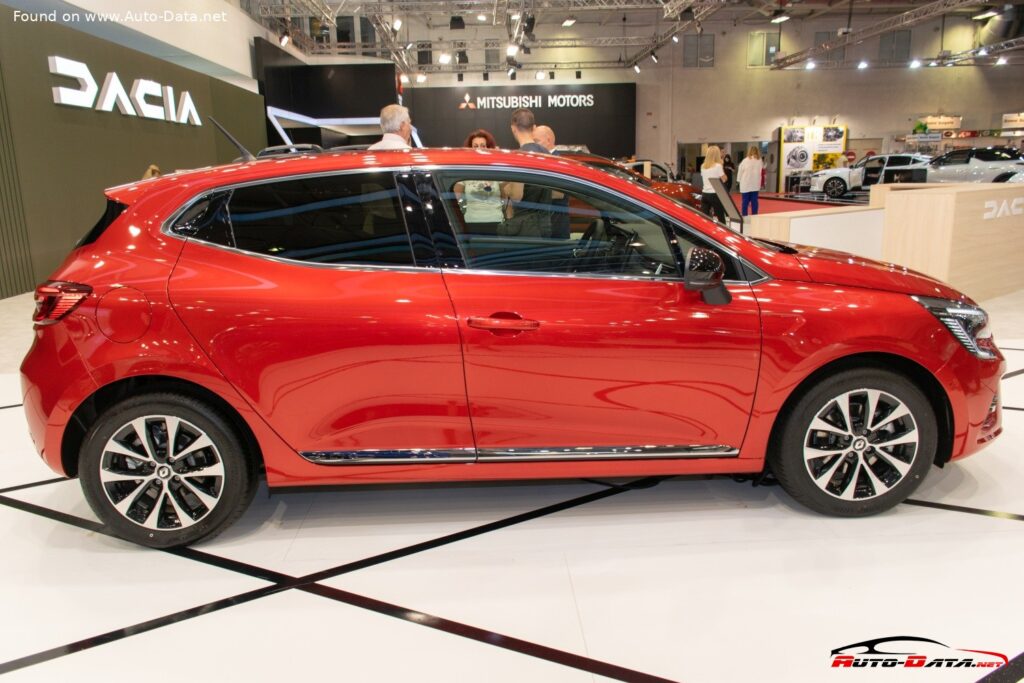
The Renault Clio V (Phase I) E-TECH 1.6 (140 Hp) Hybrid Multi-Mode sports a contemporary 5-door hatchback body type, designed to appeal to a broad European audience seeking style, practicality, and urban maneuverability. With seating for five occupants, the Clio maintains its reputation as a versatile and family-friendly subcompact. Its dimensions are optimized for city driving, with a length of 159.45 inches (4050 mm), a width of 70.79 inches (1798 mm), and a height of 56.69 inches (1440 mm). The compact footprint, combined with a tight minimum turning circle of 34.19 feet (10.42 m), makes it agile and easy to park in crowded urban landscapes.
Visually, the Clio V (Phase I) features Renault’s signature C-shaped LED daytime running lights and a sculpted, aerodynamic profile that contributes to both its modern aesthetic and its fuel efficiency. The interior is designed with a focus on ergonomics and technology, offering a comfortable and connected experience. While specific interior features beyond the powertrain are not provided in the technical data, the Clio V generation typically includes advanced infotainment systems, digital instrument clusters, and high-quality materials for its segment.
Practicality is a strong suit for the Clio, offering a minimum trunk space of 10.63 cubic feet (301 liters), which expands significantly to 34.57 cubic feet (979 liters) with the rear seats folded down. This flexibility allows it to accommodate a wide range of cargo needs, from weekly groceries to larger luggage. Safety is paramount, with standard features like ABS (Anti-lock braking system) ensuring secure braking performance. The vehicle’s robust construction and modern suspension setup—Independent type McPherson at the front and a semi-independent, coil spring, elastic beam at the rear—provide a comfortable ride and stable handling. The electric power steering system further enhances driving ease and responsiveness.
Technical Specifications
| Category | Specification | Value |
|---|---|---|
|
General Information |
Brand | Renault |
| Model | Clio | |
| Generation | Clio V (Phase I) | |
| Type (Engine) | E-TECH 1.6 (140 Hp) Hybrid Multi-Mode | |
| Start of Production | July, 2020 | |
| End of Production | January, 2022 | |
| Powertrain Architecture | FHEV (Full Hybrid Electric Vehicle) | |
|
Body & Seating |
Body Type | Hatchback |
| Seats | 5 | |
| Doors | 5 | |
|
Performance Specs |
Combined Fuel Consumption (WLTP) | 4.3 l/100 km (54.7 US mpg) |
| CO2 Emissions (WLTP) | 98 g/km | |
| Fuel Consumption (Urban, NEDC) | 4.374 l/100 km (53.8 US mpg) | |
| Fuel Consumption (Extra Urban, NEDC) | 4.027 l/100 km (58.4 US mpg) | |
| Fuel Consumption (Combined, NEDC) | 3.607 l/100 km (65.2 US mpg) | |
| CO2 Emissions (NEDC) | 82.0 g/km | |
| Fuel Type | Petrol (Gasoline) | |
| Acceleration 0 – 60 mph | 9.4 sec | |
| Maximum Speed | 111.85 mph (180 km/h) | |
| Emission Standard | Euro 6 | |
|
Electric & Hybrid Specs |
Gross Battery Capacity | 1.2 kWh |
| Battery Voltage | 230 V | |
| Electric Motor Power | 69 Hp | |
| Electric Motor Torque | 151.2 lb-ft (205 Nm) | |
| Electric Motor Location | Integrated into the transmission | |
| System Power | 140 Hp | |
|
Internal Combustion Engine Specs |
Power | 91 Hp |
| Power per Liter | 56.9 Hp/l | |
| Torque | 106.21 lb-ft @ 3200 rpm (144 Nm @ 3200 rpm) | |
| Engine Layout | Front, Transverse | |
| Engine Model/Code | H4M 632 | |
| Engine Displacement | 1.6 l (1598 cm³ / 97.52 cu. in.) | |
| Number of Cylinders | 4, Inline | |
| Number of Valves per Cylinder | 4 | |
| Fuel Injection System | Multi-port manifold injection | |
| Engine Aspiration | Naturally aspirated engine | |
|
Fluids Capacities |
Engine Oil Capacity | 4.76 US qt (4.5 l) |
| Coolant Capacity | 6.87 US qt (6.5 l) | |
| Fuel Tank Capacity | 10.3 US gal (39 l) | |
|
Dimensions & Weights |
Kerb Weight | 2729.32 lbs (1238 kg) |
| Max. Weight | 3875.73 lbs (1758 kg) | |
| Max Load | 1146.4 lbs (520 kg) | |
| Trunk (boot) Space – Minimum | 10.63 cu. ft. (301 l) | |
| Trunk (boot) Space – Maximum | 34.57 cu. ft. (979 l) | |
| Length | 159.45 in (4050 mm) | |
|
Exterior Dimensions |
Width | 70.79 in (1798 mm) |
| Width including mirrors | 78.27 in (1988 mm) | |
| Height | 56.69 in (1440 mm) | |
| Wheelbase | 101.69 in (2583 mm) | |
| Front Track | 59.76 in (1518 mm) | |
| Rear Track | 59.29 in (1506 mm) | |
| Ride Height (ground clearance) | 4.72 in (120 mm) | |
|
Drivetrain, Brakes & Suspension |
Drivetrain Architecture | FHEV (Full Hybrid Electric Vehicle) – ICE and electric motor drive front wheels with ability to work in full electric or mixed mode. |
| Drive Wheel | Front wheel drive | |
| Gearbox Type | Automatic Multi-Mode E-TECH | |
| Front Suspension | Independent type McPherson | |
| Rear Suspension | Semi-independent, coil spring, Elastic beam | |
| Front Brakes | Ventilated discs | |
|
Braking & Steering |
Rear Brakes | Drum |
| Assisting Systems | ABS (Anti-lock braking system) | |
| Steering Type | Steering rack and pinion | |
| Power Steering | Electric Steering | |
| Minimum Turning Circle | 34.19 ft (10.42 m) | |
|
Wheels & Tires |
Tire Sizes | 185/65 R15 88H; 195/55 R16 87H; 205/45 R17 88H |
| Wheel Rims Size | 15; 16; 17 |
Legacy and Market Impact
A Benchmark in European Hybrid Hatchbacks
The Renault Clio V (Phase I) E-TECH 1.6 (140 Hp) Hybrid Multi-Mode left a significant mark on the European automotive landscape, solidifying the Clio’s reputation not just as a stylish and practical hatchback, but also as a leader in efficiency and technological innovation. In a market increasingly driven by environmental consciousness and stringent emissions regulations, the E-TECH variant proved instrumental in allowing Renault to meet and exceed targets like the Euro 6 emission standard while offering a compelling product to consumers.
The Clio has always been a cornerstone of Renault’s sales, and the introduction of the E-TECH hybrid powertrain in its fifth generation was a strategic move to future-proof its appeal. It positioned Renault as a serious contender in the burgeoning hybrid segment, demonstrating that electrification could be integrated into popular, affordable models without compromising on usability or driving dynamics. Its ability to operate in full electric mode for a portion of city driving was a major selling point, providing a taste of EV benefits without range anxiety.
Competitors in the fiercely contested European B-segment included established rivals like the Ford Fiesta, Volkswagen Polo, Peugeot 208, Opel Corsa, and particularly the Toyota Yaris Hybrid, which had long dominated the full-hybrid subcompact space. The Clio E-TECH offered a fresh alternative, leveraging Renault’s unique F1-derived multi-mode gearbox to deliver a distinct driving experience and competitive efficiency. Its market impact was to democratize hybrid technology, making it a mainstream option for European car buyers who previously might have considered hybrids to be niche or expensive.
Historically, the Clio V E-TECH will be remembered as a pivotal model that helped accelerate the adoption of hybrid technology in Europe’s best-selling car class. It demonstrated Renault’s engineering prowess and commitment to a more sustainable automotive future, contributing to a broader shift towards electrification across the industry. While its production run for the “Phase I” was relatively short (July 2020 – January 2022) before subsequent updates and “Phase II” models, its introduction set a clear direction for the Clio and indeed for Renault’s entire lineup, emphasizing intelligent hybrid solutions as a key part of their powertrain strategy. This model underscored that efficiency and environmental responsibility could go hand-in-hand with the everyday practicality and engaging driving experience that consumers expect from a popular hatchback.