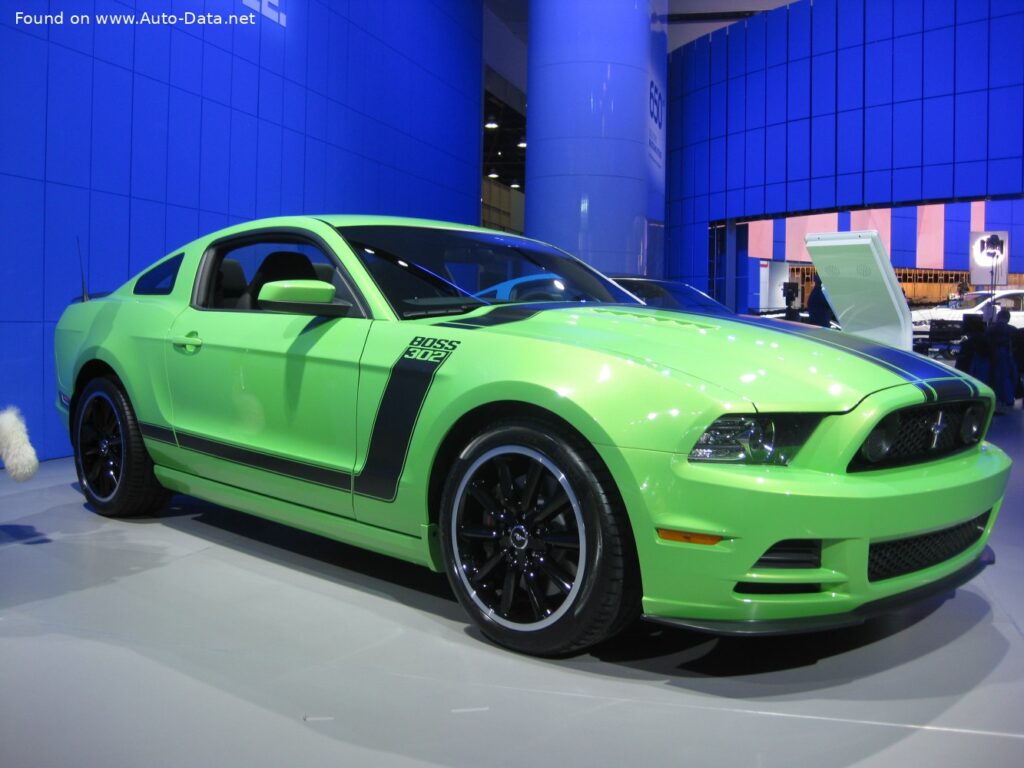
Introduction to the Ford Mustang V (facelift 2012) Boss 302 5.0 V8
The Ford Mustang, an icon of American automotive performance and style, received a significant refresh for its fifth generation (S197) in 2010, with a further update in 2012. Among the most revered variants of this era was the Ford Mustang V (facelift 2012) Boss 302 5.0 V8 (444 Hp), a limited-production, track-focused machine that resurrected a legendary nameplate from the Mustang’s storied past. Produced for the 2012 and 2013 model years, the Boss 302 was designed to bridge the gap between the standard Mustang GT and the more extreme Shelby GT500, offering a pure, naturally aspirated driving experience tailored for both road and circuit.
Positioned as a high-performance coupe, the Boss 302 was a direct competitor to other American muscle cars that were also undergoing a renaissance, such as the Chevrolet Camaro SS 1LE and the Dodge Challenger SRT8. However, the Boss 302 distinguished itself with a unique blend of heritage, engineering prowess, and a singular focus on balanced performance, making it a highly desirable model for enthusiasts and collectors alike. Its distinctive styling, enhanced powertrain, and track-ready chassis components cemented its status as a modern classic in the Mustang lineage.
Engine and Performance: The Heart of the Ford Mustang V (facelift 2012) Boss 302 5.0 V8 (444 Hp)
At the core of the Boss 302’s formidable performance was a specially tuned version of Ford’s 5.0-liter “Coyote” V8 engine. While the standard Mustang GT of the era also featured a 5.0L V8, the Boss 302’s powerplant underwent significant modifications to unleash its full potential. The engine, internally designated as Road Runner, boasted CNC-ported cylinder heads, revised camshafts with more aggressive lift and duration, and a unique intake manifold inspired by the 302R race car. These enhancements allowed the engine to produce an impressive 444 horsepower at a high 7400 rpm, a substantial increase over the standard GT’s 412 hp.
Torque output was also robust, peaking at 379.84 lb.-ft. (515 Nm) at 4500 rpm, providing ample thrust across the rev range. The naturally aspirated design, combined with a high 11:1 compression ratio and a DOHC (Dual Overhead Camshaft) valvetrain with Ti-VCT (Twin Independent Variable Camshaft Timing), ensured immediate throttle response and a linear power delivery right up to its exhilarating 7500 rpm redline. Power was exclusively sent to the rear wheels via a precise 6-speed manual transmission, emphasizing the driver-focused nature of the Boss 302. This powertrain architecture resulted in an exceptional weight-to-power ratio of 3.7 kg/Hp (269.6 Hp/tonne), underscoring its performance credentials. Fuel economy, while not the primary focus, was rated at a combined 19 US mpg (12.4 l/100 km), respectable for a high-performance V8.
Design and Features of the Boss 302
The Ford Mustang V (facelift 2012) Boss 302 was instantly recognizable, thanks to its aggressive and purposeful design cues that paid homage to the original 1969 Boss 302. Its two-door coupe body style exuded classic muscle car proportions, while unique exterior elements set it apart from its Mustang siblings. These included a distinctive front grille with blocked-off fog lamp openings, a functional front splitter, and a rear spoiler designed for aerodynamic stability at high speeds. The iconic C-stripe graphics and unique Boss 302 badging further accentuated its special status.
Beyond aesthetics, the Boss 302 featured a comprehensive suite of performance-oriented upgrades. The suspension system was significantly revised, incorporating stiffer springs, larger diameter anti-roll bars, and adjustable dampers, allowing drivers to fine-tune the ride for track use. The front suspension utilized an independent MacPherson type with a transverse stabilizer, while the rear featured a rigid axle suspension with coil springs and a transverse stabilizer, a setup optimized for both straight-line traction and cornering prowess. Braking performance was enhanced with larger ventilated discs all around: 355×32 mm at the front and 300×19 mm at the rear, supported by an Anti-lock Braking System (ABS). The car rode on staggered-width 19-inch alloy wheels, shod with performance tires (255/40 R19 front, 285/35 R19 rear) to maximize grip. The electric power steering system offered precise control and feedback, contributing to the Boss 302’s engaging driving dynamics. Inside, the four-seat cabin featured sport seats and a minimalist, driver-focused layout, reinforcing its performance intentions.
Technical Specifications
| Category | Specification | Value |
|---|---|---|
| General Information | Brand | Ford |
| Model | Mustang | |
| Generation | Mustang V (facelift 2012) | |
| Type (Engine) | Boss 302 5.0 V8 (444 Hp) | |
| Start of production | 2012 year | |
| End of production | 2013 year | |
| Powertrain Architecture | Internal Combustion engine | |
| Body type | Coupe | |
| Seats | 4 | |
| Doors | 2 | |
| Performance Specs | Fuel consumption (economy) – urban | 15.7 l/100 km (15 US mpg) |
| Fuel consumption (economy) – extra urban | 9 l/100 km (26.1 US mpg) | |
| Fuel consumption (economy) – combined | 12.4 l/100 km (19 US mpg) | |
| Fuel Type | Petrol (Gasoline) | |
| Weight-to-power ratio | 3.7 kg/Hp (269.6 Hp/tonne) | |
| Weight-to-torque ratio | 3.2 kg/Nm (312.7 Nm/tonne) | |
| Engine Specs | Power | 444 Hp @ 7400 rpm |
| Power per liter | 89.7 Hp/l | |
| Torque | 515 Nm @ 4500 rpm (379.84 lb.-ft. @ 4500 rpm) | |
| Maximum engine speed | 7500 rpm | |
| Engine layout | Front, Longitudinal | |
| Engine displacement | 4951 cm³ (302.13 cu. in.) | |
| Number of cylinders | 8 | |
| Engine configuration | V-engine | |
| Cylinder Bore | 92.2 mm (3.63 in.) | |
| Piston Stroke | 92.7 mm (3.65 in.) | |
| Compression ratio | 11:1 | |
| Number of valves per cylinder | 4 | |
| Fuel injection system | Multi-port manifold injection | |
| Engine aspiration | Naturally aspirated engine | |
| Valvetrain | DOHC, Ti-VCT | |
| Engine oil capacity | 8 l (8.45 US qt) | |
| Coolant | 14.4 l (15.22 US qt) | |
| Space, Volume and Weights | Kerb Weight | 1647 kg (3631.01 lbs.) |
| Trunk (boot) space – minimum | 379 l (13.38 cu. ft.) | |
| Fuel tank capacity | 61 l (16.11 US gal) | |
| Dimensions | Length | 4778 mm (188.11 in.) |
| Width | 1877 mm (73.9 in.) | |
| Height | 1400 mm (55.12 in.) | |
| Wheelbase | 2720 mm (107.09 in.) | |
| Front track | 1572 mm (61.89 in.) | |
| Rear (Back) track | 1588 mm (62.52 in.) | |
| Minimum turning circle (turning diameter) | 12 m (39.37 ft.) | |
| Drivetrain, Brakes and Suspension Specs | Drivetrain Architecture | The Internal combustion engine (ICE) drives the rear wheels of the vehicle. |
| Drive wheel | Rear wheel drive | |
| Number of gears and type of gearbox | 6 gears, manual transmission | |
| Front suspension | Independent type McPherson, Transverse stabilizer | |
| Rear suspension | Rigid axle suspension, Transverse stabilizer, Coil spring | |
| Front brakes | Ventilated discs, 355×32 mm | |
| Rear brakes | Ventilated discs, 300×19 mm | |
| Assisting systems | ABS (Anti-lock braking system) | |
| Steering type | Steering rack and pinion | |
| Power steering | Electric Steering | |
| Tires size | Front: 255/40 R19, Rear: 285/35 R19 | |
| Wheel rims size | Front: 9J x 19, Rear: 9.5J x 19 |
Legacy and Market Impact of the Ford Mustang V (facelift 2012) Boss 302
The Ford Mustang V (facelift 2012) Boss 302 5.0 V8 (444 Hp) carved out a unique and lasting legacy in the pantheon of American muscle cars. By reviving the revered “Boss 302” moniker, Ford not only paid homage to its racing heritage but also delivered a vehicle that authentically lived up to the name’s performance expectations. Its limited production run for only two model years (2012-2013) immediately imbued it with a sense of exclusivity and collectibility, making it a highly sought-after model among Mustang enthusiasts.
In its competitive landscape, the Boss 302 stood as a formidable contender. While the Chevrolet Camaro SS 1LE offered a similar track-focused package and the Dodge Challenger SRT8 provided raw power and classic styling, the Boss 302 distinguished itself with its high-revving, naturally aspirated V8 and a chassis tuned for surgical precision on a road course. It offered a more visceral and engaging driving experience than many of its heavier, supercharged contemporaries, appealing to purists who valued driver involvement and a direct connection to the machine. Its reputation was built on its ability to perform admirably on both the street and the track, with numerous automotive journalists praising its balanced handling and potent powertrain.
Historically, the Boss 302 played a crucial role in the Mustang’s evolution. It demonstrated Ford’s commitment to offering diverse performance variants and showcased the versatility of the S197 platform. It served as an excellent bridge between the already capable Mustang GT and the extreme Shelby GT500, providing a distinct flavor of performance that focused on agility and engine response. The success and critical acclaim of the Boss 302 undoubtedly influenced subsequent performance models, helping to solidify the Mustang’s position as a global performance icon. Today, the Ford Mustang V (facelift 2012) Boss 302 5.0 V8 remains a celebrated chapter in the Mustang saga, revered for its blend of heritage, raw power, and track-honed dynamics.