
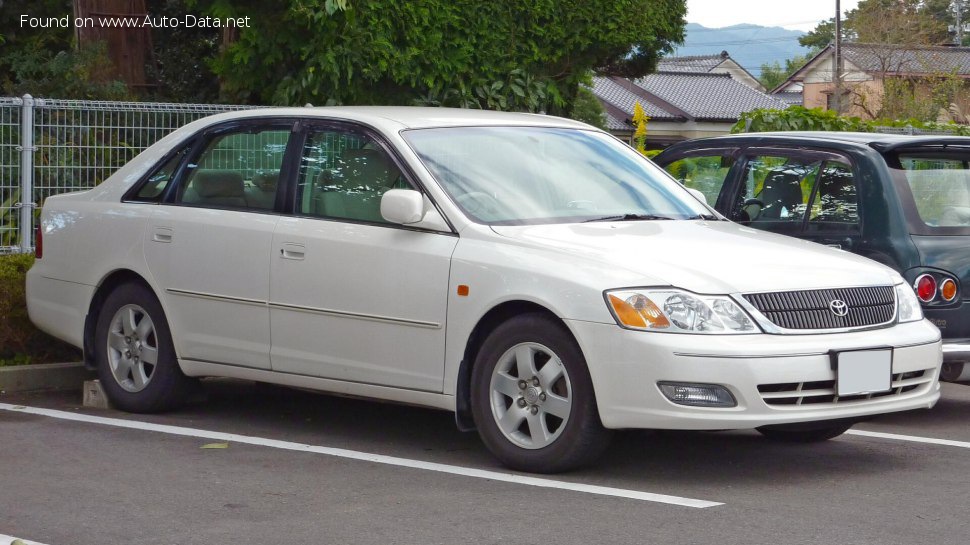
Introduction to the Toyota Pronard (MCX20)
The Toyota Pronard (MCX20) represents a fascinating chapter in Toyota’s strategy for the Japanese domestic market (JDM). Produced from 1999 to 2004, the Pronard was a full-size sedan, essentially a rebadged version of the second-generation Toyota Avalon (XX20 chassis) that was sold primarily in North America. Its introduction in Japan aimed to cater to a niche market desiring a spacious, comfortable, and American-inspired sedan, distinct from Toyota’s more traditional JDM luxury offerings like the Crown or Celsior (Lexus LS). The Pronard offered a compelling blend of robust engineering, ample interior volume, and a focus on serene ride quality, positioning it as an executive-level cruiser in its home market.
During its production run, the Pronard was available with a single powertrain option, a potent 3.0-liter V6 engine, which underscored its positioning as a premium, long-distance touring vehicle. This generation marked an effort by Toyota to diversify its JDM lineup with vehicles that offered different design philosophies and appeal, leveraging successful platforms from other global markets. While the Avalon nameplate was well-established in the United States as a flagship front-wheel-drive sedan, its reintroduction as the Pronard in Japan provided a unique proposition for consumers looking for size and comfort over outright sportiness or traditional Japanese luxury opulence.
Engine and Performance of the Toyota Pronard (MCX20) 3.0 i V6 WT-I (215 Hp)
At the heart of the Toyota Pronard (MCX20) was a sophisticated 3.0-liter 1MZ-FE V6 engine, a powerplant renowned for its smoothness, reliability, and efficiency. This particular iteration featured Toyota’s advanced VVT-i (Variable Valve Timing with intelligence) system, which optimized valve overlap for improved torque across the rev range and enhanced fuel economy. The engine, configured as a V-engine with six cylinders, produced a healthy 215 horsepower at 5800 rpm and a substantial 220.53 lb-ft of torque at 4400 rpm. This output was more than adequate to propel the large sedan with authority, offering confident acceleration and effortless highway cruising capabilities.
The 1MZ-FE engine utilized a Double Overhead Camshaft (DOHC) valvetrain with four valves per cylinder, a common and effective design for maximizing volumetric efficiency. Fuel delivery was managed by a multi-port manifold injection system, ensuring precise fuel metering for optimal combustion. As a naturally aspirated engine, it delivered its power linearly and predictably, without the complexity or lag associated with forced induction systems. The engine’s front, transverse layout was typical for a front-wheel-drive platform, contributing to efficient packaging and interior space.
Power was transmitted to the front wheels via a smooth-shifting 4-speed automatic transmission. While a 4-speed automatic might seem modest by today’s standards, it was a common and reliable choice for large sedans of this era, prioritizing smooth shifts and durability. The combination of the refined V6 engine and the automatic gearbox provided a driving experience characterized by comfort and ease, perfectly aligned with the Pronard’s intended market. Fuel economy for the 3.0 i V6 WT-I was rated at approximately 22.8 US mpg in urban conditions, a respectable figure for a vehicle of its size and engine displacement at the turn of the millennium. Its weight-to-power ratio of 7 kg/Hp (143.3 Hp/tonne) underscored its capable performance for a full-size sedan.
Design and Features
The design of the Toyota Pronard (MCX20) was a direct reflection of its North American counterpart, the second-generation Toyota Avalon. It presented a conservative yet elegant aesthetic, characterized by smooth lines, a long hood, and a spacious cabin. At 192.72 inches in length, 71.65 inches in width, and 57.48 inches in height, with a generous 107.09-inch wheelbase, the Pronard was a substantial vehicle for the Japanese market. Its dimensions were indicative of its primary focus: providing class-leading interior room and comfort for five occupants. The four-door sedan body type emphasized practicality and ease of access.
Inside, the Pronard prioritized comfort and convenience. The cabin was designed to be quiet and luxurious, featuring soft-touch materials and well-bolstered seats. While specific trim levels and features would vary, typical amenities for a vehicle of this segment and era would have included automatic climate control, power-adjustable seating, a premium audio system, and wood grain or metallic accents. Safety features, while not as extensive as modern vehicles, included standard ABS (Anti-lock Braking System), which was a critical active safety component for maintaining steering control during hard braking. The hydraulic power steering system, specifically a rack and pinion setup, offered a comfortable and predictable steering feel, well-suited for highway cruising.
The suspension system further contributed to the Pronard’s comfortable ride. The front featured a robust wishbone setup, while the rear utilized coil springs, a combination designed to absorb road imperfections effectively and provide a stable ride. Braking performance was handled by ventilated discs at the front and solid discs at the rear, ensuring reliable stopping power. The standard tire size was 205/65 R15 H, balancing ride comfort with adequate grip. The overall design philosophy was one of understated luxury and practical functionality, making it a comfortable and capable vehicle for executive transport or family duties in Japan.
Technical Specifications
| Category | Specification |
|---|---|
| Brand | Toyota |
| Model | Pronard |
| Generation | Pronard (MCX20) |
| Engine Type | 3.0 i V6 WT-I (215 Hp) |
| Production Start | 1999 year |
| Production End | 2004 year |
| Powertrain Architecture | Internal Combustion engine |
| Body Type | Sedan |
| Seats | 5 |
| Doors | 4 |
| Fuel Consumption (Urban) | 10.31 l/100 km (22.8 US mpg) |
| Fuel Type | Petrol (Gasoline) |
| Weight-to-power ratio | 7 kg/Hp (143.3 Hp/tonne) |
| Weight-to-torque ratio | 5 kg/Nm (199.3 Nm/tonne) |
| Power | 215 Hp @ 5800 rpm |
| Power per liter | 71.8 Hp/l |
| Torque | 299 Nm @ 4400 rpm (220.53 lb.-ft. @ 4400 rpm) |
| Engine Layout | Front, Transverse |
| Engine Displacement | 2994 cm3 (182.71 cu. in.) |
| Number of Cylinders | 6 |
| Engine Configuration | V-engine |
| Cylinder Bore | 87.5 mm (3.44 in.) |
| Piston Stroke | 83 mm (3.27 in.) |
| Compression Ratio | 10.5:1 |
| Valves per Cylinder | 4 |
| Fuel Injection System | Multi-port manifold injection |
| Engine Aspiration | Naturally aspirated engine |
| Valvetrain | DOHC |
| Kerb Weight | 1500 kg (3306.93 lbs.) |
| Max. Weight | 1775 kg (3913.21 lbs.) |
| Max Load | 275 kg (606.27 lbs.) |
| Fuel Tank Capacity | 70 l (18.49 US gal) |
| Length | 4895 mm (192.72 in.) |
| Width | 1820 mm (71.65 in.) |
| Height | 1460 mm (57.48 in.) |
| Wheelbase | 2720 mm (107.09 in.) |
| Front Track | 1545 mm (60.83 in.) |
| Rear Track | 1520 mm (59.84 in.) |
| Drivetrain Architecture | Front-wheel drive (ICE drives front wheels) |
| Drive Wheel | Front wheel drive |
| Gearbox Type | 4 gears, automatic transmission |
| Front Suspension | Wishbone |
| Rear Suspension | Coil spring |
| Front Brakes | Ventilated discs |
| Rear Brakes | Disc |
| Assisting Systems | ABS (Anti-lock braking system) |
| Steering Type | Steering rack and pinion |
| Power Steering | Hydraulic Steering |
| Tires Size | 205/65 R15 H |
Legacy and Market Impact of the Toyota Pronard (MCX20)
The Toyota Pronard (MCX20) occupied a unique position in the Japanese automotive landscape during its production years. As a rebadged version of the North American Toyota Avalon, it brought a distinctly American interpretation of a full-size sedan to a market often characterized by more compact or overtly luxurious vehicles. Its primary appeal lay in its exceptional interior space, particularly for rear-seat passengers, and its comfortable, unruffled ride quality – attributes highly valued by executives and families alike. This contrasted with many JDM vehicles that prioritized narrower body dimensions for navigating tight urban streets or offered a more traditional, often rear-wheel-drive, luxury experience.
Competitors in its segment in Japan would have included other large sedans, though often with different philosophies. The Nissan Cima (Infiniti Q45 in North America) and Mitsubishi Proudia were examples of domestic rivals that offered large, luxurious experiences, often with a more performance-oriented or traditional luxury RWD setup. The Pronard, with its FWD architecture and emphasis on spaciousness and comfort, carved out its own niche. It offered a compelling alternative for consumers who appreciated the reliability and quality of a Toyota but desired the generous dimensions and relaxed cruising nature of a vehicle designed for broader American highways.
While the Pronard might not have achieved the iconic status of some of Toyota’s long-running JDM nameplates, its historical significance lies in Toyota’s willingness to experiment with market positioning and leverage global platforms. It demonstrated an understanding that a segment of the Japanese market sought a vehicle that prioritized interior volume and a smooth, quiet ride above all else. Its reputation, much like the Avalon it was based on, was one of unwavering reliability, durability, and excellent long-term ownership value. The 3.0-liter V6 engine, in particular, proved to be a workhorse, contributing to the car’s dependable nature.
Ultimately, the Pronard served as a testament to Toyota’s diverse engineering capabilities and its strategy of adapting successful global models to specific regional tastes. Although it concluded its production run in 2004, the legacy of the Pronard, and by extension the Avalon, continues in Toyota’s commitment to producing comfortable, reliable, and spacious sedans that cater to a broad spectrum of consumer needs worldwide. For those in Japan who desired a taste of American-style automotive comfort and scale with Japanese quality, the Toyota Pronard (MCX20) was an ideal choice.
