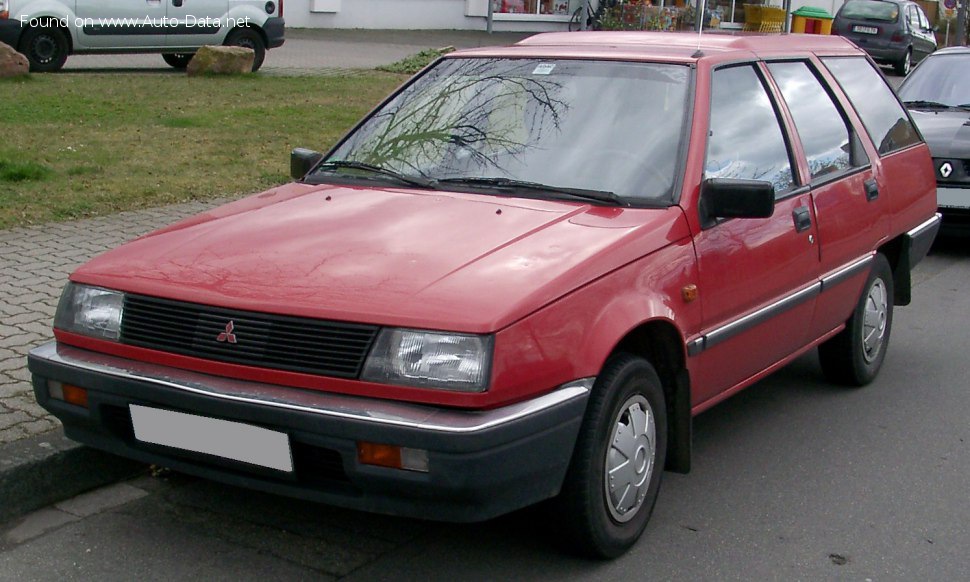
Mitsubishi Lancer III Wagon 1.8 D (60 Hp): A Practical Workhorse for Global Markets
The Mitsubishi Lancer, a nameplate synonymous with reliability and versatility for decades, saw its third generation, known internally as the C10-C30 series, introduced in 1983. While the sedan and hatchback variants were available in various markets, including North America (often rebadged as the Dodge/Plymouth Colt or Eagle Summit), the station wagon variant, particularly the Mitsubishi Lancer III Wagon 1.8 D (60 Hp), carved out a distinct niche in European and Asian markets. Produced from 1986 to 1992, this particular model represented Mitsubishi’s commitment to offering practical, fuel-efficient transportation for families and businesses in regions where diesel powertrains and compact wagons were highly valued. It was a straightforward, no-nonsense vehicle designed for durability and economy rather than outright performance, perfectly embodying the spirit of accessible motoring of its era.
Engine & Performance: The Enduring Diesel Powertrain
At the heart of the Mitsubishi Lancer III Wagon 1.8 D (60 Hp) lay a robust 1.8-liter (1796 cm3 or 109.6 cu. in.) naturally aspirated diesel engine, designated as the 4D65. This inline-four cylinder unit was engineered for longevity and exceptional fuel economy, characteristics that made it a compelling choice in its primary markets. Generating a modest 60 horsepower at 4500 rpm and 83.34 lb.-ft. (113 Nm) of torque at a low 3000 rpm, the engine delivered adequate power for daily driving, especially when paired with its standard 5-speed manual transmission. Its OHC (Overhead Camshaft) valvetrain and precombustion chamber injection system were common technologies for diesel engines of the period, emphasizing reliability and efficiency.
While not a performance car, the Lancer III Wagon 1.8 D offered respectable acceleration for its class and power output. It could accelerate from 0 to 60 mph in approximately 14.6 seconds, with a top speed of 90.1 mph (145 km/h). These figures underscored its role as a sensible family hauler rather than a speed demon. Where this powertrain truly shined was in its fuel consumption. With an impressive combined fuel economy of 34.6 US mpg (6.8 l/100 km), and an even more remarkable 50 US mpg (4.7 l/100 km) on the extra-urban cycle, the Lancer III Wagon 1.8 D was a remarkably economical vehicle to run. Its 12.42 US gallon (47 liter) fuel tank provided a substantial cruising range, a crucial advantage for long-distance travel and commercial use.
Design & Features: Practicality Personified
The Mitsubishi Lancer III Wagon adopted a classic station wagon silhouette, prioritizing interior volume and cargo capacity. Its five-door, five-seat configuration made it a highly practical vehicle for families or small businesses. The exterior design was clean and functional, characterized by straight lines and a boxy profile typical of 1980s automotive styling. This design philosophy maximized interior space and facilitated easy loading and unloading of cargo.
Inside, the Lancer III Wagon was designed with durability and straightforward functionality in mind. Materials were chosen for their hard-wearing properties, capable of withstanding the rigors of daily use. While luxury features were sparse, the cabin was ergonomically laid out, with controls easily accessible to the driver. The minimum trunk space of 13.31 cu. ft. (377 liters) could be significantly expanded by folding down the rear seats, transforming the wagon into a versatile cargo carrier. Safety features, by modern standards, were basic, but the car offered a solid, dependable platform. The vehicle’s compact dimensions—162.01 inches (4115 mm) in length, 64.37 inches (1635 mm) in width, and 55.71 inches (1415 mm) in height—made it maneuverable in urban environments while still providing ample interior room.
Technical Specifications: Mitsubishi Lancer III Wagon 1.8 D (60 Hp)
| Category | Specification |
|---|---|
| Brand | Mitsubishi |
| Model | Lancer |
| Generation | Lancer III Wagon |
| Type (Engine) | 1.8 D (60 Hp) |
| Production Years | 1986 – 1992 |
| Powertrain Architecture | Internal Combustion Engine (Front-wheel drive) |
| Body Type | Station Wagon (Estate) |
| Seats | 5 |
| Doors | 5 |
| Performance Specs | |
| Fuel Type | Diesel |
| Fuel Consumption (Urban) | 33.1 US mpg (7.1 l/100 km) |
| Fuel Consumption (Extra Urban) | 50 US mpg (4.7 l/100 km) |
| Fuel Consumption (Combined) | 34.6 US mpg (6.8 l/100 km) |
| Acceleration 0 – 60 mph | 14.6 seconds |
| Maximum Speed | 90.1 mph (145 km/h) |
| Weight-to-Power Ratio | 16.7 kg/Hp, 60 Hp/tonne |
| Weight-to-Torque Ratio | 8.8 kg/Nm, 113 Nm/tonne |
| Engine Specs | |
| Power | 60 Hp @ 4500 rpm |
| Power per liter | 33.4 Hp/l |
| Torque | 83.34 lb.-ft. (113 Nm) @ 3000 rpm |
| Engine Layout | Front, Transverse |
| Engine Model/Code | 4D65 |
| Engine Displacement | 1.8 liters (1796 cm3, 109.6 cu. in.) |
| Number of Cylinders | 4 |
| Engine Configuration | Inline |
| Cylinder Bore | 3.17 in. (80.6 mm) |
| Piston Stroke | 3.46 in. (88 mm) |
| Compression Ratio | 21.5:1 |
| Valves per Cylinder | 2 |
| Fuel Injection System | Precombustion chamber injection |
| Engine Aspiration | Naturally Aspirated |
| Valvetrain | OHC |
| Engine Oil Capacity | 5.92 US qt (5.6 l) |
| Coolant Capacity | 6.34 US qt (6 l) |
| Space, Volume & Weights | |
| Kerb Weight | 2204.62 lbs (1000 kg) |
| Trunk (Boot) Space – Minimum | 13.31 cu. ft. (377 l) |
| Fuel Tank Capacity | 12.42 US gal (47 l) |
| Dimensions | |
| Length | 162.01 in. (4115 mm) |
| Width | 64.37 in. (1635 mm) |
| Height | 55.71 in. (1415 mm) |
| Wheelbase | 93.7 in. (2380 mm) |
| Front Track | 55.51 in. (1410 mm) |
| Rear (Back) Track | 52.76 in. (1340 mm) |
| Drivetrain, Brakes & Suspension Specs | |
| Drive Wheel | Front-wheel drive |
| Gearbox | 5 gears, Manual Transmission |
| Front Suspension | Coil spring |
| Rear Suspension | Coil spring |
| Front Brakes | Disc |
| Rear Brakes | Drum |
| Steering Type | Steering rack and pinion |
| Power Steering | Hydraulic Steering |
| Tires Size | 175/70 R13 |
Legacy & Market Impact of the Mitsubishi Lancer III Wagon 1.8 D (60 Hp)
The Mitsubishi Lancer III Wagon 1.8 D (60 Hp) cemented its reputation as a highly dependable and economical choice in the compact wagon segment, particularly in Europe and parts of Asia where diesel engines and practical body styles held significant market share. Unlike its more performance-oriented Lancer Evolution successors, this model focused on utilitarian values. It was a common sight as a family car, a fleet vehicle, or even a light commercial transport, prized for its low running costs and robust build quality.
In its primary markets, the Lancer III Wagon competed against a diverse range of compact wagons from both Japanese and European manufacturers. Rivals might have included models like the Toyota Corolla Wagon, Nissan Sunny/Pulsar Wagon, Opel Kadett Caravan (Vauxhall Astra Estate in the UK), Ford Escort Estate, and even early examples of the Volkswagen Golf Variant. What set the Lancer apart was its strong reputation for Japanese engineering reliability, often outlasting some of its European counterparts in terms of mechanical endurance.
Its historical significance lies in its contribution to Mitsubishi’s global presence as a manufacturer of practical and accessible vehicles. While not a glamourous model, its quiet success in fulfilling the everyday transportation needs of countless owners speaks volumes. The Lancer III Wagon 1.8 D represented an era before the widespread dominance of SUVs, when station wagons were the go-to choice for versatility and space. It exemplifies a period when efficiency and durability were paramount, offering a compelling package for those seeking a long-lasting, low-maintenance vehicle. Its legacy is one of unwavering service and a testament to Mitsubishi’s commitment to building cars that simply worked, day in and day out.