The Mercedes-Benz S124 (facelift 1989) 300 TE-24: A Paragon of German Engineering and Practical Luxury
The Mercedes-Benz S124, a designation for the estate (station wagon) variant of the revered W124 series, stands as a testament to Mercedes-Benz’s commitment to robust engineering, timeless design, and practical luxury. Launched in 1985, the W124 chassis quickly earned a reputation for its exceptional build quality, durability, and sophisticated driving dynamics. The specific model under review, the Mercedes-Benz S124 (facelift 1989) 300 TE-24, represents a significant evolution within this iconic generation. Introduced in June 1989, this particular iteration received a notable powertrain upgrade, featuring Mercedes-Benz’s advanced M104 24-valve inline-six engine, marking a departure from the earlier 12-valve units. This enhancement solidified its position as a high-performance, yet supremely practical, luxury estate car in the European market, where it was primarily sold. It combined the spaciousness and versatility of a station wagon with the refined performance and prestige expected from the three-pointed star. Production of this specific variant ran until October 1992, making it a relatively short-lived but highly impactful model within the W124 lineage.
Engine and Performance: The Dawn of the 24-Valve Era
At the heart of the Mercedes-Benz S124 (facelift 1989) 300 TE-24 lies its defining feature: the M104 E30 engine, a naturally aspirated 3.0-liter (2960 cm3 or 180.63 cu. in.) inline-six powerplant. This engine was a significant technological leap for Mercedes-Benz, introducing a dual overhead camshaft (DOHC) valvetrain with four valves per cylinder, totaling 24 valves. This advanced cylinder head design allowed for improved breathing and combustion efficiency compared to its 12-valve predecessors. The result was a robust output of 220 horsepower at a relatively high 6400 rpm, delivering a specific power output of 74.3 horsepower per liter. Torque figures were equally impressive for the era, peaking at 195.45 lb.-ft. (265 Nm) at 4600 rpm, providing strong mid-range pull.
Power was exclusively delivered to the rear wheels via a precise 5-speed manual transmission, emphasizing driver engagement. This powertrain combination enabled the 300 TE-24 to achieve spirited performance for a luxury station wagon of its time. It could accelerate from 0 to 60 mph in a swift 7.9 seconds (0-100 km/h in 8.3 seconds) and reach a top speed of 137.94 mph (222 km/h). These figures were competitive with many sport sedans of the period, underscoring the “sporting” aspect of this particular estate model. The engine’s layout was front, longitudinal, contributing to the W124’s balanced weight distribution and characteristic driving dynamics. With a compression ratio of 10:1 and a multi-port manifold fuel injection system, the M104 engine was both powerful and refined, offering a smooth and responsive driving experience.
Despite its performance capabilities, the 300 TE-24 maintained reasonable fuel economy for a large, powerful luxury car of its time. Urban consumption was rated at approximately 15.2 US mpg (15.5 l/100 km), while extra-urban driving could yield around 26.4 US mpg (8.9 l/100 km). This blend of performance and relative efficiency, coupled with a generous 19.02 US gallon (72 l) fuel tank, made it an ideal grand tourer.
Design and Features: Timeless Elegance and Unmatched Utility
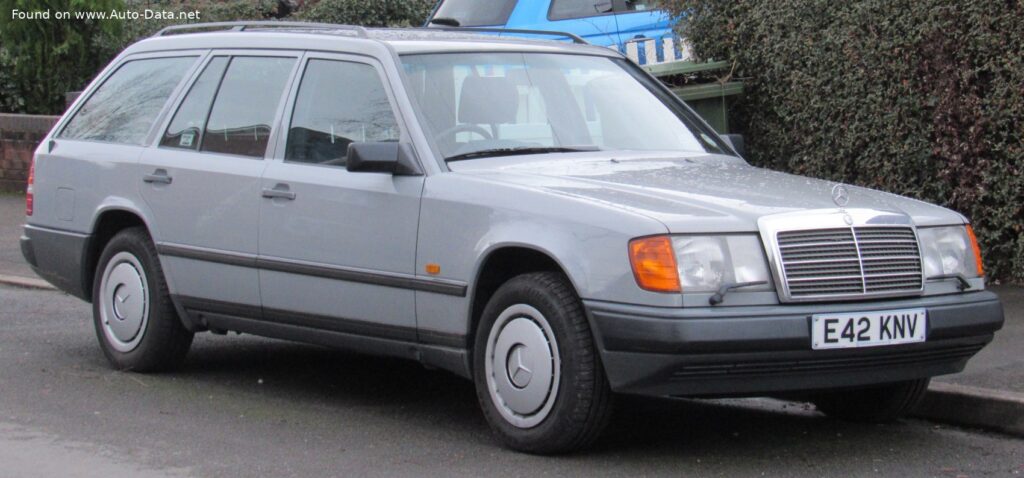
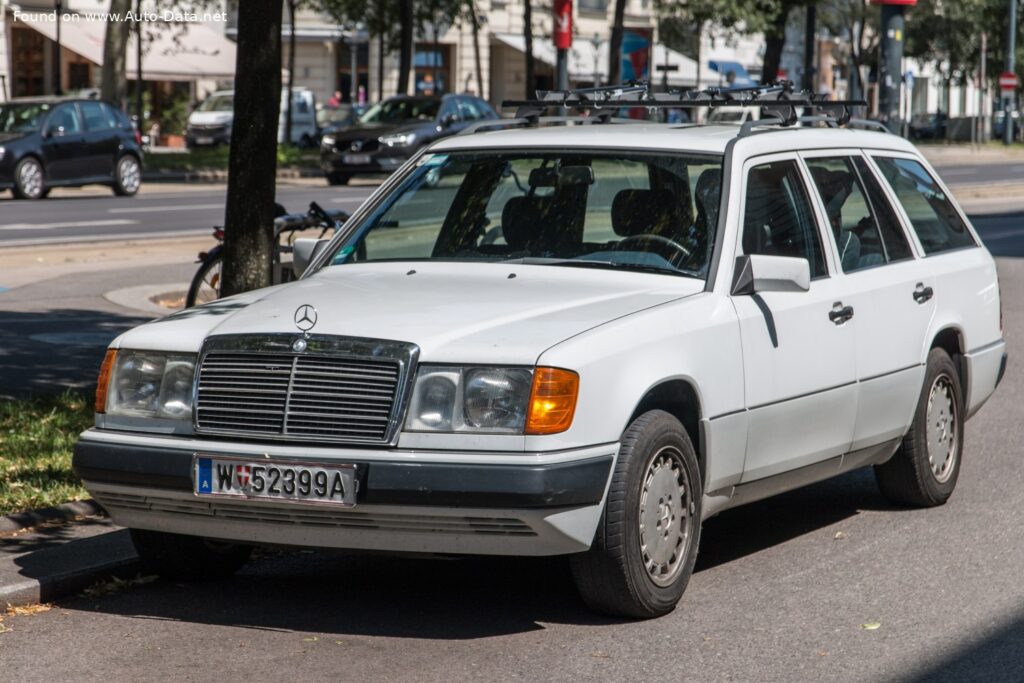
The Mercedes-Benz S124 (facelift 1989) 300 TE-24 inherited the W124’s iconic “form follows function” design philosophy, characterized by clean lines, a robust stance, and exceptional aerodynamic efficiency for its time. The station wagon (estate) body type offered unparalleled practicality, featuring five doors and comfortable seating for five occupants. The 1989 facelift brought subtle but effective updates, including body-colored side moldings and a revised front grille, enhancing its modern appeal while retaining its classic Mercedes-Benz identity.
The interior of the S124 was a benchmark for ergonomic design and material quality. Plush seating, high-quality fabrics or optional leather, and meticulously crafted wood trim created an atmosphere of understated luxury. As a premium vehicle, it came equipped with a range of features designed for comfort and convenience. While specific optional features are not detailed in the data, typical amenities for this class and era would include automatic climate control, power windows, power mirrors, and a sophisticated audio system.
Safety was a paramount concern for Mercedes-Benz, and the W124 series was renowned for its robust construction and advanced safety systems. The 300 TE-24 featured an Anti-lock Braking System (ABS) as standard, a crucial safety innovation that prevented wheel lock-up during hard braking, enhancing directional stability. The braking system itself comprised ventilated discs at the front and solid discs at the rear, providing strong and consistent stopping power. The suspension setup, a double wishbone front suspension and an independent multi-link rear suspension, contributed significantly to the S124’s legendary ride comfort, precise handling, and stability, even when fully loaded. The multi-link rear suspension, in particular, was lauded for its ability to maintain consistent wheel alignment, improving both ride quality and tire wear. Steering was managed by a durable cone worm system with recirculating balls, offering a blend of road feel and effortless operation typical of Mercedes-Benz vehicles.
With a kerb weight of 3505.35 lbs (1590 kg) and a maximum permissible weight of 3836.04 lbs (1740 kg), the S124 300 TE-24 was a substantial vehicle, reflecting its solid construction. Its dimensions – 187.6 inches (4765 mm) in length, 68.5 inches (1740 mm) in width, and 58.62 inches (1489 mm) in height – provided ample interior space and a commanding road presence. The generous 110.24-inch (2800 mm) wheelbase further contributed to its stable ride and spacious cabin.
Technical Specifications
| Mercedes-Benz S124 (facelift 1989) 300 TE-24 (220 Hp) – Full Specifications | |
|---|---|
| General Information | |
| Brand | Mercedes-Benz |
| Model | W124 |
| Generation | S124 (facelift 1989) |
| Type (Engine) | 300 TE-24 (220 Hp) |
| Start of production | June, 1989 |
| End of production | October, 1992 |
| Powertrain Architecture | Internal Combustion engine |
| Body type | Station wagon (estate) |
| Seats | 5 |
| Doors | 5 |
| Performance Specs | |
| Fuel consumption (economy) – urban | 15.5 l/100 km (15.2 US mpg) |
| Fuel consumption (economy) – extra urban | 8.9 l/100 km (26.4 US mpg) |
| Fuel Type | Petrol (Gasoline) |
| Acceleration 0 – 60 mph | 7.9 sec |
| Acceleration 0 – 62 mph (0 – 100 km/h) | 8.3 sec |
| Maximum speed | 137.94 mph (222 km/h) |
| Weight-to-power ratio | 7.2 kg/Hp, 138.4 Hp/tonne |
| Weight-to-torque ratio | 6 kg/Nm, 166.7 Nm/tonne |
| Engine Specs | |
| Power | 220 Hp @ 6400 rpm |
| Power per liter | 74.3 Hp/l |
| Torque | 195.45 lb.-ft. (265 Nm) @ 4600 rpm |
| Engine layout | Front, Longitudinal |
| Engine Model/Code | M 104 E 30 / 104.980 |
| Engine displacement | 2960 cm3 (180.63 cu. in.) |
| Number of cylinders | 6 |
| Engine configuration | Inline |
| Cylinder Bore | 3.48 in. (88.5 mm) |
| Piston Stroke | 3.16 in. (80.2 mm) |
| Compression ratio | 10:1 |
| Number of valves per cylinder | 4 |
| Fuel injection system | Multi-port manifold injection |
| Engine aspiration | Naturally aspirated engine |
| Valvetrain | DOHC |
| Engine oil capacity | 6.5 l (6.87 US qt) |
| Coolant | 9 l (9.51 US qt) |
| Space, Volume and Weights | |
| Kerb Weight | 3505.35 lbs (1590 kg) |
| Max. weight | 3836.04 lbs (1740 kg) |
| Max load | 330.69 lbs (150 kg) |
| Fuel tank capacity | 19.02 US gal (72 l) |
| Dimensions | |
| Length | 187.6 in. (4765 mm) |
| Width | 68.5 in. (1740 mm) |
| Height | 58.62 in. (1489 mm) |
| Wheelbase | 110.24 in. (2800 mm) |
| Front track | 58.94 in. (1497 mm) |
| Rear (Back) track | 58.94 in. (1497 mm) |
| Drivetrain, Brakes and Suspension Specs | |
| Drivetrain Architecture | The Internal combustion engine (ICE) drives the rear wheels of the vehicle. |
| Drive wheel | Rear wheel drive |
| Number of gears and type of gearbox | 5 gears, manual transmission |
| Front suspension | Wishbone |
| Rear suspension | Independent multi-link suspension |
| Front brakes | Ventilated discs |
| Rear brakes | Disc |
| Assisting systems | ABS (Anti-lock braking system) |
| Steering type | Cone worm with recirculation balls |
| Tires size (Front & Rear) | 195/65 R15 |
| Wheel rims size (Front & Rear) | 6.5J x 15 |
Legacy and Market Impact: The Enduring Appeal of an Over-Engineered Classic
The Mercedes-Benz S124 series, and particularly the potent Mercedes-Benz S124 (facelift 1989) 300 TE-24, holds an indelible place in automotive history. While the W124 sedans were sold globally, including in the USA, the estate variants, especially the high-performance 24-valve models, found their most enthusiastic audience in Europe. Here, they competed against formidable rivals such as the BMW 5-Series Touring (E34 generation) and the Audi 100 Avant (C3/C4 generations), all vying for supremacy in the executive estate segment.
What set the S124 apart was its reputation for being “over-engineered.” This wasn’t merely a marketing slogan; it was a fundamental aspect of its design and construction. Every component, from the robust chassis to the meticulously assembled interior, was built to withstand the test of time, often far exceeding contemporary industry standards. This legendary durability, combined with the refined power of the M104 24-valve engine, made the 300 TE-24 a highly desirable vehicle for discerning European buyers who demanded performance, luxury, and unmatched reliability for both daily driving and long-distance travel.
Its legacy is one of a vehicle that successfully blended the practicality of a station wagon with the driving dynamics and prestige of a luxury sedan. It was a status symbol for families and professionals alike, capable of effortlessly swallowing luggage for a vacation or transporting clients in comfort. Today, the W124 series, and particularly the well-maintained 24-valve estates, are highly sought after by enthusiasts and collectors. They represent a golden era of Mercedes-Benz engineering, a period when quality and longevity were prioritized above all else. The 300 TE-24 stands as a shining example of this philosophy, continuing to be admired for its timeless elegance, robust performance, and enduring mechanical integrity, solidifying its status as a true modern classic.