
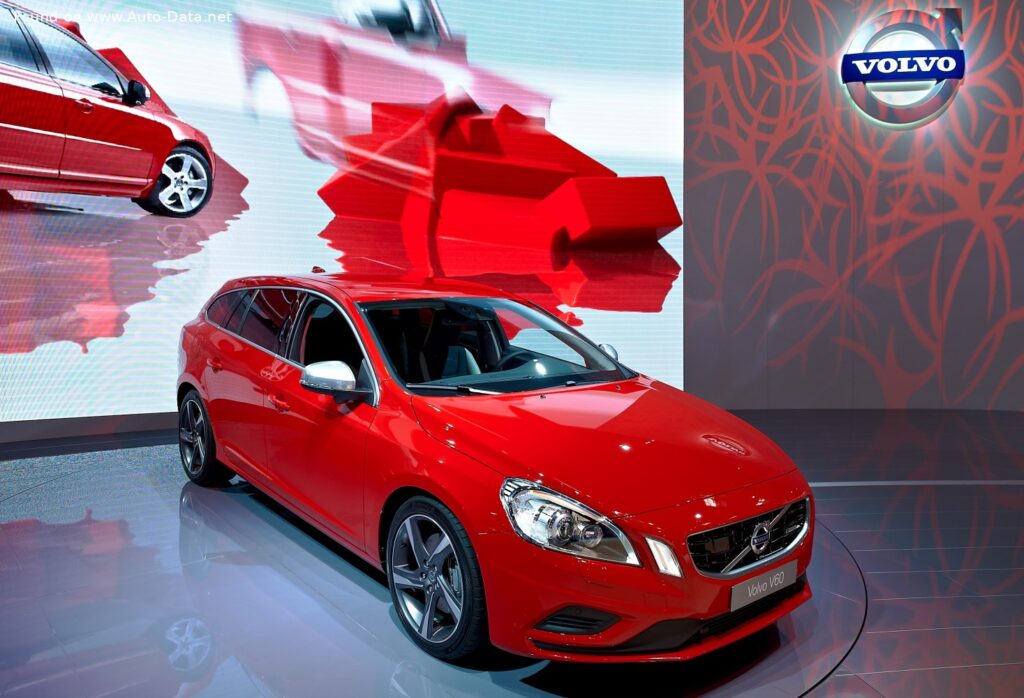
The Volvo V60 I 2.0 T (203 Hp): A Premium European Wagon
The Volvo V60 I 2.0 T (203 Hp) represents a significant chapter in Volvo’s modern history, marking the brand’s assertive push into the premium compact executive segment with a distinct wagon offering. Launched in 2010 as part of the first-generation V60 lineup, this particular variant, equipped with the 2.0-liter turbocharged engine, was a key player in the European market. While the V60 nameplate would eventually make its way to North American shores, this specific iteration, produced from 2010 to 2011, primarily catered to European consumers who valued its blend of Scandinavian design, renowned safety features, practical station wagon utility, and a dynamic driving experience. It emerged as a stylish and sophisticated alternative to its German competitors, embodying Volvo’s commitment to both innovation and its long-standing tradition of producing highly capable and family-friendly vehicles.
Engine and Performance: Powering the Volvo V60 I 2.0 T (203 Hp)
Under the hood, the Volvo V60 I 2.0 T (203 Hp) featured a robust and efficient powertrain designed to deliver a compelling balance of performance and fuel economy. The heart of this model was Volvo’s B4204T6 engine, a 2.0-liter (1999 cm3 or 121.99 cu. in.) inline four-cylinder unit. This engine benefited from a sophisticated direct injection fuel system and was boosted by a turbocharger with an intercooler, a setup that allowed it to punch well above its displacement class.
The engine produced a healthy 203 horsepower at 6000 rpm, translating to a power-per-liter output of 101.6 horsepower per liter, which was quite competitive for its time. More impressively, the torque delivery was substantial, with 300 Nm (221.27 lb.-ft.) available across a broad rev range from 1750 to 4000 rpm. This wide torque band ensured excellent responsiveness and flexibility in various driving conditions, from city commuting to highway cruising.
Power was sent to the front wheels via a six-speed manual transmission, offering an engaging driving experience for those who preferred to row their own gears. This combination allowed the V60 I 2.0 T to accelerate from 0 to 60 mph in a brisk 7.5 seconds (calculated), or 0 to 100 km/h in 7.9 seconds, making it a capable performer. Fuel efficiency figures for this model were respectable for its class, with a combined economy of 8.1 l/100 km (approximately 29 US mpg), an urban consumption of 11.3 l/100 km (20.8 US mpg), and an extra-urban figure of 6.3 l/100 km (37.3 US mpg). It also met the Euro 5 emission standard, reflecting its commitment to environmental responsibility for its era, with CO2 emissions rated at 189 g/km.
Design and Features: Scandinavian Style Meets Practicality
The first-generation Volvo V60, including the 2.0 T variant, marked a significant evolution in Volvo’s design language, moving towards a more dynamic and coupe-like profile while retaining the inherent practicality of a station wagon, or “estate” as it’s known in Europe. The V60 I was characterized by its sleek lines, a sloping roofline, and distinctive shoulder creases that gave it a muscular yet elegant stance. Its five-door, five-seat configuration made it a versatile choice for families and individuals alike.
Measuring 182.2 inches (4628 mm) in length, 73.43 inches (1865 mm) in width, and 58.43 inches (1484 mm) in height, with a wheelbase of 109.29 inches (2776 mm), the V60 I was proportioned to offer a comfortable interior without feeling overly cumbersome on European roads. The design emphasized aerodynamic efficiency and visual appeal, departing from the more boxy wagons of Volvo’s past.
Inside, the V60 I showcased Volvo’s signature Scandinavian design ethos: clean, uncluttered, and ergonomically sound. High-quality materials and thoughtful touches were evident throughout the cabin. As a Volvo, safety was paramount. While specific feature lists vary by market and trim, the V60 I would have come standard with a comprehensive suite of safety technologies, including ABS (Anti-lock Braking System), multiple airbags, and Volvo’s robust body structure. For its time, it would have offered advanced driver-assistance systems that laid the groundwork for future innovations. Practicality was also a strong suit, with a minimum trunk space of 692 liters (24.44 cu. ft.), making it highly capable for cargo duties. The fuel tank capacity of 17.83 US gallons (67.5 liters) provided a good cruising range.
Technical Specifications: Volvo V60 I 2.0 T (203 Hp)
| Category | Specification |
|---|---|
| Brand | Volvo |
| Model | V60 |
| Generation | V60 I |
| Type (Engine) | 2.0 T (203 Hp) |
| Production Start | 2010 year |
| Production End | 2011 year |
| Powertrain Architecture | Internal Combustion engine |
| Body Type | Station wagon (estate) |
| Seats | 5 |
| Doors | 5 |
| Performance Specs | |
| Fuel Consumption (Urban) | 11.3 l/100 km (20.8 US mpg) |
| Fuel Consumption (Extra Urban) | 6.3 l/100 km (37.3 US mpg) |
| Fuel Consumption (Combined) | 8.1 l/100 km (29 US mpg) |
| CO2 Emissions | 189 g/km |
| Fuel Type | Petrol (Gasoline) |
| Acceleration 0-60 mph | 7.5 sec |
| Acceleration 0-100 km/h | 7.9 sec |
| Emission Standard | Euro 5 |
| Weight-to-Power Ratio | 7.6 kg/Hp (131.4 Hp/tonne) |
| Weight-to-Torque Ratio | 5.2 kg/Nm (194.2 Nm/tonne) |
| Engine Specs | |
| Power | 203 Hp @ 6000 rpm |
| Power per liter | 101.6 Hp/l |
| Torque | 300 Nm (221.27 lb.-ft.) @ 1750-4000 rpm |
| Engine Layout | Front, Transverse |
| Engine Model/Code | B4204T6 |
| Engine Displacement | 1999 cm3 (121.99 cu. in.) |
| Number of Cylinders | 4 |
| Engine Configuration | Inline |
| Piston Stroke | 87.5 mm (3.44 in.) |
| Fuel Injection System | Direct injection |
| Engine Aspiration | Turbocharger, Intercooler |
| Engine Oil Capacity | 5.4 l (5.71 US qt) |
| Coolant Capacity | 10.5 l (11.1 US qt) |
| Space, Volume and Weights | |
| Kerb Weight | 1545 kg (3406.14 lbs.) |
| Max. Weight | 2040 kg (4497.43 lbs.) |
| Max Load | 495 kg (1091.29 lbs.) |
| Trunk (boot) Space – Minimum | 692 l (24.44 cu. ft.) |
| Fuel Tank Capacity | 67.5 l (17.83 US gal) |
| Dimensions | |
| Length | 4628 mm (182.2 in.) |
| Width | 1865 mm (73.43 in.) |
| Height | 1484 mm (58.43 in.) |
| Wheelbase | 2776 mm (109.29 in.) |
| Front Track | 1588 mm (62.52 in.) |
| Rear Track | 1585 mm (62.4 in.) |
| Minimum Turning Circle | 11.5 m (37.73 ft.) |
| Drivetrain, Brakes and Suspension Specs | |
| Drivetrain Architecture | Front wheel drive, Internal Combustion engine |
| Drive Wheel | Front wheel drive |
| Number of Gears and Type of Gearbox | 6 gears, manual transmission |
| Assisting Systems | ABS (Anti-lock braking system) |
| Steering Type | Steering rack and pinion |
Legacy and Market Impact of the Volvo V60 I
The first-generation Volvo V60, particularly variants like the 2.0 T (203 Hp), played a crucial role in redefining Volvo’s image in the early 2010s. It moved the brand further away from its traditional, conservative styling towards a more emotionally engaging and sporty aesthetic, without compromising on its core values of safety and practicality. In its primary European market, the V60 competed fiercely in the premium compact executive wagon segment, going head-to-head with established German rivals such as the BMW 3 Series Touring, Audi A4 Avant, and Mercedes-Benz C-Class Estate.
What set the V60 apart was its distinctive Scandinavian flair, both in exterior design and interior ambiance. While its cargo capacity wasn’t always class-leading compared to some competitors, its stylish design and emphasis on passenger comfort and safety resonated strongly with a discerning clientele. The 2.0 T engine, with its robust power and torque delivery, offered a compelling alternative to larger displacement engines, providing a balance of performance and efficiency that was increasingly important in a market sensitive to fuel costs and emissions.
The V60 I generation helped solidify Volvo’s reputation for producing sophisticated, safe, and desirable automobiles. It demonstrated Volvo’s ability to innovate and compete effectively in the premium segment, setting the stage for subsequent successful models. Although this specific 2.0 T (203 Hp) variant was a short-lived offering within the V60 I’s production run, its contribution to the model’s overall appeal and its testament to Volvo’s engineering prowess during that period remains significant. It is remembered as a well-engineered, elegant, and safe family wagon that offered a distinct alternative in a highly competitive market segment. Its legacy continues in the success of subsequent V60 generations, which have further refined the blend of luxury, performance, and practicality that this first-generation model so effectively introduced.
