The Ford Mustang V (Facelift 2012) GT 5.0 V8: A Modern Muscle Icon
The Ford Mustang, an enduring symbol of American automotive prowess and freedom, entered its fifth generation (S197) in 2005, drawing heavily on the styling cues of the original 1960s models. The Ford Mustang V (facelift 2012) GT 5.0 V8 represents a pivotal update within this generation, specifically targeting performance enthusiasts with the reintroduction of the legendary 5.0-liter “Coyote” V8 engine. Produced between 2012 and 2014, this iteration of the Mustang GT solidified its position as a dominant force in the pony car segment, offering a compelling blend of retro styling, modern technology, and raw, unadulterated power. This particular model, equipped with a 6-speed automatic transmission, catered to a broader audience, providing both exhilarating performance and improved daily drivability.
Engine and Performance: The Roar of the Coyote 5.0 V8
At the heart of the Ford Mustang V (facelift 2012) GT 5.0 V8 lies the much-celebrated “Coyote” engine, an all-aluminum 4,951 cm³ (302.13 cu. in.) naturally aspirated V8. This engine, designated by its internal code, revived the iconic “5.0” badge that had been synonymous with Mustang performance for decades. With a compression ratio of 11:1 and a sophisticated DOHC (Double Overhead Camshaft) design featuring Ti-VCT (Twin Independent Variable Cam Timing), the Coyote delivered an impressive 420 horsepower at 6500 rpm. Its peak torque output stood at a robust 390.17 lb.-ft. (529 Nm) at 4250 rpm, providing a broad powerband that was both tractable for street driving and exhilarating on the track.
The engine’s layout is a classic front, longitudinal configuration, driving the rear wheels, adhering to the traditional muscle car formula. Power is efficiently managed by a 6-speed automatic transmission, offering smooth shifts and contributing to the car’s dual personality as both a cruiser and a performance machine. This powertrain architecture results in a competitive weight-to-power ratio of 4 kg/Hp (251.9 Hp/tonne) and a weight-to-torque ratio of 3.2 kg/Nm (317.3 Nm/tonne), underscoring its performance credentials. Despite its formidable power, Ford engineered the Coyote for relative efficiency, achieving a combined fuel economy of approximately 19.9 US mpg (11.8 l/100 km), a commendable figure for a high-performance V8 of its era. The maximum engine speed of 7000 rpm further highlights the engine’s sporting character and willingness to rev.
Design and Features: Modern Muscle with a Classic Touch
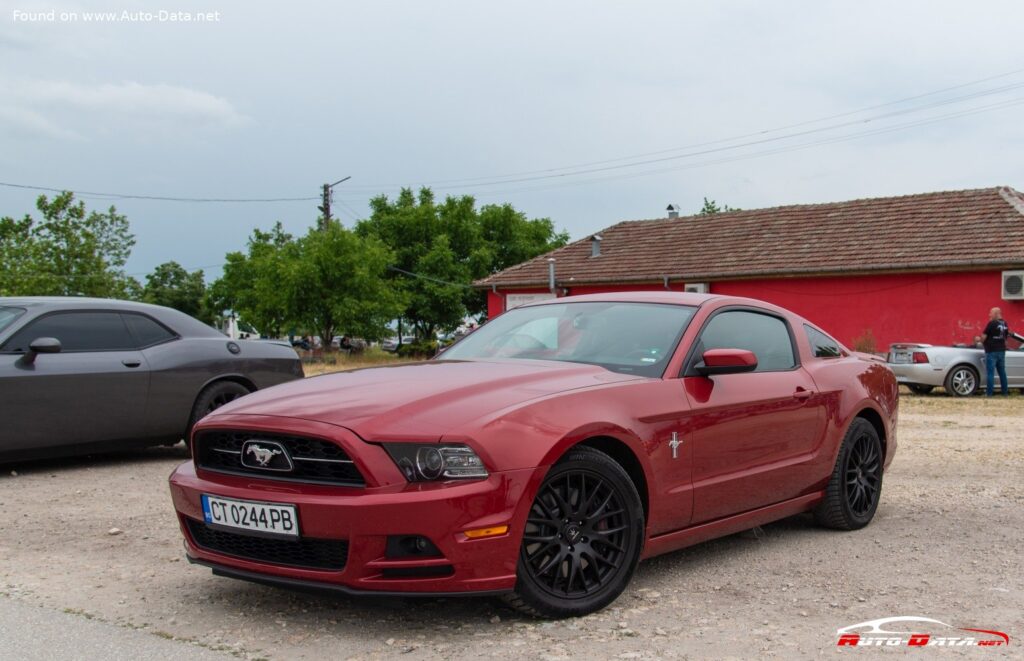
The Ford Mustang V (facelift 2012) GT 5.0 V8 maintains the classic two-door coupe body style, accommodating four occupants. The 2012 facelift introduced several aesthetic and functional enhancements that sharpened its appearance and improved its aerodynamics. Key exterior updates included a more aggressive front fascia with a revised grille and splitter, new HID (High-Intensity Discharge) headlamps with LED accents, and a redesigned rear with new LED taillights and a black panel connecting them. These changes gave the Mustang a more contemporary and assertive stance while retaining its unmistakable retro appeal. The car’s dimensions, measuring 188.5 inches in length, 73.9 inches in width (80.12 inches including mirrors), and 55.79 inches in height, provided a substantial road presence.
Underneath its muscular skin, the Mustang GT featured a robust chassis designed for spirited driving. The front suspension utilized an independent MacPherson type with a transverse stabilizer, while the rear employed a rigid axle suspension with coil springs and a transverse stabilizer. While some competitors had moved to fully independent rear suspensions, Ford maintained the rigid axle in the S197 Mustang for cost-effectiveness and durability, a characteristic often debated among enthusiasts. Stopping power was provided by ventilated disc brakes on both the front (336×36 mm) and rear (300×19 mm) axles, complemented by ABS (Anti-lock Braking System) for enhanced safety. The electric power steering system offered precise control and improved fuel efficiency compared to hydraulic setups. Standard tire sizes ranged from 235/50 R18 to 245/45 R19, mounted on 18-inch or 19-inch alloy wheels, filling the wheel wells aggressively. The trunk offered a practical 13.38 cu. ft. (379 liters) of cargo space, making it a surprisingly capable daily driver for a performance coupe.
Technical Specifications
| Category | Specification |
|---|---|
| Brand | Ford |
| Model | Mustang |
| Generation | Mustang V (facelift 2012) |
| Type (Engine) | GT 5.0 V8 (420 Hp) Automatic |
| Start of Production | 2012 year |
| End of Production | 2014 year |
| Powertrain Architecture | Internal Combustion engine |
| Body type | Coupe |
| Seats | 4 |
| Doors | 2 |
| Performance Specs | |
| Fuel Consumption (Urban) | 13.1 l/100 km (18 US mpg) |
| Fuel Consumption (Extra Urban) | 9.4 l/100 km (25 US mpg) |
| Fuel Consumption (Combined) | 11.8 l/100 km (19.9 US mpg) |
| Fuel Type | Petrol (Gasoline) |
| Weight-to-Power Ratio | 4 kg/Hp (251.9 Hp/tonne) |
| Weight-to-Torque Ratio | 3.2 kg/Nm (317.3 Nm/tonne) |
| Engine Specs | |
| Power | 420 Hp @ 6500 rpm |
| Power per Liter | 84.8 Hp/l |
| Torque | 529 Nm (390.17 lb.-ft.) @ 4250 rpm |
| Maximum Engine Speed | 7000 rpm |
| Engine Layout | Front, Longitudinal |
| Engine Model/Code | Coyote |
| Engine Displacement | 4951 cm³ (302.13 cu. in., 5.0 L) |
| Number of Cylinders | 8 |
| Engine Configuration | V-engine |
| Cylinder Bore | 92.2 mm (3.63 in.) |
| Piston Stroke | 92.7 mm (3.65 in.) |
| Compression Ratio | 11:1 |
| Number of Valves per Cylinder | 4 |
| Fuel Injection System | Multi-port manifold injection |
| Engine Aspiration | Naturally aspirated engine |
| Valvetrain | DOHC, Ti-VCT |
| Engine Oil Capacity | 7.6 l (8.03 US qt) |
| Coolant Capacity | 12.3 l (13 US qt) |
| Space, Volume and Weights | |
| Kerb Weight | 1667 kg (3675.11 lbs) |
| Trunk (boot) Space – Minimum | 379 l (13.38 cu. ft.) |
| Fuel Tank Capacity | 61 l (16.11 US gal) |
| Permitted Trailer Load with Brakes (12%) | 454 kg (1000.9 lbs) |
| Dimensions | |
| Length | 4788 mm (188.5 in.) |
| Width | 1877 mm (73.9 in.) |
| Width Including Mirrors | 2035 mm (80.12 in.) |
| Height | 1417 mm (55.79 in.) |
| Wheelbase | 2720 mm (107.09 in.) |
| Front Track | 1562 mm (61.5 in.) |
| Rear (Back) Track | 1577 mm (62.09 in.) |
| Minimum Turning Circle (Turning Diameter) | 10.2 m (33.46 ft.) |
| Drivetrain, Brakes and Suspension Specs | |
| Drivetrain Architecture | The Internal combustion engine (ICE) drives the rear wheels of the vehicle. |
| Drive Wheel | Rear wheel drive |
| Number of Gears and Type of Gearbox | 6 gears, automatic transmission |
| Front Suspension | Independent type McPherson, Transverse stabilizer |
| Rear Suspension | Rigid axle suspension, Transverse stabilizer, Coil spring |
| Front Brakes | Ventilated discs, 336×36 mm |
| Rear Brakes | Ventilated discs, 300×19 mm |
| Assisting Systems | ABS (Anti-lock braking system) |
| Steering Type | Steering rack and pinion |
| Power Steering | Electric Steering |
| Tires Size | 235/50 R18; 245/45 R19 |
| Wheel Rims Size | 8J x 18; 8.5J x 19 |
Legacy and Market Impact of the Ford Mustang V (Facelift 2012) GT 5.0 V8
The Ford Mustang V (facelift 2012) GT 5.0 V8 occupies a significant place in the Mustang’s storied history, particularly as it ushered in a new era of performance for the iconic pony car. The reintroduction of the “5.0” moniker, absent since the early 1990s, resonated deeply with enthusiasts and marked a true return to form for the GT model. The Coyote V8 was a revelation, offering a level of power, refinement, and efficiency that surpassed previous Mustang GT engines and firmly re-established Ford’s dominance in the muscle car horsepower wars.
In its primary market, the United States, the Mustang GT faced stiff competition from its traditional rivals: the Chevrolet Camaro SS and the Dodge Challenger R/T and SRT models. The 2012 Mustang GT stood out with its potent Coyote engine, distinctive retro-modern styling, and a compelling performance-to-price ratio. While the Camaro often offered a more modern independent rear suspension, the Mustang’s solid axle, refined over decades, still delivered impressive straight-line acceleration and was a favorite for drag racing. The Challenger, meanwhile, typically emphasized brute force and a larger, more comfortable cruiser experience. The Mustang GT, with its balanced approach, appealed to a wide demographic, from daily drivers seeking a stylish and powerful coupe to weekend warriors craving track-day thrills.
The 2012-2014 facelifted Mustang V GT 5.0 V8 is remembered as a high point for the S197 generation. It successfully blended classic Mustang heritage with contemporary engineering, setting the stage for the globally-oriented sixth-generation Mustang that would follow. Its legacy is one of renewed passion for the Mustang brand, a testament to the power of a well-engineered V8, and a continued celebration of American muscle car culture. Even today, these models are highly sought after by enthusiasts for their robust powertrain, timeless design, and the visceral driving experience that only a naturally aspirated 5.0-liter V8 Mustang can provide.