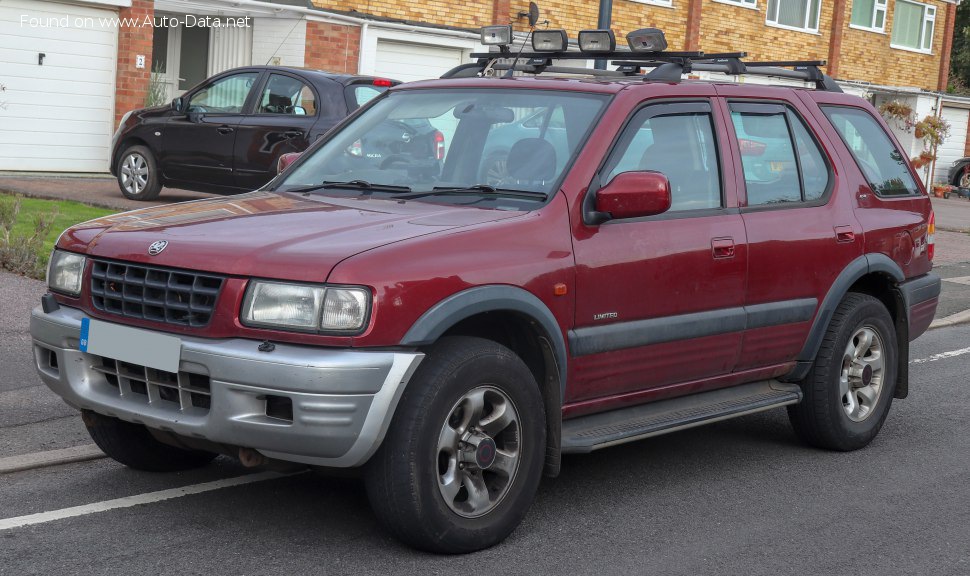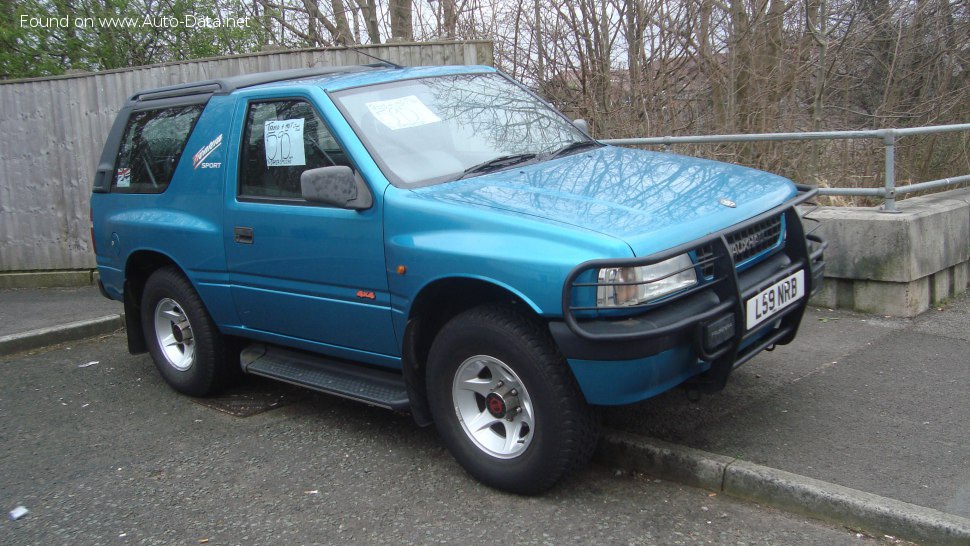
Vauxhall Frontera Sport 2.8 TD (113 Hp)
The Vauxhall Frontera Sport 2.8 TD (113 Hp) represents a significant, albeit short-lived, iteration of Vauxhall’s compact sport utility vehicle (SUV) offering in the mid-1990s. As a brand primarily sold in the United Kingdom, Vauxhall, a subsidiary of General Motors (GM), often rebadged Opel models from mainland Europe. However, the Frontera was a unique case, being a rebadged version of the Isuzu Rodeo (or Isuzu MU in some markets), reflecting GM’s global platform sharing strategy. Introduced for a brief production run between 1995 and 1996, the Frontera Sport 2.8 TD was positioned as a rugged, capable, and more agile alternative to larger, more cumbersome off-roaders, targeting consumers seeking both utility and a degree of driving enjoyment. This specific variant, with its potent 2.8-liter turbocharged diesel engine, carved out a niche for itself in the European and UK markets, where diesel powerplants were gaining considerable traction for their efficiency and torque characteristics.
The Frontera itself was available in two primary body styles: a five-door long-wheelbase wagon and the three-door “Sport” variant, which featured a shorter wheelbase. The 2.8 TD engine was a crucial upgrade, offering enhanced performance over the earlier 2.3-liter diesel and 2.0-liter gasoline engines. While never officially sold in the United States, the Frontera’s underlying Isuzu architecture meant it shared DNA with vehicles like the Isuzu Rodeo and Honda Passport that were familiar to American consumers. Its heritage as a robust, body-on-frame SUV underscored its design philosophy, focusing on off-road prowess and durability rather than the car-like comfort and refinement that would later define the crossover segment.
Engine and Performance of the Vauxhall Frontera Sport
At the heart of the Vauxhall Frontera Sport 2.8 TD (113 Hp) was its robust 2.8-liter (2771 cm³ or 169.1 cu. in.) inline four-cylinder diesel engine, designated by the code 4JB1T. This turbocharged unit was a workhorse, delivering 113 horsepower at a relatively low 3600 rpm. More importantly for an SUV designed for utility and off-road capability, it produced a substantial 242 Newton-meters (178.49 lb.-ft.) of torque at just 2100 rpm. This low-end torque was instrumental in providing the necessary pulling power for challenging terrain and towing, a key attribute for vehicles in its segment during the mid-nineties.
The engine utilized a precombustion chamber injection system, a common technology for diesel engines of its era, known for its reliability and ability to handle various fuel qualities, though it was less refined than later direct injection systems. Power was routed through a durable 5-speed manual transmission, offering drivers direct control over the engine’s output. The drivetrain featured an all-wheel drive (4×4) system, allowing for selectable two-wheel drive for on-road efficiency and four-wheel drive for enhanced traction in adverse conditions.
In terms of raw performance, the Frontera Sport 2.8 TD was surprisingly agile for its class and weight. It could accelerate from 0 to 60 mph in an estimated 8.6 seconds (calculated by Auto-Data.net), which was competitive for a diesel SUV of its time. Its maximum speed was approximately 91.34 mph (147 km/h), reflecting its design priorities toward utility and off-road capability rather than high-speed cruising. Fuel economy figures, while not exceptional by modern standards, were respectable for a 4×4 SUV of the era: an estimated 14.7 US mpg in urban driving, 27.7 US mpg on the extra-urban cycle, and a combined average of 21.4 US mpg. These figures highlighted the diesel engine’s inherent efficiency advantages, especially for long-distance travel and heavy-duty use.
Design and Features
The Vauxhall Frontera Sport 2.8 TD adopted a classic three-door SUV body type, emphasizing its sportier and more adventurous character compared to its five-door sibling. Its design was utilitarian and robust, typical of 1990s SUVs, with a boxy silhouette and prominent wheel arches that conveyed a sense of ruggedness. Measuring 165.04 inches in length, 70.08 inches in width, and 67.76 inches in height, with a compact 91.73-inch wheelbase, the Frontera Sport was designed for maneuverability, particularly in off-road scenarios where a shorter footprint is advantageous.
Despite its compact exterior, the Frontera Sport offered seating for five occupants. Cargo capacity was reasonable for a three-door vehicle, ranging from 10.59 cubic feet with all seats in place to a more generous 40.97 cubic feet when the rear seats were folded, making it practical for weekend adventures or hauling gear. The vehicle’s curb weight stood at 4030.05 pounds, contributing to its stable and solid feel, while its maximum load capacity of 1503.55 pounds underscored its utility focus.
Key features for the era included a hydraulic power steering system with a worm-reduction unit, providing predictable and robust steering feedback, essential for off-road driving. Safety was addressed with the inclusion of an Anti-lock Braking System (ABS), a significant feature for the mid-nineties, enhancing control during emergency braking. The braking system comprised ventilated discs on both the front and rear axles, ensuring effective stopping power. The Frontera Sport rode on 235/70 R16 tires mounted on 7J x 16-inch wheel rims, a practical setup designed to balance on-road comfort with off-road grip. The overall design language and feature set reflected a vehicle built for purpose, prioritizing durability and capability over luxury appointments, aligning with the expectations of SUV buyers in its primary markets.
Technical Specifications
| Category | Specification | US Equivalent |
|---|---|---|
General Information |
||
| Brand | Vauxhall | |
| Model | Frontera | |
| Generation | Frontera Sport | |
| Type (Engine) | 2.8 TD (113 Hp) | |
| Start of Production | 1995 year | |
| End of Production | 1996 year | |
| Powertrain Architecture | Internal Combustion engine | |
| Body type | SUV | |
| Seats | 5 | |
| Doors | 3 | |
Performance Specs |
||
| Fuel Consumption (Economy) – Urban | 16 l/100 km | 14.7 US mpg |
| Fuel Consumption (Economy) – Extra Urban | 8.5 l/100 km | 27.7 US mpg |
| Fuel Consumption (Economy) – Combined | 11 l/100 km | 21.4 US mpg |
| Fuel Type | Diesel | |
| Acceleration 0 – 60 mph (Calculated) | 8.6 sec | |
| Maximum Speed | 147 km/h | 91.34 mph |
| Weight-to-power ratio | 16.2 kg/Hp | 61.8 Hp/tonne |
| Weight-to-torque ratio | 7.6 kg/Nm | 132.4 Nm/tonne |
Engine Specs |
||
| Power | 113 Hp @ 3600 rpm | |
| Power per liter | 40.8 Hp/l | |
| Torque | 242 Nm @ 2100 rpm | 178.49 lb.-ft. @ 2100 rpm |
| Engine Layout | Front, Longitudinal | |
| Engine Model/Code | 4JB1T | |
| Engine Displacement | 2771 cm³ | 2.8 Liters (169.1 cu. in.) |
| Number of Cylinders | 4 | |
| Engine Configuration | Inline | |
| Cylinder Bore | 93 mm | 3.66 in. |
| Piston Stroke | 102 mm | 4.02 in. |
| Compression Ratio | 17.9:1 | |
| Number of Valves per Cylinder | 2 | |
| Fuel Injection System | Precombustion chamber injection | |
| Engine Aspiration | Turbocharger | |
| Engine Oil Capacity | 5.5 l | 5.81 US qt |
| Engine Oil Specification | Not specified in data provided | |
| Coolant Capacity | 8.8 l | 9.3 US qt |
Space, Volume and Weights |
||
| Kerb Weight | 1828 kg | 4030.05 lbs. |
| Max. Weight | 2510 kg | 5533.6 lbs. |
| Max Load | 682 kg | 1503.55 lbs. |
| Trunk (Boot) Space – Minimum | 300 l | 10.59 cu. ft. |
| Trunk (Boot) Space – Maximum | 1160 l | 40.97 cu. ft. |
| Fuel Tank Capacity | 80 l | 21.13 US gal |
Dimensions |
||
| Length | 4192 mm | 165.04 in. |
| Width | 1780 mm | 70.08 in. |
| Height | 1721 mm | 67.76 in. |
| Wheelbase | 2330 mm | 91.73 in. |
| Front Track | 1455 mm | 57.28 in. |
| Rear (Back) Track | 1460 mm | 57.48 in. |
Drivetrain, Brakes and Suspension Specs |
||
| Drive Wheel | All-wheel drive (4×4) | |
| Number of Gears and Type of Gearbox | 5 gears, manual transmission | |
| Front Brakes | Ventilated discs | |
| Rear Brakes | Ventilated discs | |
| Assisting Systems | ABS (Anti-lock braking system) | |
| Steering Type | Worm-reduction unit | |
| Power Steering | Hydraulic Steering | |
| Tires Size | 235/70 R16 | |
| Wheel Rims Size | 7J x 16 | |
Legacy and Market Impact of the Vauxhall Frontera Sport
The Vauxhall Frontera Sport 2.8 TD (113 Hp), despite its short production window for this specific engine variant, played a notable role in the burgeoning SUV market in the UK and Europe during the mid-1990s. At a time when the SUV segment was transitioning from purely utilitarian vehicles to more lifestyle-oriented options, the Frontera Sport occupied a valuable middle ground. It offered the ruggedness and off-road capability of a traditional 4×4, derived from its Isuzu underpinnings, combined with a more approachable size and a degree of on-road civility.
Its primary competitors in the UK market included vehicles like the Suzuki Vitara (known as the Geo Tracker in the US), which was smaller and often less powerful, and eventually the first-generation Land Rover Freelander, which arrived slightly later but offered a more refined, albeit less robust, monocoque design. Other rivals included the Toyota RAV4, which pioneered the compact crossover segment with its car-like handling, and more traditional offerings like the Nissan Terrano II. The Frontera Sport, with its body-on-frame construction and selectable 4×4, offered a more traditional off-road experience compared to these emerging car-based SUVs.
The reputation of the Frontera, and specifically the diesel-powered variants, was largely built on its perceived durability and value for money. It was often seen as a more affordable alternative to premium European and Japanese off-roaders, offering genuine capability without the higher price tag. The 2.8 TD engine, in particular, was praised for its strong torque, making it a capable choice for towing and navigating challenging terrain, which resonated with farmers, outdoor enthusiasts, and tradespeople alike.
However, like many vehicles of its era, the Frontera was not without its criticisms. Some reviews pointed to its somewhat agricultural driving dynamics compared to more refined competitors, and interior quality was functional rather than luxurious. Despite this, its robust mechanicals and straightforward design contributed to its appeal as a reliable workhorse.
The Frontera’s legacy is that of a significant pioneer for Vauxhall in the SUV space, establishing the brand’s presence in a rapidly expanding market segment. It demonstrated GM’s capability for global product sharing and adaptation to regional market demands, particularly the strong European preference for diesel engines. While the Frontera line eventually concluded production in 2004, succeeded by more modern crossovers, the Frontera Sport 2.8 TD remains a classic example of a mid-90s compact SUV that prioritized rugged capability and diesel efficiency, leaving its mark as a practical and dependable vehicle in its primary markets.