
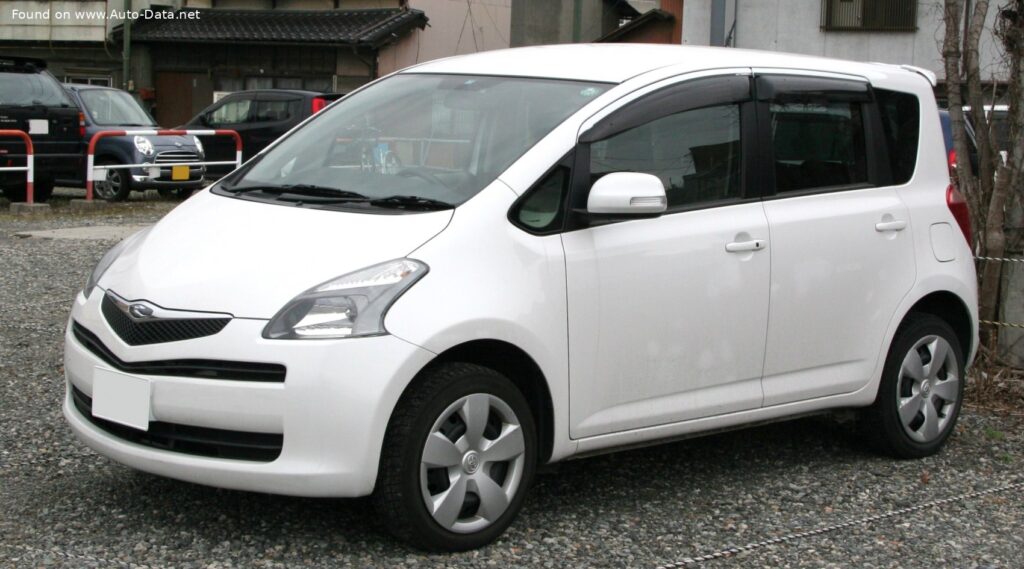
Toyota Ractis I 1.5i 16V (110 Hp)
The Toyota Ractis I 1.5i 16V (110 Hp) represents the first generation of Toyota’s compact minivan, a vehicle primarily designed for the Japanese domestic market (JDM) and also sold in select European and Asian markets. Launched in October 2005, the Ractis I was conceived as a versatile and space-efficient urban transporter, replacing the Toyota Fun Cargo (known as the Yaris Verso in Europe). Its name, “Ractis,” is a portmanteau of “Run,” “Activity,” and “Space,” clearly indicating its design philosophy. This particular variant, powered by a 1.5-liter 16-valve engine delivering 110 horsepower, was a popular choice, offering a balanced blend of performance and fuel efficiency for its segment. The Ractis I remained in production until November 2010, establishing a strong reputation for Toyota’s characteristic reliability and practicality in a compact, family-friendly package.
Overview of the Toyota Ractis I
Design Philosophy and Market Positioning
The Toyota Ractis I was developed with a clear focus on maximizing interior space within a compact footprint, a crucial consideration for crowded urban environments in Japan and Europe. Its design eschewed traditional sedan or hatchback forms in favor of a “tall wagon” or compact minivan silhouette, which allowed for a surprisingly spacious cabin despite its modest external dimensions. The Ractis I was positioned to appeal to young families and individuals seeking a highly practical vehicle with easy maneuverability, excellent visibility, and flexible cargo solutions. It competed in a segment that valued smart packaging and fuel economy, often against rivals like the Honda Fit/Jazz and Nissan Note, offering a distinctively Toyota approach to the compact multi-purpose vehicle (MPV) concept.
The vehicle’s architecture, utilizing a front, transverse-mounted internal combustion engine driving the front wheels, was typical for its class, prioritizing efficiency and packaging. Its five-door, five-seat configuration made it a versatile choice for daily commutes, grocery runs, and weekend family excursions. The Ractis I’s introduction marked Toyota’s continued commitment to innovative small car designs that catered to specific regional demands for practicality and urban suitability, even if not directly offered in the North American market.
Toyota Ractis I: Engine and Performance
At the heart of the Toyota Ractis I 1.5i 16V (110 Hp) is Toyota’s venerable 1NZ-FE engine, a 1.5-liter (1496 cm3 or 91.29 cubic inches) inline four-cylinder unit. This engine, renowned for its reliability and efficiency, features a DOHC (Double Overhead Camshaft) valvetrain with 16 valves (four per cylinder), optimizing airflow for improved performance and fuel economy. It is a naturally aspirated engine, utilizing a multi-port manifold injection system to deliver gasoline precisely to each cylinder.
The 1NZ-FE in this Ractis variant produces a respectable 110 horsepower at 6000 rpm. This power output, combined with the engine’s relatively light weight, results in a weight-to-power ratio of 10.4 kg/Hp (or 96.5 Hp per tonne), providing ample acceleration for city driving and comfortable cruising on highways. Torque peaks at 104 lb.-ft. (141 Nm) at 4400 rpm, ensuring responsive performance, particularly in the mid-range where it’s most frequently utilized in daily driving. The weight-to-torque ratio stands at 8.1 kg/Nm (or 123.7 Nm per tonne).
Fuel efficiency was a key selling point for the Ractis I. The 1.5-liter engine boasts an impressive extra-urban fuel consumption figure of 5.5 liters per 100 kilometers, which translates to approximately 42.8 US miles per gallon. This excellent economy, coupled with its Euro 4 emission standard compliance, made it an environmentally conscious choice for its time. The engine’s compression ratio of 10.5:1 further contributes to its efficiency. The vehicle’s drivetrain architecture is straightforward front-wheel drive, a common and efficient setup for compact vehicles, providing predictable handling and reducing mechanical complexity.
Interior and Exterior Design of the Toyota Ractis I
The design of the Toyota Ractis I is a testament to functional aesthetics. Its exterior, while undeniably practical, features smooth lines and a rounded profile that softens its minivan stance. Measuring 157.28 inches (3995 mm) in length, 66.73 inches (1695 mm) in width, and 64.57 inches (1640 mm) in height, the Ractis I is remarkably compact, making it easy to navigate tight city streets and park in confined spaces. The relatively long wheelbase of 100.39 inches (2550 mm) for its overall length contributes to a stable ride and maximizes interior volume.
Inside, the Ractis I shines with its intelligent use of space. As a 5-door, 5-seat minivan, its cabin is designed for flexibility. While specific details on seat folding mechanisms are not provided, vehicles in this segment typically offer versatile rear seating arrangements, such as split-folding or flat-folding seats, to accommodate varying passenger and cargo needs. Large windows and a tall roofline create an airy and open cabin feel, enhancing visibility for all occupants. The instrument panel is typically ergonomic and user-friendly, consistent with Toyota’s philosophy of intuitive controls.
Safety and Driver Assistance
For a vehicle of its era, especially one focused on urban family use, safety features were a significant consideration. The Toyota Ractis I 1.5i 16V (110 Hp) came equipped with essential assisting systems, including ABS (Anti-lock Braking System), which was crucial for maintaining steering control during hard braking. The braking system itself comprises ventilated discs at the front for effective heat dissipation and drum brakes at the rear, a common and cost-effective setup for compact cars. The suspension system, featuring independent McPherson struts at the front and a torsion beam at the rear, provided a comfortable ride while maintaining good handling characteristics, suitable for both city driving and light highway use.
Technical Specifications
| General Information | |
|---|---|
| Brand | Toyota |
| Model | Ractis |
| Generation | Ractis I |
| Type (Engine) | 1.5i 16V (110 Hp) |
| Start of Production | October, 2005 year |
| End of Production | November, 2010 year |
| Powertrain Architecture | Internal Combustion engine |
| Body Type | Minivan |
| Seats | 5 |
| Doors | 5 |
| Performance Specs | |
| Fuel Consumption (economy) – extra urban | 5.5 l/100 km (42.8 US mpg) |
| Fuel Type | Gasoline |
| Emission Standard | Euro 4 |
| Weight-to-power ratio | 10.4 kg/Hp (96.5 Hp/tonne) |
| Weight-to-torque ratio | 8.1 kg/Nm (123.7 Nm/tonne) |
| Engine Specs | |
| Power | 110 Hp @ 6000 rpm. |
| Power per liter | 73.5 Hp/l |
| Torque | 141 Nm @ 4400 rpm. (104 lb.-ft. @ 4400 rpm) |
| Engine Layout | Front, Transverse |
| Engine Model/Code | 1NZ-FE |
| Engine Displacement | 1496 cm3 (91.29 cu. in.) |
| Number of Cylinders | 4 |
| Engine Configuration | Inline |
| Cylinder Bore | 75 mm (2.95 in.) |
| Piston Stroke | 84.7 mm (3.33 in.) |
| Compression Ratio | 10.5:1 |
| Number of Valves per Cylinder | 4 |
| Fuel Injection System | Multi-port manifold injection |
| Engine Aspiration | Naturally aspirated engine |
| Valvetrain | DOHC |
| Engine Oil Capacity | 3.7 l (3.91 US qt) |
| Coolant | 4.7 l (4.97 US qt) |
| Space, Volume and Weights | |
| Kerb Weight | 1140 kg (2513.27 lbs.) |
| Max. Weight | 1415 kg (3119.54 lbs.) |
| Max Load | 275 kg (606.27 lbs.) |
| Dimensions | |
| Length | 3995 mm (157.28 in.) |
| Width | 1695 mm (66.73 in.) |
| Height | 1640 mm (64.57 in.) |
| Wheelbase | 2550 mm (100.39 in.) |
| Front Track | 1485 mm (58.46 in.) |
| Rear (Back) Track | 1475 mm (58.07 in.) |
| Drivetrain, Brakes and Suspension Specs | |
| Drivetrain Architecture | The Internal combustion engine (ICE) drives the front wheels of the vehicle. |
| Drive Wheel | Front wheel drive |
| Front Suspension | Independent type McPherson |
| Rear Suspension | Torsion |
| Front Brakes | Ventilated discs |
| Rear Brakes | Drum |
| Assisting Systems | ABS (Anti-lock braking system) |
Legacy and Market Impact of the Toyota Ractis I
The Toyota Ractis I carved out a significant niche for itself in the compact segment of the Japanese and select international markets. Its reputation was built on Toyota’s core strengths: unwavering reliability, exceptional build quality, and outstanding fuel efficiency. For many urban dwellers and small families, the Ractis I presented an ideal solution, offering the practicality of a larger vehicle without the associated bulk or higher running costs.
In its primary markets, the Ractis I faced competition from other compact, space-efficient models such as the Honda Fit/Jazz, Nissan Note, and Suzuki Solio. What set the Ractis apart was its slightly more upright and boxy profile, which translated directly into superior headroom and a more versatile cargo area compared to some of its more conventionally styled hatchback rivals. Its compact exterior dimensions, combined with a tight turning radius, made it particularly adept at navigating congested city streets and fitting into challenging parking spaces, which was a major draw in markets like Japan.
The Ractis I’s historical significance lies in its role as a successor to the popular Fun Cargo, continuing Toyota’s tradition of offering highly practical and adaptable compact vehicles. It demonstrated how thoughtful design could transform a small platform into a highly functional family car. While never officially imported into the United States, the Ractis I embodies a global automotive trend towards maximizing utility and efficiency in smaller packages, showcasing Toyota’s global design and engineering prowess. Its success paved the way for subsequent generations and reinforced the demand for compact, versatile minivans in markets where space and efficiency are paramount. The Ractis I remains a well-regarded used vehicle in its operating regions, a testament to its enduring design and mechanical robustness.

