The Renault Megane II Grandtour (Phase II, 2006) 1.9 dCi (130 Hp) FAP Automatic: A European Mainstay
The Renault Megane II Grandtour (Phase II, 2006) 1.9 dCi (130 Hp) FAP Automatic represents a significant offering from the French automaker in the highly competitive European C-segment. Launched as part of the second generation Megane’s mid-cycle refresh in 2006, this particular variant combined the practicality of a station wagon (known as an “estate” in Europe) with the efficiency and robust torque of a turbodiesel engine, paired with a convenient automatic transmission. While never officially sold in the United States, the Megane II Grandtour was a ubiquitous sight on European roads, catering to families and professionals who prioritized space, fuel economy, and a comfortable ride. It continued Renault’s tradition of innovative design and engineering, offering a compelling package from its production start in 2006 until its conclusion in 2009.
Engineering and Performance of the Renault Megane II Grandtour (Phase II, 2006)
Under the hood, the Renault Megane II Grandtour (Phase II, 2006) 1.9 dCi (130 Hp) FAP Automatic was powered by Renault’s well-regarded F9Q Turbo diesel engine. This 1.9-liter (1870 cm3 or 114.11 cu. in.) inline four-cylinder powerplant, mounted transversely at the front, was a testament to the European market’s embrace of diesel technology for its superior fuel efficiency and torque characteristics. The engine featured a Commonrail direct fuel injection system, augmented by a turbocharger and an intercooler, which together produced a respectable 130 horsepower at 4000 rpm. More importantly for real-world driving, it delivered a potent 221.27 lb.-ft. (300 Nm) of torque at a low 2000 rpm, providing excellent pulling power and making it well-suited for both urban commutes and long-distance highway cruising, especially when loaded with passengers and cargo.
Power was sent to the front wheels via a 4-speed automatic transmission, a choice that emphasized smooth operation and ease of driving over outright performance. Despite the relatively limited number of gears by modern standards, the transmission was well-matched to the engine’s torque curve, ensuring responsive acceleration. The Megane II Grandtour 1.9 dCi FAP Automatic could accelerate from 0 to 60 mph in a brisk 8.6 seconds, with a top speed of 122.41 mph (197 km/h). These figures positioned it competitively within its segment, offering a blend of performance and practicality.
Fuel economy was a key selling point for this diesel variant, especially in a region where fuel prices were a significant consideration. The vehicle achieved an impressive combined fuel economy of 35.6 US mpg (6.6 l/100 km), with even better figures on the highway at 45.2 US mpg (5.2 l/100 km). Urban consumption was rated at 26.1 US mpg (9 l/100 km). Furthermore, this model was equipped with a Particulate Filter (FAP), an advanced exhaust after-treatment system that reduced soot emissions, allowing it to meet the stringent Euro 4 emission standard with CO2 emissions of 175 g/km. This commitment to cleaner diesel technology was crucial for its market viability in the mid-2000s.
Design and Features
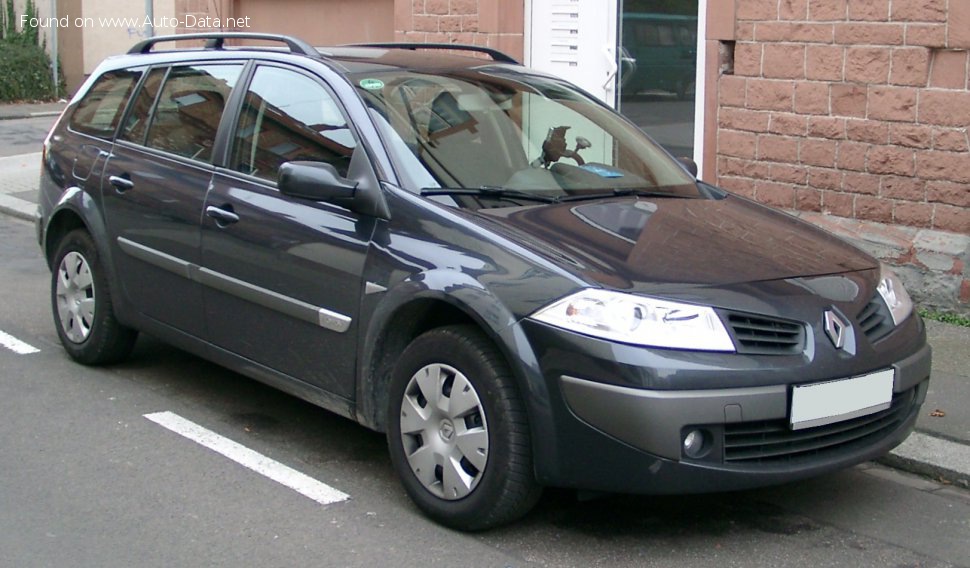
The Megane II Grandtour inherited the distinctive design language of the second-generation Megane, albeit with a more conventional rear end compared to the polarizing “bustle-back” design of the hatchback. As a station wagon, its primary focus was on utility and passenger comfort. The exterior styling was characterized by smooth lines, a prominent Renault badge, and clear, functional lighting. The Phase II refresh in 2006 brought subtle updates, including revised front and rear bumpers, new headlight designs, and updated interior trims, keeping the model fresh against newer competitors.
Measuring 177.17 inches (4500 mm) in length, 69.96 inches (1777 mm) in width (79.76 inches including mirrors), and 57.76 inches (1467 mm) in height, the Grandtour provided a spacious interior for five occupants. Its 105.75-inch (2686 mm) wheelbase contributed to a comfortable ride and generous legroom. The true highlight of the Grandtour was its cargo capacity: a substantial 18.36 cu. ft. (520 liters) with all seats in place, expanding to an impressive 56.5 cu. ft. (1600 liters) when the rear seats were folded down. This made it an ideal choice for families, travelers, or anyone needing significant hauling capability without resorting to a larger, less fuel-efficient SUV.
Beyond its spaciousness, the Megane II Grandtour featured a well-appointed interior for its class. Renault placed a strong emphasis on ergonomics and material quality. Standard features for the era included power windows, air conditioning, and a comprehensive audio system. Safety was also a priority, with the vehicle incorporating an Anti-lock Braking System (ABS) as standard, along with multiple airbags and a robust body structure. The steering system utilized an electric power steering unit, offering precise control and improved fuel efficiency compared to traditional hydraulic systems. The suspension setup, featuring independent McPherson struts at the front and a torsion beam at the rear, provided a good balance of ride comfort and predictable handling, making it a pleasant car to drive on diverse European road conditions.
Technical Specifications
| Category | Specification | US Equivalent |
|---|---|---|
| General Information | ||
| Brand | Renault | |
| Model | Megane | |
| Generation | Megane II Grandtour (Phase II, 2006) | |
| Type (Engine) | 1.9 dCi (130 Hp) FAP Automatic | |
| Start of Production | 2006 year | |
| End of Production | 2009 year | |
| Powertrain Architecture | Internal Combustion engine | |
| Body type | Station wagon (estate) | |
| Seats | 5 | |
| Doors | 5 | |
| Performance Specs | ||
| Fuel consumption (economy) – urban | 9 l/100 km | 26.1 US mpg |
| Fuel consumption (economy) – extra urban | 5.2 l/100 km | 45.2 US mpg |
| Fuel consumption (economy) – combined | 6.6 l/100 km | 35.6 US mpg |
| CO2 emissions | 175 g/km | |
| Fuel Type | Diesel | |
| Acceleration 0 – 100 km/h | 9 sec | |
| Acceleration 0 – 60 mph (Calculated) | 8.6 sec | |
| Maximum speed | 197 km/h | 122.41 mph |
| Emission standard | Euro 4 | |
| Weight-to-power ratio | 10.1 kg/Hp | 98.9 Hp/tonne |
| Weight-to-torque ratio | 4.4 kg/Nm | 228.1 Nm/tonne |
| Engine Specs | ||
| Power | 130 Hp @ 4000 rpm | |
| Power per liter | 69.5 Hp/l | |
| Torque | 300 Nm @ 2000 rpm | 221.27 lb.-ft. @ 2000 rpm |
| Engine layout | Front, Transverse | |
| Engine Model/Code | F9Q Turbo | |
| Engine displacement | 1870 cm3 | 1.9 Liters (114.11 cu. in.) |
| Number of cylinders | 4 | |
| Engine configuration | Inline | |
| Cylinder Bore | 80 mm | 3.15 in. |
| Piston Stroke | 93 mm | 3.66 in. |
| Compression ratio | 19:1 | |
| Number of valves per cylinder | 2 | |
| Fuel injection system | Diesel Commonrail | |
| Engine aspiration | Turbocharger, Intercooler | |
| Valvetrain | OHC | |
| Engine oil capacity | 4.5 l | 4.76 US qt |
| Coolant | 7.9 l | 8.35 US qt |
| Engine systems | Particulate filter | |
| Space, Volume and Weights | ||
| Kerb Weight | 1315 kg | 2899.08 lbs. |
| Max. weight (GVWR) | 1890 kg | 4166.74 lbs. |
| Max load | 575 kg | 1267.66 lbs. |
| Trunk (boot) space – minimum | 520 l | 18.36 cu. ft. |
| Trunk (boot) space – maximum | 1600 l | 56.5 cu. ft. |
| Fuel tank capacity | 60 l | 15.85 US gal |
| Max. roof load | 80 kg | 176.37 lbs. |
| Permitted trailer load with brakes (12%) | 1350 kg | 2976.24 lbs. |
| Permitted trailer load without brakes | 650 kg | 1433 lbs. |
| Permitted towbar download | 75 kg | 165.35 lbs. |
| Dimensions | ||
| Length | 4500 mm | 177.17 in. |
| Width | 1777 mm | 69.96 in. |
| Width including mirrors | 2026 mm | 79.76 in. |
| Height | 1467 mm | 57.76 in. |
| Wheelbase | 2686 mm | 105.75 in. |
| Front track | 1518 mm | 59.76 in. |
| Rear (Back) track | 1514 mm | 59.61 in. |
| Front overhang | 842 mm | 33.15 in. |
| Rear overhang | 972 mm | 38.27 in. |
| Minimum turning circle (turning diameter) | 10.7 m | 35.1 ft. |
| Drivetrain, Brakes and Suspension Specs | ||
| Drivetrain Architecture | The Internal combustion engine (ICE) drives the front wheels of the vehicle. | |
| Drive wheel | Front wheel drive | |
| Number of gears and type of gearbox | 4 gears, automatic transmission | |
| Front suspension | Independent type McPherson | |
| Rear suspension | Torsion | |
| Front brakes | Ventilated discs | |
| Rear brakes | Disc | |
| Assisting systems | ABS (Anti-lock braking system) | |
| Steering type | Steering rack and pinion | |
| Power steering | Electric Steering | |
| Tires size | 195/65 R15 | |
| Wheel rims size | 6.5J x 15 | |
Legacy and Market Impact
The Renault Megane II Grandtour (Phase II, 2006) 1.9 dCi (130 Hp) FAP Automatic carved out a strong niche for itself in the highly competitive European compact family car segment. It went head-to-head with established rivals such as the Ford Focus Estate, Opel Astra Caravan (Vauxhall Astra Estate in the UK), Volkswagen Golf Variant, and the Peugeot 307 SW. What set the Megane II Grandtour apart was its distinctive styling, particularly the daring design language that characterized the Megane II generation, combined with Renault’s reputation for comfort and safety. The Grandtour variant, in particular, was lauded for its exceptional practicality and generous cargo volume, making it a favorite among families needing versatility without the bulk of a larger vehicle.
The 1.9 dCi engine, especially in its 130 HP FAP guise, was a cornerstone of its appeal. Diesel engines were dominant in Europe during this period, and Renault’s dCi units were known for their refinement, strong low-end torque, and excellent fuel economy. The inclusion of a Particulate Filter (FAP) demonstrated Renault’s proactive approach to meeting stricter emissions standards, positioning the Megane as an environmentally conscious choice for its time, adhering to Euro 4 regulations. This was a significant technological advancement that many competitors were also adopting, but Renault’s implementation was considered effective and reliable.
The Megane II generation, including the Grandtour, also benefited from strong safety credentials, consistently achieving high ratings in Euro NCAP crash tests, which further bolstered its appeal to family buyers. Its electric power steering system was another modern touch, contributing to both driving ease and efficiency. While the 4-speed automatic transmission might seem rudimentary by today’s standards, it offered a smooth and relaxed driving experience that many European consumers appreciated for daily commuting and longer journeys.
Overall, the Renault Megane II Grandtour (Phase II, 2006) 1.9 dCi (130 Hp) FAP Automatic solidified Renault’s position as a leader in the compact segment in Europe. It successfully blended distinctive design, practical utility, advanced diesel technology, and a focus on safety and comfort. Its legacy is that of a highly competent and popular family car that perfectly met the demands of its primary market, demonstrating how European manufacturers innovated to offer efficient and versatile solutions for diverse consumer needs.