Ford Mustang VI 2.3 EcoBoost (309 Hp): A Global Pony Car Evolution
The Ford Mustang VI, introduced for the 2015 model year, marked a pivotal moment in the storied history of the American pony car. Representing the sixth generation of the iconic nameplate, this iteration was significant for being the first truly “global” Mustang, designed from the outset to be sold in markets around the world, not just North America. Among its most notable innovations was the introduction of a turbocharged four-cylinder engine option, a departure from the traditional V6 and V8 offerings that had defined the Mustang for decades. The Ford Mustang VI 2.3 EcoBoost (309 Hp) variant, produced between 2015 and 2017, offered a compelling blend of modern technology, respectable performance, and improved fuel efficiency, aiming to attract a new generation of buyers while still honoring the Mustang’s heritage.
This generation of Mustang was developed under the “One Ford” global product strategy, which sought to standardize Ford’s vehicle platforms and designs worldwide. The result was a sophisticated, modern sports car that retained the unmistakable visual cues of its predecessors while embracing contemporary engineering. The 2.3-liter EcoBoost engine was a cornerstone of this strategy, providing a powerful yet economical alternative to the larger displacement engines, particularly appealing to international markets where fuel costs and emissions regulations are stricter. The Fastback body style, a classic Mustang silhouette, was the primary offering for this dynamic new powertrain.
Engine and Performance of the Ford Mustang VI
Powertrain Innovation: The 2.3 EcoBoost
At the heart of the Ford Mustang VI 2.3 EcoBoost model is its advanced turbocharged inline-four engine. This 2.3-liter (2264 cm³ or 138.16 cu. in.) unit is part of Ford’s highly regarded EcoBoost family, known for combining direct fuel injection, turbocharging, and variable valve timing to deliver impressive power and torque from a relatively small displacement. This specific iteration generates a robust 309 horsepower at 5500 rpm, a figure that rivals and even surpasses the output of many V6 engines from previous Mustang generations. The engine’s power per liter stands at a commendable 136.5 Hp/l, showcasing its efficiency.
Torque delivery is equally impressive, with a substantial 407 Nm (300.19 lb.-ft.) available across a broad rev range, specifically from 2500 to 4500 rpm. This wide torque band contributes significantly to the car’s responsive acceleration and flexible driving characteristics, making it enjoyable in both city driving and spirited backroad excursions. The engine features a DOHC (Dual Overhead Camshaft) valvetrain and a 9.5:1 compression ratio, further optimizing combustion efficiency. An intercooler works in conjunction with the turbocharger to manage air intake temperatures, ensuring consistent performance even under demanding conditions.
Power is transmitted to the rear wheels via a precise 6-speed manual transmission, offering an engaging driving experience that appeals to enthusiasts. The rear-wheel-drive architecture maintains the traditional Mustang dynamic, while the modern powertrain provides a fresh take on performance. With a weight-to-power ratio of 5.2 kg/Hp (192.9 Hp/tonne) and a weight-to-torque ratio of 3.9 kg/Nm (254.1 Nm/tonne), the EcoBoost Mustang delivers a lively and agile feel.
Fuel Economy and Efficiency
One of the primary advantages of the 2.3 EcoBoost engine, especially when compared to its V8 brethren, is its improved fuel efficiency. The official EPA estimates for the Fastback model with the 6-speed manual transmission are 22 US mpg in the city, 30.9 US mpg on the highway, and a combined average of 26.1 US mpg. This translates to 10.7 l/100 km urban, 7.6 l/100 km extra urban, and 9 l/100 km combined. These figures made the EcoBoost Mustang a significantly more practical daily driver and a more appealing option in markets where fuel costs are a major consideration, without sacrificing a truly sporty feel.
Design and Features of the Mustang VI Fastback
Contemporary Styling with Heritage Cues
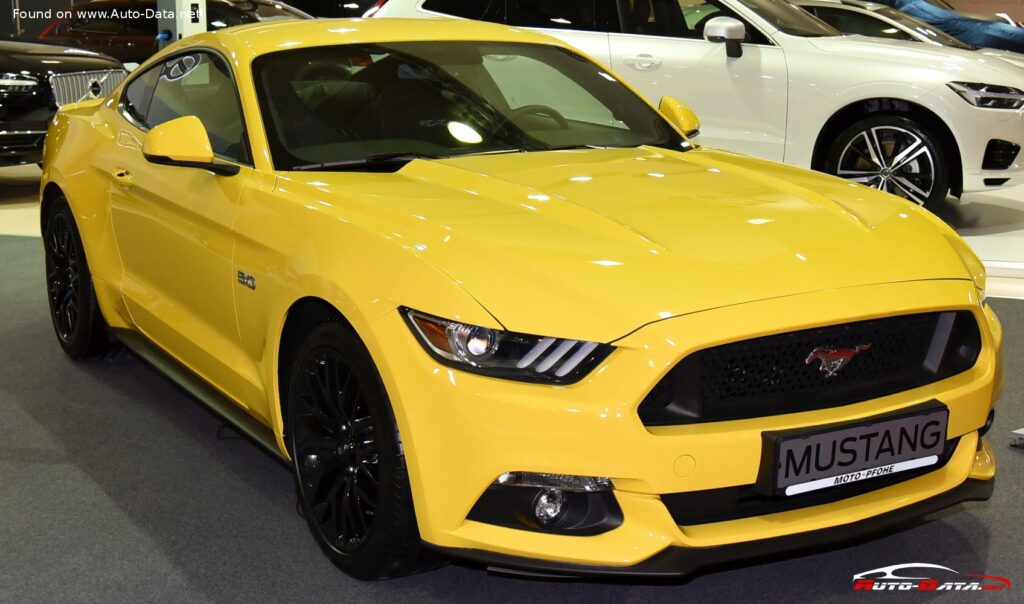
The Ford Mustang VI Fastback successfully blends classic Mustang design elements with a modern, aggressive aesthetic. Its overall dimensions – 188.31 inches (4783 mm) in length, 75.39 inches (1915 mm) in width (81.89 inches or 2080 mm with mirrors folded), and 54.41 inches (1382 mm) in height – give it a wider and lower stance than previous generations, enhancing its visual presence and handling dynamics. The iconic long hood, short deck, and muscular haunches are all present, but rendered with sharper lines and a more aerodynamic profile, indicated by a drag coefficient (Cd) of 0.32.
The interior of the Mustang VI features a driver-centric cockpit, drawing inspiration from aviation design. High-quality materials, refined ergonomics, and a host of modern conveniences were integrated to elevate the cabin experience. The 2-door, 4-seat configuration remains, offering seating for two adults comfortably in the front and two occasional passengers in the rear. Key interior features for the 2015-2017 models typically included an advanced infotainment system (Ford’s SYNC system), automatic climate control, and a customizable instrument cluster.
Advanced Chassis and Safety Systems
A significant engineering leap for the sixth-generation Mustang was the adoption of an independent rear suspension (IRS) across the entire lineup, replacing the live rear axle that had been a Mustang staple for decades. This multi-link IRS system, combined with an independent McPherson-type front suspension, dramatically improved the car’s ride quality, handling precision, and overall refinement. Both front and rear suspensions incorporate transverse stabilizers to reduce body roll during cornering.
Braking performance is handled by ventilated discs on both the front and rear axles, providing strong stopping power. An Anti-lock Braking System (ABS) comes standard, ensuring controlled deceleration in various conditions. The steering system is a rack and pinion setup with electric power steering, allowing for customizable steering feel settings and precise control. The car rides on 235/55 R17 tires mounted on 7.5J x 17 wheel rims, balancing grip with ride comfort. The minimum turning circle of 36.48 feet (11.12 meters) makes it relatively maneuverable for its size.
Technical Specifications: Ford Mustang VI 2.3 EcoBoost (309 Hp)
| Category | Specification |
|---|---|
| General Information | |
| Brand | Ford |
| Model | Mustang |
| Generation | Mustang VI |
| Type (Engine) | 2.3 EcoBoost (309 Hp) |
| Start of Production | 2015 year |
| End of Production | 2017 year |
| Powertrain Architecture | Internal Combustion engine |
| Body type | Fastback |
| Seats | 4 |
| Doors | 2 |
| Performance Specs | |
| Fuel consumption (economy) – urban | 10.7 l/100 km (22 US mpg) |
| Fuel consumption (economy) – extra urban | 7.6 l/100 km (30.9 US mpg) |
| Fuel consumption (economy) – combined | 9 l/100 km (26.1 US mpg) |
| Fuel Type | Petrol (Gasoline) |
| Weight-to-power ratio | 5.2 kg/Hp (192.9 Hp/tonne) |
| Weight-to-torque ratio | 3.9 kg/Nm (254.1 Nm/tonne) |
| Engine Specs | |
| Power | 309 Hp @ 5500 rpm |
| Power per liter | 136.5 Hp/l |
| Torque | 407 Nm (300.19 lb.-ft.) @ 2500-4500 rpm |
| Engine layout | Front, Longitudinal |
| Engine Model/Code | EcoBoost |
| Engine displacement | 2264 cm³ (2.3 l, 138.16 cu. in.) |
| Number of cylinders | 4 |
| Engine configuration | Inline |
| Cylinder Bore | 87.55 mm (3.45 in.) |
| Piston Stroke | 94 mm (3.7 in.) |
| Compression ratio | 9.5:1 |
| Number of valves per cylinder | 4 |
| Fuel injection system | Direct injection |
| Engine aspiration | Turbocharger, Intercooler |
| Valvetrain | DOHC |
| Engine oil capacity | 5.4 l (5.71 US qt) |
| Coolant | 8.96 l (9.47 US qt) |
| Space, Volume and Weights | |
| Kerb Weight | 1602 kg (3531.81 lbs) |
| Fuel tank capacity | 58 l (15.32 US gal) |
| Dimensions | |
| Length | 4783 mm (188.31 in.) |
| Width | 1915 mm (75.39 in.) |
| Width with mirrors folded | 2080 mm (81.89 in.) |
| Height | 1382 mm (54.41 in.) |
| Wheelbase | 2720 mm (107.09 in.) |
| Front track | 1582 mm (62.28 in.) |
| Rear (Back) track | 1648 mm (64.88 in.) |
| Drag coefficient (Cd) | 0.32 |
| Minimum turning circle (turning diameter) | 11.12 m (36.48 ft) |
| Drivetrain, Brakes and Suspension Specs | |
| Drivetrain Architecture | The Internal combustion engine (ICE) drives the rear wheels of the vehicle. |
| Drive wheel | Rear wheel drive |
| Number of gears and type of gearbox | 6 gears, manual transmission |
| Front suspension | Independent type McPherson, Transverse stabilizer |
| Rear suspension | Independent multi-link suspension, Transverse stabilizer |
| Front brakes | Ventilated discs |
| Rear brakes | Ventilated discs |
| Assisting systems | ABS (Anti-lock braking system) |
| Steering type | Steering rack and pinion |
| Power steering | Electric Steering |
| Tires size | 235/55 R17 |
| Wheel rims size | 7.5J x 17 |
Legacy and Market Impact of the Ford Mustang VI
The Ford Mustang VI, particularly its 2.3 EcoBoost variant, had a profound impact on the Mustang brand and the global automotive market. Its introduction sparked considerable debate among Mustang purists, who traditionally favored the larger V8 engines. However, the EcoBoost quickly proved its worth, offering a compelling package that broadened the Mustang’s appeal significantly. For many, it represented a more modern, technologically advanced, and economically sensible choice without sacrificing the essential spirit of a sports coupe.
In the United States, the EcoBoost Mustang carved out a niche as a performance-oriented daily driver, often seen as a more practical alternative to the GT models. It competed with rivals like the Chevrolet Camaro 1LT and Dodge Challenger SXT, offering a unique blend of American muscle heritage with European-inspired efficiency and handling dynamics. Its lighter front end, attributed to the smaller engine, also contributed to a more balanced weight distribution and agile handling characteristics, which some enthusiasts preferred for track driving.
Globally, the EcoBoost engine was instrumental in the Mustang’s success in new markets, particularly in Europe and Asia, where high fuel prices and stringent emissions regulations made the V8 models less viable for mass appeal. It allowed the Mustang to compete more directly with performance-oriented European coupes and hot hatches, offering a distinctive American flavor. The Mustang VI became a best-seller in many of these new markets, demonstrating the success of Ford’s global strategy.
The decision to offer a four-cylinder Mustang was a bold one, but it ultimately paid off, modernizing the brand and ensuring its relevance in an evolving automotive landscape. The 2.3 EcoBoost engine showcased that a Mustang could be both powerful and efficient, capable of delivering exciting performance while adhering to contemporary environmental and economic demands. It cemented the Mustang’s status not just as an American icon, but as a truly international sports car, paving the way for future innovations in powertrain technology for the brand.