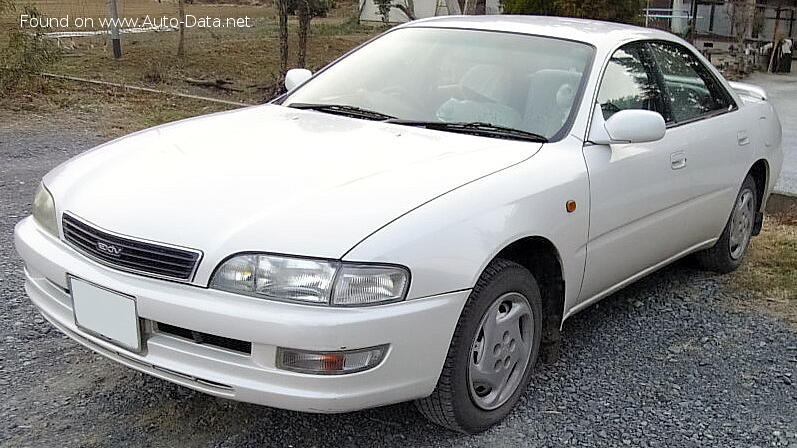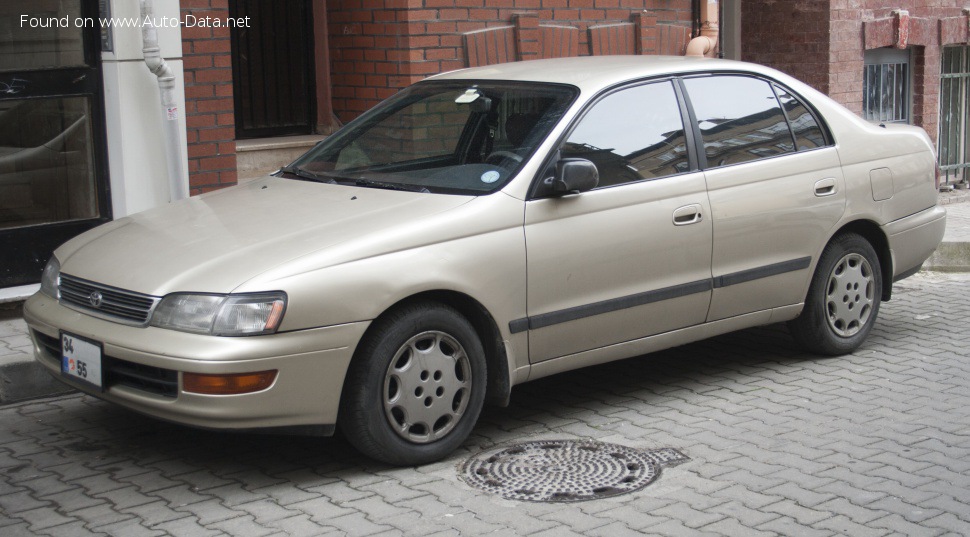
The Toyota Corona (T19) 1.8i 16V EX (125 Hp) Automatic: A Global Mainstay of Reliability
The Toyota Corona, a nameplate synonymous with dependable, practical, and economical transportation for decades, saw its ninth generation, the T19, introduced in 1992.
While the Corona name had a rich history in the United States, culminating with the T170 generation, the T19 model was largely aimed at the Japanese Domestic Market (JDM),
various Asian countries, and select European regions, where it continued Toyota’s legacy as a solid, mid-size sedan offering.
The Toyota Corona (T19) was positioned as a sensible choice for families and professionals seeking a no-frills, highly reliable vehicle.
This particular variant, the 1.8i 16V EX with 125 horsepower and an automatic transmission, represented a popular and well-balanced option within the T19 lineup,
blending reasonable performance with exceptional fuel efficiency and Toyota’s renowned build quality. Produced from 1992 to 1996, the T19 Corona
embodied the virtues of Japanese automotive engineering of its era: precision, longevity, and user-friendliness.
Engine and Performance of the Toyota Corona (T19)
At the heart of the Toyota Corona (T19) 1.8i 16V EX was Toyota’s venerable 4S-FE engine, a 1.8-liter (1,839 cm³ or 112.22 cu. in.)
inline-four cylinder powerplant. This engine featured a Double Overhead Camshaft (DOHC) valvetrain with four valves per cylinder, a configuration
that was becoming standard for efficiency and performance in the early 1990s. Fed by a multi-port manifold injection system, the naturally aspirated
engine delivered a respectable 125 horsepower at 6000 rpm, providing ample power for daily driving and highway cruising. Torque output stood at
119.49 lb.-ft. (162 Nm) at 4600 rpm, ensuring a responsive feel, especially in city traffic.
Power was delivered to the front wheels via a smooth-shifting 4-speed automatic transmission, a common and convenient choice for the target market.
This powertrain combination offered a harmonious balance between performance and economy. The Corona (T19) could achieve a top speed of 118.06 mph (190 km/h),
which was competitive for its class. More impressively, its combined fuel economy was rated at an outstanding 43.6 US mpg (5.4 L/100 km),
a testament to Toyota’s engineering prowess in efficiency, even before the widespread adoption of hybrid technology. The 4S-FE engine was known
for its robust construction, quiet operation, and exceptional longevity, further contributing to the Corona’s reputation for reliability.
With a compression ratio of 9.5:1, the engine was designed for optimal combustion and efficiency using regular unleaded gasoline.
Design and Features: The Practicality of the Toyota Corona (T19)
The Toyota Corona (T19) adopted a conservative yet elegant design, characteristic of Japanese sedans from the early to mid-1990s.
Its four-door sedan body style emphasized practicality and passenger comfort, offering seating for five occupants.
Measuring 177.95 inches in length, 66.73 inches in width, and 55.51 inches in height, with a wheelbase of 101.57 inches, the T19 Corona
provided a spacious interior for its class. The exterior styling was aerodynamic, featuring smooth lines and a clean profile
that prioritized functionality and fuel efficiency over overt flashiness. This understated aesthetic ensured the Corona aged gracefully,
remaining a timeless design in its segment.
Inside, the Corona (T19) focused on ergonomics, durability, and user-friendliness. The dashboard layout was straightforward, with
clearly legible gauges and logically placed controls. While specific trim levels dictated standard features, the EX variant typically
included comforts such as power steering, which employed a hydraulic rack-and-pinion system for easy maneuverability.
Safety features for the era included an Anti-lock Braking System (ABS), which was a significant advancement for a mainstream vehicle
in the early 1990s, enhancing stopping performance and control in adverse conditions.
The vehicle’s ride quality was managed by a suspension system featuring wishbones at the front and coil springs at the rear,
tuned to provide a comfortable and compliant ride, absorbing road imperfections effectively. Braking duties were handled by
ventilated discs at the front for improved heat dissipation and traditional drum brakes at the rear. The car rode on 175/70 R14 tires
mounted on 14-inch wheel rims, a practical choice offering a good balance of comfort, grip, and affordability.
The overall design philosophy of the T19 Corona was to create a reliable, comfortable, and efficient family sedan that
excelled in its primary role as a daily driver.
Technical Specifications
| Category | Specification | Value |
|---|---|---|
| General Information | Brand | Toyota |
| Model | Corona | |
| Generation | Corona (T19) | |
| Type (Engine) | 1.8i 16V EX (125 Hp) Automatic | |
| Start of Production | 1992 year | |
| End of Production | 1996 year | |
| Powertrain Architecture | Internal Combustion Engine | |
| Body type | Sedan | |
| Seats | 5 | |
| Doors | 4 | |
| Performance Specs | Fuel consumption (combined) | 43.6 US mpg (5.4 L/100 km) |
| Fuel Type | Petrol (Gasoline) | |
| Maximum speed | 118.06 mph (190 km/h) | |
| Weight-to-power ratio | 9 kg/Hp, 110.6 Hp/tonne | |
| Weight-to-torque ratio | 7 kg/Nm, 143.4 Nm/tonne | |
| Engine Specs | Power | 125 Hp @ 6000 rpm |
| Power per liter | 68 Hp/l | |
| Torque | 119.49 lb.-ft. @ 4600 rpm (162 Nm) | |
| Engine layout | Front, Transverse | |
| Engine Model/Code | 4S-FE | |
| Engine displacement | 1.8 L (1839 cm³, 112.22 cu. in.) | |
| Number of cylinders | 4 | |
| Engine configuration | Inline | |
| Cylinder Bore | 3.25 in. (82.5 mm) | |
| Piston Stroke | 3.39 in. (86 mm) | |
| Compression ratio | 9.5:1 | |
| Number of valves per cylinder | 4 | |
| Fuel injection system | Multi-port manifold injection | |
| Engine aspiration | Naturally aspirated engine | |
| Valvetrain | DOHC | |
| Engine oil capacity | 4.12 US qt (3.9 L) | |
| Coolant capacity | 6.97 US qt (6.6 L) | |
| Space, Volume and Weights | Kerb Weight | 2491.22 lbs. (1130 kg) |
| Max. weight (GVWR) | 3097.49 lbs. (1405 kg) | |
| Max load | 606.27 lbs. (275 kg) | |
| Fuel tank capacity | 15.85 US gal (60 L) | |
| Dimensions | Length | 177.95 in. (4520 mm) |
| Width | 66.73 in. (1695 mm) | |
| Height | 55.51 in. (1410 mm) | |
| Wheelbase | 101.57 in. (2580 mm) | |
| Front track | 57.68 in. (1465 mm) | |
| Rear (Back) track | 57.09 in. (1450 mm) | |
| Drivetrain, Brakes and Suspension | Drivetrain Architecture | Front-wheel drive, Internal Combustion Engine |
| Drive wheel | Front wheel drive | |
| Number of gears and type | 4 gears, automatic transmission | |
| Front suspension | Wishbone | |
| Rear suspension | Coil spring | |
| Front brakes | Ventilated discs | |
| Rear brakes | Drum | |
| Assisting systems | ABS (Anti-lock braking system) | |
| Steering type | Steering rack and pinion | |
| Power steering | Hydraulic Steering | |
| Tires size | 175/70 R14 | |
| Wheel rims size | 14 inch |
Legacy and Market Impact of the Toyota Corona (T19)
The Toyota Corona (T19) 1.8i 16V EX (125 Hp) Automatic, like its predecessors, solidified Toyota’s reputation for building
exceptionally reliable and durable vehicles. While the Corona nameplate had been phased out of the U.S. market by this time,
with the larger Camry taking its place as Toyota’s primary mid-size offering, the T19 continued to be a sales success
in Japan, various Asian markets, and parts of Europe. It served as a critical model, bridging the gap between the compact Corolla
and the larger luxury-oriented models like the Mark II (Cressida in some markets).
In its primary markets, the Corona (T19) competed fiercely with rivals such as the Honda Civic Ferio (a larger sedan variant of the Civic),
the Nissan Primera (known as the G20 in the U.S. under Infiniti), the Mitsubishi Lancer, and the Mazda 626.
Against these competitors, the Corona consistently stood out for its bulletproof reliability, low running costs, and high resale value.
It was not a car that aimed to be flashy or groundbreaking in terms of design or performance, but rather excelled at being a
dependable, efficient, and comfortable daily driver.
The T19 generation marked a significant point in the Corona’s evolution. It represented a mature and refined iteration of a
long-standing nameplate, showcasing Toyota’s commitment to continuous improvement in engineering and manufacturing quality.
Its success paved the way for future Toyota models that would emphasize similar virtues. In Japan, the T19 series was
succeeded by the Corona Premio, which further refined the concept of a practical and reliable family sedan. In Europe,
the spiritual successor to the Corona line eventually emerged as the Toyota Avensis, a model specifically tailored to
European tastes and regulations.
Today, the Toyota Corona (T19) is remembered as a testament to Toyota’s golden era of building cars that simply refused to quit.
Its legacy is not found in high-performance records or revolutionary design, but in the countless families and individuals
who relied on it for years, if not decades, of trouble-free motoring. It epitomizes the “workhorse” car – unglamorous perhaps,
but utterly indispensable, contributing significantly to Toyota’s global dominance in automotive manufacturing through its
unwavering commitment to quality, durability, and reliability.