
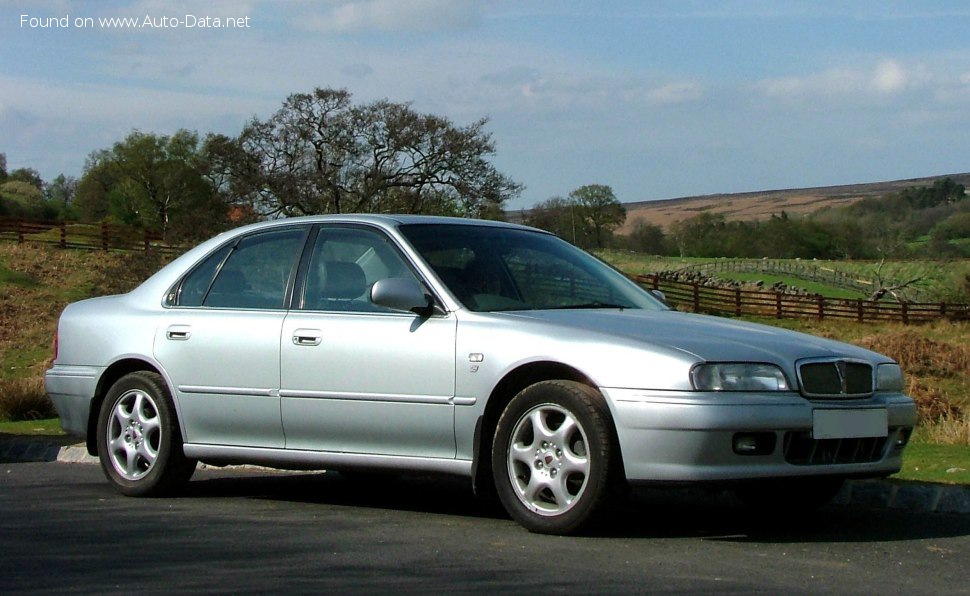
The Rover 600 (RH) 618 i/Si (115 Hp): A British Executive Sedan with Japanese Engineering
The Rover 600 (RH) series, produced by the British manufacturer Rover Group from 1993 to 1999, represented a significant chapter in the marque’s history. Positioned in the competitive European executive compact car segment, the 600 series was a testament to Rover’s long-standing collaboration with Honda. The specific variant, the Rover 600 (RH) 618 i/Si (115 Hp), introduced in 1996 and produced until the end of the generation in 1999, served as a core offering, balancing performance with fuel efficiency and traditional British styling. While never officially sold in the United States, the Rover 600 played a crucial role in the European market, offering a more upscale alternative to mainstream sedans and bridging the gap between mass-market and premium brands. Its blend of refined aesthetics, comfortable interior, and reliable Japanese-sourced mechanicals made it a compelling choice for consumers seeking a sophisticated yet practical four-door sedan.
Engine and Performance Characteristics of the Rover 600 (RH)
At the heart of the Rover 600 (RH) 618 i/Si (115 Hp) lay a robust and efficient powertrain, largely derived from Honda’s engineering prowess. This particular model featured an F18A engine, a naturally aspirated, 1.85-liter (112.89 cubic inches) inline four-cylinder gasoline unit. With an Overhead Camshaft (OHC) valvetrain and four valves per cylinder, this engine was designed for smooth operation and respectable power delivery for its class. It produced a peak output of 115 horsepower at 5500 revolutions per minute (rpm), a figure that, while not overtly sporty, was more than adequate for everyday driving and comfortable cruising on European highways.
Torque output stood at 158 Newton-meters (116.53 lb.-ft.) at 4200 rpm, providing a good mid-range pull that contributed to the car’s relaxed driving demeanor. Power was transmitted to the front wheels via a five-speed manual transmission, a common and reliable setup for vehicles in this segment during the late 1990s. This combination allowed the 618 i/Si to accelerate from 0 to 60 miles per hour in a respectable 10.7 seconds, with a top speed reaching 121.17 mph (195 km/h).
Fuel efficiency was a key consideration for European buyers, and the 618 i/Si delivered a combined fuel consumption rating of 8.3 liters per 100 kilometers, translating to approximately 28.3 US miles per gallon. This made it a relatively economical choice, especially considering its executive aspirations. The multi-port manifold injection system ensured precise fuel delivery, contributing to both performance and efficiency, while the 8.9:1 compression ratio optimized the engine’s operation on standard petrol (gasoline).
Design and Features: The Rover 600 (RH) Sedan
The design of the Rover 600 (RH) was a harmonious blend of British styling cues and Japanese underpinnings, largely based on the fifth-generation Honda Accord. The 618 i/Si variant, like all models in the 600 series, was offered exclusively as a four-door sedan. Its exterior exuded a conservative elegance, characterized by clean lines, a relatively low roofline, and Rover’s distinctive grille, which gave it a more traditional and upmarket appearance compared to its Honda cousin. The car’s dimensions—182.87 inches in length, 67.52 inches in width, and 54.33 inches in height—provided a substantial road presence without being overly cumbersome for urban environments. The 107.09-inch wheelbase contributed to a smooth ride and stable handling.
Inside, the Rover 600 (RH) offered a comfortable and well-appointed cabin designed for five occupants. The interior materials and finishes were a step above many contemporary mainstream sedans, reflecting Rover’s aspirations for a more premium market position. Standard features for the era included power steering, utilizing a hydraulic rack and pinion system, which offered precise control and ease of maneuvering. Safety was addressed with the inclusion of an Anti-lock Braking System (ABS), a significant feature for the late 1990s, enhancing braking performance and control in adverse conditions.
The suspension system was a sophisticated double wishbone setup at both the front and rear, a design choice borrowed from Honda that provided excellent ride comfort and handling dynamics. This independent suspension system effectively absorbed road imperfections while maintaining composure during spirited driving. Braking power came from ventilated discs at the front and solid discs at the rear, ensuring confident stopping performance. The vehicle rode on 185/60 R14 H tires, providing a good balance of grip and ride comfort. With a trunk capacity of 15.19 cubic feet (430 liters), the 600 series offered practical luggage space for families or business travelers. The fuel tank capacity of 17.17 US gallons (65 liters) provided a decent cruising range.
Technical Specifications
| Category | Specification | Value (Metric/US) |
|---|---|---|
| Brand | Rover | |
| Model | 600 (RH) | |
| Type (Engine) | 618 i/Si (115 Hp) | |
| Production Start | 1996 year | |
| Production End | 1999 year | |
| Powertrain Architecture | Internal Combustion Engine | |
| Body Type | Sedan | |
| Seats | 5 | |
| Doors | 4 | |
| Fuel Type | Petrol (Gasoline) | |
| Combined Fuel Consumption | 8.3 l/100 km (28.3 US mpg) | |
| Acceleration 0 – 60 mph | 10.7 sec | |
| Maximum Speed | 195 km/h (121.17 mph) | |
| Power | 115 Hp @ 5500 rpm | |
| Torque | 158 Nm (116.53 lb.-ft.) @ 4200 rpm | |
| Engine Layout | Front, Transverse | |
| Engine Model/Code | F18A | |
| Engine Displacement | 1850 cm³ (1.85 Liters / 112.89 cu. in.) | |
| Number of Cylinders | 4 | |
| Engine Configuration | Inline | |
| Cylinder Bore | 85 mm (3.35 in.) | |
| Piston Stroke | 81.5 mm (3.21 in.) | |
| Compression Ratio | 8.9:1 | |
| Valves per Cylinder | 4 | |
| Fuel Injection System | Multi-port manifold injection | |
| Engine Aspiration | Naturally aspirated engine | |
| Valvetrain | OHC | |
| Engine Oil Capacity | 3.8 l (4.02 US qt) | |
| Coolant Capacity | 7 l (7.4 US qt) | |
| Kerb Weight | 1330 kg (2932.15 lbs.) | |
| Max. Weight | 1820 kg (4012.41 lbs.) | |
| Max Load | 490 kg (1080.27 lbs.) | |
| Trunk (boot) Space – Minimum | 430 l (15.19 cu. ft.) | |
| Fuel Tank Capacity | 65 l (17.17 US gal) | |
| Length | 4645 mm (182.87 in.) | |
| Width | 1715 mm (67.52 in.) | |
| Height | 1380 mm (54.33 in.) | |
| Wheelbase | 2720 mm (107.09 in.) | |
| Front Track | 1475 mm (58.07 in.) | |
| Rear Track | 1480 mm (58.27 in.) | |
| Drivetrain Architecture | Front-wheel drive, Internal Combustion Engine | |
| Drive Wheel | Front wheel drive | |
| Gearbox | 5 gears, manual transmission | |
| Front Suspension | Double wishbone | |
| Rear Suspension | Double wishbone | |
| Front Brakes | Ventilated discs | |
| Rear Brakes | Disc | |
| Assisting Systems | ABS (Anti-lock braking system) | |
| Steering Type | Steering rack and pinion | |
| Power Steering | Hydraulic Steering | |
| Tires Size | 185/60 R14 H |
Legacy and Market Impact of the Rover 600 (RH)
The Rover 600 (RH) series, and specifically the 618 i/Si variant, left a notable legacy in the European automotive landscape. Its primary market was the United Kingdom and continental Europe, where it competed against established players like the BMW 3-Series, Mercedes-Benz C-Class, Audi A4, and more mainstream but well-equipped sedans such as the Ford Mondeo, Vauxhall Cavalier (Opel Vectra), and Peugeot 406. While it couldn’t match the premium badge appeal of the German trio, it offered a compelling blend of traditional British luxury and Honda’s renowned reliability and engineering excellence at a more accessible price point.
The decision to base the 600 on the Honda Accord platform was both a strength and a weakness for Rover. It provided the car with excellent dynamics, a comfortable ride, and a reputation for dependability that Rover desperately needed. The double wishbone suspension, for instance, was a hallmark of Honda’s engineering, providing a level of sophistication often found in more expensive vehicles. However, it also meant that the 600 was often perceived as “just a rebadged Honda,” which some purists felt diluted the Rover brand identity. Despite this, the car’s distinctive British styling, with its elegant wood and leather interior options, successfully differentiated it from its Japanese counterpart.
The Rover 600 (RH) was critically important for Rover during a tumultuous period for the company. It showcased Rover’s ability to produce a competitive and desirable executive car, even if it relied heavily on external partnerships. The 618 i/Si, with its balanced performance and good fuel economy, was a popular choice for company car fleets and private buyers looking for a refined and understated sedan. Its production run from 1993 to 1999 coincided with the latter years of Rover’s independence before its acquisition by BMW, and it remains one of the more fondly remembered models from that era. Today, the Rover 600 is appreciated by enthusiasts for its comfortable ride, robust Honda mechanicals, and classic British charm, serving as a reminder of a unique Anglo-Japanese automotive collaboration.
