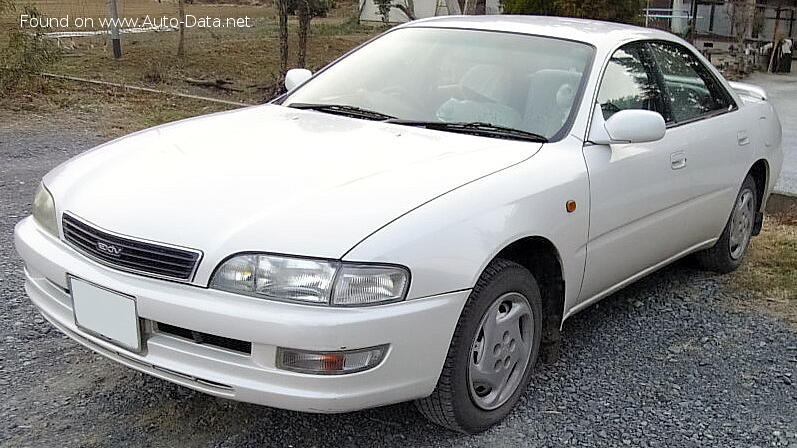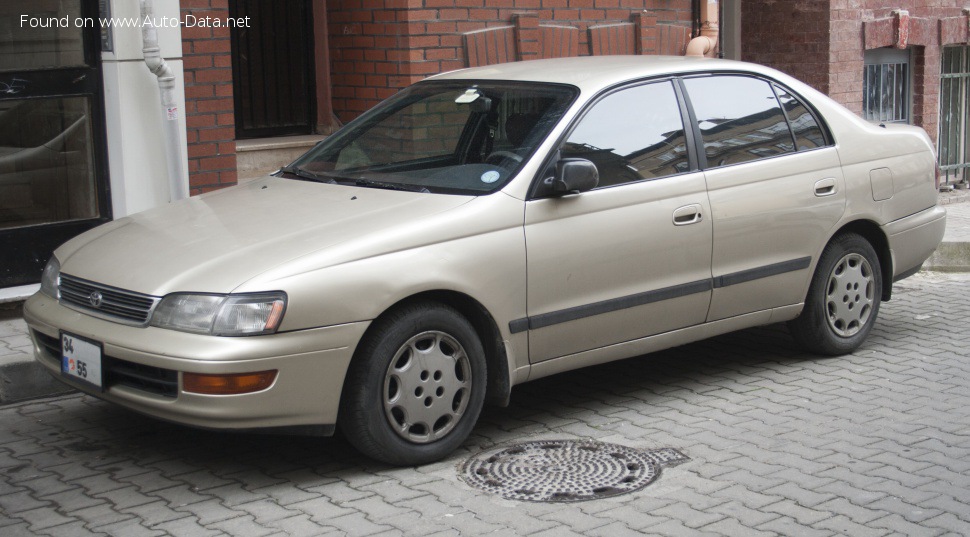
Introduction to the Toyota Corona (T19) 2.0 D (73 Hp)
The Toyota Corona is a nameplate steeped in history, representing Toyota’s commitment to building reliable, practical, and well-engineered family sedans for markets around the globe. The T19 generation, produced from 1992 to 1996, continued this legacy, offering a modern interpretation of the mid-size car. While the Corona name itself saw various iterations and market-specific branding, the T19 chassis was a global platform, underpinning models like the Carina E in Europe and the first-generation Avensis in some markets, showcasing its versatility.
This article specifically focuses on the Toyota Corona (T19) 2.0 D (73 Hp), a diesel-powered variant primarily targeted at European and Asian markets where fuel efficiency and durability were paramount. Unlike its gasoline-powered siblings which saw wider distribution, including some presence in North America (albeit often under different names or as related models), this particular diesel configuration was not offered in the United States. Its role was to provide economical and robust transportation, embodying Toyota’s reputation for quality and longevity in a segment where diesel engines were gaining traction as practical alternatives to gasoline powertrains.
Engine and Performance: The Heart of the Toyota Corona (T19)
At the core of the Toyota Corona (T19) 2.0 D (73 Hp) lies the venerable 2C inline-four diesel engine. This naturally aspirated unit, with a displacement of 1,974 cubic centimeters (120.46 cubic inches), was designed for maximum durability and fuel economy rather than outright speed. It produced a modest but dependable 73 horsepower at 4,600 revolutions per minute, delivering its power smoothly and consistently.
Torque, often a more critical metric for diesel engines, stood at 132 Newton-meters (97.36 lb.-ft.) available at a relatively low 2,800 rpm. This characteristic ensured decent pulling power from low engine speeds, making the vehicle feel responsive in city driving and capable of handling highway cruising without constant downshifts. The engine’s precombustion chamber injection system, coupled with an OHC valvetrain and a high 23:1 compression ratio, was typical for diesel technology of the early 1990s, prioritizing efficiency and reliability. Power was sent to the front wheels via a 5-speed manual transmission, a common and efficient setup for the era. The vehicle’s top speed was rated at 160 kilometers per hour (99.42 mph), underscoring its utilitarian focus.
With a curb weight of 2,535.32 lbs. (1,150 kg), the weight-to-power ratio came in at 15.8 kg/Hp (63.5 Hp/tonne), indicating a vehicle designed for practical, everyday use rather than spirited performance. The 2C engine’s robust design and simple mechanicals contributed significantly to the Corona’s reputation for being a low-maintenance and long-lasting vehicle, particularly appealing in markets where service infrastructure might be less advanced or where owners valued absolute reliability.
Design and Features of the Toyota Corona (T19) Sedan
The T19 generation of the Toyota Corona adopted a clean, aerodynamic, and understated design that was characteristic of early 1990s Japanese sedans. As a 4-door sedan with seating for five, its primary focus was on practicality, comfort, and interior space. The exterior dimensions, measuring 177.95 inches (4,520 mm) in length, 66.73 inches (1,695 mm) in width, and 55.51 inches (1,410 mm) in height, placed it firmly in the mid-size segment, offering a good balance between maneuverability and passenger accommodation.
The design emphasized smooth lines and a conservative aesthetic that aged gracefully. The long 101.57-inch (2,580 mm) wheelbase contributed to a stable ride and generous interior room for both front and rear passengers. The trunk capacity was ample, suitable for family travel or daily errands. Inside, the cabin was designed with ergonomics in mind, featuring straightforward controls and durable materials, reflecting Toyota’s commitment to build quality.
In terms of features, the Toyota Corona (T19) 2.0 D (73 Hp) was equipped with technologies that were becoming standard or desirable in its class during the early 1990s. Safety was enhanced by the inclusion of ABS (Anti-lock Braking System), a significant feature for the time, providing improved stopping power and control under hard braking. The hydraulic power steering system, a rack and pinion setup, offered easy maneuverability at low speeds and stable handling on the highway. Suspension duties were handled by a wishbone setup at both the front and rear, providing a comfortable and composed ride. Braking consisted of ventilated discs at the front and drum brakes at the rear, a common and cost-effective combination. The vehicle rode on 175/70 R14 tires, offering a balance of comfort and efficiency.
Technical Specifications
| Category | Specification |
|---|---|
| General Information | |
| Brand | Toyota |
| Model | Corona |
| Generation | Corona (T19) |
| Type (Engine) | 2.0 D (73 Hp) |
| Start of Production | 1992 year |
| End of Production | 1996 year |
| Powertrain Architecture | Internal Combustion engine |
| Body type | Sedan |
| Seats | 5 |
| Doors | 4 |
| Performance Specs | |
| Fuel Type | Diesel |
| Maximum speed | 160 km/h (99.42 mph) |
| Weight-to-power ratio | 15.8 kg/Hp (63.5 Hp/tonne) |
| Weight-to-torque ratio | 8.7 kg/Nm (114.8 Nm/tonne) |
| Engine Specs | |
| Power | 73 Hp @ 4600 rpm |
| Power per liter | 37 Hp/l |
| Torque | 132 Nm @ 2800 rpm (97.36 lb.-ft. @ 2800 rpm) |
| Engine layout | Front, Transverse |
| Engine Model/Code | 2C |
| Engine displacement | 1974 cm³ (120.46 cu. in.) |
| Number of cylinders | 4 |
| Engine configuration | Inline |
| Cylinder Bore | 86 mm (3.39 in.) |
| Piston Stroke | 85 mm (3.35 in.) |
| Compression ratio | 23:1 |
| Number of valves per cylinder | 2 |
| Fuel injection system | Precombustion chamber injection |
| Engine aspiration | Naturally aspirated engine |
| Valvetrain | OHC |
| Engine oil capacity | 4.3 l (4.54 US qt) |
| Coolant | 7 l (7.4 US qt) |
| Space, Volume and Weights | |
| Kerb Weight | 1150 kg (2535.32 lbs.) |
| Max. weight | 1425 kg (3141.59 lbs.) |
| Max load | 275 kg (606.27 lbs.) |
| Fuel tank capacity | 60 l (15.85 US gal) |
| Dimensions | |
| Length | 4520 mm (177.95 in.) |
| Width | 1695 mm (66.73 in.) |
| Height | 1410 mm (55.51 in.) |
| Wheelbase | 2580 mm (101.57 in.) |
| Front track | 1465 mm (57.68 in.) |
| Rear (Back) track | 1450 mm (57.09 in.) |
| Drivetrain, Brakes and Suspension Specs | |
| Drivetrain Architecture | Front wheel drive. Internal Combustion engine. The Internal combustion engine (ICE) drives the front wheels of the vehicle. |
| Drive wheel | Front wheel drive |
| Number of gears and type of gearbox | 5 gears, manual transmission |
| Front suspension | Wishbone |
| Rear suspension | Wishbone |
| Front brakes | Ventilated discs |
| Rear brakes | Drum |
| Assisting systems | ABS (Anti-lock braking system) |
| Steering type | Steering rack and pinion |
| Power steering | Hydraulic Steering |
| Tires size | 175/70 R14 |
Legacy and Market Impact
The Toyota Corona (T19) 2.0 D (73 Hp) carved out a significant niche in its primary markets, particularly in Europe and parts of Asia, during its production run from 1992 to 1996. While not a performance leader, its true strength lay in its unparalleled reliability, fuel economy, and low running costs – hallmarks of Toyota engineering. In an era when diesel engines were increasingly seen as the practical choice for high-mileage drivers and taxi fleets, the Corona’s 2C diesel engine proved to be a workhorse, capable of enduring hundreds of thousands of miles with proper maintenance.
Competitors in the mid-size diesel sedan segment varied by region. In Europe, it faced off against established players like the Opel Vectra (Vauxhall Cavalier in the UK), Ford Mondeo, Volkswagen Passat, and even other Japanese imports like the Nissan Primera and Mitsubishi Carisma, many of which also offered diesel variants. The Corona distinguished itself with its reputation for bulletproof reliability, often surpassing its European counterparts in long-term durability, even if it sometimes lagged in terms of perceived driving dynamics or interior flair.
The T19 generation, including its diesel variant, reinforced Toyota’s global image as a manufacturer of dependable and value-for-money vehicles. Its impact was less about groundbreaking innovation and more about consistent, high-quality engineering that delivered on its promises. It was the kind of car that owners bought and kept for many years, appreciating its fuss-free operation and minimal depreciation in its segment. Its presence helped solidify Toyota’s position in markets outside of North America, where the brand was already a household name for gasoline-powered cars like the Camry and Corolla.
Ultimately, the Toyota Corona (T19) 2.0 D (73 Hp) represents a segment of automotive history where practicality, efficiency, and unwavering reliability were the dominant virtues. It may not have been the flashiest or most powerful car on the road, but its honest approach to transportation made it a beloved and enduring choice for countless drivers, contributing significantly to Toyota’s global legacy as a purveyor of quality automobiles.