The Seat Ibiza IV SC (facelift 2015) 1.4 Eco TSI (150 Hp) ACT: A European Compact Performer
The Seat Ibiza IV SC (facelift 2015) 1.4 Eco TSI (150 Hp) ACT represents a significant iteration of the Spanish automaker Seat’s popular supermini. Unveiled as part of the fourth generation’s mid-cycle refresh, this particular model, produced from 2015 to 2017, showcased Seat’s commitment to blending sporty aesthetics, efficient performance, and modern technology within the highly competitive European compact segment. While Seat is a brand largely unfamiliar to the American market, being a subsidiary of the Volkswagen Group, its vehicles like the Ibiza are staples across Europe, offering a more passionate and youthful alternative to its German siblings such as the Volkswagen Polo. The “SC” designation, standing for “SportCoupe,” denoted the three-door hatchback variant, emphasizing its dynamic styling over the more utilitarian five-door model. This specific powertrain, featuring the advanced 1.4-liter Eco TSI engine with Active Cylinder Technology (ACT), positioned the Ibiza as a compelling choice for drivers seeking a blend of spirited driving and impressive fuel economy.
Engine and Performance: The 1.4 Eco TSI with ACT
At the heart of this particular Seat Ibiza IV SC model was a sophisticated 1.4-liter (1395 cm³ or 85.13 cu. in.) inline-four gasoline engine, designated with the code CZEA. This powerplant was a prime example of Volkswagen Group’s engineering prowess, utilizing direct injection, a turbocharger, and an intercooler to deliver a robust 150 horsepower at 5000-6000 rpm. Its impressive power output for its displacement translated to a power per liter figure of 107.5 Hp/l, highlighting its efficiency.
Equally crucial to its performance was the torque delivery: a substantial 250 Nm (184.39 lb.-ft.) available across a wide rev range from 1500 to 3500 rpm. This broad torque band ensured excellent responsiveness and flexibility in daily driving, making the car feel eager and lively whether navigating city streets or cruising on the highway. Power was sent to the front wheels via a precise 6-speed manual transmission, offering engaging control for the driver.
One of the standout features of this engine was its Active Cylinder Technology (ACT). This innovative system allowed the engine to seamlessly deactivate two of its four cylinders under light to moderate loads, such as during cruising, significantly improving fuel efficiency and reducing emissions without the driver even noticing the transition. This technology contributed to an impressive combined fuel consumption rating of 4.8 liters per 100 kilometers (equivalent to approximately 49 US mpg), and CO2 emissions of just 110 g/km, meeting the stringent Euro 6 emission standards.
In terms of raw performance, the Seat Ibiza IV SC (facelift 2015) 1.4 Eco TSI (150 Hp) ACT was remarkably sprightly. It could accelerate from 0 to 60 mph in a mere 7.2 seconds (0-100 km/h in 7.6 seconds), making it one of the quicker options in its segment. The top speed was rated at 220 km/h (136.7 mph), underscoring its capabilities beyond urban environments. The combination of a relatively light curb weight of 2354.54 lbs (1068 kg) and a potent engine resulted in an excellent weight-to-power ratio of 7.1 kg/Hp, or 140.4 Hp per tonne, further enhancing its dynamic character.
Design and Features: Sporty Aesthetics and Compact Practicality
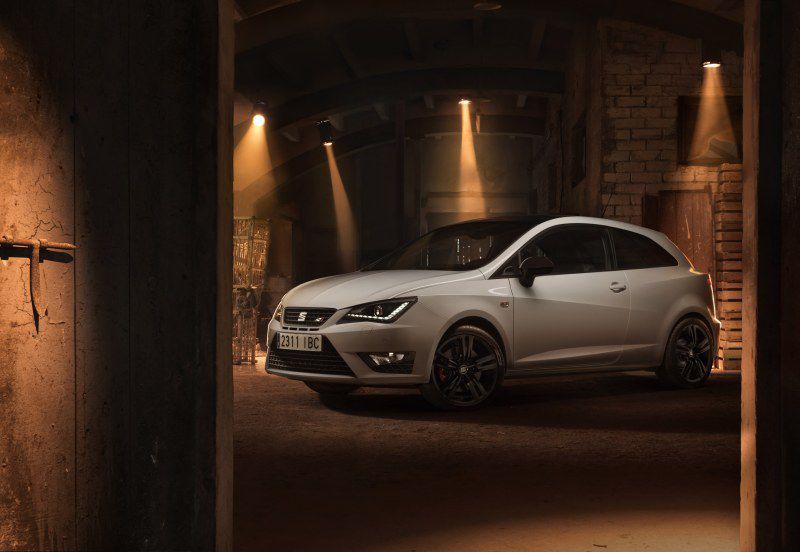
The Ibiza IV SC (SportCoupe) facelift introduced in 2015 brought subtle yet effective enhancements to its exterior and interior design, maintaining its reputation for youthful and sporty appeal. The three-door “Coupe” body type, though technically a hatchback, offered a sleeker profile compared to its five-door counterpart, with a more raked roofline and longer doors. The facelift primarily focused on revised headlights with optional LED daytime running lights, a subtly tweaked grille, and updated wheel designs, giving it a fresh and contemporary look.
Measuring 159.17 inches (4043 mm) in length, 66.65 inches (1693 mm) in width, and 56.22 inches (1428 mm) in height, with a wheelbase of 97.2 inches (2469 mm), the Ibiza SC maintained its compact dimensions, making it agile and easy to maneuver in congested European cities. Despite its compact footprint, the interior was designed to accommodate five occupants, though rear legroom in the three-door variant was understandably tighter than in the five-door.
Inside, the facelift brought improvements in material quality and technology. While specific details on infotainment are not provided, the era typically saw the introduction of more advanced touchscreen systems with smartphone integration. Practicality was decent for its class, offering a minimum trunk space of 10.31 cu. ft. (292 liters), expandable by folding the rear seats. The fuel tank capacity of 11.89 US gallons (45 liters) combined with the efficient engine provided a respectable cruising range.
Safety features for the 2015 model year included standard ABS (Anti-lock Braking System) and a robust chassis. The suspension setup featured an independent McPherson strut system with coil springs and an anti-roll bar at the front, paired with a semi-independent coil spring rear suspension. This configuration provided a balanced ride, offering both comfort for daily commutes and confident handling for more spirited driving. Braking was handled by ventilated discs at the front and solid discs at the rear, ensuring strong stopping power. The car rode on either 215/45 R16 or 215/40 R17 tires, depending on the trim, contributing to its sporty stance and grip.
Technical Specifications: Seat Ibiza IV SC (facelift 2015) 1.4 Eco TSI (150 Hp) ACT
| Category | Specification |
|---|---|
| General Information | |
| Brand | Seat |
| Model | Ibiza |
| Generation | Ibiza IV SC (facelift 2015) |
| Type (Engine) | 1.4 Eco TSI (150 Hp) ACT |
| Start of production | 2015 year |
| End of production | 2017 year |
| Powertrain Architecture | Internal Combustion engine |
| Body type | Coupe (3 Doors) |
| Seats | 5 |
| Doors | 3 |
| Performance Specs | |
| Fuel consumption (economy) – combined | 4.8 l/100 km (49 US mpg / 58.9 UK mpg) |
| CO2 emissions | 110 g/km |
| Fuel Type | Petrol (Gasoline) |
| Acceleration 0 – 60 mph | 7.2 sec |
| Acceleration 0 – 100 km/h | 7.6 sec |
| Maximum speed | 220 km/h (136.7 mph) |
| Emission standard | Euro 6 |
| Weight-to-power ratio | 7.1 kg/Hp (140.4 Hp/tonne) |
| Weight-to-torque ratio | 4.3 kg/Nm (234.1 Nm/tonne) |
| Engine Specs | |
| Power | 150 Hp @ 5000-6000 rpm |
| Power per liter | 107.5 Hp/l |
| Torque | 250 Nm @ 1500-3500 rpm (184.39 lb.-ft.) |
| Engine layout | Front, Transverse |
| Engine Model/Code | CZEA |
| Engine displacement | 1395 cm³ (85.13 cu. in. / 1.4 L) |
| Number of cylinders | 4 |
| Engine configuration | Inline |
| Cylinder Bore | 74.5 mm (2.93 in.) |
| Piston Stroke | 80 mm (3.15 in.) |
| Compression ratio | 10:1 |
| Number of valves per cylinder | 4 |
| Fuel injection system | Direct injection |
| Engine aspiration | Turbocharger, Intercooler |
| Engine oil capacity | 4 l (4.23 US qt / 3.52 UK qt) |
| Engine oil specification | Not specified in data |
| Coolant | 8 l (8.45 US qt / 7.04 UK qt) |
| Engine systems | Cylinder deactivation system (ACT) |
| Space, Volume and Weights | |
| Kerb Weight | 1068 kg (2354.54 lbs) |
| Max. weight (Gross Vehicle Weight) | 1630 kg (3593.53 lbs) |
| Max load | 562 kg (1239 lbs) |
| Trunk (boot) space – minimum | 292 l (10.31 cu. ft.) |
| Fuel tank capacity | 45 l (11.89 US gal / 9.9 UK gal) |
| Dimensions | |
| Length | 4043 mm (159.17 in.) |
| Width | 1693 mm (66.65 in.) |
| Height | 1428 mm (56.22 in.) |
| Wheelbase | 2469 mm (97.2 in.) |
| Front track | 1465 mm (57.68 in.) |
| Rear (Back) track | 1457 mm (57.36 in.) |
| Minimum turning circle (turning diameter) | 10 m (32.81 ft.) |
| Drivetrain, Brakes and Suspension Specs | |
| Drivetrain Architecture | Front-wheel drive, Internal Combustion Engine |
| Drive wheel | Front wheel drive |
| Number of gears and type of gearbox | 6 gears, manual transmission |
| Front suspension | Independent, McPherson type with coil spring and anti-roll bar |
| Rear suspension | Semi-independent, coil spring |
| Front brakes | Ventilated discs |
| Rear brakes | Disc |
| Assisting systems | ABS (Anti-lock braking system) |
| Steering type | Steering rack and pinion |
| Tires size | 215/45 R16; 215/40 R17 |
| Wheel rims size | 16; 17 |
Legacy and Market Impact in the European Segment
The Seat Ibiza, particularly its fourth generation, played a crucial role in cementing Seat’s position as a dynamic and value-oriented brand within the highly competitive European supermini segment. The Seat Ibiza IV SC (facelift 2015) 1.4 Eco TSI (150 Hp) ACT was a prime example of Seat’s strategy: offering Volkswagen Group engineering and quality with a distinct Spanish flair and a more accessible price point. Its primary competitors included established players like the Volkswagen Polo (with which it shared many underpinnings), Ford Fiesta, Renault Clio, Peugeot 208, and Opel Corsa. What set the Ibiza apart was its sharper styling, particularly in the three-door SC guise, and its emphasis on a more engaging driving experience, often perceived as sportier than its direct VW counterpart.
The introduction of the facelift in 2015, coupled with advanced powertrains like the 1.4 Eco TSI ACT, ensured the Ibiza remained relevant and competitive against newer rivals. The Active Cylinder Technology was a significant draw, allowing the Ibiza to boast impressive fuel economy figures while still delivering strong performance. This balance appealed to a broad demographic, from younger drivers seeking a stylish and fun car to those looking for an economical daily commuter with a bit of extra punch. Its compliance with Euro 6 emission standards also highlighted its environmental credentials, a growing concern in the European market.
While never officially sold in the United States, the Seat Ibiza’s influence is evident in the global automotive landscape. It showcased how compact cars could offer premium features, advanced engine technology, and engaging dynamics without sacrificing efficiency. The Ibiza’s success contributed to Seat’s overall growth and reputation, proving that a brand could carve out a strong identity within a large automotive group by offering a distinct personality. Its legacy is one of a spirited, well-engineered, and highly practical compact car that consistently offered strong value and driving enjoyment to millions of European customers. The Ibiza continues to be a cornerstone of Seat’s lineup, evolving with each generation to meet changing market demands and technological advancements.