Peugeot 3008 I (Phase II, 2013) 2.0 HDi (163 Hp) FAP Automatic: A European Crossover’s Evolution
The Peugeot 3008 I (Phase II, 2013) represents a significant refresh of Peugeot’s pioneering compact crossover, a vehicle that skillfully blended the practicality of a multi-purpose vehicle (MPV) with the rugged aesthetics and higher driving position of a sport utility vehicle (SUV). Launched in 2008, the first-generation 3008 was a pivotal model for Peugeot, marking its entry into the rapidly expanding crossover segment. The Phase II refresh, introduced in 2013, brought updated styling, enhanced features, and refined powertrain options, maintaining its competitive edge in the bustling European market. This particular variant, equipped with the 2.0 HDi (163 Hp) FAP Automatic, highlights Peugeot’s commitment to efficient diesel technology and comfortable driving. While never officially sold in the United States, the 3008 played a crucial role in shaping Peugeot’s modern lineup and influencing global automotive trends towards versatile, family-friendly crossovers. Its design and engineering philosophy were tailored to the discerning European consumer, prioritizing fuel economy, interior flexibility, and a refined driving experience.
Engine and Performance: The Robust 2.0 HDi Powerplant in the Peugeot 3008 I (Phase II, 2013)
Under the hood of this Peugeot 3008 I (Phase II, 2013) variant lies Peugeot’s well-regarded 2.0-liter HDi (High-Pressure Direct Injection) turbodiesel engine, identified by the RHH DW10CTED4 code. This inline four-cylinder unit, with a displacement of 1997 cubic centimeters (121.86 cubic inches), is a testament to Peugeot’s expertise in diesel engine technology. It produces a healthy 163 horsepower at 3750 rpm, providing ample power for both urban commuting and highway cruising. More importantly, it delivers a substantial 340 Newton-meters (250.77 lb.-ft.) of torque at a low 2000 rpm, ensuring strong acceleration and effortless overtaking capabilities.
The engine’s configuration includes four valves per cylinder and a common rail fuel injection system, optimized for efficiency and smooth power delivery. A turbocharger with an intercooler ensures that the engine breathes efficiently, contributing to its robust performance figures. Mated to a responsive 6-speed automatic transmission, power is channeled to the front wheels, a common setup for European crossovers prioritizing fuel economy over off-road prowess.
Performance figures for the 2.0 HDi (163 Hp) FAP Automatic are respectable for its class. It accelerates from 0 to 60 mph in a calculated 9.7 seconds, reaching 0 to 100 km/h in 10.2 seconds. The top speed is rated at 190 km/h (118.06 mph). Fuel efficiency is a strong suit, with a combined cycle rating of 6.1 liters per 100 kilometers, which translates to an impressive 38.6 US mpg. Urban consumption is 8 l/100 km (29.4 US mpg), while extra-urban driving achieves 5 l/100 km (47 US mpg). These figures, combined with CO2 emissions of 159 g/km, highlight its compliance with Euro 5 emission standards and its economical operation, a key factor for European buyers. The inclusion of a FAP (Filtre à Particules – Particulate Filter) system further underscores its environmental considerations, reducing diesel particulate matter emissions.
Design and Features: Practicality Meets Refinement
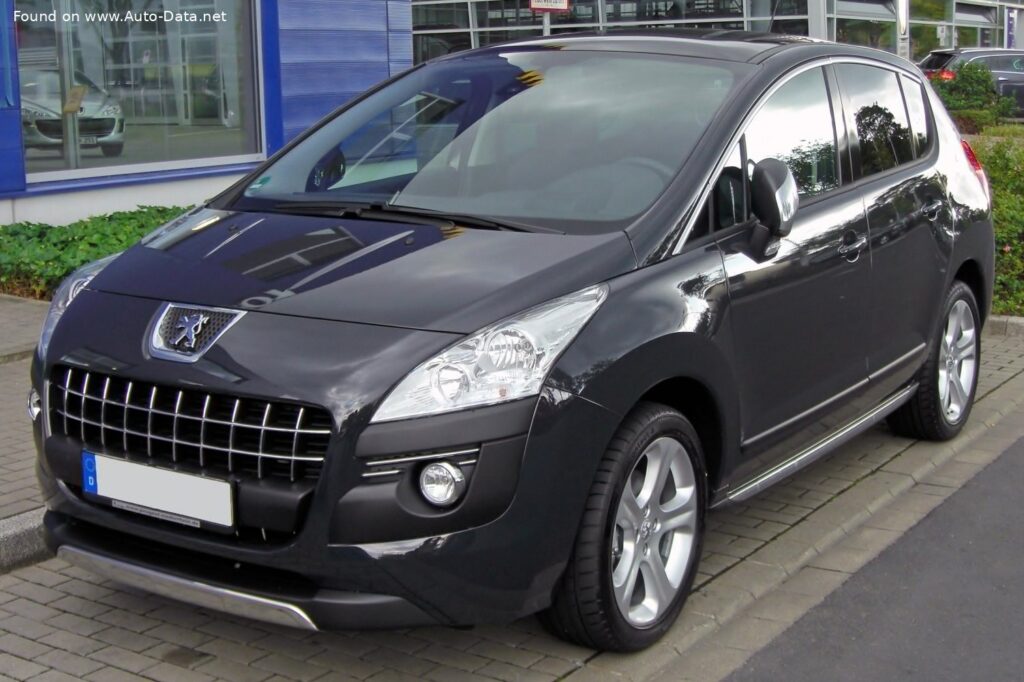
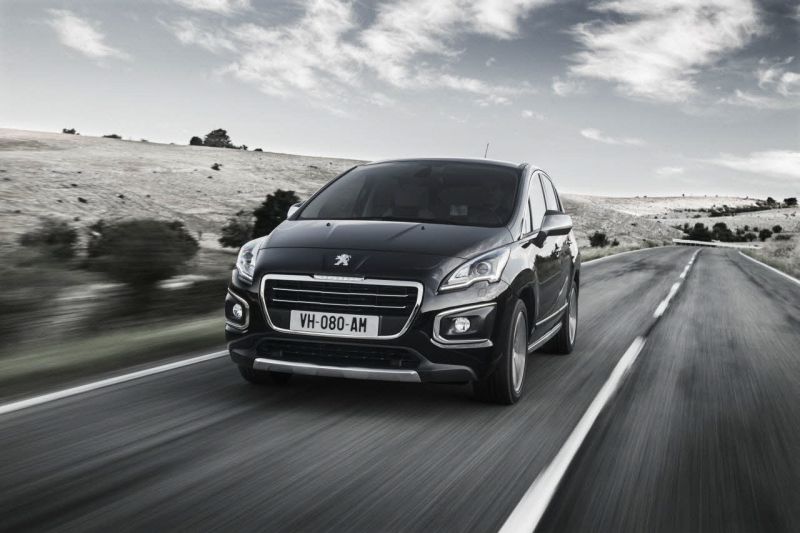
The Peugeot 3008 I (Phase II, 2013) maintained the distinctive crossover body type of its predecessor, offering a practical 5-door, 5-seat configuration. The Phase II refresh brought subtle yet effective aesthetic updates, including a revised front fascia with a new grille, updated headlights, and chrome detailing, giving it a more contemporary and upmarket appearance. Its dimensions – 4365 mm (171.85 inches) in length, 1837 mm (72.32 inches) in width (2113 mm or 83.19 inches including mirrors), and 1635 mm (64.37 inches) in height – ensured a compact footprint suitable for European city driving while still providing ample interior space. The wheelbase measures 2613 mm (102.87 inches), contributing to a stable ride.
Inside, the 3008 was designed with versatility in mind. The elevated driving position offered excellent visibility, a characteristic highly valued in SUVs and crossovers. The cabin materials and build quality were generally well-regarded for the segment, providing a comfortable and ergonomic environment. Practicality was a core strength, evidenced by its generous trunk space, which ranged from 512 liters (18.08 cubic feet) with all seats in place, expanding to a cavernous 1604 liters (56.64 cubic feet) when the rear seats were folded down. This made it an ideal choice for families and those needing flexible cargo capacity.
Key features included independent McPherson strut front suspension with coil springs and an anti-roll bar, paired with an independent coil spring rear suspension, designed to offer a comfortable and composed ride. Braking duties were handled by ventilated discs at the front and disc brakes at the rear, supported by an Anti-lock Braking System (ABS) for enhanced safety. The vehicle came with 225/50 R17 or 235/45 R18 tire options, mounted on 17-inch or 18-inch wheel rims, respectively, contributing to its confident road presence. The power steering system utilized a rack and pinion setup, providing precise and predictable handling.
Technical Specifications: Peugeot 3008 I (Phase II, 2013) 2.0 HDi (163 Hp) FAP Automatic
| Category | Specification | Value |
|---|---|---|
| General Information | Brand | Peugeot |
| Model | 3008 | |
| Generation | 3008 I (Phase II, 2013) | |
| Type (Engine) | 2.0 HDi (163 Hp) FAP Automatic | |
| Start of Production | 2013 year | |
| End of Production | 2015 year | |
| Powertrain Architecture | Internal Combustion engine | |
| Body Type | SUV | |
| Seats | 5 | |
| Doors | 5 | |
| Performance Specs | Fuel Consumption (Urban) | 8 l/100 km (29.4 US mpg) |
| Fuel Consumption (Extra Urban) | 5 l/100 km (47 US mpg) | |
| Fuel Consumption (Combined) | 6.1 l/100 km (38.6 US mpg) | |
| CO2 Emissions | 159 g/km | |
| Fuel Type | Diesel | |
| Acceleration 0 – 60 mph | 9.7 sec | |
| Acceleration 0 – 100 km/h | 10.2 sec | |
| Maximum Speed | 190 km/h (118.06 mph) | |
| Emission Standard | Euro 5 | |
| Weight-to-Power Ratio | 9.4 kg/Hp, 105.9 Hp/tonne | |
| Weight-to-Torque Ratio | 4.5 kg/Nm, 220.9 Nm/tonne | |
| Engine Specs | Power | 163 Hp @ 3750 rpm |
| Power per liter | 81.6 Hp/l | |
| Torque | 340 Nm @ 2000 rpm (250.77 lb.-ft.) | |
| Engine Layout | Front, Transverse | |
| Engine Model/Code | RHH DW10CTED4 | |
| Engine Displacement | 1997 cm3 (121.86 cu. in.) | |
| Number of Cylinders | 4 | |
| Engine Configuration | Inline | |
| Number of Valves per Cylinder | 4 | |
| Fuel Injection System | Diesel Commonrail | |
| Engine Aspiration | Turbocharger, Intercooler | |
| Engine Oil Capacity | 5 l (5.28 US qt) | |
| Engine Systems | Particulate filter | |
| Space, Volume and Weights | Kerb Weight | 1539 kg (3392.91 lbs.) |
| Max. Weight | 2100 kg (4629.71 lbs.) | |
| Max. Load | 561 kg (1236.79 lbs.) | |
| Trunk (Boot) Space – Minimum | 512 l (18.08 cu. ft.) | |
| Trunk (Boot) Space – Maximum | 1604 l (56.64 cu. ft.) | |
| Fuel Tank Capacity | 60 l (15.85 US gal) | |
| Dimensions | Length | 4365 mm (171.85 in.) |
| Width | 1837 mm (72.32 in.) | |
| Width with Mirrors Folded | 1910 mm (75.2 in.) | |
| Width Including Mirrors | 2113 mm (83.19 in.) | |
| Height | 1635 mm (64.37 in.) | |
| Wheelbase | 2613 mm (102.87 in.) | |
| Front Overhang | 916 mm (36.06 in.) | |
| Rear Overhang | 836 mm (32.91 in.) | |
| Minimum Turning Circle (Diameter) | 11.7 m (38.39 ft.) | |
| Drivetrain, Brakes and Suspension Specs | Drivetrain Architecture | Front-wheel drive (Internal Combustion engine drives front wheels) |
| Drive Wheel | Front wheel drive | |
| Number of Gears and Type of Gearbox | 6 gears, automatic transmission | |
| Front Suspension | Independent, McPherson with coil spring and anti-roll bar | |
| Rear Suspension | Independent coil spring | |
| Front Brakes | Ventilated discs | |
| Rear Brakes | Disc | |
| Assisting Systems | ABS (Anti-lock braking system) | |
| Steering Type | Steering rack and pinion | |
| Tires Size | 225/50 R17; 235/45 R18 | |
| Wheel Rims Size | 17; 18 |
Legacy and Market Impact of the Peugeot 3008 I (Phase II, 2013)
The first-generation Peugeot 3008 I (Phase II, 2013), particularly in its refreshed form, solidified Peugeot’s position in the highly competitive European compact crossover segment. When it first launched, the 3008 was a bold departure for Peugeot, combining elements of an SUV, an MPV, and even a hatchback into a single, versatile package. This innovative approach allowed it to carve out a unique niche, appealing to buyers who desired the practicality of an MPV but preferred a more rugged, elevated stance. Its primary competitors in Europe included established players like the Nissan Qashqai, Volkswagen Tiguan, Ford Kuga, and Renault Kadjar, all vying for market share in a segment that saw explosive growth throughout the 2010s.
The 3008 gained a reputation for its comfortable ride quality, refined interior, and excellent fuel economy, especially with its HDi diesel powertrains. The 2.0 HDi (163 Hp) FAP Automatic variant, in particular, was lauded for its strong torque delivery and smooth automatic transmission, making it a capable and relaxed cruiser. Its focus on front-wheel drive, rather than complex and heavy all-wheel-drive systems, further underscored its urban and on-road bias, contributing to its efficiency and lower cost.
While its styling, particularly in its initial phase, was sometimes considered polarizing for its unconventional blend of body styles, the Phase II refresh helped to modernize its appearance and broaden its appeal. The 3008’s success demonstrated Peugeot’s ability to innovate and adapt to changing consumer preferences, moving beyond traditional sedans and hatchbacks into the burgeoning crossover market. It paved the way for the critically acclaimed second-generation 3008, which transformed into a more conventional yet highly stylish SUV, winning numerous awards, including European Car of the Year. The original 3008, therefore, stands as a significant model in Peugeot’s recent history, a testament to its forward-thinking approach and its commitment to delivering practical, efficient, and well-engineered vehicles to the European market. Its legacy is one of successful adaptation and a foundational step in Peugeot’s journey to becoming a dominant force in the global SUV segment.