
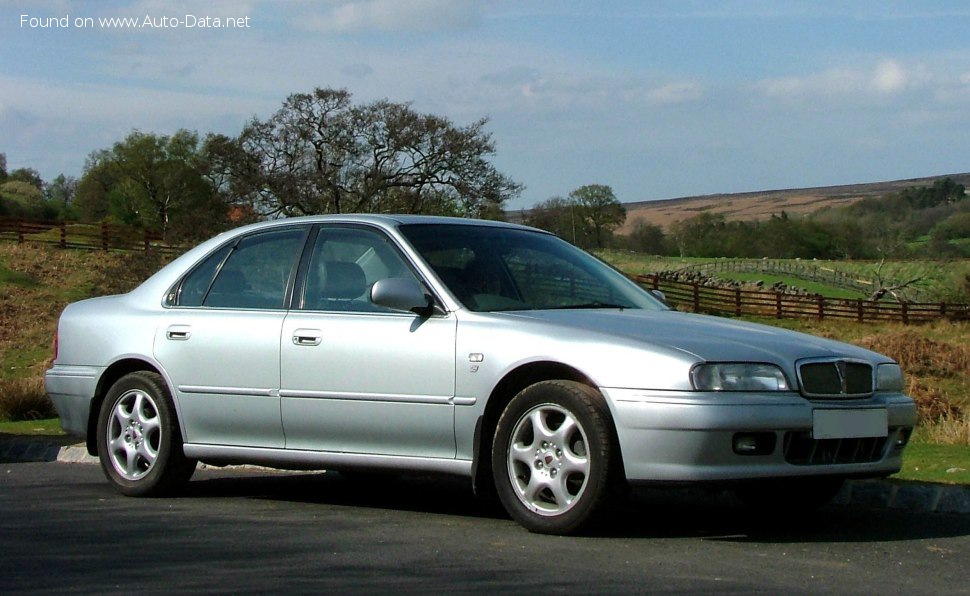
The Rover 600 (RH) 620 SDi: A British Executive Sedan with Japanese Pedigree
The Rover 600 Series, internally designated RH, represented a crucial mid-size executive sedan in the British automaker Rover’s lineup from its introduction in 1993 until 1999. Positioned as a premium offering in the competitive European D-segment, the 600 Series was a product of Rover’s long-standing collaboration with Honda, sharing its platform and many mechanical components with the fifth-generation Honda Accord. This partnership allowed Rover to offer a sophisticated and reliable vehicle with a distinctly British aesthetic, aiming to blend traditional luxury with modern engineering. The particular variant under focus, the Rover 600 (RH) 620 SDi (105 Hp), was a significant model within the range, catering to the growing demand for fuel-efficient diesel powertrains in Europe during the mid-to-late 1990s.
While never officially sold in the United States, the Rover 600 played a vital role in its primary European market, attempting to bridge the gap between mass-market family sedans and more established premium German rivals. The 620 SDi variant, introduced in 1994, brought a robust and economical diesel engine option to the lineup, broadening its appeal to business users and those prioritizing running costs without sacrificing comfort or perceived quality. Its blend of classic British styling cues, a comfortable interior, and reliable Japanese-engineered underpinnings made it a distinctive choice in its class.
Engine and Performance: The Heart of the Rover 600 (RH) 620 SDi
The powertrain of the Rover 600 (RH) 620 SDi was a notable highlight, especially for its era. Under the hood resided a 2.0-liter (1994 cm3 or 121.68 cu. in.) inline four-cylinder diesel engine, designated by Rover as the 20 2TN. This engine utilized direct injection and was boosted by a turbocharger, a combination that delivered a respectable 105 horsepower at 4200 rpm. More importantly for a diesel, it produced a strong torque output of 210 Newton-meters (approximately 154.89 lb.-ft.) available at a low 2000 rpm. This low-end torque was instrumental in providing responsive acceleration and comfortable cruising, particularly beneficial for highway driving and urban maneuverability.
Paired with a five-speed manual transmission, the 620 SDi channeled its power to the front wheels. Performance figures were competitive for a diesel sedan of its time, with an acceleration from 0 to 60 mph achieved in a respectable 11 seconds. The vehicle could reach a maximum speed of 114.95 mph (185 km/h). However, where the 620 SDi truly excelled was in its fuel economy. With a combined consumption rate of 5.1 liters per 100 kilometers, equating to an impressive 46.1 US miles per gallon, it offered significant savings at the pump, making it an attractive option for high-mileage drivers and fleet operators across Europe. The engine’s design, featuring two valves per cylinder and an OHC (Overhead Camshaft) valvetrain, emphasized durability and efficiency, characteristics highly valued in the diesel market.
Design and Features: Elegant British Form Meets Practical Function
The Rover 600 Series adopted a classic four-door sedan body type, a design choice that exuded understated elegance and suited its executive pretensions. Its exterior styling was a harmonious blend of traditional Rover design cues, such as the chrome grille and tasteful use of brightwork, with the more contemporary and aerodynamic lines of its Honda Accord donor. The car’s dimensions – a length of 182.87 inches, a width of 67.52 inches, and a height of 54.33 inches – contributed to its balanced proportions and a substantial road presence. A generous wheelbase of 107.09 inches ensured a comfortable ride and ample interior space for five occupants.
Inside, the Rover 600 aimed for a more upscale feel than its Honda counterpart. The cabin featured quality materials, often including wood trim and plush fabrics or leather upholstery, depending on the trim level. Ergonomics were generally good, with controls logically placed. For a car of its era, the 620 SDi came equipped with essential safety and convenience features. Standard ABS (Anti-lock Braking System) provided improved stopping power and control in emergency situations. The steering system was a hydraulic rack and pinion setup, offering direct feedback and assisted by power steering for ease of maneuverability. The suspension system, a sophisticated double wishbone design at both the front and rear, was a significant engineering highlight, contributing to the car’s refined ride quality and composed handling. Braking duties were handled by ventilated discs at the front and solid discs at the rear, ensuring confident deceleration. The trunk space of 15.19 cubic feet (430 liters) provided adequate cargo capacity for a family sedan.
Technical Specifications: Rover 600 (RH) 620 SDi (105 Hp)
| Category | Specification | Value |
|---|---|---|
| General Information | ||
| Brand | Rover | |
| Model | 600 | |
| Generation | 600 (RH) | |
| Type (Engine) | 620 SDi (105 Hp) | |
| Start of Production | 1994 year | |
| End of Production | 1999 year | |
| Powertrain Architecture | Internal Combustion Engine | |
| Body type | Sedan | |
| Seats | 5 | |
| Doors | 4 | |
| Performance Specs | ||
| Fuel Consumption (Combined) | 5.1 l/100 km (46.1 US mpg) | |
| Fuel Type | Diesel | |
| Acceleration 0 – 60 mph | 11.0 sec | |
| Acceleration 0 – 100 km/h | 11.6 sec | |
| Maximum Speed | 185 km/h (114.95 mph) | |
| Weight-to-Power Ratio | 12.1 kg/Hp (82.4 Hp/tonne) | |
| Weight-to-Torque Ratio | 6.1 kg/Nm (164.7 Nm/tonne) | |
| Engine Specs | ||
| Power | 105 Hp @ 4200 rpm. | |
| Power per Liter | 52.7 Hp/l | |
| Torque | 210 Nm @ 2000 rpm (154.89 lb.-ft. @ 2000 rpm) | |
| Engine Layout | Front, Transverse | |
| Engine Model/Code | 20 2TN | |
| Engine Displacement | 1994 cm3 (2.0 liters / 121.68 cu. in.) | |
| Number of Cylinders | 4 | |
| Engine Configuration | Inline | |
| Cylinder Bore | 84.5 mm (3.33 in.) | |
| Piston Stroke | 88.9 mm (3.5 in.) | |
| Compression Ratio | 19.5:1 | |
| Number of Valves per Cylinder | 2 | |
| Fuel Injection System | Direct Injection | |
| Engine Aspiration | Turbocharger | |
| Valvetrain | OHC | |
| Engine Oil Capacity | 5.9 l (6.23 US qt) | |
| Coolant Capacity | 7 l (7.4 US qt) | |
| Space, Volume and Weights | ||
| Kerb Weight | 1275 kg (2810.89 lbs) | |
| Max. Weight | 1820 kg (4012.41 lbs) | |
| Max Load | 545 kg (1201.52 lbs) | |
| Trunk (Boot) Space – Minimum | 430 l (15.19 cu. ft.) | |
| Fuel Tank Capacity | 65 l (17.17 US gal) | |
| Dimensions | ||
| Length | 4645 mm (182.87 in.) | |
| Width | 1715 mm (67.52 in.) | |
| Height | 1380 mm (54.33 in.) | |
| Wheelbase | 2720 mm (107.09 in.) | |
| Front Track | 1475 mm (58.07 in.) | |
| Rear (Back) Track | 1480 mm (58.27 in.) | |
| Drivetrain, Brakes and Suspension Specs | ||
| Drivetrain Architecture | Front-wheel drive, Internal Combustion Engine | |
| Drive Wheel | Front Wheel Drive | |
| Number of Gears and Type of Gearbox | 5 gears, manual transmission | |
| Front Suspension | Double Wishbone | |
| Rear Suspension | Double Wishbone | |
| Front Brakes | Ventilated Discs | |
| Rear Brakes | Disc | |
| Assisting Systems | ABS (Anti-lock Braking System) | |
| Steering Type | Steering rack and pinion | |
| Power Steering | Hydraulic Steering | |
| Tires Size | 185/65 R 15 H | |
Legacy and Market Impact of the Rover 600 (RH)
The Rover 600 (RH) 620 SDi, along with its petrol-powered siblings, occupied a unique position in the European automotive landscape. It was designed to compete with popular mid-size executive cars such as the Ford Mondeo, Vauxhall Cavalier (Opel Vectra), and Peugeot 406, while aspiring to challenge the lower echelons of the premium segment, including the BMW 3-Series and Mercedes-Benz C-Class, albeit at a more accessible price point. The 600 Series generally received praise for its refined ride, comfortable interior, and high build quality, much of which could be attributed to its Honda Accord underpinnings. The 620 SDi, in particular, was lauded for its excellent fuel economy and robust diesel engine, making it a strong contender for fleet sales and cost-conscious buyers.
Despite its merits, the Rover 600 faced an uphill battle. Rover’s brand image, while attempting to project traditional British luxury, struggled against the rising tide of German premium brands and the sheer volume of mainstream competitors. The car’s strong connection to the Honda Accord, while a boon for reliability and engineering, sometimes led to criticism of a lack of distinctiveness. Furthermore, the diesel engine, while efficient, was not known for its outright performance compared to some of its German rivals. The car’s production run from 1994 to 1999 coincided with a turbulent period for Rover, eventually leading to its sale by British Aerospace to BMW in 1994, and ultimately its demise as an independent marque.
In retrospect, the Rover 600 (RH) 620 SDi stands as a testament to the potential of the Rover-Honda collaboration. It delivered a competent, comfortable, and remarkably fuel-efficient executive sedan that, for a time, offered a distinctively British alternative in its segment. Its legacy is intertwined with the broader story of the British automotive industry in the late 20th century – a period marked by both innovative engineering partnerships and significant corporate challenges. Today, the 600 Series, especially well-maintained diesel examples, are remembered as dependable and understated cars that offered a refined driving experience for their time.
