The Skoda Octavia III Combi (facelift 2017) 2.0 TSI (190 Hp) 4×4 DSG: A European Workhorse
The Skoda Octavia III Combi (facelift 2017) represents a pivotal model in the Czech automaker’s lineup, showcasing the brand’s commitment to delivering exceptional value, practicality, and sophisticated engineering derived from its parent company, the Volkswagen Group. Launched for the 2018 model year and produced through 2019, this particular variant, the 2.0 TSI (190 Hp) 4×4 DSG, stood out as a robust and versatile station wagon (often referred to as an “estate” in European markets). While the Skoda brand is not officially sold in the United States, the Octavia is a cornerstone of the European compact segment, renowned for its cavernous interior, reliable powertrains, and competitive pricing. The third generation, introduced in 2012, received a significant facelift in 2017, bringing updated styling, enhanced technology, and refined powertrains, solidifying its position as a go-to family car and fleet vehicle across the continent. This specific model, with its potent gasoline engine, all-wheel-drive capability, and advanced automatic transmission, offered a compelling blend of performance, safety, and all-weather utility.
Engine and Performance of the Skoda Octavia III Combi (facelift 2017)
At the heart of this capable Skoda Octavia III Combi (facelift 2017) is the venerable EA888 2.0-liter TSI (Turbocharged Stratified Injection) inline-four engine, specifically the DKZA code variant. This powerplant, a staple across numerous Volkswagen Group models, is engineered for a harmonious blend of power and efficiency. In this application, it delivers a robust 190 horsepower, peaking across a broad range from 4200 to 6000 rpm, and an impressive 236 lb.-ft. of torque, available from a low 1500 rpm all the way up to 4100 rpm. This wide torque band ensures strong, responsive acceleration across various driving conditions, from city commuting to highway cruising.
The engine benefits from advanced technologies, including both direct injection and multi-port manifold injection, allowing for optimized fuel delivery depending on engine load and speed, enhancing both performance and fuel economy. A turbocharger and intercooler further boost output, while the DOHC (Double Overhead Camshaft) valvetrain with four valves per cylinder ensures efficient air intake and exhaust scavenging. Mated to this powerful engine is a sophisticated 7-speed DSG (Direct Shift Gearbox) automatic transmission. This dual-clutch unit is celebrated for its lightning-fast shifts, contributing to the Octavia’s impressive acceleration figures. The 2.0 TSI (190 Hp) 4×4 DSG variant can sprint from 0 to 60 mph in a brisk 6.5 seconds, with a top speed reaching 140 mph (226 km/h).
Despite its performance capabilities, the Octavia also delivers respectable fuel economy for an all-wheel-drive gasoline station wagon. The combined fuel consumption is rated at 35.6 US mpg (6.6 l/100 km), with highway figures reaching 42.8 US mpg (5.5 l/100 km). This efficiency is aided by features like a Start & Stop System and a particulate filter, helping the vehicle meet the stringent Euro 6d-TEMP-EVAP emission standard, underscoring Skoda’s commitment to environmental responsibility.
Design and Features
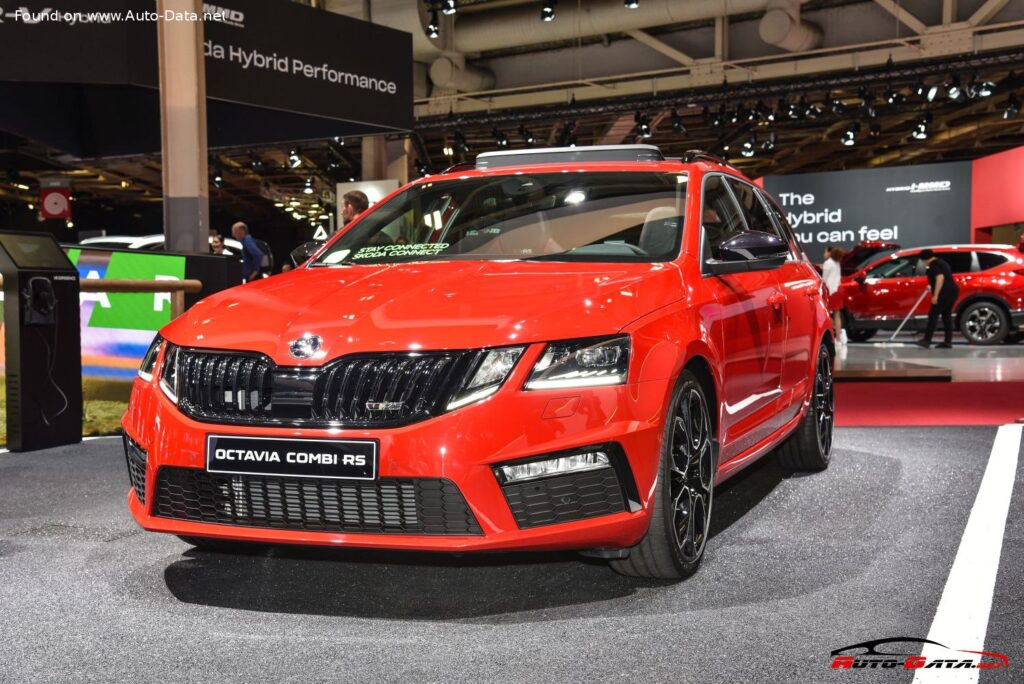
The Skoda Octavia III Combi (facelift 2017) retains the practical and understated elegance characteristic of the brand, while the 2017 facelift introduced several key aesthetic updates. Most notably, the front end received a more distinctive look with split headlights, giving it a sharper and more modern appearance, complemented by a revised grille and bumper design. The “Combi” designation signifies its station wagon body type, a highly popular and practical choice in Europe. With five doors and seating for five occupants, the Octavia Combi excels in cargo capacity and versatility.
Dimensions are generous for its class, with an overall length of 183.74 inches (4667 mm), a width of 71.42 inches (1814 mm), and a height of 57.6 inches (1463 mm). The substantial 105.51-inch (2680 mm) wheelbase contributes to a stable ride and ample interior space. One of the Octavia Combi’s most compelling features is its expansive trunk space, offering a minimum of 21.54 cubic feet (610 liters) with the rear seats up, expanding to a cavernous 61.45 cubic feet (1740 liters) when the rear seats are folded down. This positions it among the leaders in its segment for cargo-carrying capability, making it ideal for families, outdoor enthusiasts, or those requiring significant hauling capacity.
The drivetrain architecture features an all-wheel-drive (4×4) system, which primarily drives the front wheels, with the rear wheels engaging automatically via an electrically or mechanically operated clutch when additional traction is needed. This intelligent system enhances stability and grip in adverse weather conditions or on challenging terrain without significantly impacting fuel economy during normal driving. The suspension system comprises an independent McPherson strut setup with coil springs and an anti-roll bar at the front, paired with an independent multi-link spring suspension with a stabilizer at the rear, providing a comfortable yet composed ride. Braking is handled by ventilated discs at the front and solid discs at the rear, supported by an Anti-lock Braking System (ABS) for enhanced safety. Electric power steering ensures light and precise control, contributing to a pleasant driving experience.
Technical Specifications
| Category | Specification | US Equivalent / Notes |
|---|---|---|
| General Information | ||
| Brand | Skoda | |
| Model | Octavia | |
| Generation | Octavia III Combi (facelift 2017) | |
| Type (Engine) | 2.0 TSI (190 Hp) 4×4 DSG | |
| Start of production | 2018 year | |
| End of production | 2019 year | |
| Powertrain Architecture | Internal Combustion engine | |
| Body type | Station wagon (estate) | |
| Seats | 5 | |
| Doors | 5 | |
| Performance Specs | ||
| Fuel consumption (economy) – urban (NEDC, WLTP equivalent) | 8.5 l/100 km | 27.7 US mpg |
| Fuel consumption (economy) – extra urban (NEDC, WLTP equivalent) | 5.5 l/100 km | 42.8 US mpg |
| Fuel consumption (economy) – combined (NEDC, WLTP equivalent) | 6.6 l/100 km | 35.6 US mpg |
| CO2 emissions (NEDC, WLTP equivalent) | 150 g/km | |
| Fuel Type | Petrol (Gasoline) | |
| Acceleration 0 – 60 mph (Calculated) | 6.5 sec | |
| Maximum speed | 226 km/h | 140.43 mph |
| Emission standard | Euro 6d-TEMP-EVAP | |
| Weight-to-power ratio | 7.5 kg/Hp | 133.8 Hp/tonne |
| Weight-to-torque ratio | 4.4 kg/Nm | 225.4 Nm/tonne |
| Engine Specs | ||
| Power | 190 Hp @ 4200-6000 rpm | |
| Power per liter | 95.8 Hp/l | |
| Torque | 320 Nm @ 1500-4100 rpm | 236.02 lb.-ft. @ 1500-4100 rpm |
| Engine layout | Front, Transverse | |
| Engine Model/Code | EA888 / DKZA | |
| Engine displacement | 1984 cm3 | 121.07 cu. in. (2.0 Liters) |
| Number of cylinders | 4 | |
| Engine configuration | Inline | |
| Cylinder Bore | 82.5 mm | 3.25 in. |
| Piston Stroke | 92.8 mm | 3.65 in. |
| Compression ratio | 11.65:1 | |
| Number of valves per cylinder | 4 | |
| Fuel injection system | Direct injection and Multi-port manifold injection | |
| Engine aspiration | Turbocharger, Intercooler | |
| Valvetrain | DOHC | |
| Engine oil capacity | 5.7 l | 6.02 US qt |
| Engine systems | Start & Stop System, Particulate filter | |
| Space, Volume and Weights | ||
| Kerb Weight | 1420 kg | 3130.56 lbs. |
| Max. weight | 2058 kg | 4537.11 lbs. |
| Max load | 638 kg | 1406.55 lbs. |
| Trunk (boot) space – minimum | 610 l | 21.54 cu. ft. |
| Trunk (boot) space – maximum | 1740 l | 61.45 cu. ft. |
| Fuel tank capacity | 50 l | 13.21 US gal |
| Max. roof load | 75 kg | 165.35 lbs. |
| Permitted trailer load with brakes (12%) | 1700 kg | 3747.86 lbs. |
| Permitted trailer load without brakes | 740 kg | 1631.42 lbs. |
| Permitted towbar download | 80 kg | 176.37 lbs. |
| Dimensions | ||
| Length | 4667 mm | 183.74 in. |
| Width | 1814 mm | 71.42 in. |
| Width including mirrors | 2017 mm | 79.41 in. |
| Height | 1463 mm | 57.6 in. |
| Wheelbase | 2680 mm | 105.51 in. |
| Front track | 1543 mm | 60.75 in. |
| Rear (Back) track | 1542 mm | 60.71 in. |
| Ride height (ground clearance) | 139 mm | 5.47 in. |
| Drag coefficient (Cd) | 0.328 | |
| Minimum turning circle (turning diameter) | 10.6 m | 34.78 ft. |
| Approach angle | 14.2° | |
| Departure angle | 12.4° | |
| Drivetrain, Brakes and Suspension Specs | ||
| Drivetrain Architecture | ICE drives front wheels permanently; rear wheels driven via clutch if necessary. | |
| Drive wheel | All wheel drive (4×4) | |
| Number of gears and type of gearbox | 7 gears, automatic transmission DSG | |
| Front suspension | Independent, type McPherson with coil spring and anti-roll bar | |
| Rear suspension | Independent multi-link spring suspension with stabilizer | |
| Front brakes | Ventilated discs | |
| Rear brakes | Disc | |
| Assisting systems | ABS (Anti-lock braking system) | |
| Steering type | Steering rack and pinion | |
| Power steering | Electric Steering | |
| Tires size | 205/55 R16 | |
| Wheel rims size | 6.5J x 16 | |
Legacy and Market Impact
The Skoda Octavia has consistently been a cornerstone of Skoda’s success, often referred to as the “heart of the brand.” The third-generation model, particularly after its 2017 facelift, continued this legacy, reinforcing Skoda’s reputation for building practical, robust, and value-packed vehicles. In its primary European markets, the Octavia Combi 2.0 TSI (190 Hp) 4×4 DSG competed in a highly contested segment against formidable rivals such as the Volkswagen Golf Variant, Ford Focus Estate, Opel Astra Sports Tourer, and Peugeot 308 SW. What set the Octavia apart was its unique blend of attributes: offering near-mid-size car space and refinement at a competitive compact segment price point.
The combination of the potent 190 HP 2.0 TSI engine, the slick 7-speed DSG transmission, and the capable 4×4 all-wheel-drive system made this particular Octavia variant a highly desirable choice for those seeking performance, security, and versatility. It was particularly popular in regions with challenging winter conditions or for customers who frequently traveled with heavy loads or trailers, thanks to its impressive towing capacity (up to 3747.86 lbs with brakes). Its success was not just in private sales but also significantly in fleet markets, where its low running costs, reliability, and spaciousness were highly valued.
The Octavia’s impact stems from its ability to democratize premium features and performance within a mainstream package. Borrowing heavily from Volkswagen Group’s parts bin meant access to proven engines, transmissions, and chassis technology, giving the Skoda Octavia a sophisticated driving experience that often belied its more affordable price tag. The 2017 facelift ensured the Octavia remained fresh and competitive, incorporating contemporary design cues and technological advancements. Its enduring appeal lies in its honest, no-nonsense approach to motoring, delivering exactly what a family or business needs: a dependable, spacious, and efficient vehicle that doesn’t compromise on driving dynamics or safety. The Octavia III Combi (facelift 2017) 2.0 TSI (190 Hp) 4×4 DSG stands as a testament to Skoda’s journey from an Eastern European brand to a respected global player within the automotive industry, even if its presence remains largely outside of American showrooms.