
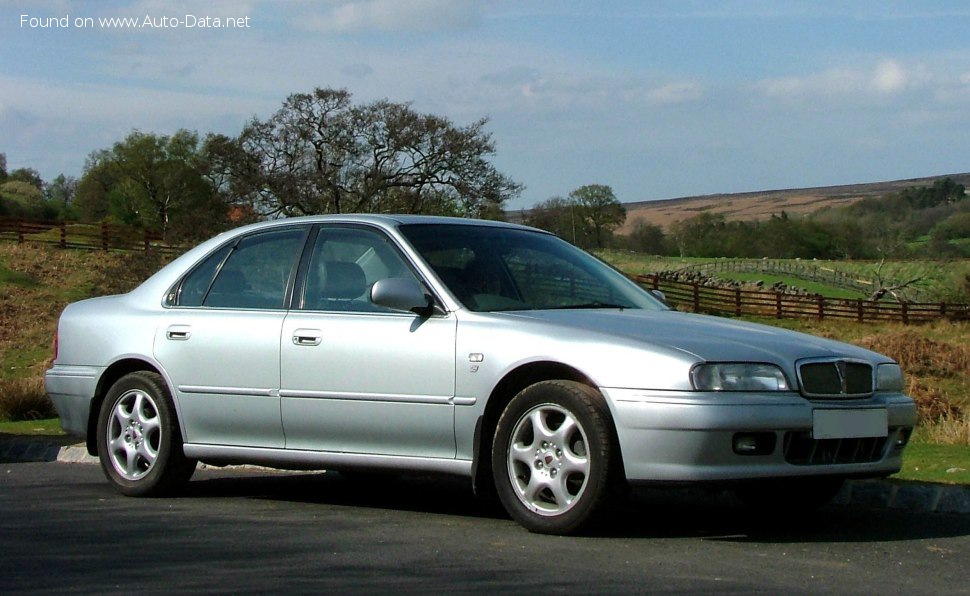
The Rover 600 (RH) 620 Ti Vitesse: A British Performance Sedan
The Rover 600 series, specifically the high-performance Rover 600 (RH) 620 Ti Vitesse, represents a significant chapter in the history of the British automotive manufacturer, Rover Group. Produced from 1994 to 1999, the 600 (RH) generation was a compact executive car that stood as a testament to Rover’s collaboration with Honda, sharing its platform with the fifth-generation Honda Accord. While the Rover 600 was primarily targeted at the European market and was not officially sold in the United States, its engineering and performance credentials, particularly in the range-topping 620 Ti Vitesse trim, made it a notable contender in the competitive European D-segment.
The 620 Ti Vitesse was the performance flagship of the 600 series, designed to inject a dose of excitement and sporting prowess into Rover’s otherwise more staid executive lineup. It combined a sophisticated chassis, a powerful turbocharged engine, and a distinctive British aesthetic to carve out its niche among European rivals, offering a compelling blend of comfort, handling, and outright speed.
Engine & Performance: The Heart of the Rover 600 (RH) 620 Ti Vitesse
At the core of the Rover 600 (RH) 620 Ti Vitesse‘s appeal was its formidable powertrain. Under the hood resided a 2.0-liter (1994 cm3 or 121.68 cu. in.) turbocharged inline-four engine, designated with the internal code H23A2. This all-aluminum, DOHC (Double Overhead Camshaft) engine featured 16 valves (four per cylinder) and a multi-port manifold fuel injection system, augmented by a turbocharger to deliver impressive output for its size.
This powerplant generated a robust 200 horsepower at 6100 rpm, translating to a remarkable 100.3 horsepower per liter, a figure that was highly competitive for its era. Torque was equally impressive, peaking at 237 Nm (174.8 lb.-ft.) at a relatively low 2100 rpm, providing strong off-the-line acceleration and flexible in-gear performance. The engine’s low-end torque delivery, courtesy of the turbocharger, made for a responsive and engaging driving experience.
Power was channeled to the front wheels via a precise 5-speed manual transmission, emphasizing the driver’s connection to the machine. This setup allowed the 620 Ti Vitesse to accelerate from 0 to 60 mph in a brisk 6.7 seconds (0-100 km/h in 7.1 seconds), and achieve a top speed of 149.13 mph (240 km/h). These figures placed it firmly in the performance sedan category, challenging established names with its blend of speed and refinement. The vehicle’s kerb weight of 2976.24 lbs (1350 kg) contributed to a favorable weight-to-power ratio of 6.8 kg/Hp, or 148.1 Hp per tonne, further underscoring its dynamic capabilities.
Design & Features: Blending British Style with Japanese Engineering
The Rover 600 (RH) series, including the 620 Ti Vitesse, adopted a sleek and understated sedan body style. Its design was a successful fusion of Rover’s traditional elegance with Honda’s contemporary aesthetics, resulting in a car that looked sophisticated and purposeful without being overtly aggressive. The 4-door, 5-seat configuration ensured practicality, while the exterior dimensions (Length: 182.87 in., Width: 67.52 in., Height: 54.33 in.) gave it a commanding road presence for its class.
Inside, the 620 Ti Vitesse offered a cabin that reflected Rover’s commitment to luxury and comfort. High-quality materials, often including leather and wood trim, were standard for the Vitesse variant, creating an inviting and upscale environment. The driver-focused cockpit featured a clear instrument cluster and ergonomically placed controls. Practicality was also a strong suit, with a minimum trunk space of 14.3 cu. ft. (405 liters) and a fuel tank capacity of 17.17 US gallons (65 liters), offering a good range for long journeys.
In terms of chassis and suspension, the 620 Ti Vitesse benefited greatly from its Honda Accord underpinnings. It featured a double wishbone suspension system at both the front and rear, a sophisticated setup that provided an excellent balance of ride comfort and agile handling. Stopping power came from ventilated disc brakes at the front and solid discs at the rear, complemented by an Anti-lock Braking System (ABS) as standard, enhancing safety and control during spirited driving. The hydraulic power steering, utilizing a rack and pinion system, offered precise feedback and a direct connection to the road, further cementing its credentials as a driver’s car.
Technical Specifications
| Category | Specification |
|---|---|
| Brand | Rover |
| Model | 600 |
| Generation | 600 (RH) |
| Type (Engine) | 620 Ti Vitesse (200 Hp) |
| Start of Production | 1994 year |
| End of Production | 1999 year |
| Powertrain Architecture | Internal Combustion Engine |
| Body Type | Sedan |
| Seats | 5 |
| Doors | 4 |
Performance Specs |
|
| Fuel Type | Petrol (Gasoline) |
| Acceleration 0 – 60 mph | 6.7 sec |
| Acceleration 0 – 100 km/h | 7.1 sec |
| Maximum Speed | 149.13 mph (240 km/h) |
| Weight-to-Power Ratio | 6.8 kg/Hp (148.1 Hp/tonne) |
| Weight-to-Torque Ratio | 5.7 kg/Nm (175.6 Nm/tonne) |
Engine Specs |
|
| Power | 200 Hp @ 6100 rpm |
| Power per liter | 100.3 Hp/l |
| Torque | 237 Nm (174.8 lb.-ft.) @ 2100 rpm |
| Engine Layout | Front, Transverse |
| Engine Model/Code | H23A2 |
| Engine Displacement | 1994 cm3 (121.68 cu. in.) |
| Number of Cylinders | 4 |
| Engine Configuration | Inline |
| Cylinder Bore | 84.5 mm (3.33 in.) |
| Piston Stroke | 88.9 mm (3.5 in.) |
| Compression Ratio | 8.5:1 |
| Number of Valves per Cylinder | 4 |
| Fuel Injection System | Multi-port manifold injection |
| Engine Aspiration | Turbocharger |
| Valvetrain | DOHC |
| Engine Oil Capacity | 5.4 l (5.71 US qt) |
| Engine Oil Specification | Not Specified |
| Coolant Capacity | 7 l (7.4 US qt) |
Space, Volume and Weights |
|
| Kerb Weight | 1350 kg (2976.24 lbs) |
| Max. Weight | 1910 kg (4210.83 lbs) |
| Max Load | 560 kg (1234.59 lbs) |
| Trunk (Boot) Space – Minimum | 405 l (14.3 cu. ft.) |
| Fuel Tank Capacity | 65 l (17.17 US gal) |
Dimensions |
|
| Length | 4645 mm (182.87 in.) |
| Width | 1715 mm (67.52 in.) |
| Height | 1380 mm (54.33 in.) |
| Wheelbase | 2720 mm (107.09 in.) |
| Front Track | 1475 mm (58.07 in.) |
| Rear (Back) Track | 1480 mm (58.27 in.) |
Drivetrain, Brakes and Suspension Specs |
|
| Drivetrain Architecture | Front-wheel drive, Internal Combustion Engine |
| Drive Wheel | Front-wheel drive |
| Number of Gears and Type of Gearbox | 5 gears, manual transmission |
| Front Suspension | Double wishbone |
| Rear Suspension | Double wishbone |
| Front Brakes | Ventilated discs |
| Rear Brakes | Disc |
| Assisting Systems | ABS (Anti-lock braking system) |
| Steering Type | Steering rack and pinion |
| Power Steering | Hydraulic Steering |
| Tires Size | 205/55 R16 V |
Legacy & Market Impact of the Rover 600 (RH) 620 Ti Vitesse
The Rover 600 (RH) 620 Ti Vitesse carved out a unique position in the European executive sedan market during its production run. In an era dominated by German premium brands like the BMW 3-Series and Audi A4, and strong mainstream contenders such as the Ford Mondeo ST200 and Vauxhall (Opel) Cavalier GSi, the 620 Ti Vitesse offered a distinctly British alternative with a potent powertrain and refined driving dynamics. Its Honda Accord underpinnings provided a solid foundation for reliability and engineering quality, which was a significant selling point for Rover at the time.
While Rover struggled with its brand image and financial stability during the 1990s, the 620 Ti Vitesse stood out as a beacon of performance and engineering prowess within its lineup. It appealed to buyers looking for a sophisticated, subtly sporting sedan that didn’t overtly broadcast its performance capabilities. Its blend of a comfortable, well-appointed interior with a genuinely quick and engaging driving experience made it a ‘Q-car’ of sorts – a fast car that maintained a discreet appearance.
The 620 Ti Vitesse’s legacy is tied to the broader narrative of the Rover Group. It represented the peak of Rover’s engineering collaboration with Honda, showcasing what could be achieved when British design sensibilities met Japanese technical expertise. However, as Rover’s relationship with Honda deteriorated and the company faced increasing pressure from global competitors, models like the 620 Ti Vitesse became increasingly rare and niche. Today, the Rover 600 (RH) 620 Ti Vitesse is regarded by enthusiasts as a classic performance sedan, admired for its spirited engine, capable chassis, and its place in British automotive history. It serves as a reminder of an era when Rover, despite its challenges, could still produce a truly competitive and enjoyable driver’s car for the discerning European market.
