The Renault Megane II GT 1.9 dCi (130 Hp) FAP: A European Diesel Performer
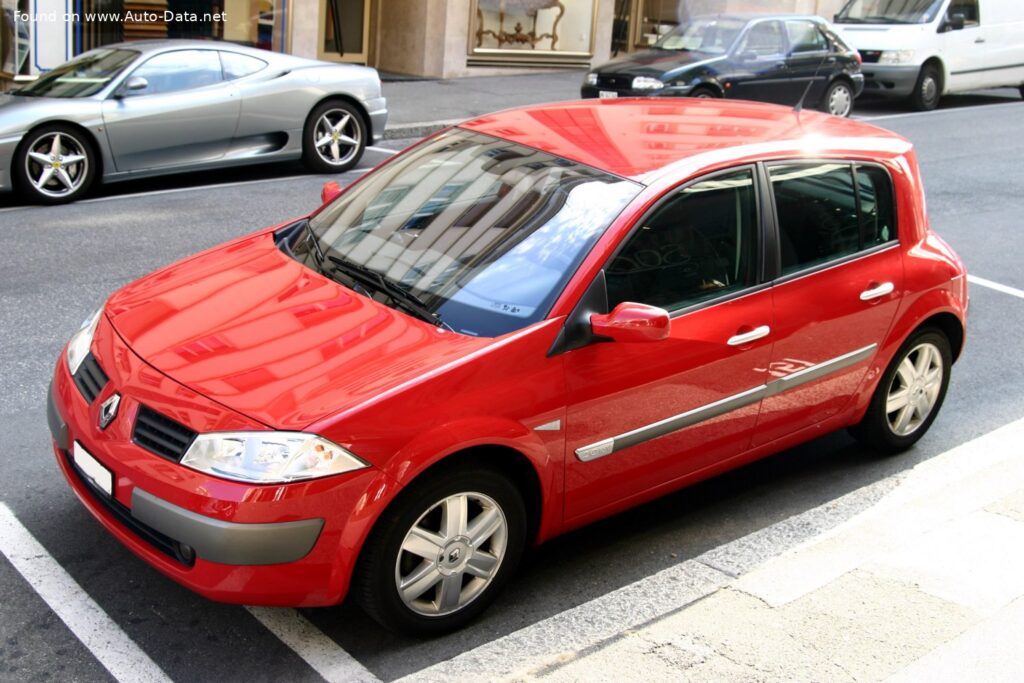
The Renault Megane II, launched in 2002, represented a significant departure from its predecessor, introducing a bold, avant-garde design that garnered both acclaim and controversy. As a pivotal model in the highly competitive European C-segment, the Megane II sought to blend distinctive styling with practicality and advanced technology. The specific variant, the Renault Megane II GT 1.9 dCi (130 Hp) FAP, produced during a focused period in 2005, exemplified Renault’s commitment to offering a powerful yet efficient diesel option within its sportier GT trim line. This five-door hatchback was designed primarily for the European market, where diesel engines and compact family cars reign supreme, offering a compelling blend of performance, fuel economy, and environmental consciousness for its era.
Unlike many vehicles sold globally, the Renault Megane II, and particularly its diesel variants, were not officially imported into the United States. Its role was firmly established in Europe, where it competed fiercely with stalwarts like the Volkswagen Golf, Ford Focus, Peugeot 307, and Opel Astra. The GT designation signified a more dynamic driving experience and aesthetic enhancements over standard Megane models, while the 1.9 dCi engine, coupled with a Diesel Particulate Filter (FAP), positioned it as a modern, responsible choice for drivers seeking both vigor and efficiency.
Engine and Performance: The Heart of the Renault Megane II GT 1.9 dCi (130 Hp) FAP
At the core of the Renault Megane II GT 1.9 dCi (130 Hp) FAP lies a robust 1.9-liter (1870 cubic centimeters or 114.11 cubic inches) inline four-cylinder turbodiesel engine, internally designated F9Q. This powerplant, a cornerstone of Renault’s diesel offerings, was engineered for a strong balance of power and torque, making it particularly well-suited for both urban commuting and long-distance highway cruising. It produced a respectable 130 horsepower at 4000 rpm, which was a competitive figure for a compact diesel in 2005. More significantly, the engine delivered a substantial 221.27 lb.-ft. (300 Nm) of torque at a low 2000 rpm, ensuring brisk acceleration and flexible in-gear performance.
Power was efficiently transmitted to the front wheels via a slick-shifting 6-speed manual transmission, providing the driver with precise control over the engine’s output and contributing to the car’s impressive fuel economy. This powertrain setup allowed the Megane II GT 1.9 dCi to accelerate from 0 to 60 mph in a swift 8.6 seconds (0-100 km/h in 9 seconds) and reach a top speed of 124.27 mph (200 km/h). These performance figures underscored its GT moniker, offering a sportier driving feel than many of its diesel-powered rivals.
Fuel efficiency was a major highlight for this diesel variant, a primary reason for its popularity in Europe. The Megane II GT 1.9 dCi achieved an impressive combined fuel consumption rating of 43.6 US mpg (5.4 l/100 km). In extra-urban driving, this figure soared to 53.5 US mpg (4.4 l/100 km), demonstrating its economical nature on open roads. Even in urban conditions, it managed a respectable 33.1 US mpg (7.1 l/100 km). Furthermore, the inclusion of a Diesel Particulate Filter (FAP) was a significant technological advancement for its time, helping the vehicle meet stringent Euro 4 emission standards with CO2 emissions of 148 g/km, reflecting Renault’s commitment to environmental responsibility.
Design and Features
The Renault Megane II was instantly recognizable for its radical “bustle-back” design, particularly evident in the hatchback variant. This distinctive rear styling, characterized by its prominent, almost vertical tailgate, was a bold move by Renault’s design team, led by Patrick le Quément. While polarizing, it certainly made the Megane II stand out in a sea of more conservatively styled compact cars. The GT trim added subtle sporty cues, such as unique badging, potentially different alloy wheels, and a slightly more aggressive stance, without overtly compromising its everyday usability.
As a 5-door hatchback, the Megane II GT offered practical seating for five occupants and a versatile cargo area. The trunk space ranged from a decent 11.65 cubic feet (330 liters) with the rear seats up, expanding to a generous 42.02 cubic feet (1190 liters) when the rear seats were folded down, making it suitable for families and active lifestyles. The interior, while not luxurious, was designed with ergonomics and functionality in mind, featuring clear instrumentation and intuitive controls. For its time, the Megane II was also innovative with features like keyless entry and start (Renault Card), which became a hallmark of the model.
Safety was a paramount concern for Renault, and the Megane II was one of the first vehicles in its class to achieve a 5-star Euro NCAP crash test rating, setting a new benchmark. Standard safety features for the GT 1.9 dCi included an Anti-lock Braking System (ABS), which significantly improved braking control, especially in emergency situations. The car featured ventilated disc brakes at the front and disc brakes at the rear, ensuring confident stopping power. The suspension system, comprising independent coil springs at the front and a torsion beam at the rear, was tuned to offer a comfortable ride while maintaining a degree of agility expected of a GT model. Electric power steering further enhanced maneuverability and ease of driving in urban environments.
Technical Specifications
| Category | Specification | Value |
|---|---|---|
General Information |
||
| Brand | Renault | |
| Model | Megane | |
| Generation | Megane II | |
| Type (Engine) | GT 1.9 dCi (130 Hp) FAP | |
| Production Start/End | 2005 – 2005 | |
| Powertrain Architecture | Internal Combustion Engine | |
| Body Type | Hatchback | |
| Seats | 5 | |
| Doors | 5 | |
Engine Specifications |
||
| Power | 130 Hp @ 4000 rpm | |
| Power per liter | 69.5 Hp/l | |
| Torque | 221.27 lb.-ft. (300 Nm) @ 2000 rpm | |
| Engine Layout | Front, Transverse | |
| Engine Model/Code | F9Q | |
| Engine Displacement | 1.9 liters (1870 cm³, 114.11 cu. in.) | |
| Number of Cylinders | 4, Inline | |
| Cylinder Bore | 3.15 in. (80 mm) | |
| Piston Stroke | 3.66 in. (93 mm) | |
| Compression Ratio | 19:1 | |
| Valves per Cylinder | 2 | |
| Fuel Injection System | Diesel Commonrail | |
| Engine Aspiration | Turbocharger, Intercooler | |
| Valvetrain | OHC | |
| Engine Oil Capacity | 4.76 US qt (4.5 l) | |
| Coolant Capacity | 8.03 US qt (7.6 l) | |
| Engine Systems | Particulate filter (FAP) | |
Performance Specifications |
||
| Acceleration 0 – 60 mph | 8.6 sec | |
| Acceleration 0 – 100 km/h | 9 sec | |
| Maximum Speed | 124.27 mph (200 km/h) | |
| Fuel Economy (Urban) | 33.1 US mpg (7.1 l/100 km) | |
| Fuel Economy (Extra Urban) | 53.5 US mpg (4.4 l/100 km) | |
| Fuel Economy (Combined) | 43.6 US mpg (5.4 l/100 km) | |
| CO2 Emissions | 148 g/km | |
| Emission Standard | Euro 4 | |
| Fuel Type | Diesel | |
| Weight-to-Power Ratio | 9.8 kg/Hp (102.4 Hp/tonne) | |
| Weight-to-Torque Ratio | 4.2 kg/Nm (236.2 Nm/tonne) | |
Dimensions, Weights, and Capacities |
||
| Length | 165.71 in. (4209 mm) | |
| Width | 69.96 in. (1777 mm) | |
| Height | 57.4 in. (1458 mm) | |
| Wheelbase | 103.35 in. (2625 mm) | |
| Front Track | 59.76 in. (1518 mm) | |
| Rear Track | 59.61 in. (1514 mm) | |
| Front Overhang | 33.15 in. (842 mm) | |
| Rear Overhang | 29.21 in. (742 mm) | |
| Minimum Turning Circle | 34.45 ft. (10.5 m) | |
| Kerb Weight | 2799.87 lbs. (1270 kg) | |
| Max. Weight (Gross Vehicle Weight) | 4012.41 lbs. (1820 kg) | |
| Max Load | 1212.54 lbs. (550 kg) | |
| Trunk (Boot) Space – Minimum | 11.65 cu. ft. (330 l) | |
| Trunk (Boot) Space – Maximum | 42.02 cu. ft. (1190 l) | |
| Fuel Tank Capacity | 15.85 US gal (60 l) | |
| Max. Roof Load | 176.37 lbs. (80 kg) | |
| Permitted Trailer Load with Brakes (12%) | 2866.01 lbs. (1300 kg) | |
| Permitted Trailer Load without Brakes | 1433 lbs. (650 kg) | |
| Permitted Towbar Download | 165.35 lbs. (75 kg) | |
Drivetrain, Brakes, and Suspension |
||
| Drivetrain Architecture | Internal Combustion Engine (ICE) drives front wheels | |
| Drive Wheel | Front Wheel Drive | |
| Number of Gears and Type of Gearbox | 6 gears, Manual Transmission | |
| Front Suspension | Independent coil spring | |
| Rear Suspension | Torsion beam | |
| Front Brakes | Ventilated discs | |
| Rear Brakes | Disc | |
| Assisting Systems | ABS (Anti-lock braking system) | |
| Steering Type | Steering rack and pinion | |
| Power Steering | Electric Steering | |
| Tires Size | 195/65 R15 | |
| Wheel Rims Size | 6J x 15 | |
Legacy and Market Impact
The Renault Megane II, and particularly its diesel variants like the GT 1.9 dCi, left a significant mark on the European automotive landscape. Its audacious design, a stark contrast to the more conservative aesthetics of many competitors, made it a conversation starter and a visual standout. While not universally loved, its unique styling contributed to its strong identity and helped solidify Renault’s reputation for innovative, if sometimes unconventional, design.
In the highly competitive C-segment, the Megane II GT 1.9 dCi successfully carved out a niche for itself. It competed directly with formidable rivals such as the diesel versions of the Volkswagen Golf, known for its refinement; the Ford Focus, praised for its driving dynamics; the Peugeot 307, with its emphasis on comfort; and the Opel Astra, a solid all-rounder. The Megane II distinguished itself with its distinctive styling, high safety ratings, and the strong performance and exceptional fuel economy offered by its dCi engines. The 1.9 dCi (130 Hp) FAP model, in particular, offered a compelling package for drivers who desired a sporty feel without sacrificing the economic benefits of a diesel engine.
The inclusion of a Diesel Particulate Filter (FAP) was forward-thinking for 2005, highlighting Renault’s early adoption of technologies aimed at reducing harmful emissions. This commitment to meeting Euro 4 standards was crucial in markets with increasingly strict environmental regulations, enhancing the car’s appeal to environmentally conscious buyers and ensuring its longevity in urban zones. The Megane II’s overall success demonstrated that a bold design, combined with strong engineering and a focus on safety and efficiency, could lead to widespread market acceptance in Europe.
Ultimately, the Renault Megane II GT 1.9 dCi (130 Hp) FAP remains a testament to Renault’s design and engineering prowess in the mid-2000s. It was a car that dared to be different, delivering a practical, safe, and efficient package with a distinct personality. Its legacy is one of innovation, strong performance within its class, and a significant contribution to the evolution of the compact family car in Europe, cementing its place as a memorable and impactful model in Renault’s history.