The Skoda Octavia III Combi (facelift 2017) RS 2.0 TDI (184 Hp): A European Performance Diesel Wagon
The Skoda Octavia III Combi (facelift 2017) RS 2.0 TDI (184 Hp) represents a compelling blend of practicality, performance, and fuel efficiency within the European C-segment. Produced by the Czech automaker Skoda, a subsidiary of the Volkswagen Group, the Octavia has long been celebrated for its spacious interior, robust engineering, and value proposition. The third generation, specifically its 2017 facelift and the high-performance RS variant, underscored Skoda’s commitment to offering a vehicle that could comfortably serve as a family hauler during the week and an engaging driver’s car on the weekends. While Skoda models are not officially sold in the United States, the Octavia RS enjoys significant popularity across Europe and other international markets, where its combination of a sporty demeanor and diesel economy resonates strongly with consumers. This particular RS model, equipped with the potent 2.0-liter TDI engine, was manufactured between 2017 and 2019, cementing its place as a desirable option for those seeking a practical, yet spirited, station wagon.
Engine and Performance: The Heart of the Skoda Octavia III Combi (facelift 2017) RS 2.0 TDI (184 Hp)
Under the hood of the Skoda Octavia III Combi RS 2.0 TDI lies a formidable 2.0-liter (120.09 cubic inches) inline-four diesel engine. This powertrain, known by its engine codes CUNA, CUPA, and DJGA, is a testament to Volkswagen Group’s expertise in diesel technology. Featuring a turbocharger and intercooler, along with a sophisticated common rail fuel injection system, it generates a robust 184 horsepower. This output translates to an impressive power-per-liter ratio of 93.5 horsepower per liter, showcasing the engine’s efficient design.
More critically for a performance-oriented diesel, the engine delivers a substantial 280.27 lb.-ft. of torque, available across a broad rev range from 1750 to 3250 rpm. This wide torque band ensures strong, effortless acceleration and excellent passing power, making the Octavia RS TDI particularly well-suited for both spirited driving and long-distance highway cruising. The engine’s layout is front, transverse, driving the front wheels through a precise 6-speed manual transmission, offering an engaging driving experience for enthusiasts.
Performance figures are impressive for a family-friendly station wagon. The Octavia RS 2.0 TDI can accelerate from 0 to 60 mph in a brisk 7.6 seconds, with 0 to 62 mph (100 km/h) achieved in 8 seconds. Its top speed is rated at 142.92 mph (230 km/h), firmly placing it in the realm of genuine performance vehicles. Despite its sporting aspirations, the diesel engine maintains remarkable fuel efficiency. The combined fuel economy is an excellent 52.3 US mpg, with urban consumption rated at 44.4 US mpg and extra-urban (highway) at an outstanding 57.4 US mpg. These figures, combined with CO2 emissions of 119 g/km and Euro 6 emission standards compliance, highlight its environmentally conscious design, especially for its era. The vehicle’s weight-to-power ratio stands at 7.6 kg/Hp (132.2 Hp/tonne), further contributing to its dynamic capabilities.
Design and Features: Sporty Practicality
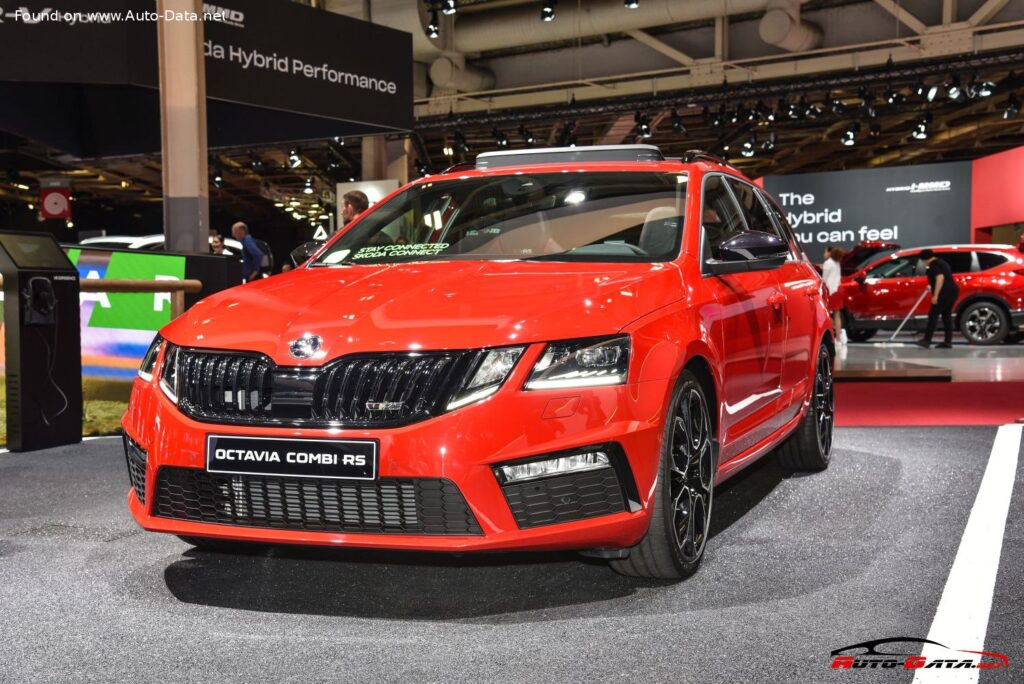
The Skoda Octavia III Combi (facelift 2017) RS 2.0 TDI (184 Hp) proudly wears its station wagon (estate) body type, offering an exceptional blend of sporty aesthetics and cavernous practicality. The 2017 facelift brought a refreshed front fascia, characterized by a more aggressive bumper design and distinctive split headlamps, giving the RS model an even sharper, more modern look. RS-specific badging, unique alloy wheels, and a subtle rear spoiler differentiate it from standard Octavia models, hinting at its performance capabilities without being overtly ostentatious.
Measuring 184.61 inches in length, 71.42 inches in width, and 57.17 inches in height, with a wheelbase of 105.51 inches, the Octavia Combi provides ample interior space for five occupants. The real highlight for many buyers is the sheer utility of the cargo area. With the rear seats in place, the trunk offers a generous 21.54 cubic feet (610 liters) of space. Folding the rear seats expands this to an impressive 61.45 cubic feet (1740 liters), making it capable of swallowing large amounts of luggage, sports equipment, or even small furniture. The maximum load capacity is 1247.82 lbs (566 kg), and it boasts a substantial towing capacity of 3527.4 lbs (1600 kg) with brakes, underscoring its versatility.
Inside, the RS treatment continues with sports seats, a flat-bottom steering wheel, and unique trim elements that enhance the cabin’s sporty appeal. Standard features include an advanced infotainment system, climate control, and a comprehensive suite of safety technologies. The vehicle is equipped with ventilated disc brakes at the front and disc brakes at the rear, complemented by an Anti-lock Braking System (ABS) for assured stopping power. The electric power steering system provides precise and responsive handling, characteristic of a performance-tuned vehicle.
Technical Specifications
| Category | Specification | Value |
|---|---|---|
| General Information | ||
| Brand | Skoda | |
| Model | Octavia | |
| Generation | Octavia III Combi (facelift 2017) | |
| Type (Engine) | RS 2.0 TDI (184 Hp) | |
| Start of Production | 2017 year | |
| End of Production | 2019 year | |
| Powertrain Architecture | Internal Combustion engine | |
| Body type | Station wagon (estate) | |
| Seats | 5 | |
| Doors | 5 | |
| Performance Specs | ||
| Fuel consumption (economy) – urban | 5.3 l/100 km | 44.4 US mpg | 53.3 UK mpg | 18.9 km/l |
| Fuel consumption (economy) – extra urban | 4.1 l/100 km | 57.4 US mpg | 68.9 UK mpg | 24.4 km/l |
| Fuel consumption (economy) – combined | 4.5 l/100 km | 52.3 US mpg | 62.8 UK mpg | 22.2 km/l |
| CO2 emissions | 119 g/km | |
| Fuel Type | Diesel | |
| Acceleration 0 – 60 mph (Calculated) | 7.6 sec | |
| Acceleration 0 – 62 mph (100 km/h) | 8 sec | |
| Maximum speed | 230 km/h | 142.92 mph |
| Emission standard | Euro 6 | |
| Weight-to-power ratio | 7.6 kg/Hp | 132.2 Hp/tonne | |
| Weight-to-torque ratio | 3.7 kg/Nm | 273 Nm/tonne | |
| Engine Specs | ||
| Power | 184 Hp | |
| Power per liter | 93.5 Hp/l | |
| Torque | 380 Nm @ 1750-3250 rpm | 280.27 lb.-ft. @ 1750-3250 rpm |
| Engine layout | Front, Transverse | |
| Engine Model/Code | CUNA, CUPA, DJGA | |
| Engine displacement | 1968 cm3 | 120.09 cu. in. |
| Number of cylinders | 4 | |
| Engine configuration | Inline | |
| Cylinder Bore | 81 mm | 3.19 in. |
| Piston Stroke | 95.5 mm | 3.76 in. |
| Compression ratio | 15.8:1 | |
| Number of valves per cylinder | 4 | |
| Fuel injection system | Diesel Commonrail | |
| Engine aspiration | Turbocharger, Intercooler | |
| Engine oil capacity | 4.6 l | 4.86 US qt | 4.05 UK qt |
| Engine systems | Particulate filter | |
| Space, Volume and Weights | ||
| Kerb Weight | 1392 kg | 3068.83 lbs. |
| Max. weight (GVWR) | 1958 kg | 4316.65 lbs. |
| Max load | 566 kg | 1247.82 lbs. |
| Trunk (boot) space – minimum | 610 l | 21.54 cu. ft. |
| Trunk (boot) space – maximum | 1740 l | 61.45 cu. ft. |
| Fuel tank capacity | 50 l | 13.21 US gal | 11 UK gal |
| Max. roof load | 75 kg | 165.35 lbs. |
| Permitted trailer load with brakes (12%) | 1600 kg | 3527.4 lbs. |
| Permitted trailer load without brakes | 730 kg | 1609.37 lbs. |
| Dimensions | ||
| Length | 4689 mm | 184.61 in. |
| Width | 1814 mm | 71.42 in. |
| Height | 1452 mm | 57.17 in. |
| Wheelbase | 2680 mm | 105.51 in. |
| Front track | 1535 mm | 60.43 in. |
| Rear (Back) track | 1544 mm | 60.79 in. |
| Minimum turning circle (turning diameter) | 10.59 m | 34.74 ft. |
| Drivetrain, Brakes and Suspension Specs | ||
| Drivetrain Architecture | The Internal combustion engine (ICE) drives the front wheels of the vehicle. | |
| Drive wheel | Front wheel drive | |
| Number of gears and type of gearbox | 6 gears, manual transmission | |
| Front brakes | Ventilated discs | |
| Rear brakes | Disc | |
| Assisting systems | ABS (Anti-lock braking system) | |
| Steering type | Steering rack and pinion | |
| Power steering | Electric Steering | |
Legacy and Market Impact
The Skoda Octavia has consistently been a cornerstone of Skoda’s success in Europe and other global markets, often lauded as a “smart choice” for its blend of space, quality, and affordability. The RS variant, and particularly the diesel-powered Skoda Octavia III Combi (facelift 2017) RS 2.0 TDI (184 Hp), carved out a significant niche. It successfully combined the practicality of a family station wagon with the engaging driving dynamics and efficiency of a performance diesel. In a market where high-performance gasoline engines often dominate the “sporty” segment, the RS TDI offered a compelling alternative, delivering strong torque and impressive fuel economy without sacrificing driving enjoyment.
Its primary competitors in the European market included other performance-oriented C-segment wagons, such as the Volkswagen Golf GTD Variant (with which it shared many underpinnings), the Ford Focus ST Wagon (though often gasoline-only), and potentially more premium offerings like the Audi A4 Avant TDI or BMW 3 Series Touring diesel, though at a significantly higher price point. The Octavia RS consistently offered a “more for less” proposition, providing near-premium quality and performance at a more accessible price.
The Octavia RS 2.0 TDI’s historical significance lies in its embodiment of the modern performance diesel. It demonstrated that diesel engines, often associated with utilitarian workhorses, could power genuinely sporty and enjoyable cars while maintaining exceptional fuel efficiency. This model contributed to Skoda’s reputation for building well-engineered, practical, and surprisingly capable vehicles, solidifying its position as a major player in the European automotive landscape. Its legacy continues as a highly sought-after used vehicle for those who appreciate its unique blend of attributes, proving that practicality and performance can indeed coexist harmoniously.