Introduction to the Volvo V60 I (2013 facelift) 1.5 T2 (122 Hp) Automatic
The Volvo V60 I, particularly its 2013 facelift iteration, represents a significant chapter in Volvo’s commitment to combining Scandinavian design, practicality, and safety within the premium compact executive segment. Launched in 2010, the first-generation V60 was Volvo’s answer to the growing demand for stylish and versatile wagons, often referred to as “sportswagons” by the brand itself, emphasizing its dynamic aspirations alongside utility. The 2013 facelift brought a refreshed exterior, updated interior elements, and a host of powertrain enhancements, keeping the model competitive in its primary European market.
This specific variant, the Volvo V60 I (2013 facelift) 1.5 T2 (122 Hp) Automatic, was produced between 2016 and 2018. It showcases Volvo’s strategy of engine downsizing to meet stringent European emission standards while still delivering adequate performance for daily driving. While the V60 was sold in the United States, this particular 1.5-liter T2 engine configuration was not offered in the North American market, where larger engines typically dominated the lineup. Instead, it played a crucial role in Europe, appealing to buyers seeking a blend of fuel efficiency, lower running costs, and premium features in a practical station wagon body style. Its powertrain architecture is based on an internal combustion engine driving the front wheels, a common and efficient setup for this segment.
Engine and Performance: The Volvo V60 I (2013 facelift) 1.5 T2
At the heart of this particular Volvo V60 I (2013 facelift) lies the B4154T5 engine, a 1.5-liter (1498 cm³) inline four-cylinder gasoline unit. This powerplant is a testament to modern engine design, featuring direct fuel injection, a turbocharger, and an intercooler to optimize combustion and boost power output from its relatively small displacement. The DOHC (Double Overhead Camshaft) valvetrain with 4 valves per cylinder ensures efficient airflow and precise control over the engine’s breathing.
The engine delivers a respectable 122 horsepower at 5000 rpm, translating to a power output of 81.4 horsepower per liter. More significantly for daily drivability, it produces a healthy 162.26 lb.-ft. of torque, available across a broad rev range from 1600 to 3500 rpm. This wide torque band is crucial for a smooth and responsive driving experience, especially when paired with the 6-speed automatic transmission. The front-transverse engine layout and front-wheel-drive architecture are typical for a vehicle in this class, offering a good balance of packaging efficiency and predictable handling characteristics.
In terms of performance, the Volvo V60 I (2013 facelift) 1.5 T2 (122 Hp) Automatic accelerates from 0 to 60 mph in an estimated 9.8 seconds, with 0-100 km/h taking 10.3 seconds. The top speed is rated at 118.06 mph (190 km/h). While not designed for outright speed, these figures indicate a competent performance for urban commuting and highway cruising. Fuel economy is a strong suit, with a combined rating of 39.9 US mpg (5.9 l/100 km), and an impressive 48 US mpg (4.9 l/100 km) on the extra-urban cycle. Urban consumption stands at 30.9 US mpg (7.6 l/100 km). With CO2 emissions of 138 g/km, this variant met the Euro 6 emission standard, highlighting its environmental considerations for the European market. The fuel tank capacity of 17.83 US gallons (67.5 liters) provides a substantial range between fill-ups.
Design and Features: The Practical Elegance of the Volvo V60
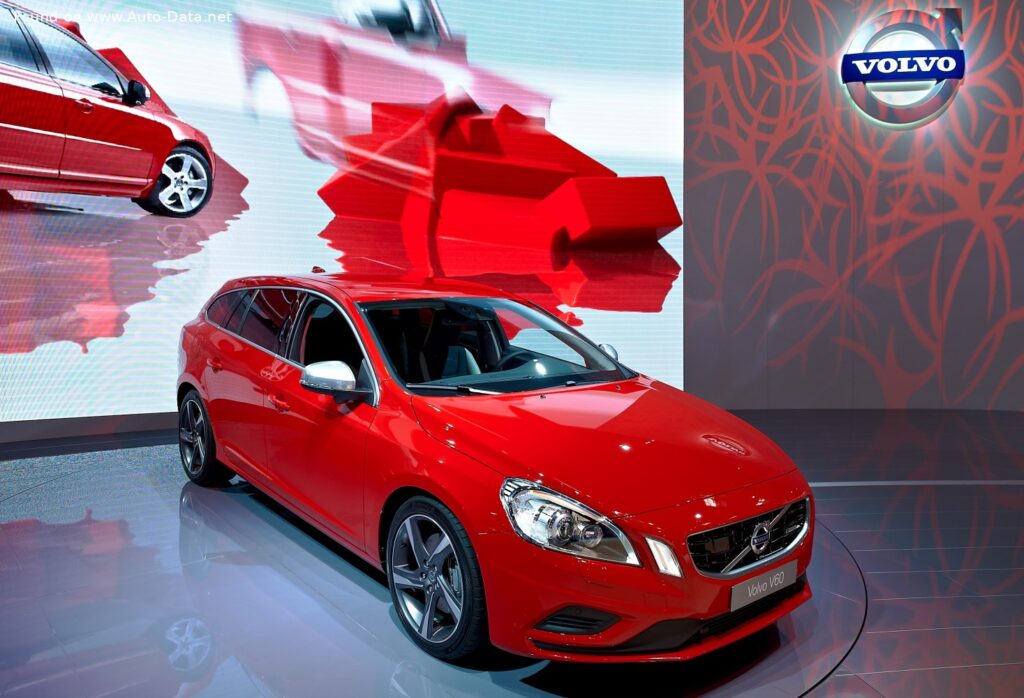
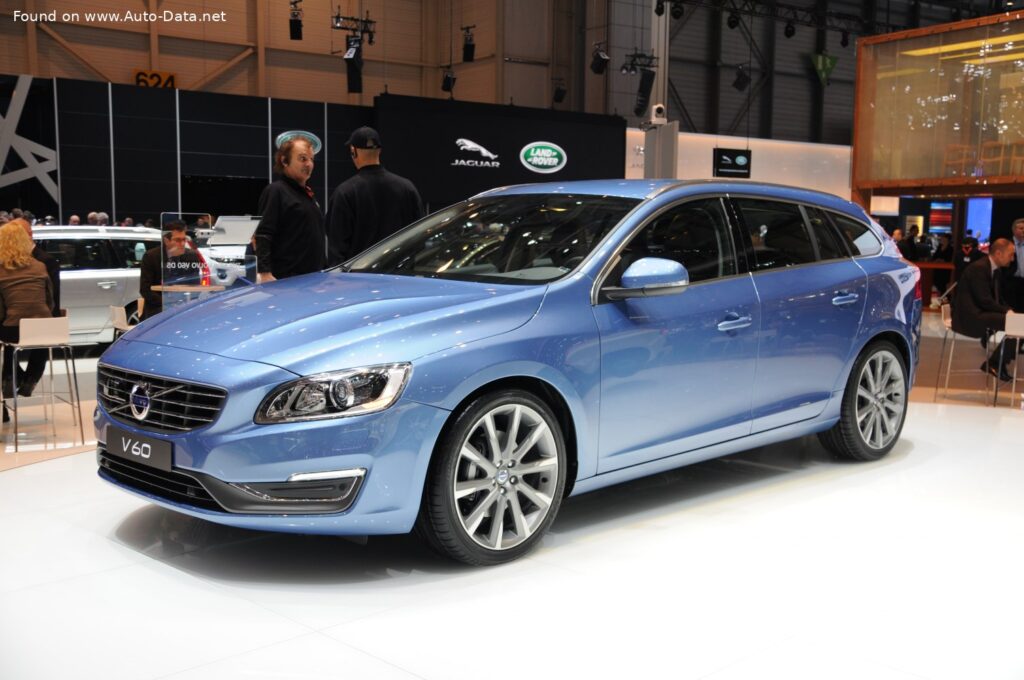
The Volvo V60 I (2013 facelift) embodies Volvo’s distinctive design language of the era, characterized by elegant lines, a sloping roofline, and strong shoulder contours that give it a dynamic, almost coupé-like profile despite its station wagon body. This “sportswagon” aesthetic aimed to differentiate it from more traditional, boxy wagons, appealing to a younger, more design-conscious demographic. The facelift subtly refined these elements, integrating a wider grille, redesigned headlights, and updated bumpers for a more cohesive and sophisticated look.
Measuring 182.48 inches (4635 mm) in length, 71.85 inches (1825 mm) in width (82.56 inches or 2097 mm including mirrors), and 58.43 inches (1484 mm) in height, the V60 offers a balanced footprint. Its 109.29-inch (2776 mm) wheelbase contributes to a stable ride and a spacious cabin for five occupants. The drag coefficient of 0.29 is commendable for a wagon, aiding both fuel efficiency and reducing wind noise at higher speeds.
Inside, the V60 presents a typically Scandinavian interior, emphasizing ergonomics, high-quality materials, and a clean, uncluttered design. The “floating” center console, a Volvo hallmark, adds to the minimalist yet sophisticated ambiance. While the 1.5 T2 variant was positioned as an entry-level engine, it still benefited from Volvo’s renowned commitment to safety. Standard features would have included a comprehensive array of airbags, ABS (Anti-lock Braking System), and Volvo’s robust body structure. Depending on the trim level, advanced driver-assistance systems (ADAS) like City Safety (Volvo’s low-speed collision avoidance system) and pedestrian detection would have been available, reinforcing Volvo’s reputation as a leader in automotive safety.
Practicality, a core wagon virtue, is well-addressed with a minimum trunk space of 15.19 cubic feet (430 liters). While not the largest in its class, the V60’s cargo area is highly usable, and the split-folding rear seats would have allowed for expanded capacity. The maximum roof load of 165.35 lbs (75 kg) and impressive trailer towing capacities of up to 3968.32 lbs (1800 kg) with brakes underscore its versatility as a family and lifestyle vehicle.
Technical Specifications: Volvo V60 I (2013 facelift) 1.5 T2 (122 Hp) Automatic
| Category | Specification |
|---|---|
| General Information | |
| Brand | Volvo |
| Model | V60 |
| Generation | V60 I (2013 facelift) |
| Type (Engine) | 1.5 T2 (122 Hp) Automatic |
| Start of Production | 2016 year |
| End of Production | 2018 year |
| Powertrain Architecture | Internal Combustion engine |
| Body type | Station wagon (estate) |
| Seats | 5 |
| Doors | 5 |
| Performance Specs | |
| Fuel consumption (economy) – urban | 7.6 l/100 km (30.9 US mpg) |
| Fuel consumption (economy) – extra urban | 4.9 l/100 km (48 US mpg) |
| Fuel consumption (economy) – combined | 5.9 l/100 km (39.9 US mpg) |
| CO2 emissions | 138 g/km |
| Fuel Type | Petrol (Gasoline) |
| Acceleration 0 – 60 mph (Calculated) | 9.8 sec |
| Acceleration 0 – 100 km/h | 10.3 sec |
| Maximum speed | 190 km/h (118.06 mph) |
| Emission standard | Euro 6 |
| Engine Specs | |
| Power | 122 Hp @ 5000 rpm |
| Power per liter | 81.4 Hp/l |
| Torque | 220 Nm (162.26 lb.-ft.) @ 1600-3500 rpm |
| Engine layout | Front, Transverse |
| Engine Model/Code | B4154T5 |
| Engine displacement | 1498 cm³ (91.41 cu. in.) |
| Number of cylinders | 4 |
| Engine configuration | Inline |
| Cylinder Bore | 82 mm (3.23 in.) |
| Piston Stroke | 70.9 mm (2.79 in.) |
| Compression ratio | 10.5:1 |
| Number of valves per cylinder | 4 |
| Fuel injection system | Direct injection |
| Engine aspiration | Turbocharger, Intercooler |
| Valvetrain | DOHC |
| Engine oil capacity | 5.6 l (5.92 US qt) |
| Coolant | 8.3 l (8.77 US qt) |
| Space, Volume and Weights | |
| Trunk (boot) space – minimum | 430 l (15.19 cu. ft.) |
| Fuel tank capacity | 67.5 l (17.83 US gal) |
| Max. roof load | 75 kg (165.35 lbs.) |
| Permitted trailer load with brakes (8%) | 1800 kg (3968.32 lbs.) |
| Permitted trailer load with brakes (12%) | 1500 kg (3306.93 lbs.) |
| Dimensions | |
| Length | 4635 mm (182.48 in.) |
| Width | 1825 mm (71.85 in.) |
| Width with mirrors folded | 1899 mm (74.76 in.) |
| Width including mirrors | 2097 mm (82.56 in.) |
| Height | 1484 mm (58.43 in.) |
| Wheelbase | 2776 mm (109.29 in.) |
| Front track | 1578-1588 mm (62.13 – 62.52 in.) |
| Rear (Back) track | 1575-1585 mm (62.01 – 62.4 in.) |
| Ride height (ground clearance) | 136 mm (5.35 in.) |
| Drag coefficient (Cd) | 0.29 |
| Minimum turning circle (turning diameter) | 13.6 m (44.62 ft.) |
| Drivetrain, Brakes and Suspension Specs | |
| Drivetrain Architecture | The Internal combustion engine (ICE) drives the front wheels of the vehicle. |
| Drive wheel | Front wheel drive |
| Number of gears and type of gearbox | 6 gears, automatic transmission |
| Front suspension | Independent, type McPherson with coil spring and anti-roll bar |
| Rear suspension | Independent coil spring |
| Front brakes | Ventilated discs |
| Rear brakes | Disc |
| Assisting systems | ABS (Anti-lock braking system) |
| Steering type | Steering rack and pinion |
| Power steering | Electric Steering |
Legacy and Market Impact of the Volvo V60 I (2013 facelift)
The Volvo V60 I, particularly in its refreshed 2013 guise, cemented Volvo’s position as a purveyor of premium, safe, and stylish vehicles in the compact executive segment. While this specific 1.5 T2 engine variant was tailored for the European market, it underscored Volvo’s commitment to efficiency and meeting evolving emissions standards without compromising on the brand’s core values. In Europe, it competed fiercely with established German rivals such as the BMW 3 Series Touring, Audi A4 Avant, and Mercedes-Benz C-Class Estate, offering a distinct Scandinavian alternative. Its strength lay in its unique blend of elegant design, renowned safety features, and a relaxed, comfortable driving experience.
The V60’s impact was particularly felt in markets where station wagons (or estates) are highly valued for their practicality and sophisticated image. Its “sportswagon” branding successfully shifted perceptions, proving that a wagon could be both functional and desirable. The facelifted model benefited from Volvo’s ongoing refinement of its Sensus infotainment system and a continued emphasis on advanced safety technologies, which were often standard or readily available, further bolstering its reputation.
For Volvo, the V60 I generation was a vital bridge between its older P2 platform vehicles and the newer SPA (Scalable Product Architecture) models that would follow. It demonstrated the brand’s ability to adapt to changing market demands, including the trend toward smaller, more efficient turbocharged engines like the 1.5-liter T2. This engine, while not powerful by American standards, was perfectly suited for European tax structures and fuel prices, offering an attractive entry point into the premium V60 lineup.
The Volvo V60 I (2013 facelift) 1.5 T2 (122 Hp) Automatic represents an important part of Volvo’s modern history, showcasing its evolution in powertrain technology and its unwavering dedication to design and safety. It remains a popular choice on the used car market in Europe, appreciated for its enduring style, comfortable ride, and robust build quality, standing as a testament to Volvo’s enduring legacy in the premium wagon segment.