Introduction to the Skoda Octavia III Combi (facelift 2017) RS 2.0 TDI (184 Hp) 4×4 6 DSG
The Skoda Octavia, a cornerstone of the Czech automaker’s lineup, has long been celebrated for its pragmatic blend of space, value, and robust engineering, largely thanks to its roots within the Volkswagen Group. The third generation, introduced in 2012, received a significant facelift in 2017, enhancing its aesthetic appeal and technological offerings. Among the various derivatives, the Skoda Octavia III Combi (facelift 2017) RS 2.0 TDI (184 Hp) 4×4 6 DSG stands out as a particularly compelling package, especially within its primary European market. This variant combines the inherent practicality of a station wagon (Combi) with the sporty dynamics of the RS badge, the efficiency and torque of a modern diesel engine, and the all-weather capability of a 4×4 drivetrain, all managed by a quick-shifting 6-speed DSG automatic transmission. While never officially sold in the United States, this particular Octavia model exemplifies Skoda’s strategy of offering sophisticated, performance-oriented family vehicles that punch above their weight in terms of utility and driving engagement.
Engine and Performance: The Heart of the Skoda Octavia III Combi (facelift 2017) RS 2.0 TDI (184 Hp) 4×4 6 DSG
At the core of this sporty wagon is a potent yet remarkably efficient 2.0-liter TDI (Turbocharged Direct Injection) inline-four engine, identified by internal codes such as EA288, CUNA, CUPA, or DJGA. This sophisticated diesel powerplant delivers a robust 184 horsepower at 3500-4000 rpm, complemented by an impressive 280.27 lb.-ft. of torque, available from a low 1750 rpm up to 3250 rpm. This broad torque band ensures strong, responsive acceleration and excellent passing power, making the Octavia RS TDI a formidable long-distance cruiser and an agile performer on winding roads.
The engine’s power is efficiently managed by a 6-speed DSG (Direct Shift Gearbox) automatic transmission, known for its rapid, seamless gear changes. This dual-clutch system contributes significantly to both the car’s sporty feel and its fuel efficiency. Coupled with a permanent all-wheel-drive (4×4) system, which intelligently distributes power between the front and rear wheels via an electrically or mechanically operated clutch, the Octavia RS TDI offers superior traction and stability, particularly in adverse weather conditions or on challenging road surfaces.
Performance figures reflect this capable powertrain: the Skoda Octavia III Combi (facelift 2017) RS 2.0 TDI (184 Hp) 4×4 6 DSG can accelerate from 0 to 60 mph in a brisk 7.3 seconds, with a top speed of 139.19 mph. Despite its performance credentials, the diesel engine maintains excellent fuel economy, boasting a combined NEDC rating of 46.1 US mpg (5.1 l/100 km). Urban consumption is rated at 39.9 US mpg (5.9 l/100 km), while extra-urban driving can achieve up to 50 US mpg (4.7 l/100 km). Furthermore, the engine adheres to the stringent Euro 6 emission standard, featuring a Start & Stop system and a particulate filter to minimize its environmental footprint, with CO2 emissions ranging from 134-136 g/km.
Design and Features: Practicality Meets Sportiness
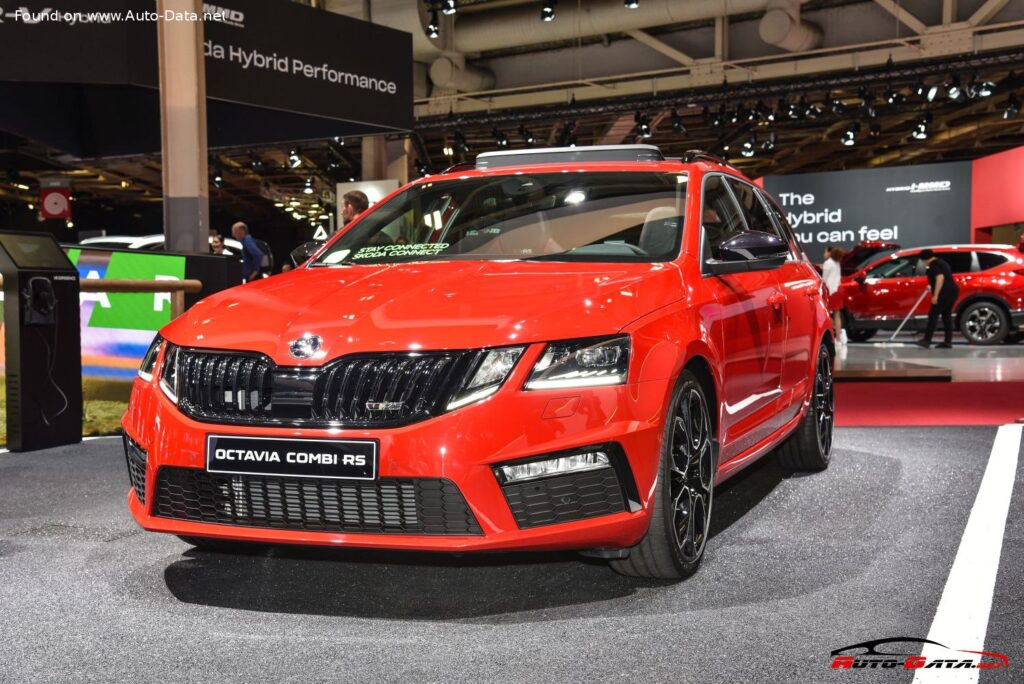
The 2017 facelift brought subtle yet impactful changes to the Octavia’s design, most notably a split headlight design that gave the front fascia a more assertive and modern appearance. As a Combi (station wagon), the vehicle prioritizes utility without sacrificing style. Its dimensions – 184.61 inches in length, 71.42 inches in width (79.41 inches including mirrors), and 57.17 inches in height – contribute to a spacious interior and a commanding road presence. The 105.51-inch wheelbase ensures a comfortable ride and ample passenger room for five occupants.
The RS designation adds a layer of sporty aggression to the practical wagon body. This includes distinctive bumpers, larger alloy wheels (available in 17, 18, or 19-inch sizes), sportier trim, and potentially a lowered suspension. Inside, RS models typically feature bolstered sport seats, a sport steering wheel, and unique trim accents, enhancing the driver-focused experience.
Practicality is a hallmark of the Octavia Combi. It offers a cavernous trunk space, ranging from 21.54 cubic feet (610 liters) with all seats in place, expanding to an impressive 61.45 cubic feet (1740 liters) with the rear seats folded down. This makes it an ideal choice for families, outdoor enthusiasts, or anyone needing significant cargo capacity. The vehicle also boasts a substantial maximum permissible trailer load with brakes of up to 4409.25 lbs (2000 kg), underlining its versatility.
Underneath, the Octavia RS features an independent McPherson strut suspension with a coil spring and anti-roll bar up front, paired with an independent multi-link spring suspension with a stabilizer at the rear. This setup provides a balanced ride, combining comfort with agile handling. Braking is handled by ventilated discs at the front and solid discs at the rear, supported by ABS (Anti-lock Braking System) for confident stopping power. Electric power steering, a rack and pinion system, offers precise control and good feedback, further enhancing the driving experience.
Technical Specifications: Skoda Octavia III Combi (facelift 2017) RS 2.0 TDI (184 Hp) 4×4 6 DSG
| Specification | Value |
|---|---|
| Brand | Skoda |
| Model | Octavia |
| Generation | Octavia III Combi (facelift 2017) |
| Type (Engine) | RS 2.0 TDI (184 Hp) 4×4 6 DSG |
| Start of production | 2017 year |
| End of production | 2018 year |
| Powertrain Architecture | Internal Combustion engine |
| Body type | Station wagon (estate) |
| Seats | 5 |
| Doors | 5 |
| Fuel consumption (economy) – urban (NEDC) | 5.9 l/100 km (39.9 US mpg) |
| Fuel consumption (economy) – extra urban (NEDC) | 4.7-4.8 l/100 km (50 – 49 US mpg) |
| Fuel consumption (economy) – combined (NEDC) | 5.1 l/100 km (46.1 US mpg) |
| CO2 emissions (NEDC) | 134-136 g/km |
| Fuel Type | Diesel |
| Acceleration 0 – 60 mph | 7.3 sec |
| Acceleration 0 – 100 km/h | 7.7 sec |
| Maximum speed | 224 km/h (139.19 mph) |
| Emission standard | Euro 6 |
| Weight-to-power ratio | 8.1 kg/Hp (122.9 Hp/tonne) |
| Weight-to-torque ratio | 3.9 kg/Nm (253.8 Nm/tonne) |
| Power | 184 Hp @ 3500-4000 rpm |
| Power per liter | 93.5 Hp/l |
| Torque | 380 Nm (280.27 lb.-ft.) @ 1750-3250 rpm |
| Engine layout | Front, Transverse |
| Engine Model/Code | EA288 / CUNA, CUPA, DJGA |
| Engine displacement | 1968 cm3 (120.09 cu. in.) |
| Number of cylinders | 4 |
| Engine configuration | Inline |
| Cylinder Bore | 81 mm (3.19 in.) |
| Piston Stroke | 95.5 mm (3.76 in.) |
| Compression ratio | 15.8:1 |
| Number of valves per cylinder | 4 |
| Fuel injection system | Diesel Commonrail |
| Engine aspiration | Turbocharger, Intercooler |
| Valvetrain | DOHC |
| Engine oil capacity | 4.6 l (4.86 US qt) |
| Engine oil specification | Specific details were not provided |
| Engine systems | Start & Stop System, Particulate filter |
| Kerb Weight | 1497 kg (3300.32 lbs.) |
| Max. weight | 2063 kg (4548.14 lbs.) |
| Max load | 566 kg (1247.82 lbs.) |
| Trunk (boot) space – minimum | 610 l (21.54 cu. ft.) |
| Trunk (boot) space – maximum | 1740 l (61.45 cu. ft.) |
| Fuel tank capacity | 55 l (14.53 US gal) |
| Max. roof load | 75 kg (165.35 lbs.) |
| Permitted trailer load with brakes (8%) | 2000 kg (4409.25 lbs.) |
| Permitted trailer load with brakes (12%) | 1800 kg (3968.32 lbs.) |
| Permitted trailer load without brakes | 750 kg (1653.47 lbs.) |
| Permitted towbar download | 80 kg (176.37 lbs.) |
| Length | 4689 mm (184.61 in.) |
| Width | 1814 mm (71.42 in.) |
| Width including mirrors | 2017 mm (79.41 in.) |
| Height | 1452 mm (57.17 in.) |
| Wheelbase | 2680 mm (105.51 in.) |
| Front track | 1535 mm (60.43 in.) |
| Rear (Back) track | 1544 mm (60.79 in.) |
| Front overhang | 903 mm (35.55 in.) |
| Rear overhang | 1106 mm (43.54 in.) |
| Ride height (ground clearance) | 127 mm (5 in.) |
| Drag coefficient (Cd) | 0.308 |
| Minimum turning circle (turning diameter) | 10.59 m (34.74 ft.) |
| Approach angle | 12.8° |
| Departure angle | 12.5° |
| Drivetrain Architecture | The Internal combustion engine (ICE) drives the front wheels permanently, and the rear wheels are driven through an electrically or mechanically operated clutch if necessary. |
| Drive wheel | All wheel drive (4×4) |
| Number of gears and type of gearbox | 6 gears, automatic transmission DSG |
| Front suspension | Independent, type McPherson with coil spring and anti-roll bar |
| Rear suspension | Independent multi-link spring suspension with stabilizer |
| Front brakes | Ventilated discs |
| Rear brakes | Disc |
| Assisting systems | ABS (Anti-lock braking system) |
| Steering type | Steering rack and pinion |
| Power steering | Electric Steering |
| Tires size | 225/45 R17; 225/40 R18; 225/35 R19 |
| Wheel rims size | 7.5J x 17; 7.5J x 18; 7.5J x 19 |
Legacy and Market Impact
The Skoda Octavia has consistently been a strong performer for the brand, embodying the “Simply Clever” philosophy that Skoda promotes. Within the highly competitive European C-segment, it carved out a niche by offering Volkswagen Group engineering and quality at a more accessible price point than its VW Golf or Audi A3 siblings, while often providing superior interior and cargo space. The third-generation Octavia, particularly after its 2017 facelift, solidified this reputation.
The Skoda Octavia III Combi (facelift 2017) RS 2.0 TDI (184 Hp) 4×4 6 DSG represents a unique proposition in the European market. It appeals to buyers who demand a practical family vehicle but refuse to compromise on driving enjoyment or all-weather capability. Its blend of a powerful and fuel-efficient diesel engine, the engaging DSG transmission, and the security of all-wheel drive makes it a compelling alternative to traditional SUVs or less versatile sedans. Competitors in its segment would include models like the Volkswagen Golf Variant GTD, Ford Focus ST Wagon, or the Peugeot 308 SW GT, though few combine the diesel performance, 4×4, and wagon body style as effectively as the Octavia RS TDI.
Skoda’s RS models have historically offered a more understated, “sleeper” performance image compared to some rivals, appealing to those who appreciate substance over overt flashiness. This particular variant further enhances that appeal by delivering strong real-world performance with impressive fuel economy, making it an economically sensible choice for high-mileage drivers who still crave a dynamic driving experience. Its robust build quality, comfortable ride, and extensive feature set have contributed to its strong reputation for reliability and owner satisfaction across Europe.
While the Octavia RS TDI 4×4 remains a European-market specialty, its success underscores a significant trend: the demand for versatile, high-performance, yet efficient vehicles that seamlessly integrate into diverse lifestyles. The Octavia’s legacy is one of smart engineering, value, and a commitment to meeting the practical needs of drivers without sacrificing modern technology or dynamic capabilities. It stands as a testament to Skoda’s evolution from a niche Eastern European brand to a globally recognized automaker known for producing high-quality, desirable vehicles.