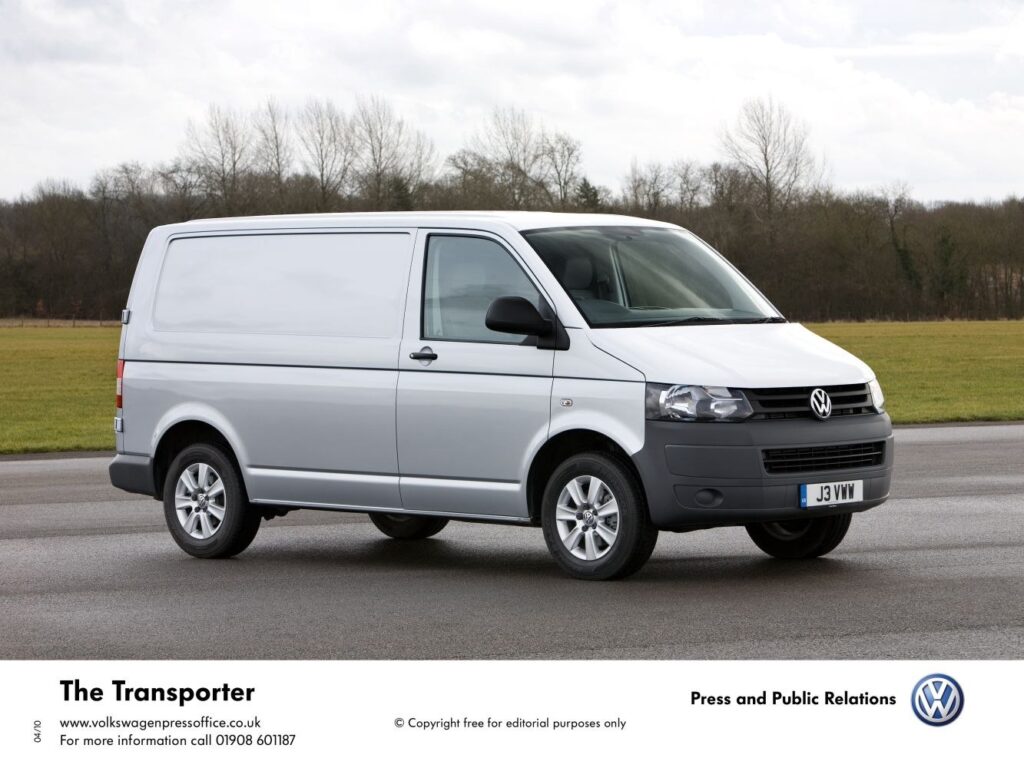
The Volkswagen Transporter (T5, facelift 2009) Panel Van 2.0 TSI (204 Hp) DSG L1H1: A European Workhorse with Potent Performance
The Volkswagen Transporter lineage represents one of the most enduring and successful commercial vehicle series globally, tracing its roots back to the legendary Type 2. By the time the T5 generation arrived, Volkswagen had refined the formula, creating a versatile and robust platform for a multitude of applications. The subject of this analysis, the Volkswagen Transporter (T5, facelift 2009) Panel Van 2.0 TSI (204 Hp) DSG L1H1, specifically represents a high-performance gasoline variant produced between 2011 and 2015. While largely a staple of European and other international markets, rather than the United States, this particular configuration showcases a blend of potent engine technology, advanced transmission, and practical design, making it a highly capable light commercial vehicle in its primary operating regions.
The T5 generation, introduced in 2003, received a significant facelift in 2009, bringing updated aesthetics, improved interiors, and, crucially, a new range of powertrains. This specific model, the 2.0 TSI (204 Hp) DSG L1H1, stands out from its more common diesel counterparts by offering an exceptional level of power and refinement for a panel van, targeting professionals who demand not only cargo capacity but also strong performance and driving comfort. The L1H1 designation indicates a short wheelbase and standard roof height, a common configuration balancing load space with maneuverability in urban environments.
Engine and Performance of the Volkswagen Transporter (T5, facelift 2009) Panel Van
At the heart of this particular Transporter lies Volkswagen’s renowned EA888 2.0-liter TSI gasoline engine, a powerplant celebrated for its efficiency and robust power delivery across the Volkswagen Group’s passenger car and light commercial vehicle ranges. In this application, the inline four-cylinder engine, with a displacement of 1984 cubic centimeters (121.07 cubic inches), is equipped with direct fuel injection, a turbocharger, and an intercooler. This sophisticated setup allows the engine to produce a formidable 204 horsepower between 4200 and 6000 rpm, and a substantial 258 lb.-ft. of torque available from a remarkably low 1500 rpm all the way up to 4000 rpm. This broad torque band is particularly beneficial for a commercial vehicle, ensuring strong pulling power even when fully loaded or towing.
Power is efficiently transmitted to the front wheels via a 7-speed DSG (Direct-Shift Gearbox) automatic transmission. Volkswagen’s DSG technology is a dual-clutch system known for its lightning-fast and smooth gear changes, contributing significantly to both the vehicle’s performance and its fuel economy. For a panel van, the acceleration figures are genuinely impressive: the Volkswagen Transporter (T5, facelift 2009) Panel Van 2.0 TSI (204 Hp) DSG L1H1 can sprint from 0 to 60 mph in approximately 8 seconds, and reach a top speed of 124 mph. These figures highlight its capability to maintain pace on highways and make swift progress, a valuable attribute for businesses requiring timely deliveries or long-distance travel.
Despite its powerful engine, the Transporter 2.0 TSI was designed with a degree of fuel efficiency in mind, adhering to the Euro 5 emission standard prevalent during its production years. Combined fuel consumption is rated between 23.3 and 24 US mpg, with urban figures ranging from 17.4 to 17.8 US mpg and extra-urban figures from 29 to 30.2 US mpg. These numbers, while respectable for a gasoline-powered commercial vehicle of its size and performance, reflect its primary market’s emphasis on balancing power with operational costs.
Design and Features
The T5 generation Transporter, especially in its post-facelift guise, presented a modern and purposeful design. As a panel van, the L1H1 configuration prioritizes functionality and cargo capacity within a manageable footprint. Its length of 192.6 inches and width of 74.96 inches (89.88 inches including mirrors) make it agile enough for city driving while still offering a substantial 204.83 cubic feet (5800 liters) of maximum cargo volume. The body features 4 to 5 doors, typically including a sliding side door for easy access to the cargo area, and rear barn doors or a tailgate, enhancing its utility for loading and unloading.
Inside, the Transporter Panel Van typically offers seating for 2 to 3 occupants, with a focus on durability and practicality. The cabin ergonomics are designed for long working hours, providing a comfortable driving position and clear instrumentation. While specific luxury features might be limited in a base panel van, the facelift brought improved materials and connectivity options for its era. Safety features included an Anti-lock Braking System (ABS) as standard, contributing to vehicle stability and control under various driving conditions. The robust chassis, independent front (McPherson strut) and rear (coil spring, trailing arm with transverse stabilizer) suspension systems, combined with a hydraulic power steering rack-and-pinion setup, ensured a comfortable ride and predictable handling, even when carrying heavy loads. The vehicle’s impressive ground clearance of 7.91 inches and a wading depth of 11.81 inches further underscore its practical capabilities for diverse environments.
Technical Specifications: Volkswagen Transporter (T5, facelift 2009) Panel Van 2.0 TSI (204 Hp) DSG L1H1
| Category | Specification |
|---|---|
| Brand | Volkswagen |
| Model | Transporter (T5, facelift 2009) Panel Van |
| Type (Engine) | 2.0 TSI (204 Hp) DSG L1H1 |
| Production Start | 2011 |
| Production End | 2015 |
| Powertrain Architecture | Internal Combustion Engine, Front Wheel Drive |
| Body Type | Van |
| Seats | 2-3 |
| Doors | 4-5 |
| Fuel Type | Petrol (Gasoline) |
| Engine Layout | Front, Transverse |
| Engine Model/Code | EA888 / CJKA |
| Engine Displacement | 1984 cm3 (121.07 cu. in.) |
| Number of Cylinders | 4, Inline |
| Cylinder Bore | 82.5 mm (3.25 in.) |
| Piston Stroke | 92.8 mm (3.65 in.) |
| Compression Ratio | 9.8:1 |
| Valves per Cylinder | 4 |
| Fuel Injection System | Direct injection |
| Engine Aspiration | Turbocharger, Intercooler |
| Valvetrain | DOHC |
| Power | 204 Hp @ 4200-6000 rpm |
| Power per Liter | 102.8 Hp/l |
| Torque | 350 Nm (258.15 lb.-ft.) @ 1500-4000 rpm |
| Acceleration 0-60 mph | 8 seconds |
| Maximum Speed | 200 km/h (124.27 mph) |
| Fuel Consumption (Urban) | 17.4 – 17.8 US mpg |
| Fuel Consumption (Extra Urban) | 29 – 30.2 US mpg |
| Fuel Consumption (Combined) | 23.3 – 24 US mpg |
| CO2 Emissions (NEDC) | 228-236 g/km |
| Emission Standard | Euro 5 |
| Drivetrain | Front Wheel Drive |
| Gearbox | 7-speed automatic transmission DSG |
| Front Suspension | Independent, McPherson with coil spring and anti-roll bar |
| Rear Suspension | Independent coil spring, Transverse stabilizer, Trailing arm |
| Front Brakes | Ventilated discs, 340×32.5 mm |
| Rear Brakes | Ventilated discs, 294×22 mm |
| Assisting Systems | ABS (Anti-lock braking system) |
| Steering Type | Steering rack and pinion, Hydraulic Power Steering |
| Tires Size | 215/60 R17; 235/55 R17; 255/45 R18 |
| Wheel Rims Size | 7J x 17; 8J x 18 |
| Kerb Weight | 1761-2150 kg (3882.34 – 4739.94 lbs.) |
| Maximum Weight | 2800-3200 kg (6172.94 – 7054.79 lbs.) |
| Maximum Load | 1039-1050 kg (2290.6 – 2314.85 lbs.) |
| Trunk (Boot) Space – Maximum | 5800 l (204.83 cu. ft.) |
| Fuel Tank Capacity | 80 l (21.13 US gal) |
| Maximum Roof Load | 100 kg (220.46 lbs.) |
| Permitted Trailer Load with Brakes (12%) | 2500 kg (5511.56 lbs.) |
| Permitted Trailer Load without Brakes | 750 kg (1653.47 lbs.) |
| Permitted Towbar Download | 100 kg (220.46 lbs.) |
| Length | 4892 mm (192.6 in.) |
| Width | 1904 mm (74.96 in.) |
| Width Including Mirrors | 2283 mm (89.88 in.) |
| Height | 1990 mm (78.35 in.) |
| Wheelbase | 3000 mm (118.11 in.) |
| Front Overhang | 896 mm (35.28 in.) |
| Rear Overhang | 996 mm (39.21 in.) |
| Ride Height (Ground Clearance) | 201 mm (7.91 in.) |
| Minimum Turning Circle | 11.9 m (39.04 ft.) |
| Approach Angle | 21° |
| Departure Angle | 17° |
| Ramp-over (Brakeover) Angle | 14° |
| Wading Depth | 300 mm (11.81 in.) |
| Engine Oil Capacity | 5.7 l (6.02 US qt) |
| Coolant Capacity | 11 l (11.62 US qt) |
Legacy and Market Impact
The Volkswagen Transporter series has forged an unparalleled legacy in the commercial vehicle sector. The T5 generation, and particularly its facelifted version, continued this tradition of reliability, versatility, and strong residual values. In its primary European markets, the Transporter faced stiff competition from rivals such as the Ford Transit Custom, Mercedes-Benz Vito, Renault Trafic, Opel Vivaro, Peugeot Expert, and Citroën Jumpy. However, the Transporter consistently held its own, often being perceived as a more premium offering with car-like driving dynamics and superior build quality.
The 2.0 TSI (204 Hp) DSG L1H1 variant, while not the highest volume seller compared to the ubiquitous diesel models, carved a niche for itself. It appealed to businesses and individuals who valued performance, refinement, and a quieter ride, perhaps for long-distance deliveries, executive transport (in its passenger configurations), or as a foundation for high-end conversions like camper vans. Its robust gasoline engine offered a compelling alternative to diesel, especially as emission regulations tightened and the public perception of diesel began to shift in certain regions. The combination of a powerful, turbocharged gasoline engine and a smooth DSG transmission provided a driving experience that was remarkably car-like for a commercial vehicle, setting it apart from many of its more utilitarian competitors.
The T5 Transporter, including this specific 2.0 TSI model, reinforced Volkswagen’s reputation for engineering excellence in the light commercial vehicle segment. Its ability to combine a practical, high-volume cargo space with a dynamic and efficient powertrain ensured its continued relevance and popularity, cementing its place as an iconic and highly respected workhorse across continents, even if it remained a specialized import rather than a mass-market offering in North America.