<!DOCTYPE html>
<html lang=”en”>
<head>
<meta charset=”UTF-8″>
<meta name=”viewport” content=”width=device-width, initial-scale=1.0″>
<title>Renault Megane II (Phase II, 2006) 1.5 dCi (106 Hp)</title>
<style>
body { font-family: Arial, sans-serif; line-height: 1.6; color: #333; margin: 20px; }
h2, h3 { color: #2c3e50; }
table { width: 100%; border-collapse: collapse; margin-bottom: 20px; }
th, td { border: 1px solid #ddd; padding: 8px; text-align: left; }
th { background-color: #f2f2f2; }
p { margin-bottom: 10px; }
</style>
</head>
<body>
<h2>Renault Megane II (Phase II, 2006) 1.5 dCi (106 Hp)</h2>
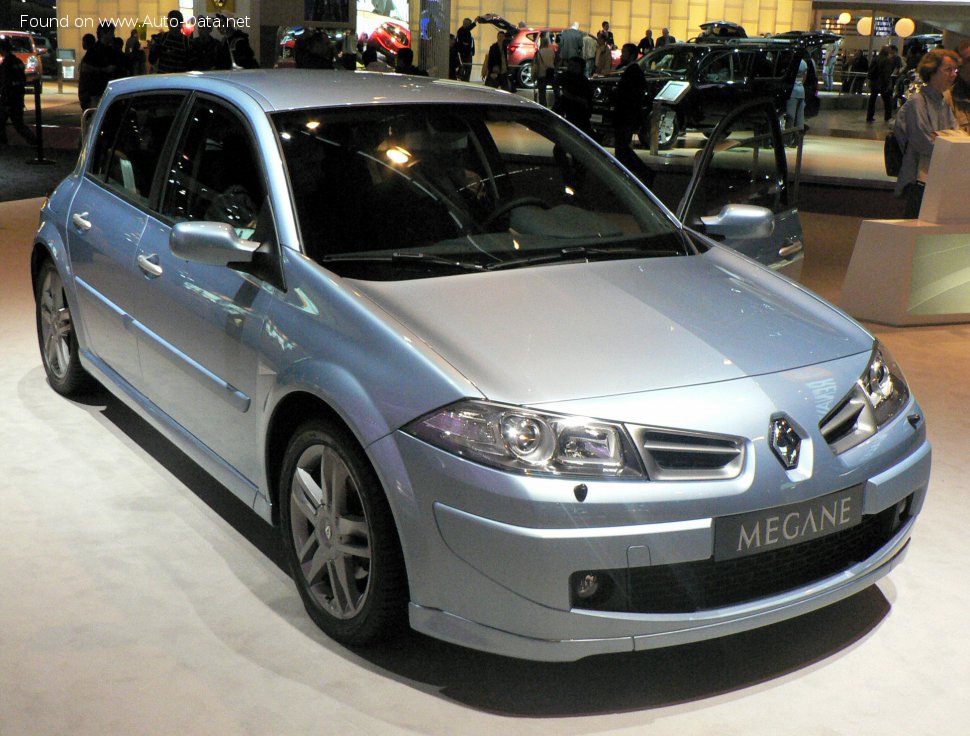
<p>The <strong>Renault Megane II (Phase II, 2006)</strong> 1.5 dCi (106 Hp) represents a significant iteration of Renault’s popular compact family car, known in Europe as a C-segment vehicle. Produced by the French automaker Renault, the Megane II generation, introduced in 2002, garnered considerable attention for its distinctive, avant-garde styling and innovative features. The Phase II model, launched in 2006, was a mid-cycle refresh that brought subtle but important updates to its aesthetics, technology, and powertrain options, aiming to keep it competitive in the fiercely contested European market. This specific variant, equipped with the 1.5-liter dCi (direct Commonrail injection) turbodiesel engine producing 106 horsepower, was a cornerstone of Renault’s strategy to offer economical and efficient transportation.</p>
<p>Unlike many models from European manufacturers, the Renault Megane was never officially sold in the United States, where the compact car market was dominated by domestic and Asian brands. Consequently, its design philosophies, engine choices (especially the prevalence of diesel), and market positioning were tailored specifically for European consumer preferences and regulatory environments. The 1.5 dCi engine, in particular, was lauded for its exceptional fuel efficiency and relatively low CO2 emissions, making it a highly attractive option in regions where fuel prices were higher and environmental regulations were becoming stricter.</p>
<h2>Engine and Performance of the Renault Megane II (Phase II, 2006)</h2>
<p>At the heart of this particular <strong>Renault Megane II (Phase II, 2006)</strong> model lies the K9K Turbo 1.5-liter dCi inline-four diesel engine. This powerplant was a testament to Renault’s expertise in diesel technology, delivering a commendable 106 horsepower at 4000 rpm and a robust 177.01 lb.-ft. of torque at a low 2000 rpm. The inclusion of a turbocharger and intercooler was crucial for extracting this level of performance and efficiency from a relatively small displacement engine, ensuring a responsive feel in everyday driving conditions.</p>
<p>Power was delivered to the front wheels via a smooth-shifting 6-speed manual transmission, a common configuration for European compacts of the era, offering both engaging driving dynamics and optimized fuel economy. The sprint from 0 to 60 mph was achieved in a respectable 10.5 seconds, with a top speed of 114.95 mph. While not designed as a performance car, these figures provided ample capability for highway cruising and city commuting.</p>
<p>Where this Megane truly shined was in its fuel economy. With a combined consumption rating of 50 US mpg (4.7 liters per 100 km), it offered impressive efficiency, a key factor for European buyers. Urban driving yielded 40.6 US mpg, while extra-urban (highway) driving could see figures as high as 57.4 US mpg. These numbers, combined with CO2 emissions of 124 g/km and adherence to the Euro 4 emission standard, positioned the 1.5 dCi Megane as an environmentally conscious and cost-effective choice for its time.</p>
<h2>Design and Features</h2>
<p>The Renault Megane II was renowned for its bold and often polarizing design, particularly its distinctive “bustle-back” rear end, which broke away from conventional hatchback aesthetics. The Phase II update in 2006 brought a series of subtle refinements rather than a complete overhaul. These included refreshed headlamps and taillamps, a revised front grille, and updated interior trim and materials, all aimed at giving the car a more contemporary and refined appearance.</p>
<p>As a 5-door hatchback, the Megane II offered practical utility with seating for five occupants. The interior was designed with comfort and ergonomics in mind, featuring a logical layout of controls and good visibility. Cargo capacity was competitive for the segment, with a minimum trunk space of 11.65 cubic feet, expanding significantly to 42.02 cubic feet with the rear seats folded down, making it suitable for family duties or transporting larger items. The overall length of the vehicle was 165.71 inches, with a width of 69.96 inches and a height of 57.4 inches, contributing to its maneuverability in urban environments, aided by a tight minimum turning circle of 34.45 feet.</p>
<p>Standard features for the era included essential safety systems such as ABS (Anti-lock Braking System), a crucial active safety component. The suspension setup comprised an independent McPherson-type front suspension and a torsion beam rear suspension, a common and effective combination for compact cars, providing a balance of ride comfort and handling stability. Steering was facilitated by an electric power steering system, offering light effort at low speeds for easy parking and more feedback at higher speeds. The vehicle rode on 195/65 R15 tires mounted on 6.5J x 15 wheel rims.</p>
<h2>Technical Specifications</h2>
<table>
<thead>
<tr>
<th colspan=”2″>General Information</th>
</tr>
</thead>
<tbody>
<tr><td>Brand</td><td>Renault</td></tr>
<tr><td>Model</td><td>Megane</td></tr>
<tr><td>Generation</td><td>Megane II (Phase II, 2006)</td></tr>
<tr><td>Type (Engine)</td><td>1.5 dCi (106 Hp)</td></tr>
<tr><td>Start of production</td><td>2006 year</td></tr>
<tr><td>End of production</td><td>2006 year</td></tr>
<tr><td>Powertrain Architecture</td><td>Internal Combustion engine</td></tr>
<tr><td>Body type</td><td>Hatchback</td></tr>
<tr><td>Seats</td><td>5</td></tr>
<tr><td>Doors</td><td>5</td></tr>
</tbody>
<thead>
<tr>
<th colspan=”2″>Performance Specs</th>
</tr>
</thead>
<tbody>
<tr><td>Fuel consumption (economy) – urban</td><td>5.8 l/100 km (40.6 US mpg)</td></tr>
<tr><td>Fuel consumption (economy) – extra urban</td><td>4.1 l/100 km (57.4 US mpg)</td></tr>
<tr><td>Fuel consumption (economy) – combined</td><td>4.7 l/100 km (50 US mpg)</td></tr>
<tr><td>CO2 emissions</td><td>124 g/km</td></tr>
<tr><td>Fuel Type</td><td>Diesel</td></tr>
<tr><td>Acceleration 0 – 60 mph</td><td>10.5 sec</td></tr>
<tr><td>Maximum speed</td><td>185 km/h (114.95 mph)</td></tr>
<tr><td>Emission standard</td><td>Euro 4</td></tr>
<tr><td>Weight-to-power ratio</td><td>11.6 kg/Hp (86.5 Hp/tonne)</td></tr>
<tr><td>Weight-to-torque ratio</td><td>5.1 kg/Nm (195.9 Nm/tonne)</td></tr>
</tbody>
<thead>
<tr>
<th colspan=”2″>Engine Specs</th>
</tr>
</thead>
<tbody>
<tr><td>Power</td><td>106 Hp @ 4000 rpm</td></tr>
<tr><td>Power per liter</td><td>72.6 Hp/l</td></tr>
<tr><td>Torque</td><td>240 Nm @ 2000 rpm (177.01 lb.-ft. @ 2000 rpm)</td></tr>
<tr><td>Engine layout</td><td>Front, Transverse</td></tr>
<tr><td>Engine Model/Code</td><td>K9K Turbo</td></tr>
<tr><td>Engine displacement</td><td>1461 cm<sup>3</sup> (89.16 cu. in.)</td></tr>
<tr><td>Number of cylinders</td><td>4</td></tr>
<tr><td>Engine configuration</td><td>Inline</td></tr>
<tr><td>Cylinder Bore</td><td>76 mm (2.99 in.)</td></tr>
<tr><td>Piston Stroke</td><td>80.5 mm (3.17 in.)</td></tr>
<tr><td>Compression ratio</td><td>18.8:1</td></tr>
<tr><td>Number of valves per cylinder</td><td>2</td></tr>
<tr><td>Fuel injection system</td><td>Diesel Commonrail</td></tr>
<tr><td>Engine aspiration</td><td>Turbocharger, Intercooler</td></tr>
<tr><td>Engine oil capacity</td><td>4.5 l (4.76 US qt)</td></tr>
<tr><td>Coolant</td><td>7.5 l (7.93 US qt)</td></tr>
</tbody>
<thead>
<tr>
<th colspan=”2″>Space, Volume and Weights</th>
</tr>
</thead>
<tbody>
<tr><td>Kerb Weight</td><td>1225 kg (2700.66 lbs.)</td></tr>
<tr><td>Max. weight</td><td>1770 kg (3902.18 lbs.)</td></tr>
<tr><td>Max load</td><td>545 kg (1201.52 lbs.)</td></tr>
<tr><td>Trunk (boot) space – minimum</td><td>330 l (11.65 cu. ft.)</td></tr>
<tr><td>Trunk (boot) space – maximum</td><td>1190 l (42.02 cu. ft.)</td></tr>
<tr><td>Fuel tank capacity</td><td>60 l (15.85 US gal)</td></tr>
<tr><td>Max. roof load</td><td>80 kg (176.37 lbs.)</td></tr>
<tr><td>Permitted trailer load with brakes (12%)</td><td>1300 kg (2866.01 lbs.)</td></tr>
<tr><td>Permitted trailer load without brakes</td><td>650 kg (1433 lbs.)</td></tr>
<tr><td>Permitted towbar download</td><td>75 kg (165.35 lbs.)</td></tr>
</tbody>
<thead>
<tr>