Ford Mustang VI (facelift 2017) GT 5.0 Ti-VCT V8 (460 Hp)
The Ford Mustang VI, particularly the facelifted 2017 GT 5.0 Ti-VCT V8 (460 Hp) variant, represents a significant evolution in the storied history of America’s iconic pony car. As the sixth generation of the Mustang, this model continued to build on the platform’s global appeal, first introduced in 2015. The 2017 facelift brought a series of enhancements, notably to its powertrain, styling, and technology, solidifying its position as a performance benchmark in its segment. Produced from 2017 to 2021, this iteration of the Ford Mustang VI (facelift 2017) GT 5.0 Ti-VCT V8 maintained its classic fastback silhouette while incorporating modern engineering and driver-focused features. It catered to enthusiasts seeking raw American muscle combined with refined driving dynamics, making it a formidable competitor in the sports coupe market both domestically and internationally.
Engine and Performance: The Heart of the Beast
At the core of the 2017 Ford Mustang GT lies the legendary 5.0-liter Coyote V8 engine, specifically designated as the Ti-VCT (Twin Independent Variable Cam Timing) unit. This naturally aspirated powerhouse delivered a robust 460 horsepower at 5500 rpm and a formidable 419.67 lb-ft of torque at 4600 rpm. The Coyote V8, renowned for its free-revving nature and intoxicating exhaust note, was a direct testament to Ford’s commitment to traditional American muscle car values while embracing modern efficiency and power delivery.
The engine’s architecture featured a V-engine configuration with eight cylinders, a displacement of 4949 cm³ (302.01 cu. in.), and a compression ratio of 11:1. Its multi-port manifold injection system ensured precise fuel delivery, optimizing combustion for both performance and relative efficiency. The Ti-VCT system played a crucial role, allowing independent control over the intake and exhaust camshafts, which enhanced power output across the rev range and improved fuel economy compared to fixed cam timing setups. With a power-to-weight ratio of 273.6 Hp per tonne (3.7 kg/Hp), the Mustang GT offered exhilarating acceleration and a truly visceral driving experience.
Power was exclusively sent to the rear wheels via a standard 6-speed manual transmission, offering purists an engaging and direct connection to the drivetrain. This setup underscored the Mustang’s heritage as a driver’s car, emphasizing control and involvement. Despite its performance orientation, the Coyote V8 managed combined fuel economy figures of 18.1 US mpg, a respectable number for a high-performance V8 in its class, with urban consumption rated at 15.1 US mpg and extra-urban at 25 US mpg.
Design and Features: Iconic Form Meets Modern Function
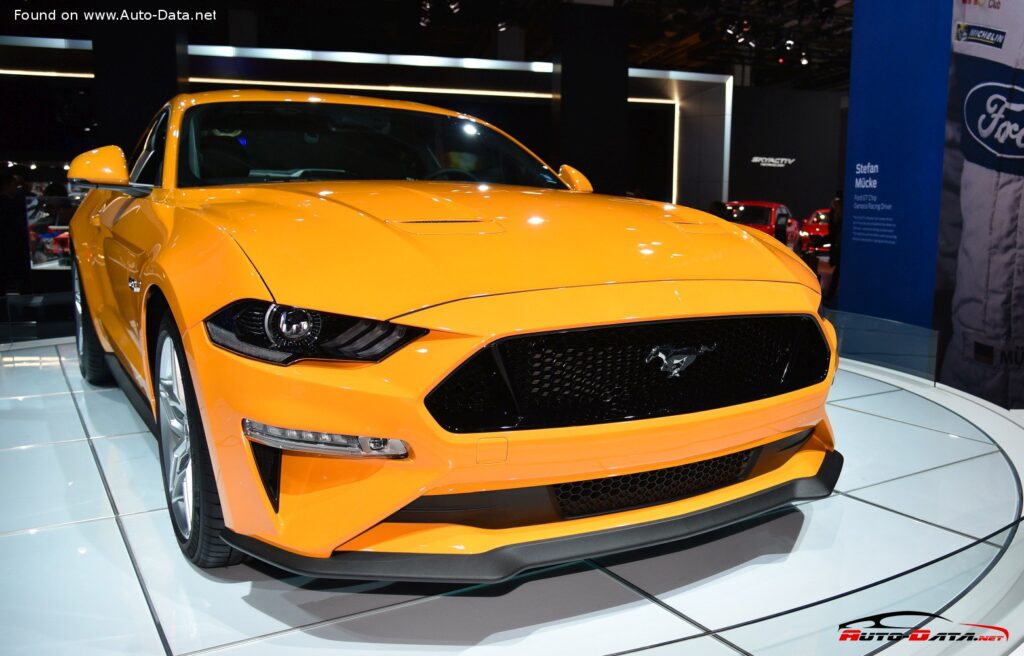
The 2017 Ford Mustang VI (facelift 2017) GT 5.0 Ti-VCT V8 retained the classic fastback body type, a design synonymous with the Mustang nameplate since its inception. The facelift introduced subtle yet impactful styling revisions, including a lower, more aggressive hood, revised front fascia with updated grille and LED lighting signatures, and new rear bumper and taillight designs. These changes gave the Mustang a sharper, more contemporary edge while preserving its instantly recognizable silhouette.
Measuring 188.5 inches in length, 75.39 inches in width (81.89 inches including mirrors), and 54.29 inches in height, with a wheelbase of 107.09 inches, the Mustang possessed a commanding road presence. Its wide stance, emphasized by a front track of 62.4 inches and a rear track of 65.12 inches, hinted at its athletic capabilities. The vehicle weighed in at 3705.97 lbs (kerb weight), a testament to its robust construction.
Underneath its muscular exterior, the Mustang GT featured a sophisticated chassis designed for dynamic handling. It boasted an independent McPherson strut front suspension with coil springs and an anti-roll bar, paired with an independent multi-link spring suspension with a stabilizer bar at the rear. This fully independent suspension setup, a hallmark of the sixth-generation Mustang, significantly improved ride comfort and handling precision compared to previous generations, elevating its appeal to a broader audience. Stopping power was provided by ventilated disc brakes on both the front and rear axles, complemented by an Anti-lock Braking System (ABS) for enhanced safety and control. The car rode on 8J x 18-inch wheel rims, providing a solid foundation for its performance tires. The interior offered a 4-seat configuration, typical for a 2-door sports coupe, and a trunk space of 13.49 cu. ft., providing reasonable practicality for daily use or weekend getaways.
Technical Specifications
| Category | Specification | Value |
|---|---|---|
| General Information | ||
| Brand | Ford | |
| Model | Mustang | |
| Generation | Mustang VI (facelift 2017) | |
| Type (Engine) | GT 5.0 Ti-VCT V8 (460 Hp) | |
| Start of Production | 2017 year | |
| End of Production | 2021 year | |
| Powertrain Architecture | Internal Combustion engine | |
| Body type | Fastback | |
| Seats | 4 | |
| Doors | 2 | |
| Performance Specs | ||
| Fuel consumption (economy) – urban | 15.1 US mpg | |
| Fuel consumption (economy) – extra urban | 25 US mpg | |
| Fuel consumption (economy) – combined | 18.1 US mpg | |
| Fuel Type | Petrol (Gasoline) | |
| Weight-to-power ratio | 3.7 kg/Hp, 273.6 Hp/tonne | |
| Weight-to-torque ratio | 3 kg/Nm, 338.5 Nm/tonne | |
| Engine Specs | ||
| Power | 460 Hp @ 5500 rpm. | |
| Power per liter | 92.9 Hp/l | |
| Torque | 419.67 lb.-ft. @ 4600 rpm. | |
| Engine layout | Front, Longitudinal | |
| Engine Model/Code | Coyote | |
| Engine displacement | 4949 cm³ (302.01 cu. in.) | |
| Number of cylinders | 8 | |
| Engine configuration | V-engine | |
| Cylinder Bore | 3.63 in. (92.2 mm) | |
| Piston Stroke | 3.65 in. (92.7 mm) | |
| Compression ratio | 11:1 | |
| Fuel injection system | Multi-port manifold injection | |
| Engine aspiration | Naturally aspirated engine | |
| Valvetrain | Ti-VCT | |
| Engine oil capacity | 10.04 US qt (9.5 l) | |
| Coolant | 13.61 US qt (12.88 l) | |
| Space, Volume and Weights | ||
| Kerb Weight | 3705.97 lbs. (1681 kg) | |
| Trunk (boot) space – minimum | 13.49 cu. ft. (382 l) | |
| Fuel tank capacity | 16.11 US gal (61 l) | |
| Dimensions | ||
| Length | 188.5 in. (4788 mm) | |
| Width | 75.39 in. (1915 mm) | |
| Width with mirrors folded | 76.1 in. (1933 mm) | |
| Width including mirrors | 81.89 in. (2080 mm) | |
| Height | 54.29 in. (1379 mm) | |
| Wheelbase | 107.09 in. (2720 mm) | |
| Front track | 62.4 in. (1585 mm) | |
| Rear (Back) track | 65.12 in. (1654 mm) | |
| Drivetrain, Brakes and Suspension Specs | ||
| Drivetrain Architecture | The Internal combustion engine (ICE) drives the rear wheels of the vehicle. | |
| Drive wheel | Rear wheel drive | |
| Number of gears and type of gearbox | 6 gears, manual transmission | |
| Front suspension | Independent, type McPherson with coil spring and anti-roll bar | |
| Rear suspension | Independent multi-link spring suspension with stabilizer | |
| Front brakes | Ventilated discs | |
| Rear brakes | Ventilated discs | |
| Assisting systems | ABS (Anti-lock braking system) | |
| Steering type | Steering rack and pinion | |
| Wheel rims size | 8J x 18 | |
Legacy and Market Impact
The Ford Mustang VI (facelift 2017) GT 5.0 Ti-VCT V8 built upon a legacy that spans over half a century, cementing its status as a cultural icon and a global performance car. This generation, particularly the facelifted GT, was pivotal in the Mustang’s journey to becoming a truly international vehicle. While always a dominant force in the American market, the S550 generation (which includes the 2017 facelift) was the first to be engineered from the ground up for global sales, including right-hand drive markets, expanding its reach significantly across Europe, Asia, and Australia.
In its primary market, the United States, the Mustang GT faced stiff competition from its traditional rivals: the Chevrolet Camaro SS and the Dodge Challenger R/T Scat Pack. Each offered a unique take on American muscle, but the Mustang GT distinguished itself with a blend of classic styling, a sophisticated independent suspension system that offered superior handling dynamics, and the potent, naturally aspirated Coyote V8. Its direct competitors often leaned more heavily into either raw power (Challenger) or aggressive track performance (Camaro), while the Mustang GT struck a compelling balance, making it a versatile choice for both daily driving and spirited weekend excursions.
The 2017 facelift further enhanced its appeal, with the increased horsepower and torque from the updated Coyote engine providing a noticeable performance bump. The refined styling and available technology features kept it competitive in an increasingly tech-driven automotive landscape. The Mustang’s reputation for customization, affordability relative to its performance, and a passionate enthusiast community ensured its continued success. Its historical significance lies in its ability to adapt and evolve while staying true to its core identity as an accessible, high-performance sports coupe. The Mustang VI (facelift 2017) GT 5.0 Ti-VCT V8 stands as a testament to Ford’s enduring commitment to the pony car segment, successfully blending heritage with modern engineering to create a truly iconic and impactful vehicle worldwide.