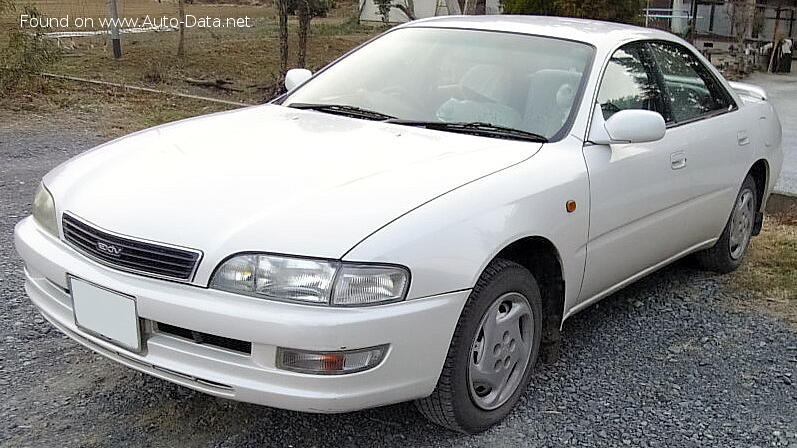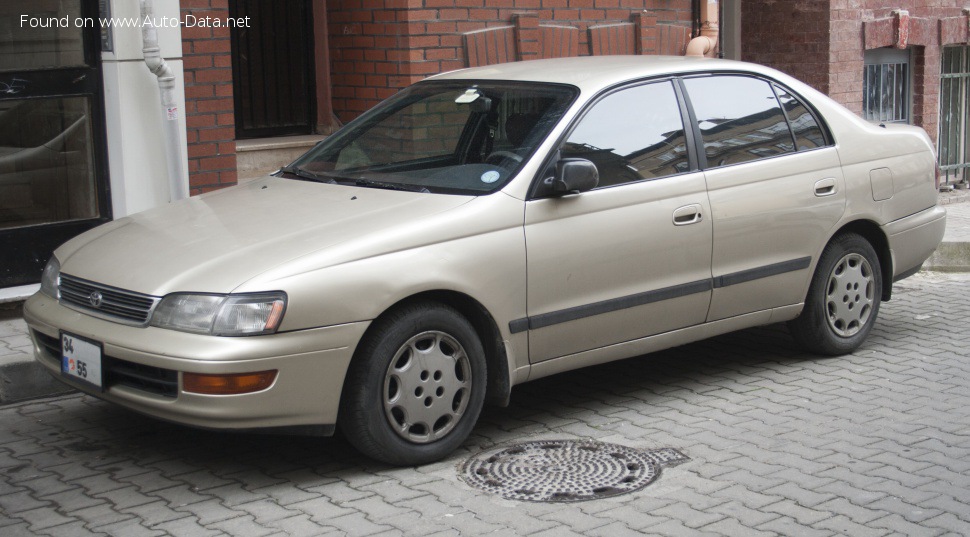
Toyota Corona (T19) 2.0i 16V EX (128 Hp) 4WD Automatic
The Toyota Corona (T19) 2.0i 16V EX (128 Hp) 4WD Automatic represents a significant iteration in the long-standing Toyota Corona lineage, a nameplate that resonated with reliability and practicality across various global markets for decades. Introduced in 1992 as part of the tenth generation of the Corona, the T19 series was primarily targeted at markets outside North America, particularly Japan, Asia, and Europe, where it was often sold as the Toyota Carina E. This specific variant, the 2.0i 16V EX with 128 horsepower and an automatic 4WD transmission, showcased Toyota’s commitment to offering robust, all-weather capable family sedans. It occupied the compact to mid-size segment, a highly competitive category, positioning itself as a dependable and comfortable choice for consumers seeking a well-engineered vehicle with advanced features for its time, including a sophisticated all-wheel-drive system.
The T19 generation of the Toyota Corona marked a period of refinement and technological integration for Toyota’s mainstream sedans. While the Corona name itself might not be as familiar to American consumers as the Camry or Corolla, its engineering principles and market positioning were analogous to those successful models. This particular 4WD automatic model, produced between 1992 and 1996, highlighted Toyota’s capability to blend practicality with enhanced traction and ease of driving, making it a versatile option for diverse driving conditions, from urban commuting to more challenging terrains.
Engine & Performance of the Toyota Corona (T19)
At the heart of the Toyota Corona (T19) 2.0i 16V EX (128 Hp) 4WD Automatic lies the venerable 3S-FE engine, a 2.0-liter (1998 cm3 or 121.93 cu. in.) naturally aspirated inline-four powerplant. This engine, known for its robust construction and longevity, features a DOHC (Dual Overhead Camshaft) valvetrain with four valves per cylinder, a configuration that was becoming standard for efficient, high-performance engines in the early 1990s. With a compression ratio of 9.8:1 and multi-port manifold injection, the 3S-FE was designed to deliver a balanced blend of power and fuel efficiency.
The engine produces a respectable 128 horsepower (Hp) at 5600 rpm and 179 Newton-meters (132.02 lb.-ft.) of torque at 4400 rpm. This power output, coupled with its 4WD system, provided confident acceleration and strong highway cruising capabilities for a family sedan of its era. The power per liter stands at 64.1 Hp/l, indicative of a well-tuned, non-turbocharged engine. Power is managed by a 4-speed automatic transmission, offering smooth and convenient shifting, which was a hallmark of Toyota’s focus on user-friendly driving experiences.
In terms of performance, the Corona T19 2.0i 16V EX was capable of reaching a maximum speed of 185 km/h (approximately 114.95 mph). Fuel economy, a crucial factor for any family car, was rated at 6.4 liters per 100 kilometers in a combined cycle, translating to an impressive 36.8 US miles per gallon. This efficiency, especially for an all-wheel-drive vehicle, underscored Toyota’s engineering prowess in optimizing powertrain performance and reducing consumption. The vehicle’s curb weight of 1250 kg (2755.78 lbs) resulted in a weight-to-power ratio of 9.8 kg/Hp, contributing to its responsive character.
Design & Features
The Toyota Corona (T19) adopted a classic four-door sedan body style, a timeless design choice for family vehicles. Measuring 4520 mm (177.95 inches) in length, 1695 mm (66.73 inches) in width, and 1425 mm (56.1 inches) in height, the T19 Corona offered a spacious and comfortable cabin for five occupants. Its wheelbase of 2580 mm (101.57 inches) contributed to a stable ride and ample interior room, especially for rear passengers.
Visually, the T19 generation featured a clean, understated aesthetic, characterized by smooth lines and a conservative yet appealing silhouette. This design philosophy aimed for broad appeal and longevity, eschewing fleeting trends in favor of enduring elegance. The interior was designed with ergonomics and practicality in mind, featuring durable materials and straightforward controls. While specific trim levels varied by market, the EX designation typically indicated a well-equipped model, including features like power windows, central locking, and quality upholstery.
A standout feature of this particular Corona variant was its All-Wheel Drive (4WD) system. This capability provided enhanced traction and stability, particularly beneficial in adverse weather conditions or on unpaved roads, setting it apart from many front-wheel-drive competitors in its class. For safety, the T19 Corona was equipped with ventilated disc brakes at the front and disc brakes at the rear, complemented by an Anti-lock Braking System (ABS), a significant safety feature for the early 1990s that helped prevent wheel lock-up during hard braking. The suspension system utilized wishbones at both the front and rear, a sophisticated setup designed to offer a comfortable ride and predictable handling. Steering was managed by a hydraulic rack and pinion system, ensuring precise and responsive control. The vehicle rode on 185/65 R14 tires mounted on 6.0J x 14 wheel rims.
Technical Specifications
| Category | Specification | US Equivalent |
|---|---|---|
General Information |
||
| Brand | Toyota | Toyota |
| Model | Corona | Corona |
| Generation | Corona (T19) | Corona (T19) |
| Type (Engine) | 2.0i 16V EX (128 Hp) 4WD Automatic | 2.0i 16V EX (128 Hp) 4WD Automatic |
| Start of Production | 1992 year | 1992 |
| End of Production | 1996 year | 1996 |
| Powertrain Architecture | Internal Combustion engine | Internal Combustion engine |
| Body type | Sedan | Sedan |
| Seats | 5 | 5 |
| Doors | 4 | 4 |
Performance Specs |
||
| Fuel consumption (economy) – combined | 6.4 l/100 km | 36.8 US mpg |
| Fuel Type | Petrol (Gasoline) | Gasoline |
| Maximum speed | 185 km/h | 114.95 mph |
| Weight-to-power ratio | 9.8 kg/Hp | 21.6 lbs/Hp |
| Weight-to-torque ratio | 7 kg/Nm | 10.3 lbs/lb-ft |
Engine Specs |
||
| Power | 128 Hp @ 5600 rpm | 128 Hp @ 5600 rpm |
| Power per liter | 64.1 Hp/l | 64.1 Hp/l |
| Torque | 179 Nm @ 4400 rpm | 132.02 lb.-ft. @ 4400 rpm |
| Engine layout | Front, Transverse | Front, Transverse |
| Engine Model/Code | 3S-FE | 3S-FE |
| Engine displacement | 1998 cm3 | 121.93 cu. in. (2.0 liters) |
| Number of cylinders | 4 | 4 |
| Engine configuration | Inline | Inline |
| Cylinder Bore | 86 mm | 3.39 in. |
| Piston Stroke | 86 mm | 3.39 in. |
| Compression ratio | 9.8:1 | 9.8:1 |
| Number of valves per cylinder | 4 | 4 |
| Fuel injection system | Multi-port manifold injection | Multi-port manifold injection |
| Engine aspiration | Naturally aspirated engine | Naturally aspirated engine |
| Valvetrain | DOHC | DOHC |
| Engine oil capacity | 3.9 l | 4.12 US qt |
| Coolant | 6.6 l | 6.97 US qt |
Space, Volume and Weights |
||
| Kerb Weight | 1250 kg | 2755.78 lbs. |
| Max. weight | 1525 kg | 3362.05 lbs. |
| Max load | 275 kg | 606.27 lbs. |
| Fuel tank capacity | 60 l | 15.85 US gal |
Dimensions |
||
| Length | 4520 mm | 177.95 in. |
| Width | 1695 mm | 66.73 in. |
| Height | 1425 mm | 56.1 in. |
| Wheelbase | 2580 mm | 101.57 in. |
| Front track | 1465 mm | 57.68 in. |
| Rear (Back) track | 1435 mm | 56.5 in. |
Drivetrain, Brakes and Suspension Specs |
||
| Drive wheel | All wheel drive (4×4) | All wheel drive (4×4) |
| Number of gears and type of gearbox | 4 gears, automatic transmission | 4-speed automatic transmission |
| Front suspension | Wishbone | Wishbone |
| Rear suspension | Wishbone | Wishbone |
| Front brakes | Ventilated discs | Ventilated disc brakes |
| Rear brakes | Disc | Disc brakes |
| Assisting systems | ABS (Anti-lock braking system) | ABS (Anti-lock braking system) |
| Steering type | Steering rack and pinion | Rack and pinion |
| Power steering | Hydraulic Steering | Hydraulic Power Steering |
| Tires size | 185/65 R14 | 185/65 R14 |
| Wheel rims size | 6.0J x 14 | 6.0J x 14 |
Legacy & Market Impact of the Toyota Corona (T19)
The Toyota Corona, particularly the T19 generation, holds a significant place in automotive history, especially in markets where it was a staple family vehicle. While the Corona nameplate had been phased out in North America by the early 1980s in favor of the Camry, the T19 continued the legacy of a reliable, well-built, and practical sedan in other parts of the world. In Europe, it was known as the Carina E, effectively replacing the previous Carina II and becoming a strong competitor in the C/D-segment against rivals like the Ford Mondeo, Opel Vectra, Volkswagen Passat, and fellow Japanese offerings such as the Honda Accord and Nissan Primera (Bluebird in some markets). In Japan and Asia, it competed fiercely with models like the Nissan Bluebird and Mazda Capella (626).
The Toyota Corona (T19) 2.0i 16V EX (128 Hp) 4WD Automatic distinguished itself through its all-wheel-drive capability, a feature not commonly found in mainstream sedans of its class during the early to mid-1990s. This provided a compelling advantage for buyers in regions with challenging weather or diverse terrain, offering enhanced safety and driving confidence. Toyota’s reputation for impeccable build quality, durability, and low running costs was further cemented by the T19 Corona. The 3S-FE engine, in particular, became renowned for its robustness and longevity, contributing to the car’s overall reliability. This made the Corona a popular choice for both private owners and fleet operators, who valued its minimal downtime and strong resale value.
The T19’s legacy is primarily one of quiet competence. It wasn’t a car known for flashy styling or groundbreaking performance, but rather for its consistent execution of fundamental automotive virtues. It offered a comfortable ride, a practical interior, and mechanical components engineered for thousands of miles of trouble-free operation. The inclusion of features like ABS and a sophisticated wishbone suspension system at both ends showcased Toyota’s commitment to modern safety and dynamic refinement, even in a non-luxury segment.
Ultimately, the Toyota Corona (T19) played a crucial role in maintaining Toyota’s dominance in various international markets. It served as a testament to the brand’s core values: building dependable, efficient, and well-equipped vehicles that met the evolving needs of a global customer base. While the Corona name eventually gave way to other models like the Avensis in Europe or was absorbed into the broader Camry/Corolla strategy in other regions, the T19 generation remains an important chapter in Toyota’s history, embodying an era of solid engineering and widespread market appeal. Its 4WD automatic variant, in particular, stands as an example of Toyota’s foresight in offering specialized capabilities within a mainstream package.