Introduction to the Mitsubishi Lancer IV Hatchback
The Mitsubishi Lancer, a nameplate synonymous with accessible and reliable compact transportation, entered its fourth generation in 1988, continuing its global presence in various markets. Among its diverse offerings, the Mitsubishi Lancer IV Hatchback, particularly the 1.5-liter variant producing 84 horsepower, stood out as a practical and economical choice for a wide range of consumers. This generation, produced from 1988 to 1992, represented a refinement of Mitsubishi’s compact car philosophy, emphasizing efficiency, utility, and everyday usability in a competitive segment.
While the Lancer nameplate has enjoyed a significant following in the United States, often associated with its more performance-oriented Evolution variants, the Lancer IV Hatchback with this specific powertrain was a common sight in European and Asian markets. It served as a staple for families and commuters seeking a dependable and fuel-efficient vehicle without excessive frills. This article delves into the technical specifications, design philosophies, and market impact of this notable iteration of the Mitsubishi Lancer, examining its role during an evolving period for the automotive industry.
Engine and Performance: The Heart of the Mitsubishi Lancer IV Hatchback
At the core of the Mitsubishi Lancer IV Hatchback 1.5 (84 Hp) was a straightforward yet robust powertrain designed for dependability and economical operation. The vehicle was equipped with a 1.5-liter (1468 cm³ or 89.58 cu. in.) naturally aspirated inline-four engine. This unit produced a modest but adequate 84 horsepower at 6000 rpm, paired with 90.72 lb.-ft. (123 Nm) of torque peaking at a lower 3500 rpm. This torque delivery profile was ideal for urban driving and provided sufficient responsiveness for daily commuting, ensuring that the car felt capable in stop-and-go traffic.
The engine’s architecture featured an OHC (Overhead Camshaft) valvetrain with three valves per cylinder, a configuration that offered a good balance between performance and efficiency for its time. Fuel delivery was managed by a carburettor system, a common technology during the late 1980s, which contributed to the engine’s simplicity and ease of maintenance. The compression ratio stood at 9.2:1, indicating a design focused on reliability with standard gasoline fuels. Power was channeled to the front wheels via a 5-speed manual transmission, a setup that allowed the driver to extract the most out of the engine’s output while also contributing to fuel economy.
In terms of outright performance, the Lancer IV Hatchback 1.5 (84 Hp) achieved a top speed of approximately 105.63 mph (170 km/h). While not a speed demon, this figure was respectable for a compact hatchback of its era, especially one prioritized for practicality. The weight-to-power ratio of 13.2 kg/Hp (or 76 Hp/tonne) further illustrates its positioning as an economical and sensible daily driver rather than a performance-oriented machine. This powertrain combination solidified the Lancer’s reputation as a reliable and cost-effective vehicle, capable of meeting the demands of everyday life.
Design and Features of the Mitsubishi Lancer IV Hatchback
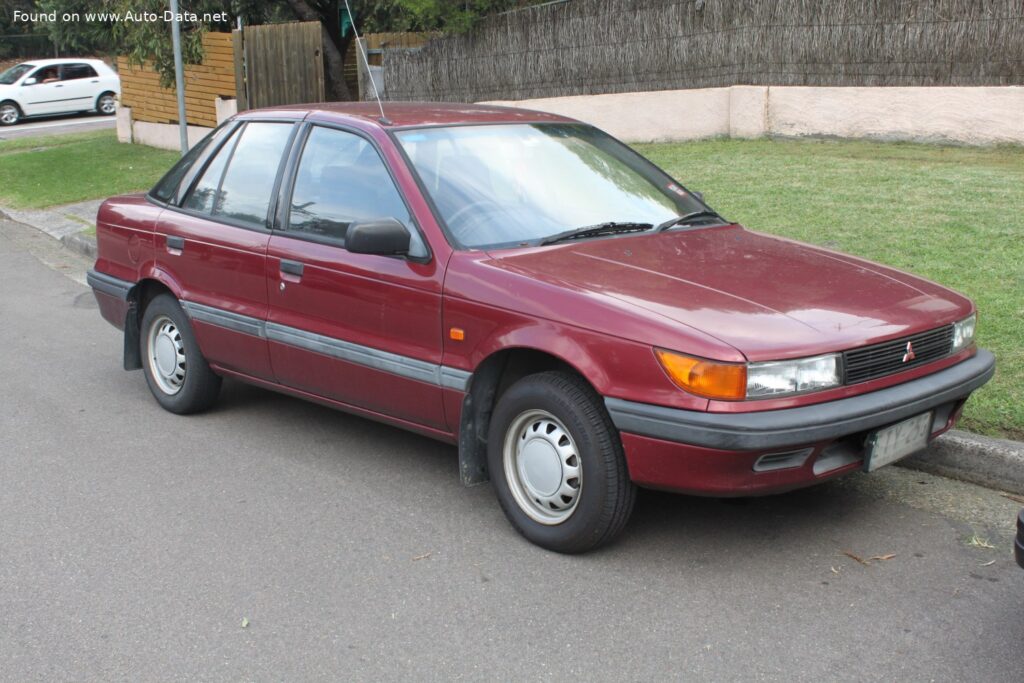
The design of the Mitsubishi Lancer IV Hatchback was characterized by its functional and unpretentious aesthetics, reflecting the prevailing automotive trends of the late 1980s. As a 5-door hatchback, it prioritized practicality and versatility, offering easy access to both passenger and cargo areas. The exterior dimensions—a length of 166.73 inches (4235 mm), width of 65.75 inches (1670 mm), and height of 55.31 inches (1405 mm)—contributed to its nimble footprint, making it well-suited for congested city environments and tight parking spaces. A wheelbase of 96.65 inches (2455 mm) ensured a stable ride quality for its class.
Inside, the Lancer IV Hatchback offered seating for five occupants, a standard configuration for compact cars of the period. The interior was designed with durability and straightforward ergonomics in mind. One of its most significant assets was its cargo capacity: a minimum trunk space of 11.3 cu. ft. (320 liters) that could expand to an impressive 33.55 cu. ft. (950 liters) with the rear seats folded down. This flexibility made it an ideal choice for grocery runs, family trips, or hauling larger items, significantly enhancing its utility compared to sedan counterparts.
Underneath its practical exterior, the Lancer IV Hatchback featured a robust chassis. It utilized coil springs for both front and rear suspension, a common and effective setup that provided a comfortable ride while maintaining decent handling characteristics. Braking duties were handled by disc brakes at the front and drum brakes at the rear, a typical configuration for entry-level compacts of the era, offering reliable stopping power. The steering system was a familiar rack and pinion type, providing direct and predictable control. The vehicle rode on 175/70 R13 tires, a size indicative of its economical nature and contributing to its comfortable ride and low running costs. While advanced safety features like airbags or ABS were not standard in this segment at the time, Mitsubishi engineered the Lancer with a focus on structural integrity and passive safety measures appropriate for its generation.
Technical Specifications
| Category | Specification | US Equivalent |
|---|---|---|
General Information |
||
| Brand | Mitsubishi | Mitsubishi |
| Model | Lancer | Lancer |
| Generation | Lancer IV Hatchback | Lancer IV Hatchback |
| Type (Engine) | 1.5 (84 Hp) | 1.5 (84 Hp) |
| Start of Production | 1988 year | 1988 |
| End of Production | 1992 year | 1992 |
| Powertrain Architecture | Internal Combustion engine | Internal Combustion engine |
| Body Type | Hatchback | Hatchback |
| Seats | 5 | 5 |
| Doors | 5 | 5 |
Performance Specs |
||
| Fuel Type | Petrol (Gasoline) | Gasoline |
| Maximum Speed | 170 km/h | 105.63 mph |
| Weight-to-Power Ratio | 13.2 kg/Hp | 29.10 lbs/Hp |
| Weight-to-Torque Ratio | 9 kg/Nm | 6.52 lbs/lb.-ft. |
Engine Specs |
||
| Power | 84 Hp @ 6000 rpm | 84 Hp @ 6000 rpm |
| Power per Liter | 57.2 Hp/l | 57.2 Hp/l |
| Torque | 123 Nm @ 3500 rpm | 90.72 lb.-ft. @ 3500 rpm |
| Engine Layout | Front, Transverse | Front, Transverse |
| Engine Displacement | 1468 cm³ | 89.58 cu. in. |
| Number of Cylinders | 4 | 4 |
| Engine Configuration | Inline | Inline |
| Cylinder Bore | 75.5 mm | 2.97 in. |
| Piston Stroke | 82 mm | 3.23 in. |
| Compression Ratio | 9.2:1 | 9.2:1 |
| Valves per Cylinder | 3 | 3 |
| Fuel Injection System | Carburettor | Carburetor |
| Engine Aspiration | Naturally aspirated engine | Naturally aspirated |
| Valvetrain | OHC | OHC |
Space, Volume and Weights |
||
| Kerb Weight | 1105 kg | 2436.11 lbs. |
| Max. Weight | 1520 kg | 3351.03 lbs. |
| Max Load | 415 kg | 914.92 lbs. |
| Trunk (boot) Space – Minimum | 320 l | 11.3 cu. ft. |
| Trunk (boot) Space – Maximum | 950 l | 33.55 cu. ft. |
| Fuel Tank Capacity | 50 l | 13.21 US gal |
Dimensions |
||
| Length | 4235 mm | 166.73 in. |
| Width | 1670 mm | 65.75 in. |
| Height | 1405 mm | 55.31 in. |
| Wheelbase | 2455 mm | 96.65 in. |
| Front Track | 1430 mm | 56.3 in. |
| Rear (Back) Track | 1430 mm | 56.3 in. |
Drivetrain, Brakes and Suspension Specs |
||
| Drivetrain Architecture | The Internal combustion engine (ICE) drives the front wheels of the vehicle. | Front-wheel drive ICE |
| Drive Wheel | Front wheel drive | Front wheel drive |
| Number of Gears and Type of Gearbox | 5 gears, manual transmission | 5-speed manual |
| Front Suspension | Coil spring | Coil spring |
| Rear Suspension | Coil spring | Coil spring |
| Front Brakes | Disc | Disc |
| Rear Brakes | Drum | Drum |
| Steering Type | Steering rack and pinion | Rack and pinion |
| Tires Size | 175/70 R13 | 175/70 R13 |
Legacy and Market Impact of the Mitsubishi Lancer IV Hatchback
The Mitsubishi Lancer IV Hatchback, particularly the 1.5-liter variant, played a crucial role in Mitsubishi’s global strategy during the late 1980s and early 1990s. While not always the flashiest or most performance-oriented vehicle in its segment, its enduring legacy is rooted in its reputation for reliability, affordability, and practical utility. In markets like Europe and various parts of Asia, where compact hatchbacks were (and still are) immensely popular, the Lancer IV offered a compelling package for budget-conscious buyers and families.
Competitors in its primary markets were numerous and fierce, including established players such as the Honda Civic, Toyota Corolla, Nissan Sentra (known as Sunny in some markets), Ford Escort, and the omnipresent Volkswagen Golf. Against these rivals, the Lancer IV Hatchback carved out its niche by offering a solid, no-nonsense approach to compact car design. It might not have had the dynamic driving characteristics of a Golf or the perceived refinement of some Japanese competitors, but it consistently delivered on its promise of dependable transportation.
Its robust mechanicals and straightforward design meant lower maintenance costs and a longer service life, which were significant selling points for consumers in an era before widespread leasing and rapid vehicle turnover. The car’s ample trunk space, especially with the rear seats folded, made it a versatile companion for daily chores and leisure activities, further cementing its appeal as a practical family vehicle. This generation contributed significantly to solidifying Mitsubishi’s image as a producer of durable and value-for-money vehicles worldwide.
Although the Lancer nameplate would later gain significant recognition in the United States through its high-performance Evolution models, the Lancer IV Hatchback represents a more fundamental aspect of the Lancer’s heritage: that of a reliable, efficient, and accessible compact car. It was a workhorse that quietly served millions of drivers, contributing to Mitsubishi’s global market share and paving the way for future generations of the Lancer, which would eventually embrace both its economical roots and its performance aspirations. Today, the Lancer IV Hatchback is remembered as a resilient and honest example of late 20th-century compact car engineering.