
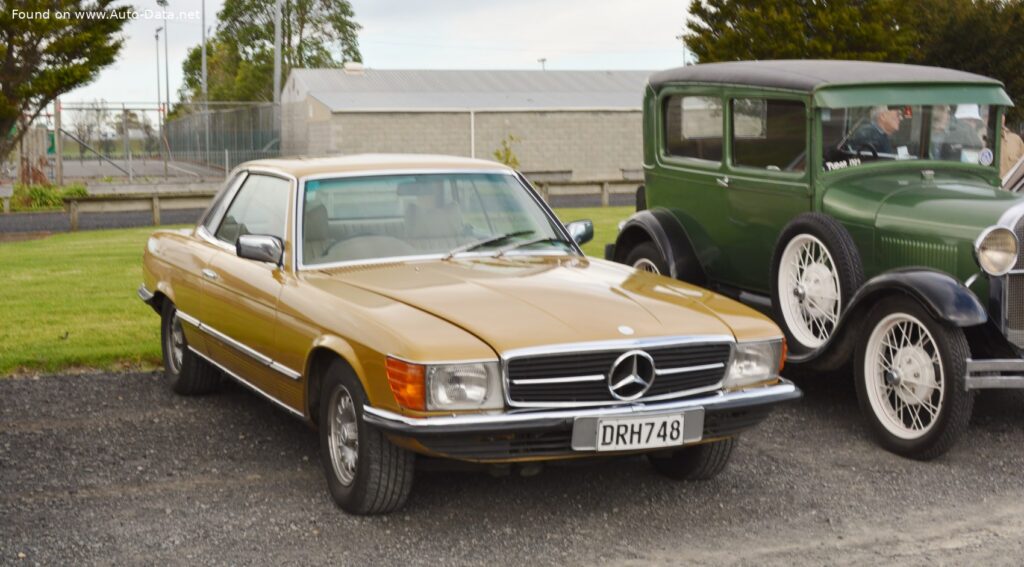
Mercedes-Benz SLC (C107) 380 SLC V8 (218 Hp): A Classic Grand Tourer
The Mercedes-Benz SLC (C107) 380 SLC V8 (218 Hp) represents a distinctive chapter in the Stuttgart automaker’s illustrious history of luxury grand touring automobiles. Produced between February 1980 and September 1981, this model was part of the C107 generation, a fixed-roof coupe variant built on the same platform as the iconic R107 SL roadster. Distinguished by its longer wheelbase, which allowed for a usable rear seating area, and its elegant, pillarless hardtop design, the SLC catered to buyers seeking the prestige and performance of an SL combined with enhanced practicality for longer journeys and additional passengers. The 380 SLC V8, specifically, marked a significant update to the powertrain lineup, offering a refined and potent V8 engine that delivered a compelling blend of power, smoothness, and Mercedes-Benz’s hallmark engineering excellence.
Positioned in the premium grand tourer segment, the C107 SLC aimed to offer a sophisticated driving experience, combining luxurious appointments with robust mechanicals. While its sibling, the R107 SL, emphasized open-top motoring and a sportier image, the SLC provided a more understated, comfortable, and versatile coupé experience. It was a testament to Mercedes-Benz’s commitment to offering a diverse range of luxury vehicles, each tailored to specific customer preferences while upholding the brand’s reputation for quality, safety, and enduring design.
Engine and Performance of the 380 SLC V8
At the heart of the Mercedes-Benz SLC (C107) 380 SLC V8 was the M 116 E 38 engine, a naturally aspirated V8 unit renowned for its smooth operation and robust construction. This powertrain architecture featured a front, longitudinal engine layout, driving the rear wheels, a classic setup for a grand tourer emphasizing balanced weight distribution and engaging dynamics. With an engine displacement of 3,818 cubic centimeters (232.99 cu. in.), the V8 delivered a respectable 218 horsepower at 5500 rpm. The power per liter stood at 57.1 Hp/l, showcasing efficient power delivery for its era.
Torque figures were equally impressive for a vehicle of its time, with the engine producing 220.53 lb.-ft. (299 Nm) at a relatively low 4000 rpm. This ample torque ensured strong acceleration and effortless cruising, characteristics highly valued in a luxury grand tourer. The engine featured a V-configuration with 8 cylinders, each equipped with 2 valves, operated by a Single Overhead Camshaft (SOHC) valvetrain. Fuel delivery was managed by a multi-port manifold injection system, a sophisticated technology for the early 1980s, contributing to better fuel atomization and efficiency compared to carbureted setups.
Performance metrics for the 380 SLC V8 were competitive within its class. The car could accelerate from 0 to 60 mph in an estimated 8.6 seconds, with 0 to 100 km/h achieved in 9.0 seconds. Its maximum speed was rated at 133.59 mph (215 km/h), allowing for comfortable high-speed travel. Power was transmitted to the rear wheels via a smooth-shifting 4-speed automatic transmission, perfectly suited to the car’s relaxed yet capable demeanor. Despite its performance, the 380 SLC V8 had a notable appetite for fuel, reflecting the technology of the period and the engine’s displacement. Urban fuel consumption was rated at approximately 12.4 US mpg, while extra-urban driving saw figures closer to 21.2 US mpg. With a generous 23.78 US gallon fuel tank, the SLC was well-equipped for extended journeys.
Design Philosophy and Interior Features
The design of the Mercedes-Benz SLC (C107) 380 SLC V8 was an evolution of the iconic R107 SL roadster, adapted for its coupe role. Measuring 187.01 inches in length, 70.47 inches in width, and 52.36 inches in height, with a substantial 111.02-inch wheelbase, the SLC presented a graceful and substantial presence. Its longer wheelbase was a key differentiator from the SL, allowing for the inclusion of a pair of small but functional rear seats, transforming it into a true 2+2 coupe. The fixed steel roof, unlike the removable hardtop of the SL, contributed to a quieter and more refined cabin environment, enhancing its grand touring credentials.
Aesthetically, the SLC retained the clean, elegant lines that characterized Mercedes-Benz design of the era. Its pillarless hardtop design, with the rear side windows able to fully retract, gave it an open-air feel when desired, despite being a fixed-roof coupe. The design was both understated and commanding, projecting an image of timeless luxury rather than overt sportiness. The front fascia featured the signature Mercedes-Benz grille and rectangular headlights, while the rear was characterized by broad taillights and a refined chrome bumper treatment.
Inside, the 380 SLC V8 offered a cabin that epitomized Mercedes-Benz luxury of the early 1980s. High-quality materials, including fine leather, wood trim, and durable plastics, were meticulously crafted to create an inviting and comfortable environment. The front seats were designed for excellent support on long drives, and the ergonomic layout of the dashboard ensured all controls were within easy reach. Standard features would have included power windows, automatic climate control, and a sophisticated audio system, all contributing to the car’s premium feel. Mercedes-Benz’s commitment to safety was evident even in this era, with a robust body structure, well-engineered crumple zones, and advanced braking systems for its time, including ventilated discs at the front and solid discs at the rear. The suspension setup, featuring a double wishbone with a transverse stabilizer at the front and a trailing arm with a transverse stabilizer at the rear, provided a comfortable ride while maintaining composed handling.
Technical Specifications: Mercedes-Benz SLC (C107) 380 SLC V8
Below are the detailed technical specifications for the Mercedes-Benz SLC (C107) 380 SLC V8 (218 Hp).
| Category | Specification |
|---|---|
| Brand | Mercedes-Benz |
| Model | SLC |
| Generation | SLC (C107) |
| Type (Engine) | 380 SLC V8 (218 Hp) |
| Start of Production | February, 1980 |
| End of Production | September, 1981 |
| Powertrain Architecture | Internal Combustion engine |
| Body Type | Coupe |
| Seats | 5 |
| Doors | 2 |
| Fuel Consumption (Urban) | 12.4 US mpg |
| Fuel Consumption (Extra Urban) | 21.2 US mpg |
| Fuel Type | Petrol (Gasoline) |
| Acceleration 0 – 60 mph | 8.6 sec |
| Maximum Speed | 133.59 mph (215 km/h) |
| Power | 218 Hp @ 5500 rpm |
| Power per Liter | 57.1 Hp/l |
| Torque | 220.53 lb.-ft. @ 4000 rpm |
| Engine Layout | Front, Longitudinal |
| Engine Model/Code | M 116 E 38 / 116.960 |
| Engine Displacement | 3818 cm3 (232.99 cu. in.) |
| Number of Cylinders | 8 |
| Engine Configuration | V-engine |
| Cylinder Bore | 3.62 in. (92 mm) |
| Piston Stroke | 2.83 in. (71.8 mm) |
| Compression Ratio | 9:1 |
| Number of Valves per Cylinder | 2 |
| Fuel Injection System | Multi-port manifold injection |
| Engine Aspiration | Naturally aspirated engine |
| Valvetrain | SOHC |
| Engine Oil Capacity | 8.45 US qt (8 l) |
| Coolant Capacity | 13.21 US qt (12.5 l) |
| Kerb Weight | 3439.21 lbs. (1560 kg) |
| Max. Weight | 4519.48 lbs. (2050 kg) |
| Max Load | 1080.27 lbs. (490 kg) |
| Fuel Tank Capacity | 23.78 US gal (90 l) |
| Length | 187.01 in. (4750 mm) |
| Width | 70.47 in. (1790 mm) |
| Height | 52.36 in. (1330 mm) |
| Wheelbase | 111.02 in. (2820 mm) |
| Front Track | 57.17 in. (1452 mm) |
| Rear (Back) Track | 56.69 in. (1440 mm) |
| Drivetrain Architecture | The Internal combustion engine (ICE) drives the rear wheels of the vehicle. |
| Drive Wheel | Rear wheel drive |
| Number of Gears and Type of Gearbox | 4 gears, automatic transmission |
| Front Suspension | Double wishbone, Transverse stabilizer |
| Rear Suspension | Transverse stabilizer, Trailing arm |
| Front Brakes | Ventilated discs |
| Rear Brakes | Disc |
| Steering Type | Cone worm with recirculation balls |
| Power Steering | Hydraulic Steering |
| Tires Size | 205/70 R14 |
| Wheel Rims Size | 6.5J x 14 |
Legacy and Market Impact of the C107 SLC
The Mercedes-Benz SLC (C107), including the 380 SLC V8, carved out a distinct niche in the luxury car market during its production run. While often overshadowed by its more famous convertible sibling, the R107 SL, the SLC offered a compelling alternative for buyers who prioritized a fixed roof, a modicum of rear passenger space, and a slightly more understated aesthetic. It successfully combined the robust engineering and timeless elegance of Mercedes-Benz with the practicality of a 2+2 grand touring coupe, making it suitable for both daily use and long-distance travel across continents.
In its primary markets, particularly in Europe and North America, the SLC competed with other luxury coupes of the era such as the BMW 6-Series (E24) and the Jaguar XJ-S. While the BMW offered a sportier edge and the Jaguar a more traditional British luxury feel, the SLC stood out with its unparalleled build quality, legendary reliability, and a perception of understated German engineering prowess. Its robust construction and sophisticated V8 engine contributed to its reputation as a highly durable and dependable vehicle, capable of accumulating high mileage with proper maintenance.
The C107 generation, both SL and SLC, proved to be one of Mercedes-Benz’s most successful and longest-running platforms, a testament to its fundamental soundness and enduring appeal. The SLC’s role in this success was significant, demonstrating the brand’s ability to diversify its luxury offerings. Although the 380 SLC V8 had a relatively short production span of just over a year within the C107’s long lifecycle, it represented an important update to the engine lineup, offering a more modern and efficient V8 compared to its predecessors.
Today, the Mercedes-Benz SLC (C107) models are increasingly recognized as classic cars, appreciated for their elegant styling, comfortable ride, and solid Mercedes-Benz engineering. The 380 SLC V8, in particular, is sought after by enthusiasts and collectors who value its powerful yet refined V8 engine and its unique position as a luxurious 2+2 coupe. Its heritage is cemented as a prime example of Mercedes-Benz’s commitment to building durable, high-quality, and prestigious vehicles that stand the test of time, continuing to offer a compelling blend of classic luxury and driving pleasure decades after leaving the production line.
