The Renault Espace I (J11/13, Phase II 1988): A European Pioneer in Family Mobility
The Renault Espace I (J11/13, Phase II 1988) represents a pivotal moment in automotive history, particularly in the European market. Often credited with inventing the modern European multi-purpose vehicle (MPV) segment, the Espace broke away from traditional car designs, offering unparalleled interior flexibility and passenger comfort in a compact footprint. While never officially sold in the United States, its influence on global automotive design, especially in the development of minivans and people carriers, is undeniable. The Phase II model, introduced in 1988, refined the original groundbreaking concept, offering improved aesthetics and updated powertrain options, including the robust 2.0i TXE variant with 120 horsepower. This vehicle was a testament to Renault’s willingness to innovate and cater to the evolving needs of families seeking more versatile and spacious transportation than conventional sedans or station wagons could provide.
Engine & Performance of the Renault Espace I (J11/13, Phase II 1988) 2.0i TXE (120 Hp)
Under the hood, the Renault Espace I (J11/13, Phase II 1988) 2.0i TXE was equipped with a naturally aspirated 2.0-liter (1995 cm3 or 121.74 cu. in.) inline-four engine, designated as the J7R model. This powerplant delivered a respectable 120 horsepower at 5500 revolutions per minute (rpm) and 123.91 lb.-ft. of torque at 4500 rpm. Featuring a multi-port manifold injection system and a 10:1 compression ratio, the engine was designed for a balance of efficiency and smooth power delivery, well-suited for family transportation. With two valves per cylinder and a front, longitudinal engine layout, the Espace offered a conventional yet effective setup for its era.
Power was transmitted to the front wheels via a 5-speed manual transmission, a common and reliable choice for vehicles in this segment. This drivetrain architecture contributed to the vehicle’s approachable driving dynamics and fuel economy. The Espace I 2.0i TXE could accelerate from 0 to 60 mph in a reasonable 10.8 seconds and achieve a maximum speed of 108.74 mph (175 km/h). Its weight-to-power ratio stood at 10.8 kg per horsepower, or approximately 93 horsepower per ton, indicating a solid, if not sporty, performance for a family-focused vehicle. Fuel efficiency was rated at an estimated 24.2 US mpg combined (9.7 l/100 km), with urban consumption around 20.1 US mpg and extra-urban figures reaching 30.9 US mpg, making it a practical choice for both city driving and longer journeys.
Design & Features: The Revolutionary Espace I
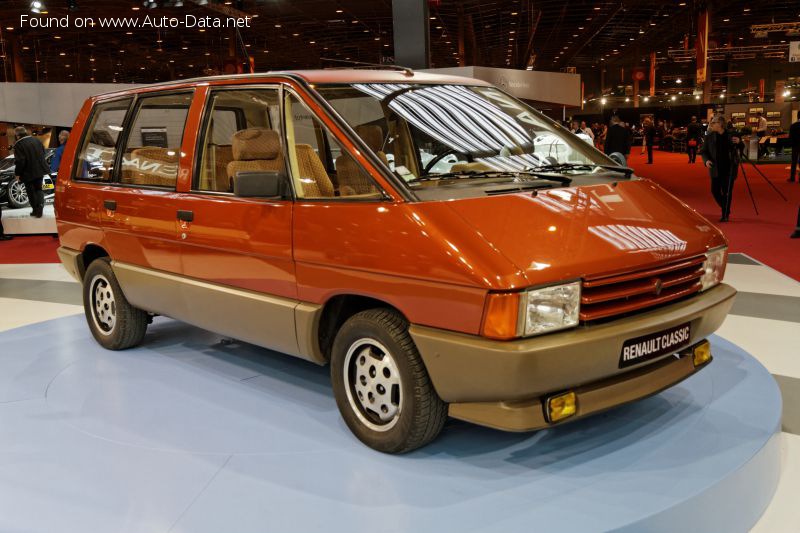
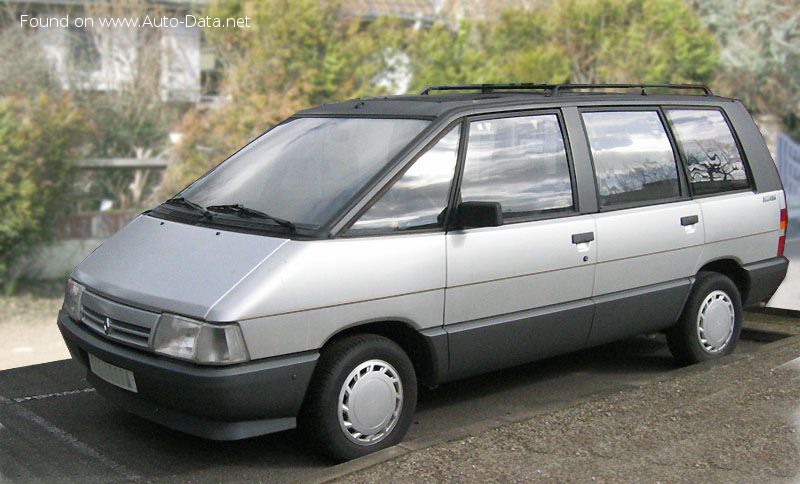
The design of the Renault Espace I (J11/13, Phase II 1988) was its most defining characteristic. It pioneered the “monobox” or one-box design philosophy, where the engine compartment, passenger cabin, and cargo area were integrated into a single, continuous volume. This design maximized interior space and offered excellent visibility, a stark contrast to the traditional three-box sedan or two-box station wagon. The Espace was originally conceived by Matra, a French engineering firm, and featured a unique construction process with a galvanized steel chassis and composite (fiberglass) body panels, which offered benefits in terms of weight, corrosion resistance, and ease of repair.
As a minivan or MPV, the Espace I was configured with 5 doors and could comfortably seat up to 7 passengers. Its interior was remarkably flexible, with individual rear seats that could be removed, folded, or even turned around to create a lounge-like setup, enabling vast cargo capacities ranging from 20.48 cu. ft. (580 liters) with all seats in place to an expansive 108.06 cu. ft. (3060 liters) when the rear seats were removed. This modularity was a key selling point, offering families unparalleled versatility for various activities, from daily commutes to vacation trips.
Dimensions for the Phase II Espace were 171.85 inches (4365 mm) in length, 69.96 inches (1777 mm) in width, and 65.35 inches (1660 mm) in height, with a wheelbase of 101.57 inches (2580 mm). Its relatively compact exterior belied its spacious interior. The vehicle had a curb weight of 2843.96 lbs (1290 kg) and a maximum gross weight of 4321.06 lbs (1960 kg). Safety, while not featuring the advanced systems of modern cars, was addressed through its sturdy chassis and comfortable, elevated driving position. The steering utilized a rack and pinion system, and braking was handled by ventilated discs at the front and drums at the rear. It rode on 195/70 R14 tires, fitted to 14-inch wheel rims.
Technical Specifications: Renault Espace I (J11/13, Phase II 1988) 2.0i TXE (120 Hp)
| Category | Specification | US Equivalent (Approx.) |
|---|---|---|
General Information |
||
| Brand | Renault | |
| Model | Espace I (J11/13, Phase II 1988) | |
| Type (Engine) | 2.0i TXE (120 Hp) | |
| Start of Production | 1988 | |
| End of Production | 1991 | |
| Powertrain Architecture | Internal Combustion engine | |
| Body Type | Minivan, MPV | |
| Seats | 7 | |
| Doors | 5 | |
Performance Specs |
||
| Fuel consumption (economy) – urban | 11.7 l/100 km | 20.1 US mpg |
| Fuel consumption (economy) – extra urban | 7.6 l/100 km | 30.9 US mpg |
| Fuel consumption (economy) – combined | 9.7 l/100 km | 24.2 US mpg |
| Fuel Type | Petrol (Gasoline) | |
| Acceleration 0 – 60 mph | 10.8 sec | |
| Maximum speed | 175 km/h | 108.74 mph |
| Weight-to-power ratio | 10.8 kg/Hp | 23.81 lbs/Hp |
| Weight-to-torque ratio | 7.7 kg/Nm | |
Engine Specs |
||
| Power | 120 Hp @ 5500 rpm | |
| Power per liter | 60.2 Hp/l | |
| Torque | 168 Nm @ 4500 rpm | 123.91 lb.-ft. @ 4500 rpm |
| Engine layout | Front, Longitudinal | |
| Engine Model/Code | J7R | |
| Engine displacement | 1995 cm3 | 121.74 cu. in. |
| Number of cylinders | 4 | |
| Engine configuration | Inline | |
| Cylinder Bore | 88 mm | 3.46 in. |
| Piston Stroke | 82 mm | 3.23 in. |
| Compression ratio | 10:1 | |
| Number of valves per cylinder | 2 | |
| Fuel injection system | Multi-port manifold injection | |
| Engine aspiration | Naturally aspirated engine | |
| Engine oil capacity | 6.2 l | 6.55 US qt |
| Coolant | 7.2 l | 7.61 US qt |
Space, Volume and Weights |
||
| Kerb Weight | 1290 kg | 2843.96 lbs. |
| Max. weight | 1960 kg | 4321.06 lbs. |
| Max load | 670 kg | 1477.1 lbs. |
| Trunk (boot) space – minimum | 580 l | 20.48 cu. ft. |
| Trunk (boot) space – maximum | 3060 l | 108.06 cu. ft. |
| Fuel tank capacity | 63 l | 16.64 US gal |
| Max. roof load | 70 kg | 154.32 lbs. |
Dimensions |
||
| Length | 4365 mm | 171.85 in. |
| Width | 1777 mm | 69.96 in. |
| Height | 1660 mm | 65.35 in. |
| Wheelbase | 2580 mm | 101.57 in. |
| Front track | 1467 mm | 57.76 in. |
| Rear (Back) track | 1489 mm | 58.62 in. |
| Front overhang | 920 mm | 36.22 in. |
| Rear overhang | 865 mm | 34.06 in. |
| Ride height (ground clearance) | 150-125 mm | 5.91 – 4.92 in. |
| Drag coefficient (Cd) | 0.34 | |
| Minimum turning circle (turning diameter) | 12.4 m | 40.68 ft. |
Drivetrain, Brakes and Suspension Specs |
||
| Drivetrain Architecture | The Internal combustion engine (ICE) drives the front wheels of the vehicle. | |
| Drive wheel | Front wheel drive | |
| Number of gears and type of gearbox | 5 gears, manual transmission | |
| Front suspension | Independent type McPherson | |
| Front brakes | Ventilated discs | |
| Rear brakes | Drum | |
| Steering type | Steering rack and pinion | |
| Tires size | 195/70 R14 | |
| Wheel rims size | 14 | |
Legacy & Market Impact of the Renault Espace I (J11/13, Phase II 1988)
The Renault Espace holds a significant place in automotive history, particularly in Europe, for essentially creating the modern MPV segment. When it first launched in 1984, followed by the refined Phase II in 1988, it offered a groundbreaking alternative to the traditional family car. Its innovative ‘one-box’ design, unparalleled interior flexibility, and comfortable ride quickly established it as a benchmark for family vehicles. Before the Espace, large families or those needing significant cargo space typically opted for station wagons or commercial vans. The Espace combined the passenger comfort of a car with the practicality of a van, all within a stylish and manageable package.
In its primary European market, the Espace I faced competition from a few niche vehicles, but its true rivals emerged later. Initially, its success prompted other manufacturers to develop their own MPVs, such as the Fiat Ulysse/Lancia Zeta/Peugeot 806/Citroën Evasion “Eurovans” and Volkswagen’s Sharan/Ford Galaxy twins, which arrived much later in the 1990s. Even the American Chrysler Voyager, which eventually made its way to Europe, had to contend with the Espace’s established reputation and unique design. The Espace’s relatively light composite body panels and innovative construction were also noteworthy, contributing to its distinct identity.
The Espace’s reputation was built on its practicality, comfort, and innovative design. It was seen as a forward-thinking vehicle that perfectly met the needs of the modern European family. Its ability to transform from a comfortable seven-seater people carrier to a cavernous cargo hauler with removable seats was a game-changer. This versatility, combined with a comfortable driving experience and reasonable running costs for its class, ensured its popularity and longevity. The Renault Espace I (J11/13, Phase II 1988) not only defined a new vehicle category but also influenced subsequent generations of family cars, paving the way for the MPV boom of the 1990s and beyond, and ultimately shaping how families travel around the world. Its legacy as a true automotive pioneer remains strong.