Ford Mustang VI (facelift 2017) GT 5.0 Ti-VCT V8 (460 Hp) SelectShift: A Modern American Icon
The Ford Mustang, a name synonymous with American muscle and performance, entered its sixth generation (S550) in 2015, marking a significant evolution in its storied history. For the 2017 model year, Ford introduced a substantial facelift to the Mustang VI, enhancing its aesthetics, technology, and, crucially, its powertrain. The Ford Mustang VI (facelift 2017) GT 5.0 Ti-VCT V8 (460 Hp) SelectShift variant stood as a formidable contender in the performance coupe segment, embodying the spirit of raw power combined with contemporary engineering. This iteration of the Mustang GT, produced from 2017 to 2021, continued to captivate enthusiasts with its naturally aspirated V8 engine, rear-wheel-drive architecture, and updated features, solidifying its status as a global performance car while remaining deeply rooted in its American heritage.
Engine and Performance of the Ford Mustang VI (facelift 2017)
The Heart of the Beast: Coyote V8 with Ti-VCT
At the core of the Ford Mustang VI (facelift 2017) GT 5.0 Ti-VCT V8 (460 Hp) SelectShift lies the revered 5.0-liter “Coyote” V8 engine. This naturally aspirated powerhouse, with an engine displacement of 4949 cm3 (302.01 cubic inches), delivered a robust 460 horsepower at 5500 rpm. Torque figures were equally impressive, peaking at 569 Nm (419.67 lb.-ft.) at 4600 rpm, ensuring exhilarating acceleration and formidable pulling power across the rev range. The engine’s layout is front-longitudinal, driving the rear wheels, a classic configuration for a performance vehicle designed for enthusiast engagement.
The “Ti-VCT” designation refers to Twin Independent Variable Cam Timing, a sophisticated valvetrain technology that optimizes valve timing on both intake and exhaust camshafts independently. This system allows the engine to maximize power output, improve fuel efficiency, and reduce emissions across various operating conditions. With a compression ratio of 11:1 and a multi-port manifold injection fuel system, the Coyote V8 maintained its status as a high-revving, responsive engine. Its power per liter stood at 92.9 Hp/l, showcasing its efficient design despite being a naturally aspirated unit in an era dominated by forced induction.
Advanced Transmission and Drivetrain
A significant upgrade for the 2017 facelift was the introduction of Ford’s advanced 10-speed SelectShift automatic transmission. This gearbox, a collaboration between Ford and General Motors, replaced the outgoing 6-speed automatic and proved to be a game-changer for the Mustang GT. With ten closely spaced gears, the SelectShift transmission ensured that the engine remained in its optimal power band more frequently, leading to quicker acceleration, smoother shifts, and improved fuel economy. Drivers could also take manual control via paddle shifters, offering a more engaging experience. The drivetrain architecture remained faithful to the Mustang’s heritage, with the internal combustion engine exclusively driving the rear wheels, providing a traditional, engaging sports car feel.
Performance metrics reflected the potency of this setup. The vehicle boasted a weight-to-power ratio of 3.7 kg/Hp (271.7 Hp/tonne) and a weight-to-torque ratio of 3 kg/Nm (336.1 Nm/tonne). Fuel consumption, while not the primary concern for a muscle car, showed improvements thanks to the new transmission. Combined fuel economy was rated at 12.3 l/100 km (19.1 US mpg), with urban figures at 14.7 l/100 km (16 US mpg) and extra-urban at 9.4 l/100 km (25 US mpg). The fuel type is standard Petrol (Gasoline), fed by a 61-liter (16.11 US gallon) fuel tank.
Design and Features
Updated Aesthetics and Functional Design
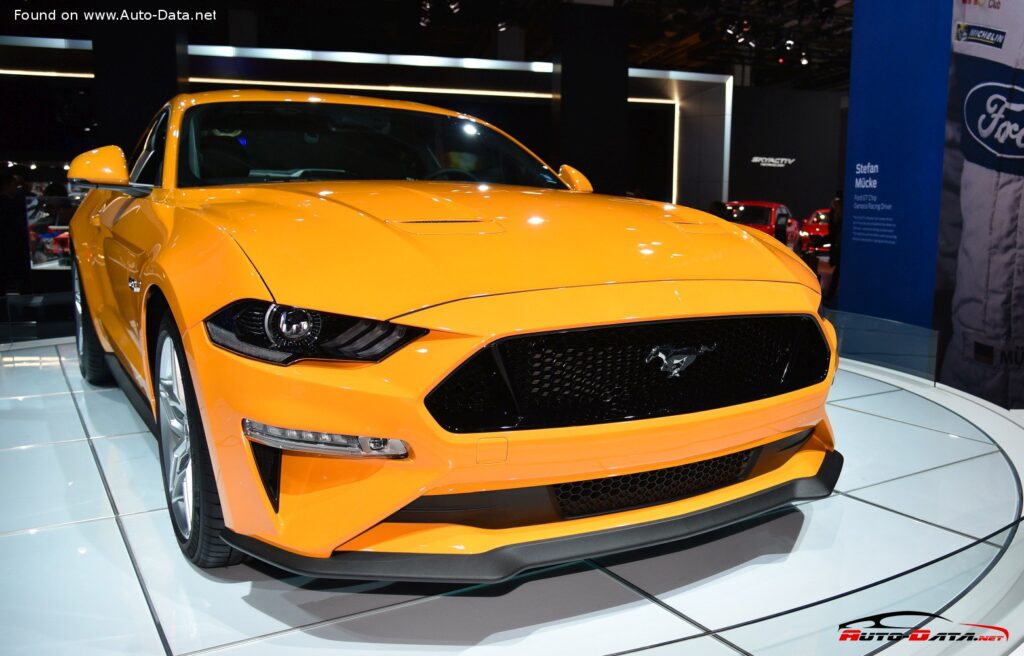
The 2017 facelift brought several key design enhancements to the Mustang VI Fastback, making it appear more aggressive and aerodynamic. The front fascia received a significant overhaul, featuring a lower, restyled hood with new vents, a revised grille, and updated LED headlights that gave the car a more modern and menacing presence. The signature triple-bar LED daytime running lights were retained but integrated into the updated headlight cluster. At the rear, new C-shaped LED taillights and a redesigned bumper with a quad-tip exhaust system (standard on the GT with the performance package) further distinguished the facelifted model.
The body type remained a classic 2-door Fastback, seating four occupants. Its dimensions were substantial yet proportioned for a sports coupe: a length of 4788 mm (188.5 in.), a width of 1915 mm (75.39 in.), and a height of 1379 mm (54.29 in.). The wheelbase measured 2720 mm (107.09 in.), contributing to both stability and interior space. The curb weight of 1693 kg (3732.43 lbs.) underscored its solid build.
Interior Refinements and Modern Technology
Inside, the 2017 Mustang GT continued its blend of retro-inspired design cues with modern technology. While the core cabin architecture remained, the facelift introduced a significant technological upgrade: an optional 12-inch digital instrument cluster. This customizable display allowed drivers to tailor the gauge layout and information presented, offering different modes (Normal, Sport, Track) that changed the graphics and priorities. Standard features included a SYNC 3 infotainment system with an 8-inch touchscreen, offering Apple CarPlay and Android Auto compatibility, navigation, and voice control.
For ride and handling, the Ford Mustang VI (facelift 2017) GT 5.0 Ti-VCT V8 (460 Hp) SelectShift featured an independent McPherson strut front suspension with coil springs and an anti-roll bar, paired with an independent multi-link spring suspension at the rear, also equipped with a stabilizer. This fully independent suspension setup was a hallmark of the S550 generation, vastly improving the Mustang’s handling dynamics compared to previous generations. Stopping power was provided by ventilated disc brakes on both front and rear axles, complemented by an Anti-lock Braking System (ABS) for enhanced safety and control. The steering system was a responsive rack and pinion type, and the car rode on 8J x 18-inch wheel rims. Practicality was decent for a coupe, with a trunk (boot) space of 382 liters (13.49 cu. ft.).
Technical Specifications
| Category | Specification |
|---|---|
| Brand | Ford |
| Model | Mustang |
| Generation | Mustang VI (facelift 2017) |
| Engine Type | GT 5.0 Ti-VCT V8 (460 Hp) SelectShift |
| Production Years | 2017 – 2021 |
| Powertrain Architecture | Internal Combustion Engine |
| Body Type | Fastback, 2 Doors, 4 Seats |
| Performance Specs | |
| Power | 460 Hp @ 5500 rpm |
| Torque | 569 Nm (419.67 lb.-ft.) @ 4600 rpm |
| Fuel Consumption (Urban) | 14.7 l/100 km (16 US mpg) |
| Fuel Consumption (Extra Urban) | 9.4 l/100 km (25 US mpg) |
| Fuel Consumption (Combined) | 12.3 l/100 km (19.1 US mpg) |
| Fuel Type | Petrol (Gasoline) |
| Weight-to-Power Ratio | 3.7 kg/Hp (271.7 Hp/tonne) |
| Weight-to-Torque Ratio | 3 kg/Nm (336.1 Nm/tonne) |
| Engine Specs | |
| Engine Model/Code | Coyote |
| Engine Displacement | 4949 cm3 (302.01 cu. in.) |
| Number of Cylinders | 8 (V-engine) |
| Engine Layout | Front, Longitudinal |
| Cylinder Bore | 92.2 mm (3.63 in.) |
| Piston Stroke | 92.7 mm (3.65 in.) |
| Compression Ratio | 11:1 |
| Fuel Injection System | Multi-port manifold injection |
| Engine Aspiration | Naturally aspirated engine |
| Valvetrain | Ti-VCT |
| Engine Oil Capacity | 9.5 l (10.04 US qt) |
| Coolant Capacity | 12.88 l (13.61 US qt) |
| Space, Volume and Weights | |
| Kerb Weight | 1693 kg (3732.43 lbs.) |
| Trunk (Boot) Space – Minimum | 382 l (13.49 cu. ft.) |
| Fuel Tank Capacity | 61 l (16.11 US gal) |
| Dimensions | |
| Length | 4788 mm (188.5 in.) |
| Width | 1915 mm (75.39 in.) |
| Width with Mirrors Folded | 1933 mm (76.1 in.) |
| Width Including Mirrors | 2080 mm (81.89 in.) |
| Height | 1379 mm (54.29 in.) |
| Wheelbase | 2720 mm (107.09 in.) |
| Front Track | 1585 mm (62.4 in.) |
| Rear (Back) Track | 1654 mm (65.12 in.) |
| Drivetrain, Brakes and Suspension Specs | |
| Drivetrain Architecture | Internal Combustion Engine (ICE) drives the rear wheels. |
| Drive Wheel | Rear wheel drive |
| Number of Gears and Type of Gearbox | 10 gears, automatic transmission SelectShift |
| Front Suspension | Independent, type McPherson with coil spring and anti-roll bar |
| Rear Suspension | Independent multi-link spring suspension with stabilizer |
| Front Brakes | Ventilated discs |
| Rear Brakes | Ventilated discs |
| Assisting Systems | ABS (Anti-lock braking system) |
| Steering Type | Steering rack and pinion |
| Wheel Rims Size | 8J x 18 |
Legacy and Market Impact
The Ford Mustang VI (facelift 2017) GT 5.0 Ti-VCT V8 (460 Hp) SelectShift carved out a significant niche in the performance car market, further solidifying the Mustang’s global appeal that began with the S550 generation’s international launch. In its primary market, the United States, it continued its fierce rivalry with the Chevrolet Camaro SS and the Dodge Challenger R/T Scat Pack. While the Camaro often offered slightly sharper handling and the Challenger boasted raw, uncompromising power, the Mustang GT struck a compelling balance, delivering robust V8 performance, iconic styling, and a more refined driving experience than its predecessors.
The facelifted GT’s reputation was built on its enhanced performance, particularly the synergy between the powerful Coyote V8 and the new 10-speed automatic transmission. This combination made the Mustang GT quicker in a straight line and more responsive in daily driving, impressing both critics and consumers. The introduction of advanced technology like the digital instrument cluster and improved infotainment kept the Mustang competitive in an increasingly tech-driven automotive landscape.
Historically, this generation of Mustang marked a pivotal moment where the car truly transcended its “pony car” roots to become a legitimate global sports coupe. Its independent rear suspension, a first for the Mustang, transformed its handling characteristics, making it more capable on twisty roads and more comfortable on long journeys. The 2017 facelift refined this package, ensuring the Mustang remained at the forefront of the modern muscle car segment, offering an unbeatable combination of heritage, performance, and value. Its enduring appeal lies in its ability to deliver an authentic American V8 experience while embracing modern advancements in technology and driving dynamics, making it a beloved icon for a new generation of enthusiasts worldwide.