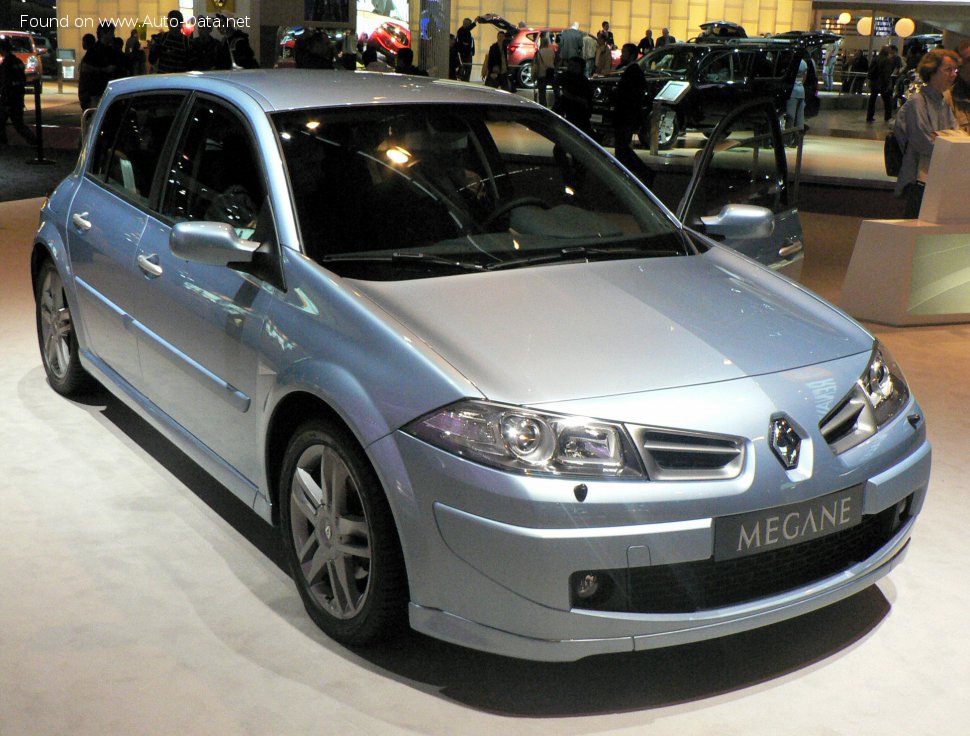
Renault Megane II (Phase II, 2006) 1.6 16V (112 Hp) Automatic
The Renault Megane II (Phase II, 2006) 1.6 16V (112 Hp) Automatic represents a significant iteration of Renault’s popular compact family car, a staple in the European market. Unveiled as a facelifted version of the second-generation Megane, the Phase II models, produced from 2006 to 2008, refined the distinctive and sometimes polarizing design language introduced in 2002. This particular variant, equipped with the 1.6-liter 16-valve engine and an automatic transmission, was designed to offer a balance of everyday usability, comfort, and efficiency for its target audience. While the Megane was never officially sold in the United States, it played a crucial role in the highly competitive European C-segment, vying for market share against formidable rivals like the Volkswagen Golf, Ford Focus, and Opel Astra. The Megane II was particularly noted for its bold styling, strong emphasis on safety, and innovative features for its class during its production run.
Engine and Performance of the Renault Megane II (Phase II, 2006)
Powertrain Configuration
At the heart of this specific Renault Megane II (Phase II, 2006) model is the robust and well-proven K4M 1.6-liter 16-valve inline-four engine. This naturally aspirated gasoline (petrol) engine features a DOHC (Double Overhead Camshaft) valvetrain with four valves per cylinder, optimizing both intake and exhaust gas flow for improved efficiency and power delivery. With an engine displacement of 1598 cm³ (97.52 cu. in.) and a compression ratio of 10:1, the K4M engine was a workhorse for Renault, known for its reliability across various models. Fuel is delivered via a multi-port manifold injection system.
The engine produces a respectable 112 horsepower (Hp) at 6000 rpm, translating to a power-per-liter output of 70.1 Hp/l. Torque peaks at 152 Nm (112.11 lb.-ft.) at 4200 rpm, providing adequate pulling power for city driving and highway cruising. Power is directed to the front wheels through a 4-speed automatic transmission, a common choice for convenience in the compact segment during this era. This powertrain architecture emphasizes smooth operation and ease of driving, particularly in congested urban environments, rather than outright sporty performance.
Driving Dynamics and Efficiency
In terms of performance, the Megane II 1.6 16V Automatic accelerates from 0 to 60 mph in a measured 12.2 seconds, with a top speed of 113.09 mph (182 km/h). While not a speed demon, these figures are entirely competitive for a non-performance-oriented compact hatchback with an automatic transmission of its time. The vehicle’s weight-to-power ratio stands at 11.2 kg/Hp (89.6 Hp/tonne), indicating a balanced approach to its design.
Fuel efficiency for this model is rated at a combined 7.7 liters per 100 km, which translates to approximately 30.5 US mpg. Urban consumption is 10.7 l/100 km (22 US mpg), while extra-urban driving yields 6 l/100 km (39.2 US mpg). These figures highlight the engine’s capability to deliver reasonable economy, especially on longer journeys. The CO2 emissions are 184 g/km, adhering to the Euro 4 emission standard, which was in effect during its production years. The fuel tank capacity of 60 liters (15.85 US gallons) ensures a decent cruising range.
Design and Features
The Renault Megane II (Phase II, 2006) maintained the distinctive and often avant-garde styling of its predecessor, characterized by its prominent, almost vertical rear window and the “bustle-back” design for the hatchback. The Phase II facelift brought subtle but effective updates, including revised headlights, taillights, and bumpers, giving the car a fresher and more modern appearance without departing from its unique identity. The five-door hatchback body style provided practicality and versatility, a key requirement for family cars in its segment.
Measuring 165.71 inches (4209 mm) in length, 69.96 inches (1777 mm) in width (79.76 inches or 2026 mm including mirrors), and 57.4 inches (1458 mm) in height, the Megane II offers a compact footprint that is easy to maneuver in European cities. Its wheelbase of 103.35 inches (2625 mm) contributes to a stable ride and a reasonably spacious cabin for five occupants. The minimum turning circle of 34.45 feet (10.5 m) further aids urban agility.
Inside, the Megane II was known for its comfortable seating and a user-friendly cabin layout. The trunk space is quite versatile, offering a minimum of 330 liters (11.65 cu. ft.) and expanding to a generous 1190 liters (42.02 cu. ft.) with the rear seats folded, making it suitable for varying cargo needs. The kerb weight of the vehicle is 2755.78 lbs. (1250 kg), with a maximum permissible weight of 3913.21 lbs. (1775 kg), allowing for a maximum load of 1157.43 lbs. (525 kg).
For its time, the Megane II was well-equipped with safety features. It came standard with ABS (Anti-lock Braking System), a crucial active safety system. The car featured ventilated disc brakes at the front and disc brakes at the rear, providing confident stopping power. The suspension system utilized an independent McPherson type at the front and a torsion beam setup at the rear, a common and cost-effective configuration for front-wheel-drive compact cars, balancing ride comfort with handling stability. Steering was handled by a rack and pinion system with electric power steering, offering light and responsive feedback. The car rode on 205/55 R16 tires mounted on 6.5J x 16 wheel rims.
Technical Specifications
| General Information | |
|---|---|
| Brand | Renault |
| Model | Megane |
| Generation | Megane II (Phase II, 2006) |
| Type (Engine) | 1.6 16V (112 Hp) Automatic |
| Start of Production | 2006 year |
| End of Production | 2008 year |
| Powertrain Architecture | Internal Combustion engine |
| Body type | Hatchback |
| Seats | 5 |
| Doors | 5 |
| Performance Specifications | |
| Fuel consumption (economy) – urban | 10.7 l/100 km (22 US mpg) |
| Fuel consumption (economy) – extra urban | 6 l/100 km (39.2 US mpg) |
| Fuel consumption (economy) – combined | 7.7 l/100 km (30.5 US mpg) |
| CO2 emissions | 184 g/km |
| Fuel Type | Petrol (Gasoline) |
| Acceleration 0 – 60 mph | 12.2 sec |
| Maximum speed | 113.09 mph (182 km/h) |
| Emission standard | Euro 4 |
| Weight-to-power ratio | 11.2 kg/Hp (89.6 Hp/tonne) |
| Weight-to-torque ratio | 8.2 kg/Nm (121.6 Nm/tonne) |
| Engine Specifications | |
| Power | 112 Hp @ 6000 rpm |
| Power per liter | 70.1 Hp/l |
| Torque | 152 Nm @ 4200 rpm (112.11 lb.-ft. @ 4200 rpm) |
| Engine layout | Front, Transverse |
| Engine Model/Code | K4M |
| Engine displacement | 1598 cm³ (97.52 cu. in.) |
| Number of cylinders | 4 |
| Engine configuration | Inline |
| Cylinder Bore | 79.5 mm (3.13 in.) |
| Piston Stroke | 80.5 mm (3.17 in.) |
| Compression ratio | 10:1 |
| Number of valves per cylinder | 4 |
| Fuel injection system | Multi-port manifold injection |
| Engine aspiration | Naturally aspirated engine |
| Valvetrain | DOHC |
| Engine oil capacity | 4.8 l (5.07 US qt) |
| Coolant | 6.5 l (6.87 US qt) |
| Space, Volume and Weights | |
| Kerb Weight | 1250 kg (2755.78 lbs.) |
| Max. weight | 1775 kg (3913.21 lbs.) |
| Max load | 525 kg (1157.43 lbs.) |
| Trunk (boot) space – minimum | 330 l (11.65 cu. ft.) |
| Trunk (boot) space – maximum | 1190 l (42.02 cu. ft.) |
| Fuel tank capacity | 60 l (15.85 US gal) |
| Max. roof load | 80 kg (176.37 lbs.) |
| Permitted trailer load with brakes (12%) | 1300 kg (2866.01 lbs.) |
| Permitted trailer load without brakes | 650 kg (1433 lbs.) |
| Permitted towbar download | 75 kg (165.35 lbs.) |
| Dimensions | |
| Length | 4209 mm (165.71 in.) |
| Width | 1777 mm (69.96 in.) |
| Width including mirrors | 2026 mm (79.76 in.) |
| Height | 1458 mm (57.4 in.) |
| Wheelbase | 2625 mm (103.35 in.) |
| Front track | 1518 mm (59.76 in.) |
| Rear (Back) track | 1514 mm (59.61 in.) |
| Front overhang | 842 mm (33.15 in.) |
| Rear overhang | 742 mm (29.21 in.) |
| Minimum turning circle (turning diameter) | 10.5 m (34.45 ft.) |
| Drivetrain, Brakes and Suspension Specifications | |
| Drivetrain Architecture | The Internal combustion engine (ICE) drives the front wheels of the vehicle. |
| Drive wheel | Front wheel drive |
| Number of gears and type of gearbox | 4 gears, automatic transmission |
| Front suspension | Independent type McPherson |
| Rear suspension | Torsion |
| Front brakes | Ventilated discs |
| Rear brakes | Disc |
| Assisting systems | ABS (Anti-lock braking system) |
| Steering type | Steering rack and pinion |
| Power steering | Electric Steering |
| Tires size | 205/55 R16 |
| Wheel rims size | 6.5J x 16 |
Legacy and Market Impact
The Renault Megane II, particularly in its Phase II iteration (2006-2008), left a significant mark on the European compact car segment. Its bold styling, which initially garnered both praise and criticism, matured well into the latter half of the decade, making it instantly recognizable. Beyond aesthetics, the Megane II was a leader in safety, being one of the first cars in its class to achieve a 5-star Euro NCAP safety rating, which significantly boosted its reputation and desirability among safety-conscious European buyers.
In its primary European markets, the Renault Megane II (Phase II, 2006) competed fiercely with established rivals such as the Volkswagen Golf V, Ford Focus II, Opel Astra H, and Peugeot 307. While the Golf was often seen as the benchmark for refinement and build quality, and the Focus for its driving dynamics, the Megane carved out its niche through distinctive design, comfort-oriented ride quality, and a strong emphasis on passive and active safety features. The 1.6 16V automatic variant, specifically, catered to a broad demographic looking for a practical, comfortable, and easy-to-drive daily vehicle without the need for high-performance capabilities.
The Megane II’s impact extended beyond its direct sales figures. It helped solidify Renault’s reputation for innovative design and leading-edge safety technology in the early 2000s. Its success paved the way for future generations of Renault vehicles that continued to push boundaries in styling and feature content. For the American market, the Megane II, like many European compacts, remained an intriguing curiosity. Its absence from the U.S. can be attributed to Renault’s withdrawal from the American market in the late 1980s and the differing market preferences, where larger sedans and SUVs dominated the family car segment. Nevertheless, the Megane II stands as a testament to European automotive engineering and design, a car that successfully blended practicality with a unique personality during its time. Its reliable K4M engine and comfortable demeanor ensured its continued presence on European roads for many years after its production ceased.