The Renault Espace I (J11/13, Phase II 1988): A European MPV Pioneer
The Renault Espace is a groundbreaking nameplate in the European automotive landscape, widely credited with popularizing the Multi-Purpose Vehicle (MPV) segment on the continent. The first generation, internally designated J11/13, made its debut in 1984, representing a radical departure from traditional automotive design. The specific model under review, the Renault Espace I (J11/13, Phase II 1988) 2.1 TD (88 Hp), represents the updated version introduced in 1988, which featured a refreshed exterior and interior, alongside technical enhancements. This Phase II model, produced from 1988 to 1991, solidified the Espace’s position as a family-focused vehicle offering unparalleled space, versatility, and comfort. While never officially sold in the United States, the Espace profoundly influenced global automotive trends, demonstrating the potential of a “one-box” design for passenger carrying.
At its core, the Espace I was conceived as a highly adaptable family transporter, combining the driving dynamics of a passenger car with the spaciousness typically found in a van. Its innovative design and flexible interior layout quickly resonated with European families seeking practical solutions for travel, leisure, and daily commuting. The 2.1 TD (88 Hp) variant, specifically, offered a compelling blend of diesel efficiency and adequate performance for the era, making it a popular choice for long-distance journeys and heavy family use across Europe.
Engine and Performance: The 2.1 TD (88 Hp) Powertrain
The heart of the Renault Espace I (J11/13, Phase II 1988) 2.1 TD (88 Hp) is its robust J8S 240/774 diesel engine. This inline four-cylinder unit, with a displacement of 2.1 liters (2068 cubic centimeters or 126.2 cubic inches), was a workhorse for Renault, known for its durability and fuel economy. The “TD” designation signifies a turbocharged diesel, a crucial technology for enhancing both power output and efficiency in the late 1980s.
The engine produced 88 horsepower at a relatively low 4250 rpm, indicative of its diesel nature, which prioritizes torque delivery. More impressively, it generated 134.24 lb.-ft. (182 Nm) of torque at just 2000 rpm. This low-end torque was vital for an MPV, ensuring strong pulling power, especially when fully loaded with passengers and cargo, or when towing. The power was sent to the front wheels via a 5-speed manual transmission, a common and reliable setup for European vehicles of this period, offering drivers direct control and optimizing fuel efficiency.
Performance figures for the 2.1 TD model were respectable for a family-oriented vehicle of its size and weight. It could accelerate from 0 to 60 mph in a calculated 12.4 seconds, with a top speed of 102.53 mph (165 km/h). These numbers were more than adequate for navigating European highways and urban environments. Fuel economy was a significant selling point for this diesel variant, with an impressive extra-urban consumption of 46.1 US mpg (5.1 l/100 km) and urban consumption of 29.4 US mpg (8 l/100 km). This efficiency made the Espace 2.1 TD an economical choice for families, especially considering the higher fuel prices in Europe compared to the U.S. at the time. The engine utilized a precombustion chamber injection system and a single overhead camshaft (SOHC) valvetrain with two valves per cylinder, a proven and reliable configuration for diesel engines of its generation.
Design and Features: Form Follows Function
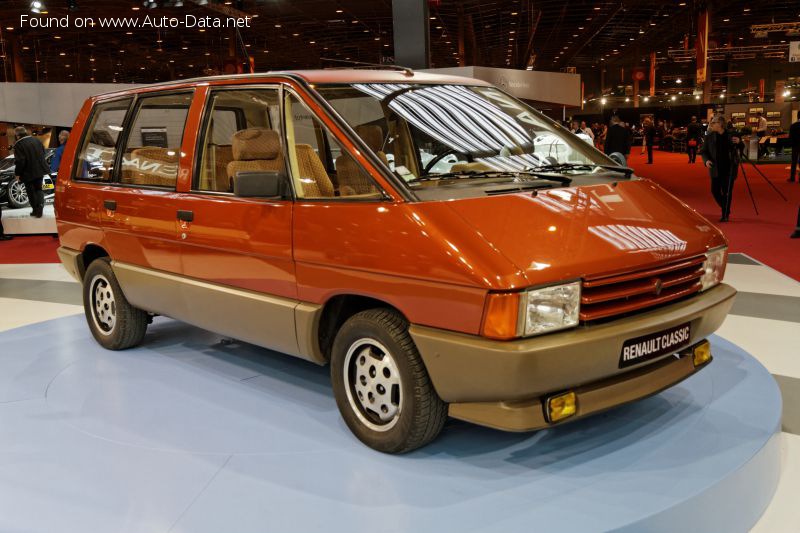
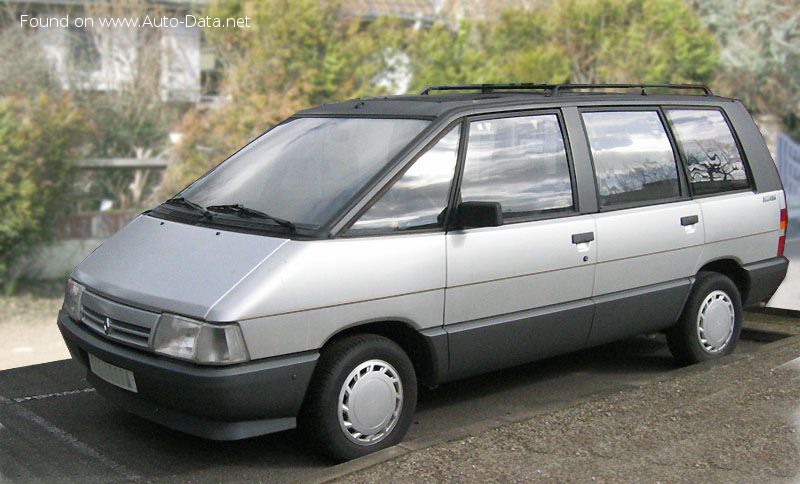
The design of the Renault Espace I (J11/13, Phase II 1988) was revolutionary. Its distinctive “one-box” silhouette, characterized by a steeply raked windshield that seamlessly flowed into the hood and roofline, maximized interior volume. The vehicle measured 171.85 inches in length, 69.96 inches in width, and 65.35 inches in height, providing a compact footprint for European cities while offering exceptional interior space. The long wheelbase of 101.57 inches contributed significantly to ride comfort and interior room.
The Espace was marketed as a Minivan or MPV, offering five doors and seating for seven passengers. Its most innovative feature was the highly modular interior. The rear seats could be individually removed, reversed to face backward, or folded flat, allowing for an incredible range of configurations from a comfortable seven-seater to a vast cargo hauler. Minimum trunk space started at 20.48 cubic feet (580 liters), expanding to an enormous 108.06 cubic feet (3060 liters) with the rear seats removed, making it exceptionally practical for large families, adventurers, or those needing to transport bulky items.
A unique construction method for the Espace I involved a hot-dip galvanized steel chassis onto which fiberglass body panels were bonded. This approach offered several advantages: it resisted corrosion exceptionally well, reduced overall weight, and allowed for easier repair of minor body damage. The Phase II facelift in 1988 brought subtle but effective styling updates, including a revised grille, headlights, and bumpers, giving it a more modern and refined appearance while retaining its distinctive profile. Features for the era included power steering (rack and pinion), independent McPherson strut front suspension, and a combination of ventilated disc brakes at the front and disc brakes at the rear, ensuring a comfortable and secure driving experience. The 195/65 R14 tires on 14-inch wheels provided a good balance of ride comfort and handling for a family vehicle.
Technical Specifications
| Category | Specification |
|---|---|
| General Information | |
| Brand | Renault |
| Model | Espace I (J11/13, Phase II 1988) |
| Type (Engine) | 2.1 TD (88 Hp) |
| Production Start | 1988 |
| Production End | 1991 |
| Body Type | Minivan, MPV |
| Seats | 7 |
| Doors | 5 |
| Performance Specs | |
| Power | 88 Hp @ 4250 rpm |
| Torque | 134.24 lb.-ft. (182 Nm) @ 2000 rpm |
| Acceleration 0-60 mph | 12.4 sec |
| Maximum Speed | 102.53 mph (165 km/h) |
| Fuel Type | Diesel |
| Fuel Consumption (Urban) | 29.4 US mpg (8 l/100 km) |
| Fuel Consumption (Extra Urban) | 46.1 US mpg (5.1 l/100 km) |
| Engine Specs | |
| Engine Layout | Front, Longitudinal |
| Engine Model/Code | J8S 240/774 |
| Engine Displacement | 2.1 l (2068 cm3 / 126.2 cu. in.) |
| Number of Cylinders | 4, Inline |
| Valves per Cylinder | 2 |
| Compression Ratio | 21.5:1 |
| Fuel Injection System | Precombustion chamber injection |
| Engine Aspiration | Turbocharger |
| Valvetrain | SOHC |
| Engine Oil Capacity | 6.66 US qt (6.3 l) |
| Coolant Capacity | 7.61 US qt (7.2 l) |
| Dimensions & Weights | |
| Length | 171.85 in (4365 mm) |
| Width | 69.96 in (1777 mm) |
| Height | 65.35 in (1660 mm) |
| Wheelbase | 101.57 in (2580 mm) |
| Kerb Weight | 3104.11 lbs. (1408 kg) |
| Max. Weight | 4243.9 lbs. (1925 kg) |
| Max Load | 1139.79 lbs. (517 kg) |
| Trunk (Boot) Space (Min) | 20.48 cu. ft. (580 l) |
| Trunk (Boot) Space (Max) | 108.06 cu. ft. (3060 l) |
| Fuel Tank Capacity | 16.64 US gal (63 l) |
| Drag Coefficient (Cd) | 0.34 |
| Minimum Turning Circle | 40.68 ft. (12.4 m) |
| Drivetrain, Brakes & Suspension | |
| Drive Wheel | Front-wheel drive |
| Gearbox Type | 5 gears, manual transmission |
| Front Suspension | Independent type McPherson |
| Front Brakes | Ventilated discs |
| Rear Brakes | Disc |
| Steering Type | Steering rack and pinion |
| Tires Size | 195/65 R14 |
| Wheel Rims Size | 14 inch |
Legacy and Market Impact
The Renault Espace I, and particularly its updated Phase II models like the 2.1 TD (88 Hp), carved out an enduring legacy as a pioneering force in the European automotive market. Before the Espace, large family vehicles were typically sedans, station wagons, or commercial vans converted for passenger use. The Espace offered a radical alternative: a purpose-built vehicle designed from the ground up to prioritize passenger comfort, versatility, and a commanding driving position. Its innovative “one-box” design and modular interior redefined expectations for family transport.
Initially, the Espace faced skepticism due to its unconventional design, but its practical advantages quickly won over consumers. It became a significant sales success for Renault, establishing the company as a leader in the nascent MPV segment. Its success prompted other European manufacturers to develop their own MPV offerings, such as the Ford Galaxy/Volkswagen Sharan twins and later the Fiat Ulysse/Lancia Zeta/Peugeot 806/Citroën Evasion quartet, all of which followed the Espace’s lead in emphasizing spaciousness and interior flexibility. Even the American Chrysler Voyager, which later entered the European market, found itself competing in a segment largely defined by the Espace.
The Renault Espace I (J11/13, Phase II 1988) demonstrated that a family vehicle could be both practical and stylish, comfortable for long journeys, and adaptable to a multitude of needs. Its diesel variants, like the 2.1 TD, were particularly well-suited to the European market’s preference for fuel efficiency and robust torque for extended travel. The Espace’s influence extended beyond its direct competitors, inspiring a generation of car designers to rethink interior packaging and space utilization in passenger vehicles. It remains a significant milestone in automotive history, a testament to Renault’s boldness in innovation and its ability to anticipate and shape consumer preferences for family mobility. The Espace nameplate continued through several generations, each building upon the foundational principles established by this revolutionary first model.