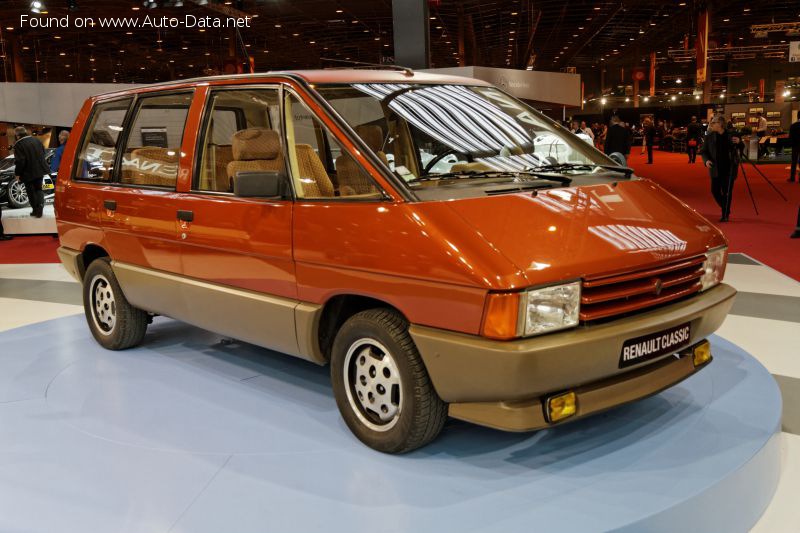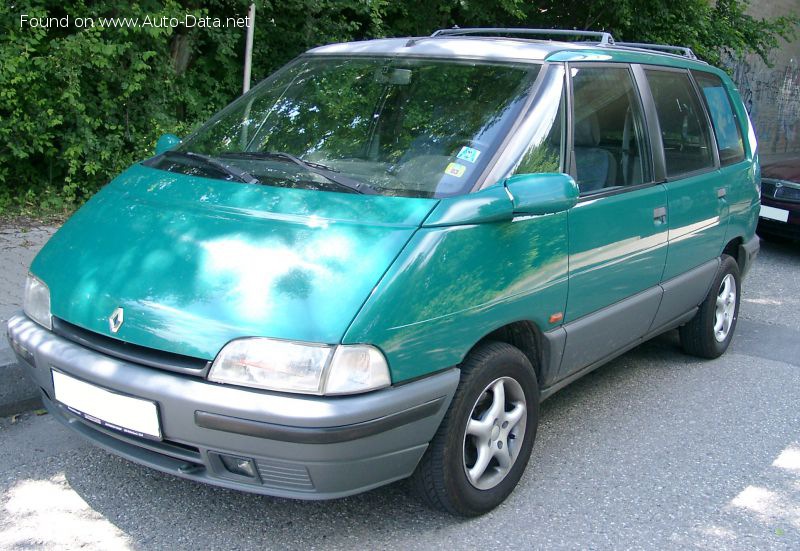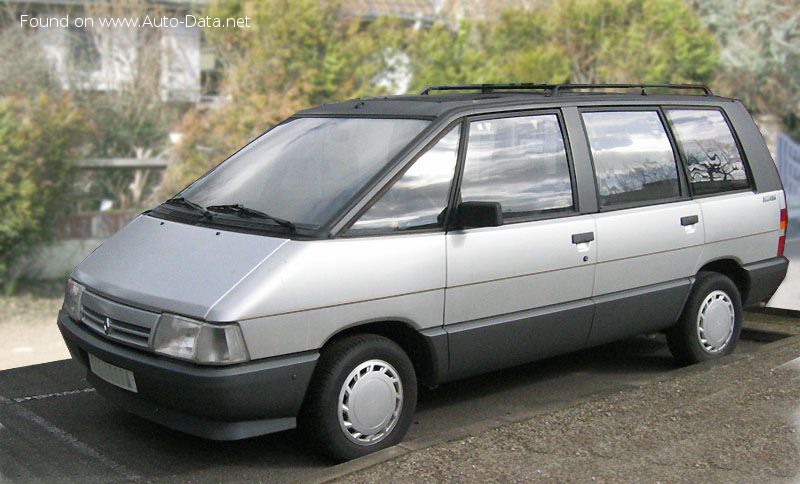
Renault Espace I (J11/13, Phase II 1988) 2.2i (107 Hp) Quadra
The Renault Espace I (J11/13, Phase II 1988) 2.2i (107 Hp) Quadra represents a significant milestone in automotive history, particularly within the European market. Launched in 1984, the Espace (French for “space”) is widely credited as one of the very first successful multi-purpose vehicles (MPVs) or minivans in Europe, predating many of its competitors. Developed initially by Matra and later brought to market by Renault, the Espace pioneered a new segment focused on family utility, modularity, and passenger comfort. The Phase II, introduced in 1988, brought a refresh to the original design, refining its aesthetics and mechanicals. This particular variant, the 2.2i (107 Hp) Quadra, stood out for its relatively potent engine and, more notably, its advanced all-wheel-drive system, offering enhanced traction and versatility, a rare feature for a family-oriented vehicle of its era.
While never officially sold in the United States, the Renault Espace left an indelible mark on global automotive design, influencing the development of minivans and crossovers worldwide. Its innovative approach to interior packaging and the bold, single-volume body shape challenged traditional automotive norms, offering a glimpse into the future of family transportation. The Espace’s enduring legacy in Europe cemented its status as a foundational vehicle in the MPV segment, a segment that would eventually see fierce competition but where the Espace always held a special pioneering place.
Engine and Performance of the Renault Espace I (J11/13, Phase II 1988) 2.2i (107 Hp) Quadra
At the heart of the Renault Espace I (J11/13, Phase II 1988) 2.2i (107 Hp) Quadra was a robust 2.2-liter (2165 cm3 or 132.12 cu. in.) inline-four engine, designated as the J7R 760. This naturally aspirated gasoline engine utilized a multi-port manifold injection system, a modern feature for its time, ensuring efficient fuel delivery and combustion. It produced a respectable 107 horsepower at 5000 rpm, which, coupled with 125.39 lb.-ft. of torque peaking at 3500 rpm, provided adequate power for family duties and highway cruising. The engine featured an inline configuration with a bore of 3.46 inches and a piston stroke of 3.5 inches, along with a compression ratio of 9.2:1 and two valves per cylinder.
Power was delivered to all four wheels via a 5-speed manual transmission, a key differentiator for the Quadra model. This all-wheel-drive (4×4) system significantly enhanced the Espace’s traction and stability, especially in adverse weather conditions or on unpaved roads, a practical benefit for families venturing beyond urban environments. Performance figures for this seven-seater minivan were quite competitive for its class: it could accelerate from 0 to 60 mph in a calculated 10.8 seconds (0-100 km/h in 11.4 seconds) and reach a top speed of 105.63 mph (170 km/h).
Fuel efficiency, while not its primary selling point, was reasonable for an all-wheel-drive vehicle of its size and era. The combined fuel economy was estimated at 23.8 US mpg (9.9 l/100 km), with urban consumption around 19.4 US mpg (12.1 l/100 km) and extra-urban figures reaching 31.8 US mpg (7.4 l/100 km). With a fuel tank capacity of 15.32 US gallons (58 liters), the Espace offered a decent cruising range, making it suitable for long family trips across Europe.
Design and Features
The design of the Renault Espace was revolutionary, characterized by its distinctive “one-box” silhouette. The Phase II refresh retained the fundamental shape but introduced subtle styling updates, including revised headlights, grille, and bumpers, giving it a more modern appearance. The body type was a minivan or MPV, featuring five doors and seating for seven passengers. Its innovative construction, utilizing a fiberglass body shell mounted on a galvanized steel chassis, contributed to its relatively light curb weight of 2888.06 lbs (1310 kg) and good corrosion resistance.
The interior was where the Espace truly shone. Its modular seating system allowed for immense flexibility, with individual rear seats that could be folded, removed, or even swiveled to face each other, creating a versatile lounge-like space. This level of adaptability was groundbreaking and set a new standard for family vehicles. Cargo capacity was impressive, ranging from a minimum of 20.48 cu. ft. (580 liters) with all seats in place, expanding to a cavernous 108.06 cu. ft. (3060 liters) when the rear seats were removed or folded, making it incredibly practical for hauling luggage, sports equipment, or even small furniture.
Dimensions were compact by modern minivan standards but generous for its time: a length of 171.85 inches (4365 mm), a width of 69.96 inches (1777 mm), and a height of 65.75 inches (1670 mm). The 101.57-inch (2580 mm) wheelbase contributed to a stable ride, while a drag coefficient (Cd) of 0.34 was quite respectable, aiding both fuel economy and reducing wind noise. The Espace featured independent McPherson strut front suspension, ventilated disc brakes at both the front and rear, and a steering rack and pinion system, providing a comfortable and predictable driving experience. It rode on 195/65 R14 tires, fitted to 14-inch wheel rims.
Technical Specifications: Renault Espace I (J11/13, Phase II 1988) 2.2i (107 Hp) Quadra
| Category | Specification |
|---|---|
| Brand | Renault |
| Model | Espace I (J11/13, Phase II 1988) 2.2i (107 Hp) Quadra |
| Production Years | 1988 – 1991 |
| Powertrain Architecture | Internal Combustion Engine |
| Body Type | Minivan, MPV |
| Seats | 7 |
| Doors | 5 |
| Performance Specs | |
| Fuel Consumption (Urban) | 19.4 US mpg (12.1 l/100 km) |
| Fuel Consumption (Extra Urban) | 31.8 US mpg (7.4 l/100 km) |
| Fuel Consumption (Combined) | 23.8 US mpg (9.9 l/100 km) |
| Fuel Type | Petrol (Gasoline) |
| Acceleration 0 – 60 mph | 10.8 sec |
| Maximum Speed | 105.63 mph (170 km/h) |
| Weight-to-Power Ratio | 12.2 kg/Hp, 81.7 Hp/tonne |
| Weight-to-Torque Ratio | 7.7 kg/Nm, 129.8 Nm/tonne |
| Engine Specs | |
| Power | 107 Hp @ 5000 rpm |
| Power per liter | 49.4 Hp/l |
| Torque | 125.39 lb.-ft. (170 Nm) @ 3500 rpm |
| Engine Layout | Front, Longitudinal |
| Engine Model/Code | J7R 760 |
| Engine Displacement | 2.2 l (2165 cm3, 132.12 cu. in.) |
| Number of Cylinders | 4 |
| Engine Configuration | Inline |
| Cylinder Bore | 3.46 in. (88 mm) |
| Piston Stroke | 3.5 in. (89 mm) |
| Compression Ratio | 9.2:1 |
| Valves per Cylinder | 2 |
| Fuel Injection System | Multi-port manifold injection |
| Engine Aspiration | Naturally aspirated engine |
| Engine Oil Capacity | 6.55 US qt (6.2 l) |
| Coolant Capacity | 7.61 US qt (7.2 l) |
| Space, Volume and Weights | |
| Kerb Weight | 2888.06 lbs (1310 kg) |
| Max. Weight (GVWR) | 4508.45 lbs (2045 kg) |
| Max Load | 1620.4 lbs (735 kg) |
| Trunk Space (Minimum) | 20.48 cu. ft. (580 l) |
| Trunk Space (Maximum) | 108.06 cu. ft. (3060 l) |
| Fuel Tank Capacity | 15.32 US gal (58 l) |
| Max. Roof Load | 154.32 lbs (70 kg) |
| Dimensions | |
| Length | 171.85 in. (4365 mm) |
| Width | 69.96 in. (1777 mm) |
| Height | 65.75 in. (1670 mm) |
| Wheelbase | 101.57 in. (2580 mm) |
| Front Track | 57.99 in. (1473 mm) |
| Rear Track | 58.86 in. (1495 mm) |
| Front Overhang | 36.22 in. (920 mm) |
| Rear Overhang | 34.06 in. (865 mm) |
| Ride Height (Ground Clearance) | 5.43 in. (138 mm) |
| Drag Coefficient (Cd) | 0.34 |
| Minimum Turning Circle | 40.68 ft. (12.4 m) |
| Drivetrain, Brakes and Suspension Specs | |
| Drive Wheel | All-wheel drive (4×4) |
| Gearbox | 5 gears, Manual Transmission |
| Front Suspension | Independent type McPherson |
| Front Brakes | Ventilated Discs |
| Rear Brakes | Ventilated Discs |
| Steering Type | Steering rack and pinion |
| Tire Size | 195/65 R14 |
| Wheel Rims Size | 14 inches |
Legacy and Market Impact
The Renault Espace, particularly the first generation, carved out an entirely new niche in the European automotive landscape. Before its arrival, large families or those needing significant cargo space were typically limited to station wagons or rudimentary vans. The Espace offered a compelling alternative, blending the comfort and driving dynamics of a passenger car with the spaciousness and versatility of a light commercial vehicle. Its innovative design, born from a collaboration with Matra, was initially a hard sell to Renault’s management, who were skeptical of its unconventional form factor. However, upon its launch, the Espace quickly gained traction, becoming a runaway success and defining the European MPV segment.
The Renault Espace I (J11/13, Phase II 1988) 2.2i (107 Hp) Quadra variant, with its all-wheel-drive capability, further broadened the Espace’s appeal. In a market where SUVs were still niche and luxury items, the Quadra offered enhanced traction and utility in a family-friendly package, making it suitable for varying road conditions and appealing to consumers in regions with harsher winters or more challenging terrains. This foresight in offering AWD in a minivan was ahead of its time and showcased Renault’s willingness to experiment with powertrain configurations to meet diverse consumer needs.
Competitors in its primary market, Europe, soon followed suit. Ford introduced the Galaxy (developed with Volkswagen as the Sharan and SEAT Alhambra), and Chrysler briefly offered its Voyager minivan, attempting to capitalize on the segment the Espace had pioneered. Other European manufacturers like Peugeot (806/Expert) and Citroën (Evasion/Jumpy) also entered the MPV fray, but the Espace consistently held its reputation as the original and often the benchmark for innovation in the category. Its fiberglass body and galvanized chassis were also notable for their durability and resistance to rust, contributing to the Espace’s longevity and reputation for robustness.
The Espace’s historical significance lies not just in its commercial success but in its profound influence on automotive design and consumer expectations. It demonstrated that a family vehicle could be both practical and stylish, offering a flexible interior that adapted to various lifestyles. This concept of modularity and a spacious, airy cabin became aspirational for many families, fundamentally changing how Europeans viewed family transportation. The first-generation Espace, and especially its refined Phase II models like the 2.2i Quadra, remain iconic examples of forward-thinking automotive engineering and design, solidifying Renault’s position as a leader in innovation during that era.