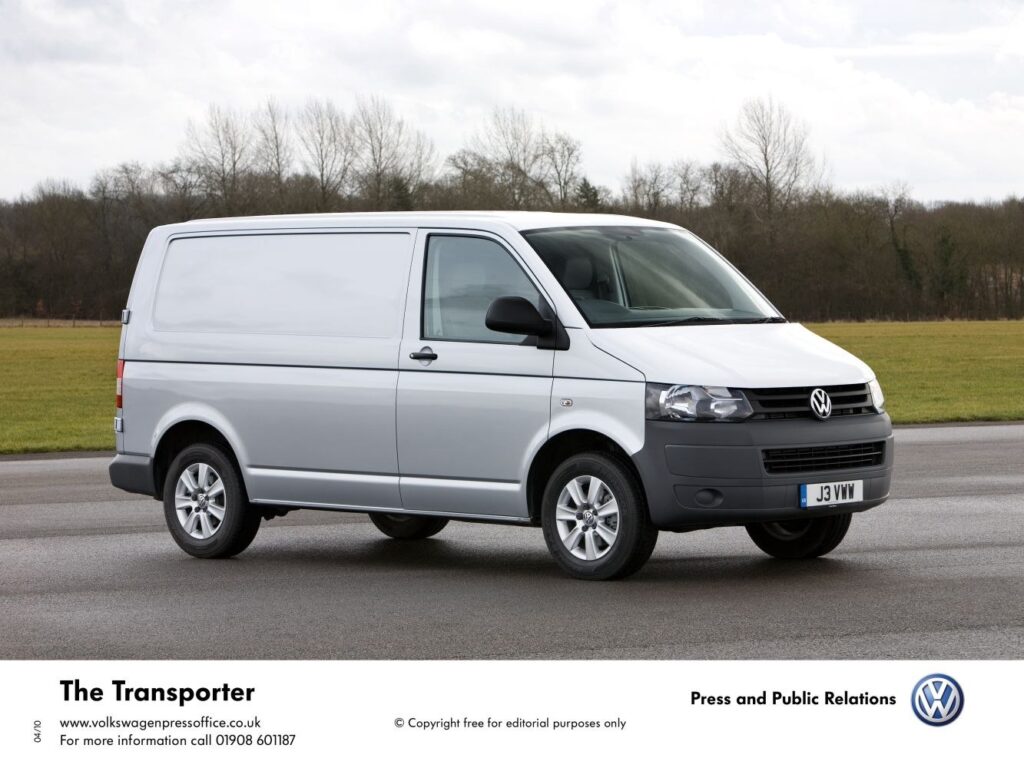
Volkswagen Transporter (T5, facelift 2009) Panel Van 2.0 TSI (204 Hp) L1H1
The Volkswagen Transporter, an iconic nameplate in the light commercial vehicle segment, has a rich history spanning over seven decades. The subject of this article, the Volkswagen Transporter (T5, facelift 2009) Panel Van with the potent 2.0 TSI (204 Hp) L1H1 powertrain, represents a significant evolution in its fifth generation. Produced between 2011 and 2015, this particular variant was part of the refreshed T5 series, known internally as the T5.1, which brought a host of technological and aesthetic updates to the popular commercial platform. While not widely sold in the United States in this specific panel van configuration, the Transporter series, often referred to as the VW Bus or Microbus in its passenger forms, holds immense cultural significance globally and serves as a ubiquitous workhorse across Europe and other international markets. The L1H1 designation signifies the shortest wheelbase and standard roof height, underscoring its design for agility and practicality in urban and suburban commercial applications.
Engine and Performance
At the heart of this Volkswagen Transporter (T5, facelift 2009) Panel Van lies a sophisticated 2.0-liter TSI (Turbocharged Stratified Injection) inline-four gasoline engine, a powerplant renowned within the Volkswagen Group for its blend of power and efficiency. This particular iteration delivers a robust 204 horsepower (Hp) at a broad range of 4200-6000 revolutions per minute (rpm), making it one of the most powerful gasoline options available in the T5 commercial range. The engine’s direct injection system, combined with a turbocharger and intercooler, ensures optimal fuel atomization and air density, contributing to its impressive output.
Torque figures are equally compelling for a commercial vehicle, with 350 Newton-meters (Nm) or 258.15 lb.-ft. available across a wide band from 1500 to 4000 rpm. This broad torque curve is crucial for a panel van, providing excellent pulling power for heavy loads and responsive acceleration even when fully laden. Mated to a six-speed manual transmission, the Transporter 2.0 TSI L1H1 can accelerate from 0 to 60 mph in a swift 8 seconds, reaching a maximum speed of 124.27 mph. These performance metrics are noteworthy for a utility vehicle, allowing it to keep pace with passenger cars on highways and navigate demanding driving conditions with ease.
Despite its performance capabilities, Volkswagen engineered this powertrain to meet Euro 5 emission standards, reflecting the brand’s commitment to environmental responsibility. Fuel economy, while secondary to utility for many commercial buyers, is respectable for its class and power output, with a combined cycle (NEDC) rating of 24.8 – 24 US mpg. The engine’s displacement of 1984 cubic centimeters (121.07 cu. in.) and a compression ratio of 9.8:1 further highlight its modern design and engineering prowess.
Design and Features of the Volkswagen Transporter (T5, facelift 2009) Panel Van
The T5 generation of the Transporter, especially after its 2009 facelift, presented a more modern and refined aesthetic while retaining the practical, no-nonsense character expected of a commercial vehicle. The Volkswagen Transporter (T5, facelift 2009) Panel Van features a classic van body type with 4-5 doors and seating for 2-3 occupants, prioritizing cargo space and utility. The L1H1 designation indicates the standard length and standard roof height, making it a versatile choice for businesses requiring a balance between maneuverability and cargo capacity.
Measuring 192.6 inches in length, 74.96 inches in width (89.88 inches including mirrors), and 78.35 inches in height, the Transporter L1H1 is compact enough for urban deliveries yet offers a substantial cargo volume. The maximum trunk (boot) space of 5800 liters (204.83 cu. ft.) underscores its primary role as a goods transporter. The design is characterized by clean lines, a prominent Volkswagen grille (updated in the facelift), and large headlights that integrate well into the front fascia.
Inside, the Transporter’s cabin is designed for durability and functionality. While specific luxury features are typically absent in a panel van, the facelift brought improved materials and ergonomics. Features like hydraulic power steering and an independent suspension system (McPherson struts with coil springs and anti-roll bar at the front, independent coil spring with trailing arm and transverse stabilizer at the rear) contribute to a comfortable and stable ride, even when carrying heavy loads. Safety is addressed with ventilated disc brakes (340×32.5 mm front, 294×22 mm rear) and an Anti-lock Braking System (ABS), standard for its era. The robust chassis allows for a maximum payload of 2317.06 – 2341.31 lbs. and a substantial towing capacity of 5511.56 lbs. with brakes, highlighting its capability as a true workhorse.
Technical Specifications
| General Information | |
|---|---|
| Brand | Volkswagen |
| Model | Transporter |
| Generation | Transporter (T5, facelift 2009) Panel Van |
| Type (Engine) | 2.0 TSI (204 Hp) L1H1 |
| Start of Production | 2011 year |
| End of Production | 2015 year |
| Powertrain Architecture | Internal Combustion engine |
| Body Type | Van |
| Seats | 2-3 |
| Doors | 4-5 |
| Performance Specifications | |
| Fuel Consumption (Urban – NEDC) | 12.7-13 l/100 km (18.5 – 18.1 US mpg) |
| Fuel Consumption (Extra Urban – NEDC) | 7.7-8 l/100 km (30.5 – 29.4 US mpg) |
| Fuel Consumption (Combined – NEDC) | 9.5-9.8 l/100 km (24.8 – 24 US mpg) |
| CO2 Emissions (NEDC) | 222-228 g/km |
| Fuel Type | Petrol (Gasoline) |
| Acceleration 0 – 60 mph | 8 seconds |
| Maximum Speed | 200 km/h (124.27 mph) |
| Emission Standard | Euro 5 |
| Weight-to-Power Ratio | 8.6 kg/Hp (116.6 Hp/tonne) |
| Weight-to-Torque Ratio | 5 kg/Nm (200.1 Nm/tonne) |
| Engine Specifications | |
| Power | 204 Hp @ 4200-6000 rpm |
| Power per Liter | 102.8 Hp/l |
| Torque | 350 Nm (258.15 lb.-ft.) @ 1500-4000 rpm |
| Engine Layout | Front, Transverse |
| Engine Model/Code | EA888 / CJKA |
| Engine Displacement | 1984 cm3 (121.07 cu. in.) |
| Number of Cylinders | 4 |
| Engine Configuration | Inline |
| Cylinder Bore | 82.5 mm (3.25 in.) |
| Piston Stroke | 92.8 mm (3.65 in.) |
| Compression Ratio | 9.8:1 |
| Number of Valves per Cylinder | 4 |
| Fuel Injection System | Direct injection |
| Engine Aspiration | Turbocharger, Intercooler |
| Valvetrain | DOHC |
| Engine Oil Capacity | 5.7 l (6.02 US qt) |
| Engine Oil Specification | Not specified |
| Coolant Capacity | 11 l (11.62 US qt) |
| Space, Volume and Weights | |
| Kerb Weight | 1749-2138 kg (3855.88 – 4713.48 lbs.) |
| Max. Weight | 2800-3200 kg (6172.94 – 7054.79 lbs.) |
| Max Load | 1051-1062 kg (2317.06 – 2341.31 lbs.) |
| Trunk (Boot) Space – Maximum | 5800 l (204.83 cu. ft.) |
| Fuel Tank Capacity | 80 l (21.13 US gal) |
| Max. Roof Load | 100 kg (220.46 lbs.) |
| Permitted Trailer Load with Brakes (12%) | 2500 kg (5511.56 lbs.) |
| Permitted Trailer Load without Brakes | 750 kg (1653.47 lbs.) |
| Permitted Towbar Download | 100 kg (220.46 lbs.) |
| Dimensions | |
| Length | 4892 mm (192.6 in.) |
| Width | 1904 mm (74.96 in.) |
| Width Including Mirrors | 2283 mm (89.88 in.) |
| Height | 1990 mm (78.35 in.) |
| Wheelbase | 3000 mm (118.11 in.) |
| Front Overhang | 896 mm (35.28 in.) |
| Rear Overhang | 996 mm (39.21 in.) |
| Ride Height (Ground Clearance) | 201 mm (7.91 in.) |
| Minimum Turning Circle (Turning Diameter) | 11.9 m (39.04 ft.) |
| Approach Angle | 21° |
| Departure Angle | 17° |
| Ramp-over (Brakeover) Angle | 14° |
| Wading Depth | 300 mm (11.81 in.) |
| Drivetrain, Brakes and Suspension Specifications | |
| Drivetrain Architecture | The Internal combustion engine (ICE) drives the front wheels of the vehicle. |
| Drive Wheel | Front wheel drive |
| Number of Gears and Type of Gearbox | 6 gears, manual transmission |
| Front Suspension | Independent, type McPherson with coil spring and anti-roll bar |
| Rear Suspension | Independent coil spring, Transverse stabilizer, Trailing arm |
| Front Brakes | Ventilated discs, 340×32.5 mm |
| Rear Brakes | Ventilated discs, 294×22 mm |
| Assisting Systems | ABS (Anti-lock braking system) |
| Steering Type | Steering rack and pinion |
| Power Steering | Hydraulic Steering |
| Tire Sizes | 215/60 R17; 235/55 R17; 255/45 R18 |
| Wheel Rims Size | 7J x 17; 8J x 18 |
Legacy and Market Impact
The Volkswagen Transporter series, and particularly the T5 generation, solidified its reputation as a benchmark in the European light commercial vehicle market. The Volkswagen Transporter (T5, facelift 2009) Panel Van 2.0 TSI (204 Hp) L1H1, while a niche high-performance variant, contributed to the overall appeal and versatility of the range. Its primary market was undoubtedly Europe, where the Transporter has been a ubiquitous sight on roads for decades, serving a vast array of businesses from tradespeople and delivery services to shuttle operators and emergency services.
Competitors in its segment included formidable rivals such as the Mercedes-Benz Vito, Ford Transit Custom, Renault Trafic, and Fiat Ducato. What set the Transporter apart, especially in its higher-spec versions, was its car-like driving dynamics, robust build quality, and strong residual values. The 2.0 TSI engine variant offered a level of refinement and performance that was arguably superior to many of its diesel-focused competitors, appealing to operators who valued quicker transit times and a more engaging driving experience, even in a commercial setting.
Historically, the Transporter (known as the Type 2 in earlier generations) holds a legendary status, particularly its T1 and T2 predecessors, which became cultural icons globally. The T5, while more modern and less “hippie van,” continued this legacy of reliability, adaptability, and enduring appeal. The facelifted T5, with its updated styling and advanced powertrains like the 2.0 TSI, ensured its competitiveness during its production run. Its impact lies in its continued role as an indispensable tool for countless businesses, showcasing Volkswagen’s ability to blend utilitarian design with sophisticated engineering and impressive performance. The L1H1 configuration, in particular, highlighted its urban agility, making it a favorite for city-based logistics and service providers who needed a capable yet manageable vehicle. The T5 generation paved the way for the subsequent T6 and T6.1 models, building on a foundation of proven success and continuous innovation in the commercial vehicle sector.