The Volkswagen Polo I (86) 0.9 (40 Hp): A European Supermini Pioneer
The Volkswagen Polo I (Type 86), particularly the 0.9 (40 Hp) variant, represents a pivotal moment in Volkswagen’s history, marking the brand’s concerted entry into the burgeoning supermini segment in Europe. Launched in 1975, the first-generation Polo was designed as a smaller, more economical companion to the highly successful Golf, offering a compact and efficient solution for urban driving and budget-conscious consumers across the continent. While never officially sold in the United States, the Polo quickly established itself as a cornerstone of Volkswagen’s European lineup, embodying the practical, no-nonsense engineering for which the German automaker was becoming renowned. This initial iteration, produced until 1981, laid the groundwork for a model line that would span multiple generations and sell millions of units worldwide, becoming a defining vehicle in its class.
The Genesis of the Volkswagen Polo I (86)
Following the success of the Golf, Volkswagen sought to expand its front-wheel-drive, water-cooled lineup with an even smaller offering. The Polo I (86) shared its platform with the Audi 50, which had debuted in 1974, allowing for cost-effective development and production. This strategic move enabled Volkswagen to quickly bring a competitive product to market that was smaller than the Golf, yet still offered a surprising amount of interior space for its compact footprint. The 0.9-liter engine variant, with its modest 40 horsepower, was positioned as the entry-level option, emphasizing affordability and fuel efficiency, characteristics that were highly valued in Europe during the mid-to-late 1970s.
Engine and Performance: The Heart of the Volkswagen Polo I (86) 0.9 (40 Hp)
At the core of the Volkswagen Polo I (86) 0.9 (40 Hp) was a straightforward yet reliable powertrain designed for maximum economy and ease of maintenance. The vehicle was propelled by a modest 0.9-liter (specifically, 895 cubic centimeters or 54.62 cubic inches) inline-four cylinder engine, code-named HA. This unit was mounted transversely at the front of the vehicle, driving the front wheels – a modern and efficient layout for the era. As a naturally aspirated engine, it relied solely on atmospheric pressure to draw air into its cylinders, feeding fuel through a simple carburetor system, a common setup before the widespread adoption of electronic fuel injection.
This diminutive engine produced 40 horsepower at a relatively high 5900 revolutions per minute (rpm), indicating its willingness to rev. Torque output was 61 Newton-meters, which translates to approximately 44.99 pound-feet, delivered at 3500 rpm. These figures, while seemingly low by today’s standards, were entirely adequate for the Polo’s intended role as an urban commuter and economical family car. The power-to-weight ratio stood at 17.1 kilograms per horsepower (or 58.4 horsepower per ton), highlighting the car’s lightweight construction as a key factor in its performance.
Mated to a 4-speed manual transmission, the 0.9-liter Polo offered a direct and engaging driving experience, albeit one focused on efficiency rather than outright speed. Acceleration from 0 to 60 miles per hour was a leisurely 20.6 seconds, with a top speed of 82.02 mph. While these numbers might suggest sluggishness, it’s crucial to remember the context of 1970s motoring, especially for an entry-level supermini. The car’s performance was sufficient for navigating city streets and maintaining pace on secondary roads. Fuel economy was a strong suit, with a combined consumption rating of 7.5 liters per 100 kilometers, equating to an impressive 31.4 US miles per gallon. This efficiency was a major selling point, particularly during a decade marked by energy crises and rising fuel prices. The engine’s design, with two valves per cylinder and a compression ratio of 8.2:1, emphasized durability and low running costs, making the Polo an attractive proposition for European buyers.
Design and Features: Form Follows Function
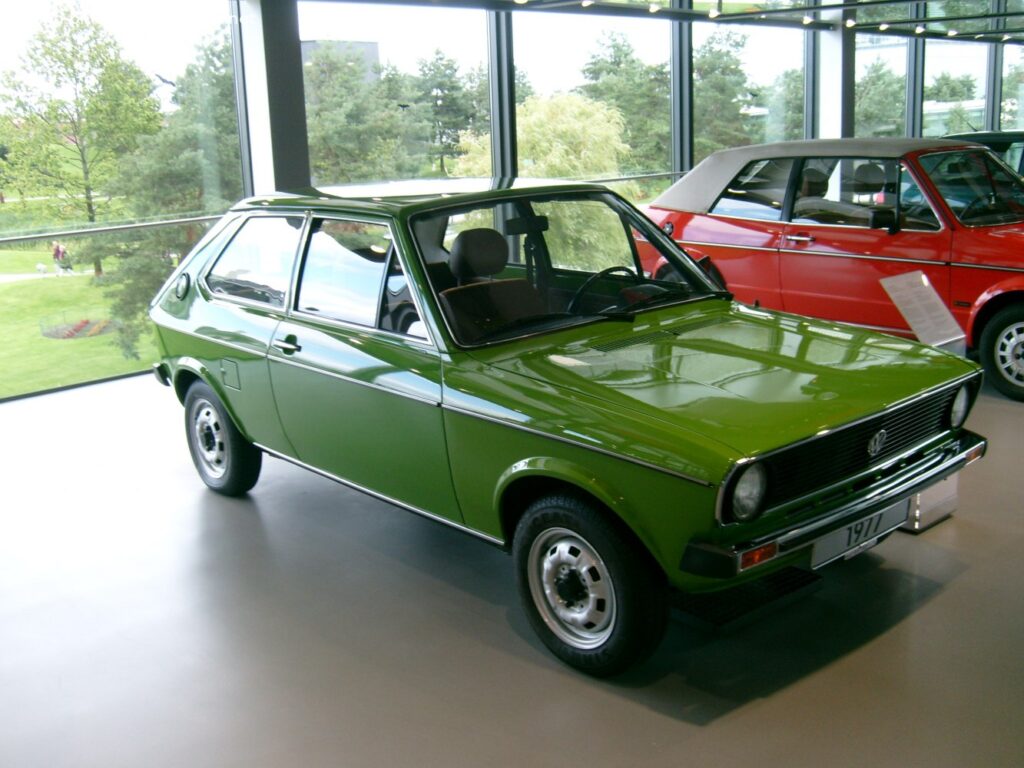
The design of the Volkswagen Polo I (86) was a testament to the “form follows function” philosophy, characteristic of German engineering in the 1970s. The car adopted a practical and popular 3-door hatchback body type, offering versatile cargo space in a compact package. Its dimensions were notably small, measuring 137.8 inches in length, 61.38 inches in width, and 52.91 inches in height. This compact footprint, combined with a tight minimum turning circle of 31.5 feet, made the Polo exceptionally agile and easy to maneuver in congested European cities.
Visually, the Polo I was clean and understated. It featured simple, angular lines, a relatively flat hood, and large glass areas that provided excellent visibility. The front end typically sported round headlights and a modest grille, maintaining a family resemblance to the larger Golf. The lightweight construction was evident in its curb weight of just 1510.17 pounds, contributing significantly to both its fuel economy and its nimble handling. Despite its small exterior, the Polo was designed to accommodate five occupants, though the rear seats were best suited for shorter journeys or children.
Practicality was a key strength. The hatchback design allowed for flexible cargo capacity, with a minimum trunk space of 10.06 cubic feet that could expand to a generous 31.78 cubic feet when the rear seats were folded down. This adaptability made the Polo a versatile choice for everything from weekly grocery runs to weekend trips. Features for the era were rudimentary but robust. The vehicle featured a simple dashboard layout with clear instrumentation, manual windows, and basic heating and ventilation systems. Safety, while not as advanced as modern cars, included basic seatbelts and a sturdy unibody construction. The relatively low drag coefficient (Cd) of 0.39 was respectable for the period, further aiding its fuel efficiency and stability at higher speeds. The Polo I was not about luxurious amenities; it was about providing reliable, affordable, and practical transportation to the masses.
Technical Specifications
| Feature | Specification |
|---|---|
| Brand | Volkswagen |
| Model | Polo |
| Generation | Polo I (86) |
| Type (Engine) | 0.9 (40 Hp) |
| Start of Production | 1975 |
| End of Production | 1981 |
| Powertrain Architecture | Internal Combustion Engine |
| Body Type | Hatchback |
| Seats | 5 |
| Doors | 3 |
| Fuel Consumption (Combined) | 31.4 US mpg (7.5 l/100 km) |
| Fuel Type | Petrol (Gasoline) |
| Acceleration 0 – 60 mph | 20.6 sec |
| Maximum Speed | 82.02 mph (132 km/h) |
| Weight-to-Power Ratio | 17.1 kg/Hp (58.4 Hp/tonne) |
| Weight-to-Torque Ratio | 11.2 kg/Nm (89.1 Nm/tonne) |
| Power | 40 Hp @ 5900 rpm |
| Power per Liter | 44.7 Hp/l |
| Torque | 44.99 lb.-ft. @ 3500 rpm (61 Nm) |
| Engine Layout | Front, Transverse |
| Engine Model/Code | HA |
| Engine Displacement | 0.9 liters (895 cm3 / 54.62 cu. in.) |
| Number of Cylinders | 4 |
| Engine Configuration | Inline |
| Cylinder Bore | 2.74 in. (69.5 mm) |
| Piston Stroke | 2.32 in. (59 mm) |
| Compression Ratio | 8.2:1 |
| Number of Valves per Cylinder | 2 |
| Fuel Injection System | Carburetor |
| Engine Aspiration | Naturally Aspirated |
| Engine Oil Capacity | 3.17 US qt (3 l) |
| Coolant Capacity | 4.23 US qt (4 l) |
| Curb Weight | 1510.17 lbs (685 kg) |
| Max. Weight (GVWR) | 2425.08 lbs (1100 kg) |
| Max Load | 914.92 lbs (415 kg) |
| Trunk Space (Minimum) | 10.06 cu. ft. (285 l) |
| Trunk Space (Maximum) | 31.78 cu. ft. (900 l) |
| Fuel Tank Capacity | 9.51 US gal (36 l) |
| Length | 137.8 in. (3500 mm) |
| Width | 61.38 in. (1559 mm) |
| Height | 52.91 in. (1344 mm) |
| Wheelbase | 91.73 in. (2330 mm) |
| Front Track | 51.02 in. (1296 mm) |
| Rear Track | 51.65 in. (1312 mm) |
| Drag Coefficient (Cd) | 0.39 |
| Minimum Turning Circle | 31.5 ft (9.6 m) |
| Drivetrain Architecture | Front-wheel drive, Internal Combustion Engine |
| Drive Wheel | Front Wheel Drive |
| Number of Gears and Type of Gearbox | 4 gears, manual transmission |
Legacy and Market Impact: The Enduring Charm of the Volkswagen Polo I (86)
The Volkswagen Polo I (86) 0.9 (40 Hp) quickly carved out a significant niche in the European automotive landscape. As a direct competitor to other burgeoning superminis like the Fiat 127, Renault 5, and the original Ford Fiesta Mk1, the Polo distinguished itself with Volkswagen’s reputation for solid engineering and robust build quality. It was marketed as a sensible, economical, and reliable choice for a wide demographic, from first-time drivers and young families to urban commuters looking for efficient transportation. Its relative affordability and low running costs made it particularly appealing during a period of economic uncertainty.
The Polo’s impact was profound in its primary markets. It helped Volkswagen diversify its product portfolio beyond the Beetle and Golf, establishing a strong presence in the increasingly popular small car segment. This first generation laid the foundation for the Polo to become one of the brand’s most successful models globally, with subsequent generations continuing to evolve and adapt to changing market demands. Its practical hatchback design, combined with its compact dimensions, proved to be an ideal formula for European roads and parking conditions.
While the Polo I (86) was never officially imported to the United States, its influence on global automotive trends is undeniable. Its success in Europe helped validate the supermini concept, demonstrating that small, efficient cars could be desirable and practical. For American audiences, the Polo’s story is a reminder of the differing market priorities between continents; while the US market leaned towards larger vehicles, Europe embraced the efficiency and agility of cars like the Polo. Today, classic examples of the Polo I are cherished by enthusiasts for their historical significance, their straightforward mechanics, and their enduring charm as an icon of 1970s European motoring. Its legacy is not just in the millions of Polos sold since, but in cementing Volkswagen’s reputation as a master of practical, well-engineered automobiles across a broad spectrum of sizes and price points.