The Nissan Sunny I (B11): A Global Compact Car of the 1980s
The Nissan Sunny I, specifically the B11 generation, represented a pivotal shift for Nissan’s long-running compact car nameplate. Introduced in 1981 (with production of this variant starting in 1982) and continuing through 1986, the B11 marked a significant departure from its rear-wheel-drive predecessors by adopting a front-wheel-drive architecture. This strategic move brought the Sunny in line with contemporary trends in the compact segment, emphasizing efficiency, interior space, and modern packaging. While often known as the Sentra in North America, the Nissan Sunny I (B11) maintained its original name in many international markets, including Europe and Asia, where it competed fiercely as a reliable and economical family sedan. The 1.7 D (54 Hp) Automatic variant, the focus of this detailed examination, was particularly geared towards markets where diesel fuel economy and durability were highly valued, offering a practical and cost-effective solution for daily commuting and long-distance travel.
Engine and Performance of the Nissan Sunny I (B11) 1.7 D Automatic
Powering this particular iteration of the Nissan Sunny I (B11) was a naturally aspirated 1.7-liter (1681 cubic centimeters) inline four-cylinder diesel engine, internally designated as the CD17. This robust powerplant was designed for longevity and fuel efficiency rather than outright speed. It produced a modest 54 horsepower at 4800 RPM and 73.76 pound-feet (100 Nm) of torque. While these figures may seem low by today’s standards, they were entirely adequate for the vehicle’s intended purpose in the early 1980s compact segment, especially for a diesel engine. The engine’s layout was front, transverse, contributing to the efficient packaging afforded by the front-wheel-drive platform.
The CD17 engine featured a compression ratio of 22.2:1, characteristic of diesel engines, and utilized a precombustion chamber injection system, a common technology for indirect injection diesels of the era. With two valves per cylinder, the engine prioritized reliability and straightforward maintenance. Mated to this diesel engine was a 3-speed automatic transmission. This gearbox, while simple, offered a smooth and convenient driving experience, especially in urban environments, contrasting with the more common manual transmissions found in many economy cars of the period. The combination of the economical diesel engine and the automatic transmission underscored the B11’s role as a no-nonsense, practical vehicle designed for ease of use and low running costs.
Fuel economy was a major selling point for the 1.7 D variant. Nissan claimed impressive figures for the time: an urban consumption of 33.6 US miles per gallon (7 liters/100 km), an extra-urban (highway) consumption of 50 US miles per gallon (4.7 liters/100 km), and a combined average of 39.2 US miles per gallon (6 liters/100 km). These numbers highlight the diesel engine’s inherent efficiency, making the Sunny a compelling option for budget-conscious buyers and those facing high fuel prices in international markets.
Design and Features: The Practicality of the Nissan Sunny I (B11) Sedan
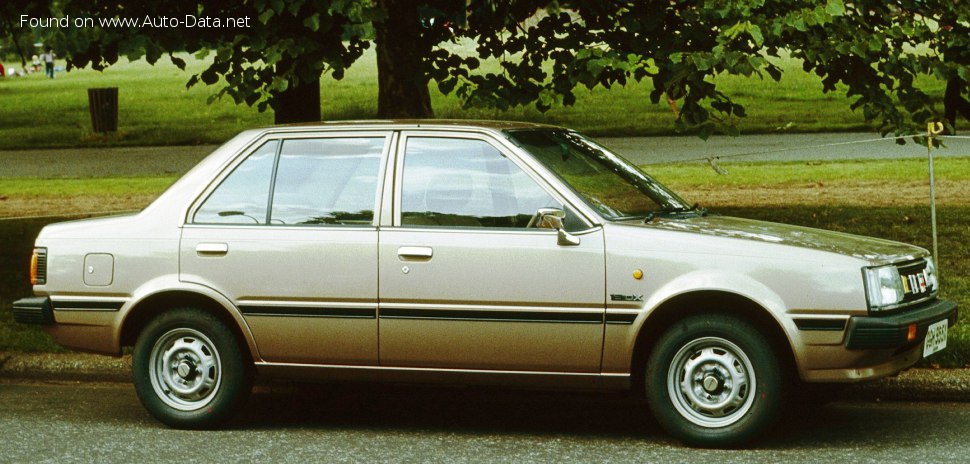
The Nissan Sunny I (B11) adopted a clean, functional design that was emblematic of early 1980s automotive aesthetics. As a 4-door sedan, it offered seating for five occupants, prioritizing interior volume and practicality within its compact footprint. The B11’s transition to front-wheel drive allowed for a more spacious cabin compared to its rear-wheel-drive predecessors, with a flatter floor and improved legroom, particularly for rear passengers.
From a chassis perspective, the Sunny B11 featured an independent McPherson strut front suspension, a widely adopted and effective design for its balance of ride comfort and handling characteristics in compact cars. The rear brakes were conventional drums, while the front utilized ventilated discs, a common setup for economy cars of the period, providing adequate stopping power for its performance levels. Steering was handled by a cone worm with recirculation balls system, augmented by hydraulic power steering, a welcome feature that reduced driver effort, particularly during low-speed maneuvers and parking. The car rode on relatively small 155/75 R13 tires, reflecting its lightweight construction and focus on efficiency.
With a kerb weight of just 1851.88 pounds (840 kg) and a maximum gross weight of 2832.94 pounds (1285 kg), the Sunny B11 was a lightweight vehicle, which further contributed to its fuel efficiency and nimble handling. The design emphasized functionality over flamboyance, appealing to a broad demographic looking for dependable and economical transportation.
Technical Specifications
| Category | Specification |
|---|---|
| Brand | Nissan |
| Model | Sunny |
| Generation | Sunny I (B11) |
| Type (Engine) | 1.7 D (54 Hp) Automatic |
| Start of Production | 1982 year |
| End of Production | 1986 year |
| Powertrain Architecture | Internal Combustion engine |
| Body Type | Sedan |
| Seats | 5 |
| Doors | 4 |
| Performance Specs | |
| Fuel Consumption (Urban) | 7 l/100 km (33.6 US mpg) |
| Fuel Consumption (Extra Urban) | 4.7 l/100 km (50 US mpg) |
| Fuel Consumption (Combined) | 6 l/100 km (39.2 US mpg) |
| Fuel Type | Diesel |
| Weight-to-Power Ratio | 15.6 kg/Hp, 64.3 Hp/tonne |
| Weight-to-Torque Ratio | 8.4 kg/Nm, 119 Nm/tonne |
| Engine Specs | |
| Power | 54 Hp @ 4800 rpm |
| Power per Liter | 32.1 Hp/l |
| Torque | 100 Nm (73.76 lb.-ft.) |
| Engine Layout | Front, Transverse |
| Engine Model/Code | CD17 |
| Engine Displacement | 1681 cm3 (1.7 Liters / 102.58 cu. in.) |
| Number of Cylinders | 4 |
| Engine Configuration | Inline |
| Cylinder Bore | 80 mm (3.15 in.) |
| Piston Stroke | 83.6 mm (3.29 in.) |
| Compression Ratio | 22.2:1 |
| Number of Valves per Cylinder | 2 |
| Fuel Injection System | Precombustion chamber injection |
| Engine Aspiration | Naturally aspirated engine |
| Engine Oil Capacity | 4.1 l (4.33 US qt) |
| Space, Volume and Weights | |
| Kerb Weight | 840 kg (1851.88 lbs.) |
| Max. Weight | 1285 kg (2832.94 lbs.) |
| Max Load | 445 kg (981.06 lbs.) |
| Drivetrain, Brakes and Suspension Specs | |
| Drivetrain Architecture | Front wheel drive (ICE drives front wheels) |
| Drive Wheel | Front wheel drive |
| Number of Gears and Type of Gearbox | 3 gears, automatic transmission |
| Front Suspension | Independent type McPherson |
| Front Brakes | Ventilated discs |
| Rear Brakes | Drum |
| Steering Type | Cone worm with recirculation balls |
| Power Steering | Hydraulic Steering |
| Tires Size | 155/75 R13 |
Legacy and Market Impact of the Nissan Sunny I (B11)
The Nissan Sunny I (B11) holds a significant place in automotive history, particularly for its role in global markets. Its shift to front-wheel drive was a critical decision that allowed Nissan to remain competitive in the compact car segment, which was rapidly evolving in the early 1980s. While known as the Sentra in the North American market, where it was typically offered with gasoline engines, the Sunny nameplate, especially with diesel variants like the 1.7 D, carved out a strong niche in Europe, Asia, and other regions where fuel economy and diesel’s inherent durability were highly prized.
Competitors for the Sunny B11 in its primary markets included the likes of the Toyota Corolla (E80 generation), Honda Civic (third generation), Mazda 323/Familia (BF generation), and various European compacts such as the Volkswagen Golf and Opel Kadett. The Sunny differentiated itself through its reputation for robust engineering, reliability, and economical operation, particularly with the diesel option. Its straightforward design and mechanical simplicity also contributed to lower maintenance costs and ease of repair, which were important factors for many buyers.
The Nissan Sunny I (B11) contributed significantly to Nissan’s reputation as a manufacturer of dependable and affordable transportation. It solidified the Sunny’s status as a global workhorse, capable of enduring diverse road conditions and consumer demands. The B11 generation’s impact was not revolutionary in terms of performance or luxury, but rather in its consistent delivery of practical, efficient, and reliable motoring. It represented a successful adaptation to changing automotive trends, laying the groundwork for future generations of Nissan’s compact offerings and reinforcing the brand’s presence in key international markets.