The Renault Espace I (J11/13, Phase II 1988): A Pioneer in Family Transport
The Renault Espace I (J11/13, Phase II 1988) represents a pivotal moment in automotive history, particularly in the European market. Launched originally in 1984, the Espace pioneered the Multi-Purpose Vehicle (MPV) segment, effectively creating the modern minivan as we know it today. The Phase II, introduced in 1988, brought a refreshed aesthetic and mechanical refinements to this revolutionary vehicle. While never officially sold in the United States, the Espace’s influence on vehicle design and family transportation was profound across the Atlantic, setting a benchmark for practicality, versatility, and passenger comfort. This particular variant, the 2.2i TXE with 107 horsepower, was a popular mid-range offering, blending adequate performance with the Espace’s signature spaciousness.
Engine & Performance
The heart of the Renault Espace I (J11/13, Phase II 1988) 2.2i TXE was its robust 2.2-liter (2165 cm³ or 132.12 cu. in.) inline-four gasoline engine, designated by the code J7T 770. This naturally aspirated unit featured a multi-port manifold injection system, a modern touch for its era, ensuring efficient fuel delivery and reliable performance. With a compression ratio of 9.2:1 and two valves per cylinder, the engine produced a respectable 107 horsepower at 5000 rpm. Torque output was equally impressive for a family vehicle of its time, delivering 125.39 lb.-ft. (170 Nm) at a relatively low 3500 rpm, providing ample pulling power for its intended use.
Power was routed through a 5-speed manual transmission, offering drivers direct control over the engine’s output. A notable feature for a vehicle of this type was its all-wheel-drive (4×4) powertrain architecture, which provided enhanced traction and stability, particularly beneficial in adverse weather conditions or for light off-road excursions – a somewhat unusual but appealing option for a minivan.
Performance figures for the 2.2i TXE were competitive for its segment. The vehicle could accelerate from 0 to 60 mph in an estimated 9.5 seconds (0-100 km/h in 10 seconds), and reach a maximum speed of 108.74 mph (175 km/h). While not a performance car, these figures ensured confident highway cruising and adequate merging capabilities. Fuel economy, a growing concern even in the late 1980s, was rated at a combined 26.1 US mpg (9 l/100 km), with urban consumption at 20.1 US mpg and extra-urban at 32.7 US mpg, demonstrating reasonable efficiency for a seven-seater vehicle of its size and weight. The 16.64 US gallon (63 liter) fuel tank provided a decent cruising range.
Design & Features
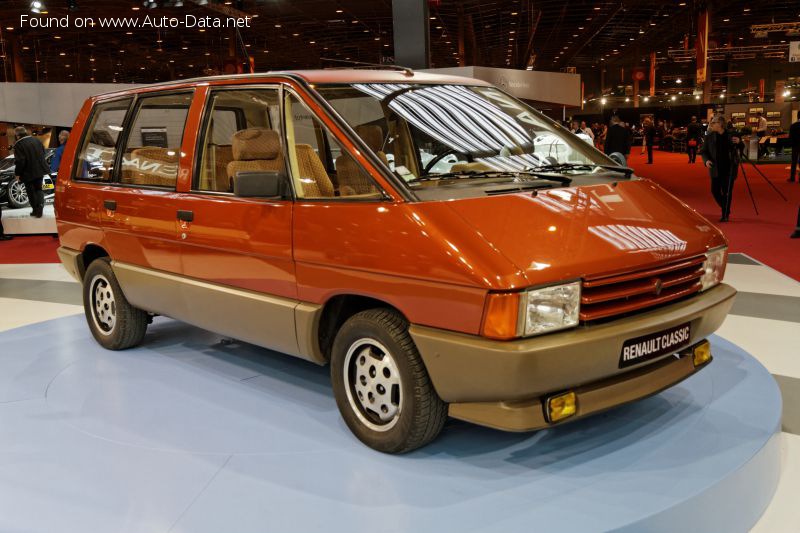
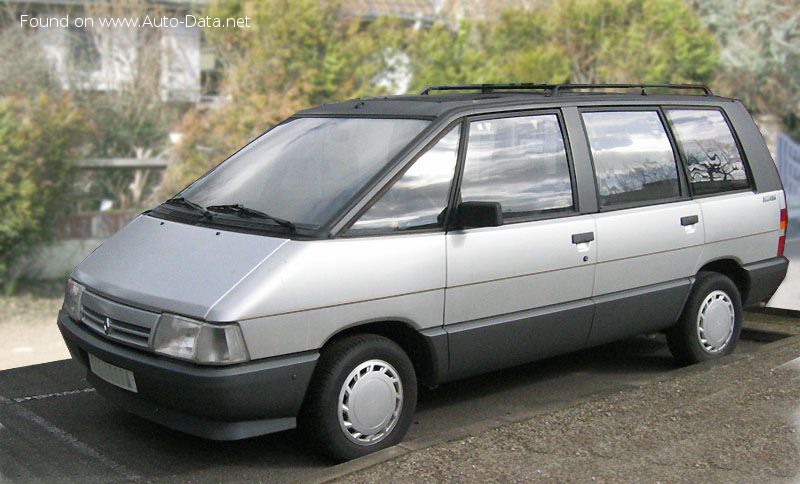
The design of the Renault Espace I (J11/13, Phase II 1988) was revolutionary, fundamentally reshaping expectations for family vehicles. Its distinctive “one-box” silhouette, characterized by a steeply raked windshield that seamlessly flowed into the hood, gave it a futuristic appearance for the late 1980s. The body type was classified as a Minivan or MPV, offering five doors and seating for up to seven passengers. At 171.85 inches (4365 mm) long, 69.96 inches (1777 mm) wide, and 65.35 inches (1660 mm) tall, the Espace was compact enough for European city driving yet surprisingly spacious inside. The relatively long wheelbase of 101.57 inches (2580 mm) contributed to a stable ride and maximized interior volume.
A key design innovation was the Espace’s composite body panels, made from fiberglass-reinforced polyester mounted on a galvanized steel chassis. This construction offered advantages in terms of weight, rust resistance, and ease of repair, contributing to the vehicle’s longevity and unique character. The Phase II facelift in 1988 brought revised headlights, a new grille, and updated taillights, giving it a slightly more modern and integrated look while retaining its distinctive profile