The Volkswagen Polo I (86) 1.1 (50 Hp): A European Compact Pioneer
The Volkswagen Polo I (86) represents a pivotal moment in the history of the German automaker, marking its definitive entry into the burgeoning supermini segment. Launched in 1975, the first-generation Polo, internally designated Type 86, was Volkswagen’s answer to the growing demand for smaller, more economical vehicles in Europe, a trend significantly amplified by the 1973 oil crisis. While never officially sold in the United States, the Polo I (86) became a foundational model for Volkswagen in its primary European market, establishing a reputation for practicality, efficiency, and robust engineering in a compact package. The specific variant under discussion, the Volkswagen Polo I (86) 1.1 (50 Hp), produced between 1979 and 1981, exemplified the model’s philosophy of offering accessible, reliable transportation with modest but adequate performance.
Evolution and Market Positioning
The Polo I (86) was essentially a rebadged and slightly revised version of the Audi 50, which had debuted in 1974. This strategic move allowed Volkswagen to quickly enter the supermini market with a proven platform. Positioned beneath the highly successful Golf, the Polo aimed to capture a segment of buyers looking for even more compact dimensions and lower running costs. It competed fiercely against rivals like the Ford Fiesta, Renault 5, and Fiat 127, all vying for dominance in Europe’s urban landscapes and fuel-conscious households. The 1979-1981 iteration of the Polo I (86) 1.1 (50 Hp) maintained the model’s core attributes while benefiting from minor refinements during its production run.
Engine and Performance of the Volkswagen Polo I (86) 1.1 (50 Hp)
At the heart of the Volkswagen Polo I (86) 1.1 (50 Hp) was a transverse-mounted, naturally aspirated 1.1-liter (1093 cm3 or 66.7 cu. in.) inline four-cylinder engine, designated by the code HB. This powerplant was a staple of Volkswagen’s smaller models during the era, known for its simplicity and reliability. It produced a modest 50 horsepower at 5800 rpm and 56.79 lb-ft of torque (77 Nm) at 3500 rpm. While these figures might seem diminutive by modern standards, they were entirely appropriate for a vehicle weighing a mere 1510.17 pounds (685 kg). The engine’s design featured two valves per cylinder and relied on a carburettor for fuel delivery, a common setup for economical vehicles of the late 1970s.
Power was sent to the front wheels via a 4-speed manual transmission, a standard configuration for entry-level cars of the period. This drivetrain architecture, with its front-wheel-drive layout, contributed to efficient packaging and predictable handling. The Polo 1.1 (50 Hp) was not built for speed, but its performance was adequate for its intended purpose. It could accelerate from 0 to 60 mph in approximately 14.6 seconds, reaching a maximum speed of 90.1 mph (145 km/h). Fuel efficiency was a key selling point, with a combined consumption rating of 26.4 US mpg (8.9 l/100 km), which was competitive for the time and crucial for its target market. The engine’s 8:1 compression ratio and simple design made it relatively easy to maintain, a further boon for cost-conscious owners.
Design and Features
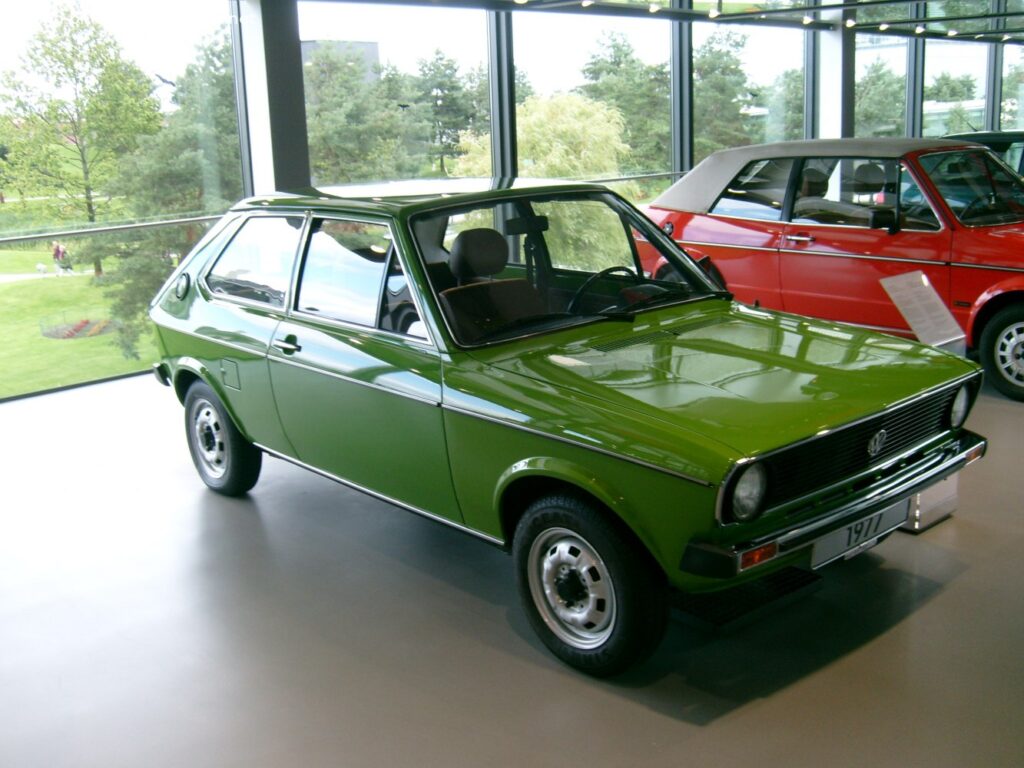
The design of the Volkswagen Polo I (86) was characterized by its functional and straightforward hatchback body style. The 3-door configuration offered a compact footprint, making it highly maneuverable in congested European city environments. Measuring 141.93 inches (3605 mm) in length, 61.38 inches (1559 mm) in width, and 52.91 inches (1344 mm) in height, the Polo was undeniably small but cleverly packaged. Its 91.73-inch (2330 mm) wheelbase provided a surprisingly stable ride for its size.
Inside, the Polo I (86) was designed to accommodate five occupants, though rear-seat space was naturally constrained given its supermini classification. The interior emphasized practicality over luxury, featuring durable materials and a simple, ergonomic dashboard layout. One of its most significant features was its versatility: the hatchback design provided easy access to a cargo area that could expand from a minimum of 8.4 cu. ft. (238 liters) to an impressive 29.66 cu. ft. (840 liters) with the rear seats folded down. This flexibility was a major draw for young families and individuals needing a vehicle capable of handling both daily commutes and occasional larger loads. The relatively low drag coefficient of 0.39 was respectable for a small, boxy car of its era, contributing marginally to its overall efficiency.
Technical Specifications
The following table details the technical specifications for the Volkswagen Polo I (86) 1.1 (50 Hp), produced from 1979 to 1981:
| Category | Specification |
|---|---|
| Brand | Volkswagen |
| Model | Polo |
| Generation | Polo I (86) |
| Type (Engine) | 1.1 (50 Hp) |
| Start of Production | 1979 year |
| End of Production | 1981 year |
| Powertrain Architecture | Internal Combustion engine |
| Body Type | Hatchback |
| Seats | 5 |
| Doors | 3 |
| Performance Specs | |
| Fuel Consumption (Urban) | 9.5 l/100 km (24.8 US mpg) |
| Fuel Consumption (Extra Urban) | 8.3 l/100 km (28.3 US mpg) |
| Fuel Consumption (Combined) | 8.9 l/100 km (26.4 US mpg) |
| Fuel Type | Petrol (Gasoline) |
| Acceleration 0 – 60 mph | 14.6 sec |
| Acceleration 0 – 100 km/h | 15.4 sec |
| Maximum Speed | 145 km/h (90.1 mph) |
| Weight-to-Power Ratio | 13.7 kg/Hp (73 Hp/tonne) |
| Weight-to-Torque Ratio | 8.9 kg/Nm (112.4 Nm/tonne) |
| Engine Specs | |
| Power | 50 Hp @ 5800 rpm |
| Power per Liter | 45.7 Hp/l |
| Torque | 77 Nm (56.79 lb-ft) @ 3500 rpm |
| Engine Layout | Front, Transverse |
| Engine Model/Code | HB |
| Engine Displacement | 1093 cm3 (1.1 liters / 66.7 cu. in.) |
| Number of Cylinders | 4 |
| Engine Configuration | Inline |
| Cylinder Bore | 69.5 mm (2.74 in.) |
| Piston Stroke | 72 mm (2.83 in.) |
| Compression Ratio | 8:1 |
| Number of Valves per Cylinder | 2 |
| Fuel Injection System | Carburettor |
| Engine Aspiration | Naturally Aspirated |
| Engine Oil Capacity | 3 l (3.17 US qt) |
| Coolant Capacity | 4 l (4.23 US qt) |
| Space, Volume, and Weights | |
| Kerb Weight | 685 kg (1510.17 lbs) |
| Max. Weight | 1100 kg (2425.08 lbs) |
| Max Load | 415 kg (914.92 lbs) |
| Trunk (boot) Space – Minimum | 238 l (8.4 cu. ft.) |
| Trunk (boot) Space – Maximum | 840 l (29.66 cu. ft.) |
| Fuel Tank Capacity | 36 l (9.51 US gal) |
| Dimensions | |
| Length | 3605 mm (141.93 in.) |
| Width | 1559 mm (61.38 in.) |
| Height | 1344 mm (52.91 in.) |
| Wheelbase | 2330 mm (91.73 in.) |
| Front Track | 1296 mm (51.02 in.) |
| Rear (Back) Track | 1312 mm (51.65 in.) |
| Drag Coefficient (Cd) | 0.39 |
| Minimum Turning Circle | 9.6 m (31.5 ft) |
| Drivetrain, Brakes, and Suspension Specs | |
| Drivetrain Architecture | The Internal combustion engine (ICE) drives the front wheels of the vehicle. |
| Drive Wheel | Front wheel drive |
| Number of Gears and Type of Gearbox | 4 gears, manual transmission |
Legacy and Market Impact of the Volkswagen Polo I (86)
The Volkswagen Polo I (86), particularly variants like the 1.1 (50 Hp) model, carved out a significant niche for Volkswagen in the European market. Its primary impact was establishing the Polo nameplate as a formidable contender in the supermini segment, a position it has maintained for decades. Before the Polo, Volkswagen’s smallest successful front-wheel-drive car was the Golf, which itself was a compact. The Polo successfully downsized the Golf’s winning formula, offering a more affordable and even more economical option.
In terms of reputation, the Polo I quickly became known for its robust build quality, reliability, and low running costs—qualities that Volkswagen buyers had come to expect. It was seen as a sensible, no-frills choice for students, young professionals, and small families across Europe. Its mechanical simplicity meant that maintenance was straightforward and inexpensive, contributing to its long-term appeal. Competitors such as the Ford Fiesta, which launched around the same time, offered similar practicality and economy, leading to a vibrant and highly competitive segment. However, the Polo’s association with Volkswagen’s growing reputation for quality and engineering excellence helped it stand out.
Historically, the Polo I (86) played a crucial role in Volkswagen’s product strategy, demonstrating the brand’s ability to diversify its lineup beyond the iconic Beetle and the more modern Golf. It proved that Volkswagen could successfully adapt to changing market demands for smaller, more efficient vehicles. The success of the first generation laid the groundwork for subsequent Polo generations, each building on the original’s principles of practicality, efficiency, and solid engineering. Today, the Polo remains a cornerstone of Volkswagen’s global offerings, a testament to the enduring legacy of this pioneering compact from the late 1970s.