The Renault Megane II (Phase II, 2006) GT 1.9 dCi (110 Hp) FAP: A European Compact Diesel Powerhouse
The Renault Megane II, specifically its Phase II iteration from 2006, represents a significant chapter in the history of the European compact car segment. Launched in 2002, the second-generation Megane quickly garnered attention for its distinctive styling, particularly its controversial “bustle-back” rear design for the hatchback variant, and its focus on safety and technological innovation. The Phase II refresh, introduced in 2006, brought subtle but effective updates, refining its aesthetics and upgrading its powertrain options. Among these, the Renault Megane II (Phase II, 2006) GT 1.9 dCi (110 Hp) FAP stood out as a compelling proposition for drivers seeking a blend of performance, efficiency, and practicality in the fiercely competitive European C-segment.
This particular model, the GT 1.9 dCi, was not intended for the American market, where compact diesel hatchbacks were a rarity. Instead, it was a core offering in Europe, designed to compete with stalwarts like the Volkswagen Golf, Ford Focus, and Peugeot 307. The “GT” designation, in this context, signified a sportier trim level rather than outright high performance, often incorporating cosmetic enhancements and a slightly firmer suspension setup, appealing to those who desired a more dynamic driving experience without sacrificing the economic benefits of a diesel engine. The inclusion of a Diesel Particulate Filter (FAP – Filtre à Particules) was also a forward-thinking move, aligning the vehicle with evolving European emissions standards.
Engine & Performance of the Renault Megane II (Phase II, 2006) GT 1.9 dCi (110 Hp) FAP
At the heart of the Renault Megane II (Phase II, 2006) GT 1.9 dCi (110 Hp) FAP was Renault’s venerable F9Q Turbo diesel engine. This inline four-cylinder powerplant, with a displacement of 1,870 cubic centimeters (1.9 liters), was a cornerstone of Renault’s diesel offerings for many years, known for its robustness and efficiency. In this specific GT tune, it delivered a respectable 110 horsepower at 4000 rpm. More crucially for everyday driving, it produced a substantial 191.77 pound-feet of torque at a low 2000 rpm, providing excellent pulling power and making it feel more responsive in urban traffic and during highway overtaking maneuvers.
Power was transmitted to the front wheels via a precise 6-speed manual transmission, allowing the driver to optimally manage the engine’s torque band and further enhance fuel economy. The sprint from 0 to 60 mph was achieved in a brisk 10.1 seconds, with a top speed of 116.82 mph. While not a performance car by traditional American standards, these figures were highly competitive within its European segment, especially for a diesel.
A key feature of this powertrain was the inclusion of a Diesel Particulate Filter (FAP). In 2006, this technology was becoming increasingly important for manufacturers to meet stricter European emissions regulations, specifically the Euro 4 standard. The FAP system was designed to trap and periodically burn off soot particles from the exhaust gases, significantly reducing harmful emissions and contributing to cleaner air. Despite the added complexity, it was a necessary step towards more environmentally responsible diesel motoring.
Fuel efficiency was a strong suit for the Megane GT 1.9 dCi. It boasted an impressive combined fuel economy of 42 US mpg (5.6 liters per 100 km), with extra-urban driving achieving an even more remarkable 49 US mpg (4.8 liters per 100 km). This made the Megane an economical choice for commuters and long-distance travelers alike, further cementing its appeal in markets where fuel prices were a significant consideration. Its CO2 emissions were rated at 148 g/km, reflecting its relatively clean operation for the time.
Design & Features
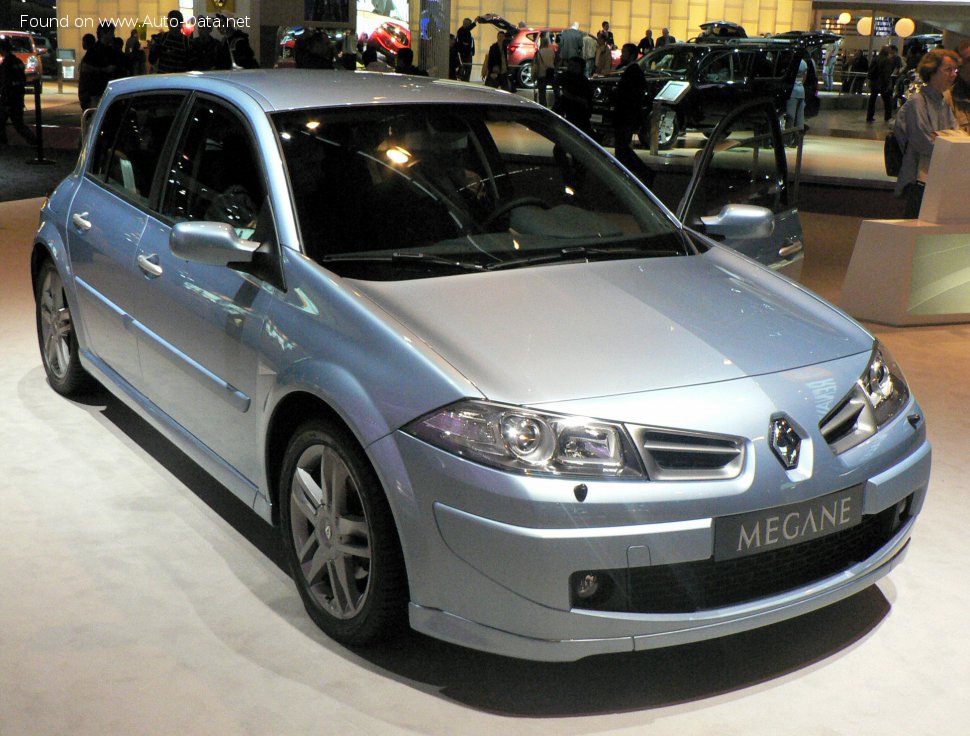
The Renault Megane II (Phase II, 2006) GT 1.9 dCi (110 Hp) FAP retained the distinctive styling that defined the second-generation Megane. As a 5-door hatchback, it offered a blend of practicality and contemporary design. The Phase II facelift introduced subtle revisions to the front grille, headlights, and bumpers, giving it a slightly more refined and mature appearance compared to the original launch model. The “GT” trim typically included sportier exterior accents, such as unique alloy wheels and specific badging, hinting at its more dynamic character.
Inside, the Megane II offered a spacious and comfortable cabin designed for five occupants. The interior architecture was modern for its time, featuring soft-touch materials and a generally ergonomic layout. The hatchback body style provided excellent versatility, with a minimum trunk space of 11.65 cubic feet (330 liters) that could expand to a generous 42.02 cubic feet (1190 liters) with the rear seats folded down, making it highly practical for families or those needing to transport larger items.
Safety was a paramount concern for Renault, and the Megane II was one of the first cars in its class to achieve a 5-star Euro NCAP safety rating. Standard safety features for this 2006 model included an Anti-lock Braking System (ABS), which was crucial for maintaining steering control under heavy braking. The car also featured an electric power steering system, offering a lighter feel at low speeds for easier maneuvering and a more weighted feel at higher speeds for improved stability. The drivetrain architecture was front-wheel drive, a common and effective setup for compact cars, providing predictable handling and efficient packaging. Braking duties were handled by ventilated discs at the front and solid discs at the rear, ensuring confident stopping power.
The vehicle rode on a conventional independent coil spring front suspension and a torsion beam rear suspension, a setup that balanced ride comfort with capable handling. Standard tire size was 195/65 R15, mounted on 6.5J x 15-inch wheels, providing a good balance between grip and ride quality for everyday driving conditions.
Technical Specifications
| Category | Specification | Value |
|---|---|---|
General Information |
||
| Brand | Renault | |
| Model | Megane | |
| Generation | Megane II (Phase II, 2006) | |
| Type (Engine) | GT 1.9 dCi (110 Hp) FAP | |
| Production Start | 2006 | |
| Production End | 2006 | |
| Powertrain Architecture | Internal Combustion Engine | |
| Body Type | Hatchback | |
| Seats | 5 | |
| Doors | 5 | |
Performance Specifications |
||
| Fuel Consumption (Urban) | 7.1 l/100 km | 33.1 US mpg |
| Fuel Consumption (Extra Urban) | 4.8 l/100 km | 49 US mpg |
| Fuel Consumption (Combined) | 5.6 l/100 km | 42 US mpg |
| CO2 Emissions | 148 g/km | |
| Fuel Type | Diesel | |
| Acceleration 0-60 mph | 10.1 sec | |
| Acceleration 0-62 mph (0-100 km/h) | 10.6 sec | |
| Maximum Speed | 188 km/h | 116.82 mph |
| Emission Standard | Euro 4 | |
| Weight-to-Power Ratio | 11.5 kg/Hp | 86.6 Hp/tonne |
| Weight-to-Torque Ratio | 4.9 kg/Nm | 204.7 Nm/tonne |
Engine Specifications |
||
| Power | 110 Hp @ 4000 rpm | |
| Power per Liter | 58.8 Hp/l | |
| Torque | 260 Nm @ 2000 rpm | 191.77 lb.-ft. @ 2000 rpm |
| Engine Layout | Front, Transverse | |
| Engine Model/Code | F9Q Turbo | |
| Engine Displacement | 1870 cm3 | 1.9 liters / 114.11 cu. in. |
| Number of Cylinders | 4 | |
| Engine Configuration | Inline | |
| Cylinder Bore | 80 mm | 3.15 in. |
| Piston Stroke | 93 mm | 3.66 in. |
| Compression Ratio | 19:1 | |
| Valves per Cylinder | 2 | |
| Fuel Injection System | Diesel Commonrail | |
| Engine Aspiration | Turbocharger, Intercooler | |
| Valvetrain | OHC (Overhead Camshaft) | |
| Engine Oil Capacity | 4.5 l | 4.76 US qt |
| Coolant Capacity | 7.9 l | 8.35 US qt |
| Engine Systems | Particulate Filter (FAP) | |
Space, Volume and Weights |
||
| Kerb Weight | 1270 kg | 2799.87 lbs. |
| Maximum Weight | 1820 kg | 4012.41 lbs. |
| Maximum Load | 550 kg | 1212.54 lbs. |
| Trunk (Boot) Space – Minimum | 330 l | 11.65 cu. ft. |
| Trunk (Boot) Space – Maximum | 1190 l | 42.02 cu. ft. |
| Fuel Tank Capacity | 60 l | 15.85 US gal |
| Maximum Roof Load | 80 kg | 176.37 lbs. |
| Permitted Trailer Load with Brakes (12%) | 1300 kg | 2866.01 lbs. |
| Permitted Trailer Load without Brakes | 650 kg | 1433 lbs. |
| Permitted Towbar Download | 75 kg | 165.35 lbs. |
Dimensions |
||
| Length | 4209 mm | 165.71 in. |
| Width | 1777 mm | 69.96 in. |
| Width Including Mirrors | 2026 mm | 79.76 in. |
| Height | 1458 mm | 57.4 in. |
| Wheelbase | 2625 mm | 103.35 in. |
| Front Track | 1518 mm | 59.76 in. |
| Rear Track | 1514 mm | 59.61 in. |
| Front Overhang | 842 mm | 33.15 in. |
| Rear Overhang | 742 mm | 29.21 in. |
| Minimum Turning Circle | 10.5 m | 34.45 ft. |
Drivetrain, Brakes and Suspension |
||
| Drivetrain Architecture | Front-wheel drive, Internal Combustion Engine | |
| Drive Wheel | Front Wheel Drive | |
| Gearbox Type | 6-speed Manual Transmission | |
| Front Suspension | Independent Coil Spring | |
| Rear Suspension | Torsion Beam | |
| Front Brakes | Ventilated Discs | |
| Rear Brakes | Disc | |
| Assisting Systems | ABS (Anti-lock Braking System) | |
| Steering Type | Steering Rack and Pinion | |
| Power Steering | Electric Steering | |
| Tire Size | 195/65 R15 | |
| Wheel Rims Size | 6.5J x 15 | |
Legacy & Market Impact
The Renault Megane II, and particularly its Phase II facelift in 2006, played a crucial role in Renault’s strategy to maintain its strong presence in the European compact segment. The Renault Megane II (Phase II, 2006) GT 1.9 dCi (110 Hp) FAP exemplified the growing trend towards efficient and environmentally conscious diesel powertrains in Europe. While the Megane II’s initial styling was polarizing, its emphasis on safety, comfort, and innovative features like the “keyless entry and start” card system (which was revolutionary at the time) helped it carve out a significant market share.
In its primary European market, the Megane GT 1.9 dCi faced stiff competition from well-established rivals. The Volkswagen Golf, renowned for its build quality and understated design, was arguably its most formidable competitor. Other strong contenders included the Ford Focus, praised for its engaging driving dynamics, and the Peugeot 307, which offered a distinct French flavor with its comfortable ride and practical interior. Despite this intense competition, the Megane managed to hold its own, appealing to buyers who valued its distinctive styling, high safety ratings, and the strong value proposition offered by its efficient diesel engines.
The 1.9 dCi engine, in particular, solidified Renault’s reputation for producing reliable and economical diesel powerplants. The inclusion of the FAP system was a testament to Renault’s commitment to meeting evolving emissions standards, positioning the Megane as a responsible choice for environmentally conscious drivers. This focus on efficiency and lower emissions became increasingly important as European regulations tightened, and the Megane GT 1.9 dCi was well-equipped to navigate this landscape.
Ultimately, the Megane II’s legacy is one of boldness and innovation within the compact class. It pushed boundaries in design and safety, and its diesel variants like the GT 1.9 dCi demonstrated how performance and fuel economy could be effectively balanced. Although never sold in the United States, its impact on the European automotive scene was undeniable, contributing to the evolution of the compact car and shaping consumer expectations for efficiency, technology, and safety in the segment. The Megane II paved the way for future generations of Renault vehicles, solidifying the brand’s position as a key player in the global automotive industry.