The Volvo V60 I (2013 facelift) 1.6 T4F (180 Hp) Ethanol: A European Wagon with a Green Edge
The Volvo V60, first introduced in 2010, marked a significant step for the Swedish automaker in the premium compact executive segment. As a stylish and practical station wagon (known as an “estate” in Europe), it was designed to appeal to families and individuals seeking a blend of Scandinavian design, robust safety features, and dynamic driving characteristics. The specific variant under review, the Volvo V60 I (2013 facelift) 1.6 T4F (180 Hp) Ethanol, represents a crucial period in the model’s first generation, incorporating a comprehensive refresh that enhanced its aesthetic appeal and technological offerings. Produced between 2013 and 2015, this particular iteration stood out for its innovative powertrain architecture, notably its “Flexifuel” capability, allowing it to run on both conventional gasoline and E85 ethanol. While never officially sold in the United States, this model played a vital role in Volvo’s strategy for the European market, particularly in countries with a strong emphasis on alternative fuels and reduced carbon emissions. It epitomized Volvo’s commitment to environmental responsibility alongside its long-standing reputation for safety and quality.
Engineering for Efficiency and Performance: The 1.6 T4F Powertrain
At the heart of the Volvo V60 I (2013 facelift) 1.6 T4F (180 Hp) Ethanol lies a sophisticated 1.6-liter (1596 cm³ or 97.39 cu. in.) inline four-cylinder engine, designated as the B4164T2. This powerplant, equipped with a turbocharger and direct fuel injection, was engineered to deliver a compelling balance of power and fuel efficiency. It generated a healthy 180 horsepower at 5700 rpm, translating to an impressive 112.8 horsepower per liter. Torque figures were equally robust, peaking at 177.01 lb.-ft. (240 Nm) across a broad range from 1600 to 5000 rpm, ensuring strong pulling power and flexible acceleration in various driving conditions.
What truly set this engine apart was its “Flexifuel” designation, allowing it to operate seamlessly on either standard unleaded gasoline or E85 ethanol. This adaptability was a key selling point in European markets where ethanol infrastructure was more developed and incentivized. When running on gasoline, the V60 1.6 T4F achieved a combined fuel economy of approximately 33.6 US mpg (7.0 l/100 km), with urban consumption at 24.8 US mpg (9.5 l/100 km) and extra-urban at 42 US mpg (5.6 l/100 km). On E85 ethanol, while urban consumption increased to 12.9 l/100 km and combined to 9.5 l/100 km, CO2 emissions saw a slight reduction from 162 g/km to 156 g/km, highlighting the environmental benefits of E85.
Power was delivered to the front wheels via a precise 6-speed manual transmission, offering an engaging driving experience. This setup allowed the V60 to accelerate from 0 to 60 mph in a respectable 8.1 seconds (0-100 km/h in 8.5 seconds) and reach a maximum speed of 136.7 mph (220 km/h). The front-wheel-drive architecture, combined with an independent McPherson strut front suspension and independent coil spring rear suspension, provided a comfortable yet composed ride, characteristic of Volvo’s European tuning. Ventilated disc brakes up front and disc brakes at the rear, complemented by an Anti-lock Braking System (ABS), ensured confident stopping power.
Scandinavian Design and Practicality
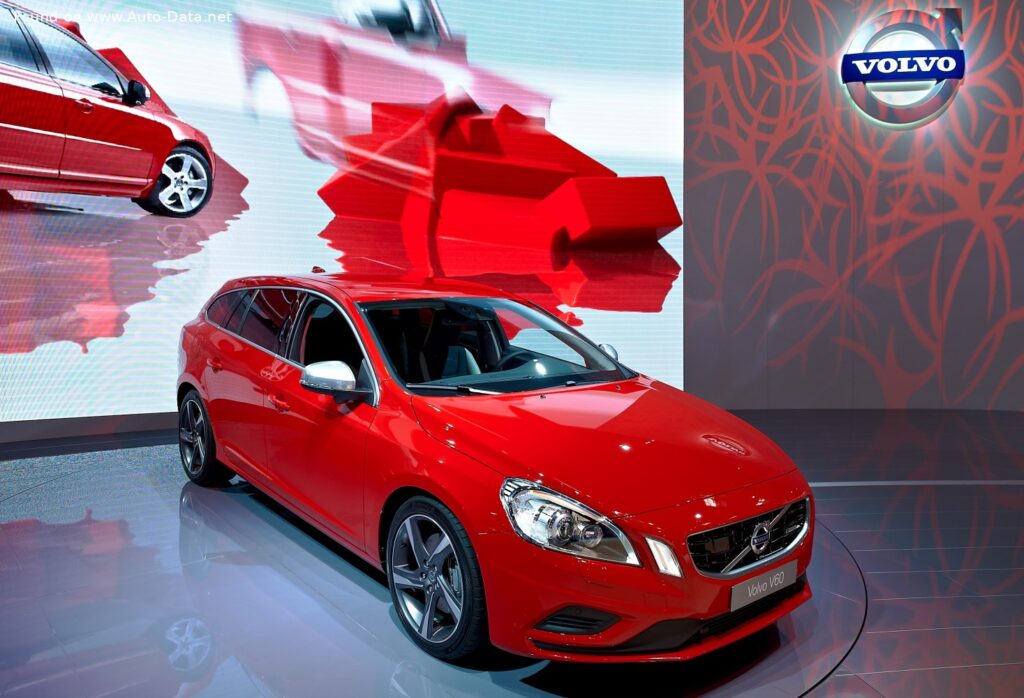
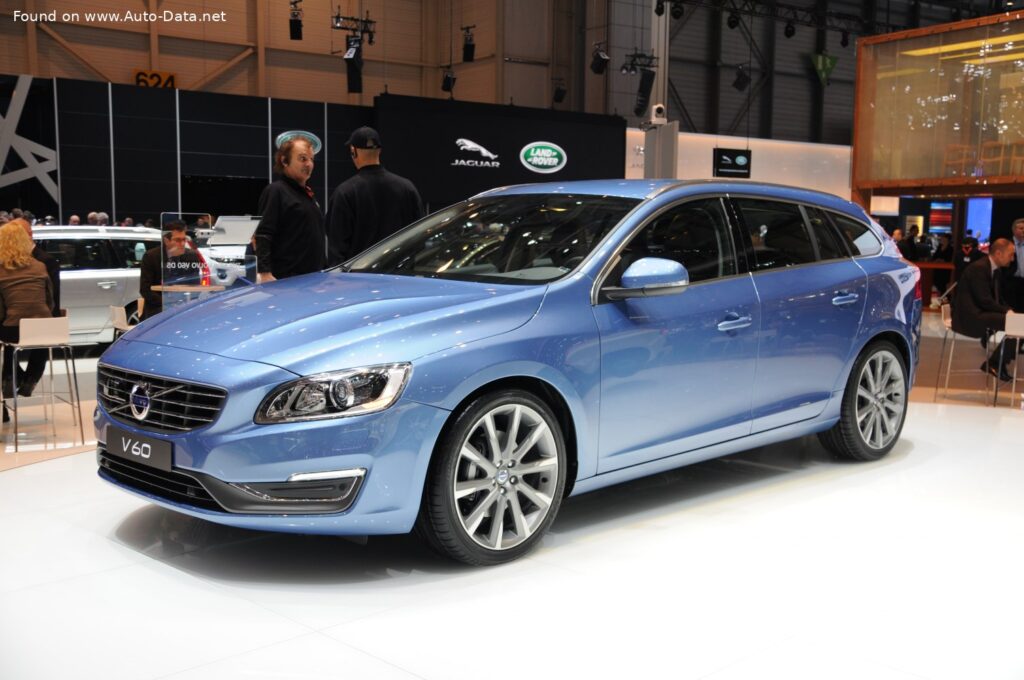
The 2013 facelift brought a refreshed aesthetic to the V60, harmonizing its design with Volvo’s evolving visual identity. The most noticeable changes included a wider grille, new headlights that integrated into a more cohesive front fascia, and redesigned bumpers. These updates gave the V60 a more sophisticated and contemporary look, reinforcing its premium aspirations. As a station wagon, the V60 offered a practical five-door body style with seating for five occupants, making it a versatile choice for families. Its dimensions—182.48 inches (4635 mm) in length, 74.76 inches (1899 mm) in width, and 58.43 inches (1484 mm) in height—positioned it squarely within the compact executive wagon segment, offering a substantial yet manageable footprint. The wheelbase of 109.29 inches (2776 mm) contributed to a stable ride and generous interior space.
Inside, the V60 maintained Volvo’s hallmark ergonomic design and high-quality materials. The cabin was characterized by its floating center console, intuitive controls, and comfortable seating, all designed with long-distance travel in mind. While not explicitly detailed in the provided data, a Volvo from this era would typically feature a suite of advanced safety technologies, including the renowned City Safety system, which could automatically brake the car to avoid or mitigate low-speed collisions. Other available features, depending on market and trim, would have included advanced infotainment systems, driver-assist functions, and a strong emphasis on passive safety through its robust body structure. The fuel tank capacity of 17.83 US gallons (67.5 liters) provided a good range for European touring, especially when utilizing the more efficient gasoline option.
Technical Specifications: Volvo V60 I (2013 facelift) 1.6 T4F (180 Hp) Ethanol
| Category | Specification |
|---|---|
| General Information | |
| Brand | Volvo |
| Model | V60 |
| Generation | V60 I (2013 facelift) |
| Type (Engine) | 1.6 T4F (180 Hp) Ethanol |
| Production Start | 2013 year |
| Production End | 2015 year |
| Powertrain Architecture | Internal Combustion engine |
| Body type | Station wagon (estate) |
| Seats | 5 |
| Doors | 5 |
| Performance Specs | |
| Fuel consumption (economy) – urban (Gasoline) | 9.5 l/100 km (24.8 US mpg) |
| Fuel consumption (economy) – urban (Ethanol – E85) | 12.9 l/100 km |
| Fuel consumption (economy) – extra urban (Gasoline) | 5.6 l/100 km (42 US mpg) |
| Fuel consumption (economy) – extra urban (Ethanol – E85) | 7.5 l/100 km |
| Fuel consumption (economy) – combined (Gasoline) | 7.0 l/100 km (33.6 US mpg) |
| Fuel consumption (economy) – combined (Ethanol – E85) | 9.5 l/100 km |
| CO2 emissions (Gasoline) | 162 g/km |
| CO2 emissions (Ethanol – E85) | 156 g/km |
| Fuel Type | Petrol / Ethanol – E85 |
| Acceleration 0 – 60 mph | 8.1 sec |
| Acceleration 0 – 100 km/h | 8.5 sec |
| Maximum speed | 136.7 mph (220 km/h) |
| Engine Specs | |
| Power | 180 Hp @ 5700 rpm |
| Power per liter | 112.8 Hp/l |
| Torque | 177.01 lb.-ft. (240 Nm) @ 1600-5000 rpm |
| Engine layout | Front, Transverse |
| Engine Model/Code | B4164T2 |
| Engine displacement | 1596 cm³ (97.39 cu. in.) |
| Number of cylinders | 4 |
| Engine configuration | Inline |
| Cylinder Bore | 3.11 in. (79 mm) |
| Piston Stroke | 3.2 in. (81.4 mm) |
| Compression ratio | 10:1 |
| Number of valves per cylinder | 4 |
| Fuel injection system | Direct injection |
| Engine aspiration | Turbocharger |
| Valvetrain | DOHC |
| Engine oil capacity | 4.33 US qt (4.1 l) |
| Coolant capacity | 9.72 US qt (9.2 l) |
| Space, Volume and Weights | |
| Fuel tank capacity | 17.83 US gal (67.5 l) |
| Dimensions | |
| Length | 182.48 in. (4635 mm) |
| Width | 74.76 in. (1899 mm) |
| Height | 58.43 in. (1484 mm) |
| Wheelbase | 109.29 in. (2776 mm) |
| Front track | 62.52 – 62.13 in. (1588-1578 mm) |
| Rear (Back) track | 62.4 – 62.01 in. (1585-1575 mm) |
| Ride height (ground clearance) | 5.35 in. (136 mm) |
| Minimum turning circle (turning diameter) | 37.73 – 40.68 ft. (11.5 – 12.4 m) |
| Drivetrain, Brakes and Suspension Specs | |
| Drivetrain Architecture | Internal combustion engine (ICE) drives the front wheels. |
| Drive wheel | Front wheel drive |
| Number of gears and type of gearbox | 6 gears, manual transmission |
| Front suspension | Independent, type McPherson with coil spring and anti-roll bar |
| Rear suspension | Independent coil spring |
| Front brakes | Ventilated discs |
| Rear brakes | Disc |
| Assisting systems | ABS (Anti-lock braking system) |
| Steering type | Steering rack and pinion |
Legacy and Market Position of the Volvo V60 I (2013 facelift) 1.6 T4F (180 Hp) Ethanol
The Volvo V60 I (2013 facelift) 1.6 T4F (180 Hp) Ethanol carved out a distinct niche for itself in the highly competitive European premium wagon segment. It was positioned as a sophisticated and safer alternative to rivals like the BMW 3 Series Touring, Audi A4 Avant, and Mercedes-Benz C-Class Estate. While Volvo traditionally emphasized safety and practicality, the V60, especially after the 2013 facelift, added a stronger element of dynamic styling and engaging driving dynamics to its repertoire.
The “Flexifuel” capability of the 1.6 T4F engine was a significant differentiator. In an era when environmental consciousness was gaining traction, and governments in certain European countries offered incentives for alternative fuel vehicles, the V60 T4F Ethanol provided a compelling option for eco-minded buyers. It allowed owners to reduce their carbon footprint and potentially benefit from lower fuel costs or tax advantages, depending on local regulations. This commitment to sustainable mobility underscored Volvo’s forward-thinking approach, even before the widespread adoption of electrification.
The V60’s reputation for robust build quality, comfortable interiors, and comprehensive safety features remained unchallenged. It continued to uphold Volvo’s brand image as a producer of reliable and secure family vehicles, but with an added layer of desirability through its sleek design and refined driving experience. The 6-speed manual transmission in this variant further appealed to enthusiasts who preferred a more direct connection with the vehicle.
Although this specific Flexifuel variant was not offered in the North American market, the broader V60 lineup did eventually make its way across the Atlantic, albeit with different powertrain options. The European success of models like the Volvo V60 I (2013 facelift) 1.6 T4F (180 Hp) Ethanol demonstrated Volvo’s ability to innovate within regional market demands, offering specialized powertrains to meet specific environmental and economic considerations. Today, this generation of the V60 remains a popular choice in the used car market in Europe, valued for its enduring style, practicality, and the unique appeal of its alternative-fuel capability, representing a significant chapter in Volvo’s journey towards sustainable luxury.